The software sector is currently experiencing one of the sharpest falls in share prices since 2022. While AI shares continue to rise to record highs, established software companies are being downright punished by the market. The fear of disruption from artificial intelligence has led to a veritable sell-off. But it is precisely in phases like these that exceptional opportunities arise for disciplined options traders. In today's blog post, we show you how you can take advantage of the current sell-off in the software sector with Cash Secured Puts strategically.
The current situation in the software sector
The software sector is currently experiencing turbulent times. Many of the largest software stocks have seen significant losses, with Adobe down 35%, Salesforce down 27% and HubSpot down as much as 45%. European heavyweights such as SAP have not been spared either - SAP shares plunged by up to 17% on January 29 after its cloud growth forecast for 2026 fell short of market expectations.
There are many reasons for this weakness. Investors fear that AI could fundamentally change the software industry, either through a decline in license revenues or through the complete obsolescence of traditional software. This fear is leading to a change in sentiment, which is highly interesting from an options perspective.
What do the fundamentals say?
This is where it gets exciting: while share prices are plummeting, company results are showing a completely different picture. Software companies have presented strong sales growth and promising forecasts in recent quarters. A Analyst from Morningstar puts it in a nutshell: "Although the fundamentals are quite good, share prices have not recovered.
This discrepancy between price performance and actual business performance is exactly what we are looking for as options traders. Volatility increases, premiums become attractive and the fundamental basis remains solid.
IGV - The software ETF as a diversification alternative
The iShares Expanded Tech-Software Sector ETF (IGV) offers an interesting alternative for investors who do not want to commit to individual software stocks. This ETF tracks the entire North American software sector and thus enables a broader diversification.
The current situation at IGV:
IGV has experienced a dramatic slump in recent weeks. With a current price of around $80, the ETF is around 32% below its 52-week high of around $118. Particularly alarming: The ETF recorded eight consecutive days of losses - one of the longest losing streaks in its history. The year-to-date performance is a staggering -20.67%, which is the worst start to a year since 2022.
The composition:
IGV currently holds 119 different software shares, the top positions being:
- Microsoft (9,70%)
- Palantir Technologies (8,32%)
- Salesforce (7,68%)
- Oracle (7,37%)
- Intuit (5,03%)
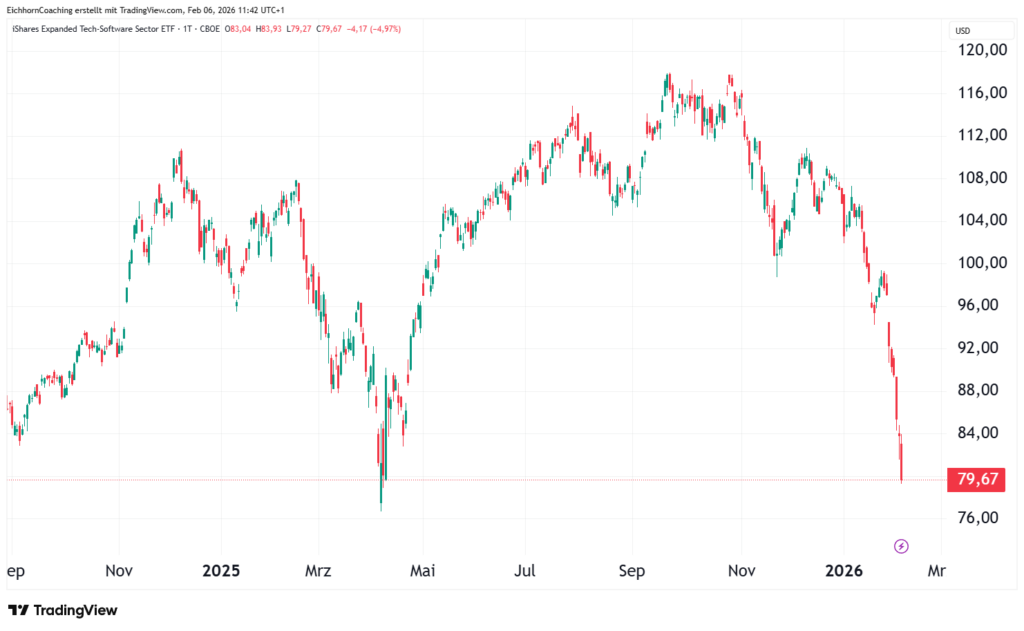
Example trade for IGV:
- Sale of a put contract on IGV
- Strike: $80 (close to the current price)
- Term: April 2026 (approx. 70 days)
- Expected premium: approx. $8-9 per contract (10-11%)
- Capital requirement: $8,000 (100 shares × $80)
- Maximum win: $800-900 (bonus)
- Risk: Tender of 100 IGV shares at prices below $80
Premium income of around 10% can currently be achieved for an at-the-money put with a remaining term of around 70 days (April). This level is exceptionally high for an ETF and represents an attractive alternative to options trading on individual shares.
Individual shares - ServiceNow (NOW)
There are also many opportunities in individual stocks. ServiceNow is regarded as one of the highest quality software companies with strong growth and outstanding profitability. ServiceNow shares have fallen by around 30% since the beginning of the year.
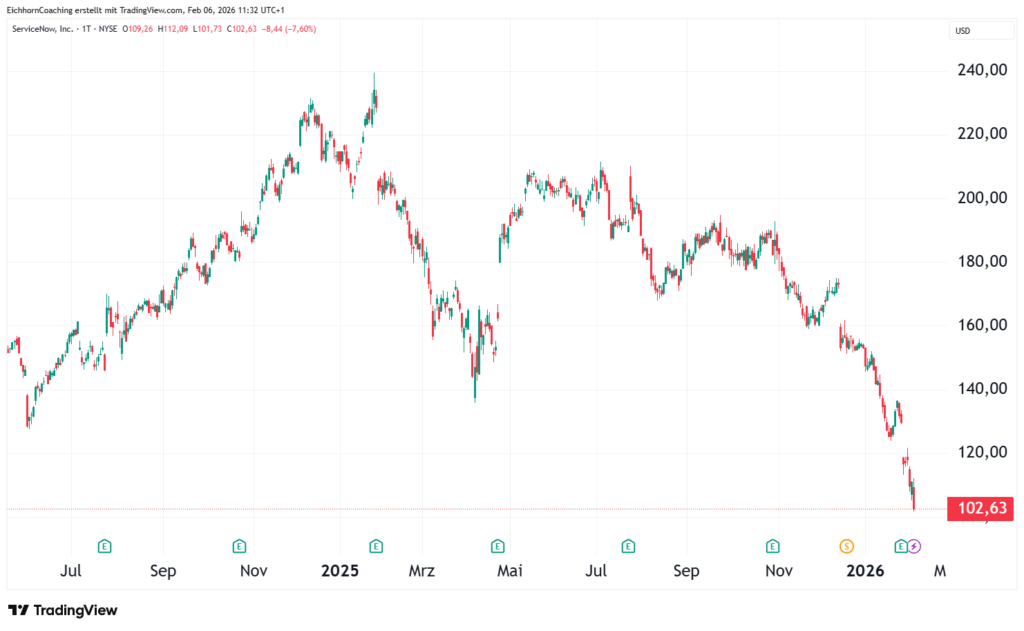
The market reaction to the latest quarterly figures was negative. It is precisely moments like these that lend themselves to cash secured puts. Premiums of over 9% can currently be achieved for the maturity month of April. This means that you can either keep this premium as a return or you can add shares in a fundamentally strong company to your portfolio at a significantly reduced entry price.
Other interesting titles could be:
- Duolingo (DUOL)
- Adobe (ADBE)
- Salesforce (CRM)
- Intuit (INTU)
- PayPal (PYPL)
What you should look out for
Not every price drop is automatically a buying opportunity. You should bear the following points in mind:
1. Check fundamental quality
Ensures that the company has solid fundamentals. The results of ServiceNow, SAP and Microsoft were basically solid, but growth rates were slightly below expectations. This is very different from structural problems in the business model.
2. Check normalized volatility
Cash secured puts should only be traded when volatility is high. Implied volatility in the software sector is currently at a multi-month high - ideal for writers.
3. Stay at the money (ATM)
The most attractive risk/reward ratios are typically found with ATM options. Here is the Normalized volatility highest.
4. Social media sentiment as a counter-indicator
If a share is ridiculed on X, Reddit or other platforms after a sharp fall, this is often a sign that capitulation is near. Conversely, if there is exuberant euphoria again after a sharp rise, caution is advised.
5. Wheel strategy in mind
Always plan your cash-secured puts in the context of the wheel strategy. If the shares are offered to you, you should be prepared to write covered calls until you can sell the shares again at a profit.
IMPORTANT WARNING: Do not underestimate the risks!
The premiums of 10% for IGV or 9-12% for individual shares described here sound tempting - but they are not a protection against losses, but a warning signal. With these high premiums, the market is pricing in the likelihood of further drastic price falls. A concrete example: You sell an IGV put for $80 and collect a premium of $8. The IGV falls to $65. 100 shares are tendered to you at $80 - your $800 premium is offset by a book loss of $1,500, net result: -$700 loss. Worse still, if fears of AI disruption are justified and software stocks trade permanently 50-70% below their highs, your 10% premium doesn't begin to compensate for a 40-60% loss.
Don't forget: Your maximum profit is limited to 10%, while your maximum risk theoretically extends to a total loss. This strategy is not suitable for investors who need their money in the short term, have no options experience or cannot cope emotionally with book losses. As attractive as the premiums may seem, never underestimate the risks. Software shares can continue to fall, even if the fundamentals are solid. Therefore, only trade with capital you actually want to invest in these stocks, diversify across multiple companies and use only a portion of your available capital - typically a maximum of 20-30% for option strategies. Be prepared to hold the shares for the long term if they are tendered to you and plan how you would proceed with covered calls as soon as you sell the put. Be aware that this is not a „safe" strategy for guaranteed premium income. The exceptionally high premiums are themselves the warning signal - the market is expecting further chaos in the software sector.
Conclusion
The current price decline in the software sector offers exceptional opportunities for strategic options traders. The combination of high volatility, negative market sentiment and solid fundamentals creates an ideal environment for cash secured puts.
The important thing is not to seize these opportunities blindly, but with strategy and discipline. Wait for the right moments - typically after several days of losses in a row, when panic is at its highest. Pay attention to social media sentiment as a counter-indicator. And above all: only sell puts on shares that you actually want to own.
History shows time and time again that the best long-term entry opportunities arise when the masses punish an entire sector across the board while the fundamental business models remain intact. With Cash Secured Puts, you can not only profit from a possible recovery, but also get paid to wait - regardless of whether the recovery starts immediately or only in a few weeks.
The bottom line: be greedy when others are fearful - but be strategic, disciplined and well-calculated. The current sell-off in the software sector offers the perfect stage for this.