


Blockchain stocks offer numerous investors a fascinating option to profit from the growth of the blockchain and crypto economy without having to own cryptocurrencies themselves. The sector benefits from powerful megatrends such as the tokenization of physical assets, DeFi solutions, modern digital payment systems, and the growing integration of blockchain into traditional financial markets.
This article highlights blockchain stocks for the year 2026. In addition, we provide insights into key opportunities and risks that you should keep in mind when selecting them for your portfolio.

The most important facts in brief:
- Blockchain stocks offer indirect exposure to crypto and blockchain growth without having to buy coins directly.
- Companies from the infrastructure, payment processing, cloud, and semiconductor sectors, such as Nvidia, Microsoft, Visa, Oracle, and Coinbase, can be particularly interesting.
- The greatest opportunities lie in megatrends such as tokenization, stablecoins, AI integration, and institutional adoption.
What are blockchain stocks?
Blockchain stocks refer to shares in publicly traded companies whose business model is largely based on the development and provision of blockchain technology.
Instead of investing directly in volatile cryptocurrencies, investors here participate in the physical and digital foundation of the sector. This enables access to the market via regulated securities that represent real tangible assets such as data centers, patents, and hardware manufacturing.
- Cryptocurrencies are digital payment methods that function independently of central institutions such as banks and are generally based on blockchain technology. Among the best known are Bitcoin, Ethereum, and Solana. They serve not only as a means of payment, but also for store of value and for using digital applications such as DeFi or NFTs.
- Blockchains act as a digital ledger in which transactions are documented continuously and tamper-proof. You can think of them as a decentralized, transparent system that is jointly managed and verified by many participants instead of being controlled by a central authority.
Despite high volatility, the crypto sector remains an interesting building block in a portfolio because it not only involves „pure“ cryptocurrencies, but increasingly incorporates traditional companies such as exchanges, payment providers, banks, or technology corporations. Crypto stocks can, for example, be related to themes like the tokenization of real-world assets or DeFi applications.
Learn more about Bitcoin and how to trade crypto with Captrader in our report on the subject Bitcoin Halving and trading ETFs like Bitcoin.
Structure of the crypto value chain
Blockchain stocks can be categorized along different stages of the so-called value chain. In business, this term describes all participating processes and actors required to develop, provide, and ultimately establish a product on the market.
Applied to the crypto market, this chain encompasses all areas that ensure digital assets can be created, stored, traded, and put to practical use.
The individual segments differ significantly in their dependence on market phases, regulatory frameworks, and general sentiment among crypto investors.
The market for blockchain stocks can be divided into five core segments depending on their business model, revenue drivers, and risk profile:
- Crypto-Mining & Data CenterOperate large-scale data centers to validate crypto transactions and are increasingly shifting capacity into the AI sector. Their revenues depend heavily on the Bitcoin price and local energy prices.
- Trading platforms & brokersThey provide exchanges and custodians for cryptocurrency trading. They earn money primarily from transaction fees, which is why their success is directly linked to overall trading volume.
- Corporate Treasury (Crypto Holdings)use crypto assets like Bitcoin as a primary reserve asset on their corporate balance sheet. As a result, the stock essentially acts on the capital market as a directly leveraged bet on the respective token price.
- Hardware and chip manufacturersProvide the physical processor and semiconductor infrastructure for mining rigs and blockchain nodes. Since their products are also used in gaming and AI, they offer a more diversified risk profile.
- Enterprise Software & ConsultingDeveloping customized private blockchains, smart contracts, and tokenization solutions for enterprise clients. Blockchain usually represents only a small sub-area of an established major corporation here.
Some publicly traded crypto companies are not limited to just one segment, but rather cover multiple areas at the same time. This broad positioning enables them to tap into different revenue streams and better cushion fluctuations in individual business areas.


The market potential of blockchain stocks in 2026
By 2026, the focus will have shifted from speculative crypto assets to broad industrial applications. The global blockchain market is currently estimated to be worth approximately $55 billion, with experts¹ projecting a massive compound annual growth rate (CAGR) of over 65 % for the coming decade.
This development is particularly reflected in the performance of infrastructure stocks, as the technology has now left the phase of pure pilot projects and is functioning as a critical backbone for global supply chains, financial systems, and identity solutions.
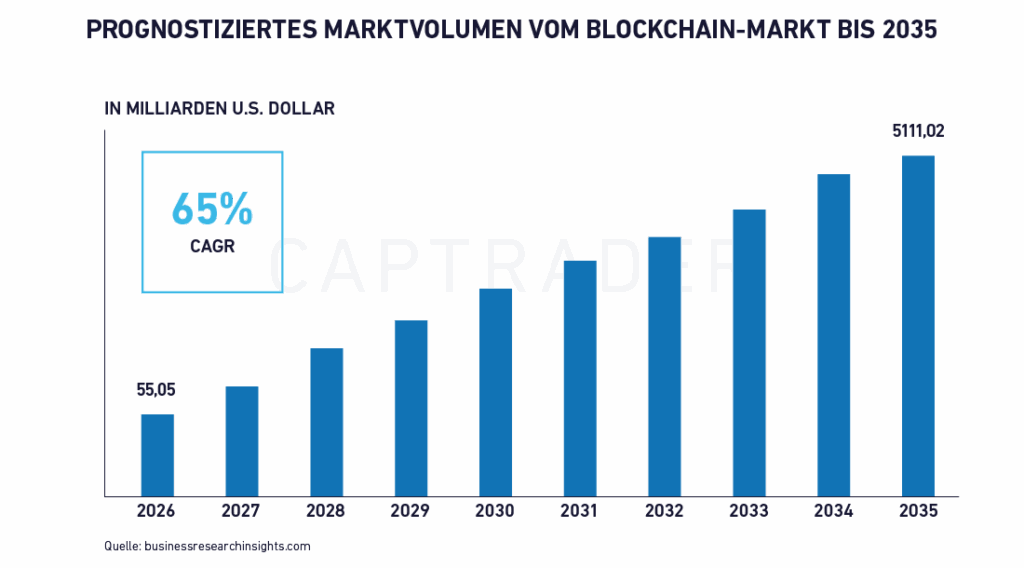
The global blockchain market is expected to grow from a market volume of approximately 55 billion in 2026 to over 5,111 billion USD by 2035.
Institutional adaptation and regulatory certainty
By 2026, blockchain technology has made the leap from a speculative fringe phenomenon to an integral part of the global financial architecture. This is largely due to the completion of major legislative processes, such as the MiCA (Markets in Crypto-Assets) regulation in Europe and comparable regulatory frameworks in the US.
This regulatory clarity has lowered the barriers for institutional investors (such as pension funds, insurance companies, and sovereign wealth funds). Blockchain stocks are no longer viewed in isolation today, but are integrated into traditional portfolios as part of the broader technology sector ("Fintech 2.0").
Particularly companies that offer software solutions for linking decentralized on-chain data with traditional ERP systems (such as SAP or Oracle) are the focus of capital, as they provide the operational bridge for the mass market.
The convergence of AI and blockchain infrastructure
In 2026, blockchain technology acts as the necessary „operating system for trust“ within the AI revolution. As AI models become increasingly complex, the need for transparency regarding the training data used and the authorship of content grows.
The blockchain solves this problem by immutably certifying data sources, thereby massively improving protection against deepfakes and data manipulation. At the same time, smart contracts create entirely new economic models in which AI systems autonomously execute transactions, purchase computing power in real time, and license intellectual property without human intermediaries.
This development transforms blockchain stocks from pure crypto assets into essential infrastructure investments for the entire AI era.
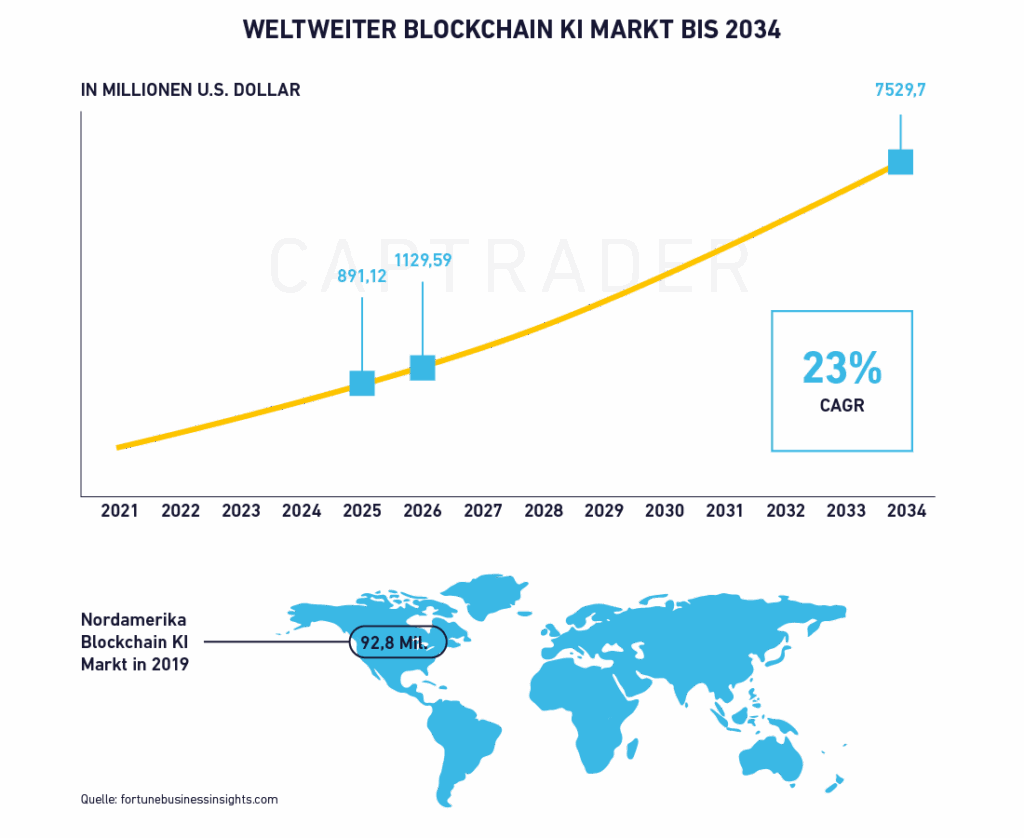
- Market growth & validationAccording to Fortune Business Insights, the blockchain-AI market will reach a volume of USD 1.13 billion by 2026, driven by the need to document AI decisions in an auditable and tamper-proof manner.
- Hardware and Data Center SynergiesCompanies like Nvidia and AMD, as well as operators of specialized data centers, are benefiting from a dual demand, as modern server clusters can be flexibly used both for training language models and for securing decentralized networks.
- Autonomous Smart ContractsA central trend is equipping AI agents with their own digital wallets, enabling them to independently pay and operate via blockchain infrastructure, which radically increases efficiency in cloud computing.
- Intellectual property protectionBy integrating AI into decentralized protocols, unauthorized model usage is prevented, as each query is automatically settled via the blockchain and credited to the rightful developer.
Real-World Asset (RWA) Tokenization
By 2026, tokenization has evolved from a technological vision into a trillion-dollar market. Physical assets such as real estate, government bonds, and works of art are translated into digital tokens on the blockchain, making them tradeable globally, around the clock, and in the smallest fractions for the first time.
For blockchain infrastructure companies, this means unprecedented growth potential, as they provide the legally compliant platforms and technical rails for this fundamental transformation of the global financial system.
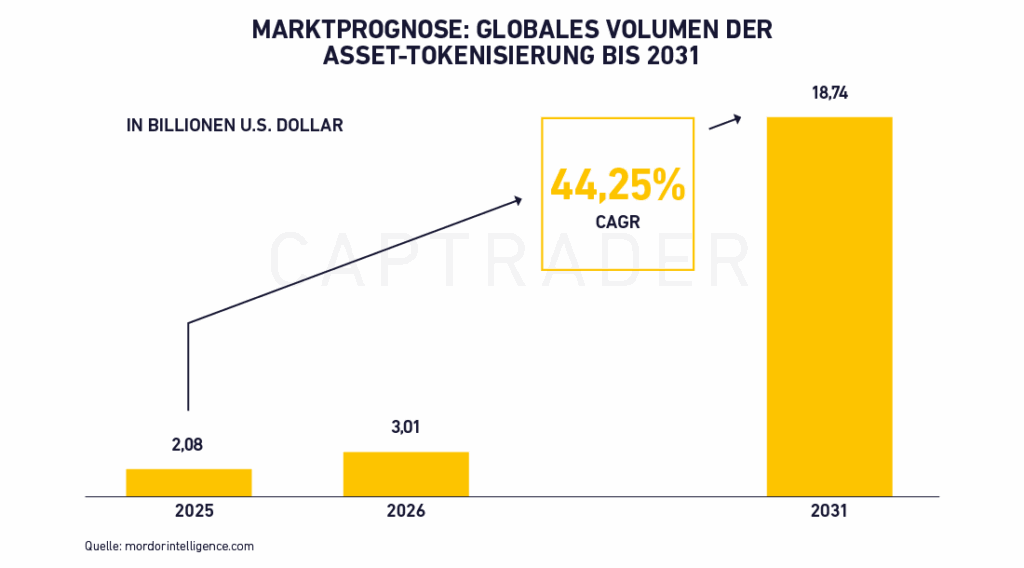
- Market potential 2026According to data from Mordor Intelligence, the market volume of asset tokenization is already reaching USD 3.01 trillion this year.
- Exponential growth: With a compound annual growth rate (CAGR) of 44.25 %, the analysis forecasts a rise to a staggering 18.74 trillion USD by 2031.
- Institutional focusLeading banks and asset managers are increasingly using the technology in 2026 to make previously illiquid markets (such as private equity or real estate) digitally accessible and to drastically reduce transaction costs.
The main beneficiaries are platform providers, specialized custodians, and software firms that build the regulatory interfaces for these trillions in assets.
An overview of the best-known and largest blockchain stocks
The following overview presents a selection of stocks whose companies directly or indirectly profit from the blockchain market. The list is sorted by market capitalization and refers to the status as of April 2026, allowing you to classify blockchain stocks by size and market weight.
| Company | ISIN | Country | Market capitalization in US dollars² |
| NVIDIA | US67066G1040 | USA | 4.909 billion |
| Alphabet | US02079K3059 | USA | 4.624 billion |
| Microsoft | US5949181045 | USA | 3.073 billion |
| Visa | US92826C8394 | USA | 616 billion |
| Oracle | US68389X1054 | USA | 519 billion |
| Mastercard | US57636Q1040 | USA | 446 billion |
| SAP | DE0007164600 | Germany | 202 billion |
| MicroStrategy | US5949724083 | USA | 64 billion |
| Coinbase Global | US19260Q1076 | USA | 53 billion |
| Block, Inc. | US8522341036 | USA | 43 billion |
If you want to invest in blockchain stocks, you can now open your account with CapTrader. Secure direct access to 124 international stock exchanges and benefit from attractive conditions: trade US stocks starting from just 1 cent per share, with a minimum fee of only $2.00 per order.


1. Coinbase Global
Coinbase (ISIN: US19260Q1076) has evolved from a trading exchange into the leading infrastructure provider for institutional investors. With its proprietary Layer 2 network „Base,“ Coinbase provides the technical rails for mass-market on-chain applications.
Furthermore, the company acts as the primary custodian for most US crypto ETFs, thereby securing the digital bridge to the traditional financial system.
For investors, Coinbase represents the core of institutional adoption. As the company increasingly relies on subscription models and service fees in the custody and staking sectors, its business model is becoming increasingly independent of short-term cryptocurrency price fluctuations.
| Tax year | estimated revenue (in million USD)² | Change compared to previous year² |
| 2025 | 7.181 | 9,4 % |
| 2026 | 6.976 | -2,86 % |
| 2027 | 8.394 | 20,33 % |
2. NVIDIA
Nvidia (ISIN: US67066G1040) is the technological foundation of the blockchain and AI revolution. As the world’s leading developer of graphics processing units (GPUs), the company provides the computing power needed to validate transactions and train complex AI models (AI shares) on the blockchain.
Nvidia dominates the market for high-performance chips and, through its CUDA platform, sets the standard for distributed computing.
The company is benefiting from massive dual demand: while data centers for AI applications are being expanded, they are simultaneously acting as the backbone for modern blockchain networks. By merging the two worlds, Nvidia is securing a key role in the Web3 infrastructure.
| Tax year | estimated revenue (in million USD)² | Change compared to previous year² |
| 2025 | 130.497 | 114,2 % |
| 2026 | 215.938 | 65,47 % |
| 2027 | 370.542 | 71,6 % |
3. Visa
Visa (ISIN: US92826C8394) is a well-known Bluechip-Akie and the pioneer in integrating blockchain technology into global payments. Instead of viewing the technology as a threat, Visa uses it as a new infrastructure rail to settle transactions with stablecoins and digital currencies in real time.
The company connects billions of users with decentralized networks and acts as a regulatory anchor point.
Through the "multi-chain strategy," Visa enables financial institutions to access blockchains such as Solana or Ethereum without having to handle the technical complexity themselves. Visa is thus transforming itself into the universal connection layer of the financial world.
| Tax year | estimated revenue (in million USD)² | Change compared to previous year² |
| 2025 | 40.000 | 11,34 % |
| 2026 | 45.426 | 13,56 % |
| 2027 | 50.244 | 10,61 % |
4. Oracle
Oracle (ISIN: US68389X1054) is the specialized provider for the operational bridge between decentralized ledgers and traditional ERP systems.
In 2026, Oracle is indispensable for companies that need to integrate on-chain data into their existing accounting, logistics, and supply chain management. With its "oracle services," the company solves the problem of blockchain data isolation.
Investors in this blockchain stock are investing in an essential middleware solution. Since Oracle is deeply embedded in the IT structures of major corporations, the stock offers stable access to the blockchain market based on real industrial use and long-term software contracts.
| Tax year | estimated revenue (in million USD)² | Change compared to previous year² |
| 2025 | 57.399 | 8,38 % |
| 2026 | 67.228 | 17,12 % |
| 2027 | 88.479 | 31,61 % |
5. Microsoft
Microsoft (ISIN: US5949181045) offers one of the world's most important "Blockchain-as-a-Service" (BaaS) environments via its cloud platform Azure. The company enables corporations to launch their own blockchain nodes and smart contracts at the push of a button.
Especially through the deep integration of AI assistants (Copilot) into the developer environment, Microsoft is becoming the most important toolset for Web3 development.
As an infrastructure giant, Microsoft profits from every company that hosts blockchain applications in the cloud. This makes the stock one of the safest ways to participate in the growth of blockchain technology without having to bear the risks of smaller crypto startups.
| Tax year | estimated revenue (in million USD)² | Change compared to previous year² |
| 2025 | 281.724 | 14,93 % |
| 2026 | 329.331 | 16,90 % |
| 2027 | 383.931 | 16,58 % |
CapTrader can do that:
At CapTrader, the trading fees are extremely low: you can trade US shares from as little as $ 0.01 per share (order minimum $ 2.00) and German shares from as little as 0.1 % of the order volume (order minimum €2.00), options from €2.00, futures from €1.00, ETFs from €2.00 and much more!
Risk factors in blockchain stocks
Investing in blockchain stocks offers enormous opportunities due to the transformation of the financial and technology sectors, but it carries specific risks that go beyond those of traditional stock investments.
In 2026, it becomes apparent that while the industry has matured, it offers new vulnerabilities precisely because of its deeper integration into the global economy. Investors must understand that companies in this sector are often at the forefront of technological and regulatory upheavals, which can lead to increased volatility.
The following three factors currently represent the most critical hurdles for a stable performance.
Volatility and market correlation
A significant risk remains the often unpredictable and close tie of many blockchain companies to the price performance of the underlying cryptocurrencies as well as the general market sentiment in the tech sector.
- Dependency on leading cryptocurrenciesIn particular, crypto exchanges and pure infrastructure providers often record drastic price losses as soon as the Bitcoin price corrects, since trading volume and investor interest usually drop abruptly during such phases.
- The leverage effect of mining stocksMining companies often act as a lever on the Bitcoin price; if energy costs rise while crypto prices fall at the same time, profit margins come under pressure extremely quickly, which can lead to disproportionate price drops.
- Narratives and speculative bubblesSince the sector is still heavily driven by technological promises in 2026, disappointments regarding the speed of adoption or the failure of prominent projects could adversely affect the entire industry in the short term.
Regulatory uncertainty and compliance
Despite the introduction of groundbreaking regulations such as the MiCA Regulation in the EU, the global legal environment remains a „patchwork quilt“ that can massively impact scalability and profitability.
- Geopolitical regulatory differencesWhile Europe has created legal certainty through MiCA, sudden, restrictive legislative changes in the US or in key Asian markets can restrict the operations of globally active platforms or make them more expensive overnight.
- High compliance and implementation costsCompanies that operate tokenization platforms must meet extremely strict anti-money laundering (AML) and identity verification (KYC) requirements, which requires immense investments in legal departments and technical monitoring systems.
- Impending fines and revocation of license: Financial regulators will crack down much more strictly in 2026; even the slightest violations in the custody of digital assets or the issuance of tokens can result in fines that threaten a company's very existence.
Technological Disruption and Cybersecurity
In an environment developing as rapidly as blockchain technology, paradoxically, rapid technological change poses one of the greatest risks to established market leaders.
- Vulnerabilities in smart contractsAlthough the underlying blockchains are mostly secure, the applications and „bridges“ (interfaces between networks) built on top of them remain attractive targets for hackers, with attacks potentially leading to massive outflows of capital and irreparable damage to trust.
- Hardware Management and Energy EfficiencyIn the hardware sector, new, more efficient chip generations can render the existing infrastructure of mining companies or validation operations unprofitable within a few months, resulting in high depreciation charges on machinery.
- Quantum computing threatIn the long term, companies must begin investing in quantum-resistant encryption as early as 2026; firms that miss this technological leap risk the integrity of their entire infrastructure against future computing power.
Conclusion: Are blockchain stocks worth it in 2026?
Blockchain stocks remain an interesting option in 2026 for investors who want to profit from the growth of blockchain technology without investing directly in cryptocurrencies.
Particularly attractive are companies that provide the technical foundation of the market, such as those in the fields of semiconductors, cloud computing, payment processing, custody, or software. These blockchain stocks benefit not only from the performance of individual coins, but from the increasing adoption of the technology in business and the financial world.
At the same time, as an investor, you should not underestimate the risks. Many stocks continue to react strongly to cryptocurrency price trends, regulatory changes, and technological setbacks. Therefore, anyone investing should pay attention to quality, business model, and market position, and view blockchain stocks rather as a high-opportunity addition to their portfolio.
All in all, blockchain stocks are primarily suitable for investors with a long-term horizon who want to participate in the structural trends surrounding tokenization, digital payments, and the combination of blockchain and AI.
For building a robust portfolio, the Core-satellite strategy . In this context, established, high-quality companies with stable business models and reliable Dividendenhistorie the defensive core, while growth-oriented blockchain stocks are added as smaller, higher-potential satellites to increase the return potential.
This flexible concept is not only suitable for the crypto and blockchain sector, but can also be applied to other sectors such as Automotive stocks, Silver stocks or Oil stocks transfer.
List of sources:
(1) Source: Business Research Insights dated Apr 21, 2026
(2) Source: Marketscreener from 04/21/2026
