


Many investors see Finnish stocks as an interesting opportunity to benefit from a stable and innovation-driven economy. The market is characterized by globally leading companies in technology, industry, and renewable energy, supported by solid economic conditions and high sustainability standards.
In this article, you will learn which Finnish stocks are currently particularly relevant, what opportunities and risks the market offers, and which factors influence price development.

The most important facts in brief:
- For 2026, Finland is expected to see only moderate GDP growth of about 1 %.
- Technology and quantum technology are considered important drivers of the future. Significantly more skilled workers are expected by 2035.
- The energy sector remains attractive because the expansion of renewable energies in Finland continues to grow, creating new opportunities for utilities, infrastructure, and suppliers.
Finnish stocks: What characterizes the market?
The Finnish stock market consists of export-driven, internationally competitive large corporations in the industrial, technology, and financial services sectors.
According to the Bank of Finland, Finland's long-term growth prospects are rather moderate, which is related, among other things, to demographic change and a weaker development of labor potential.
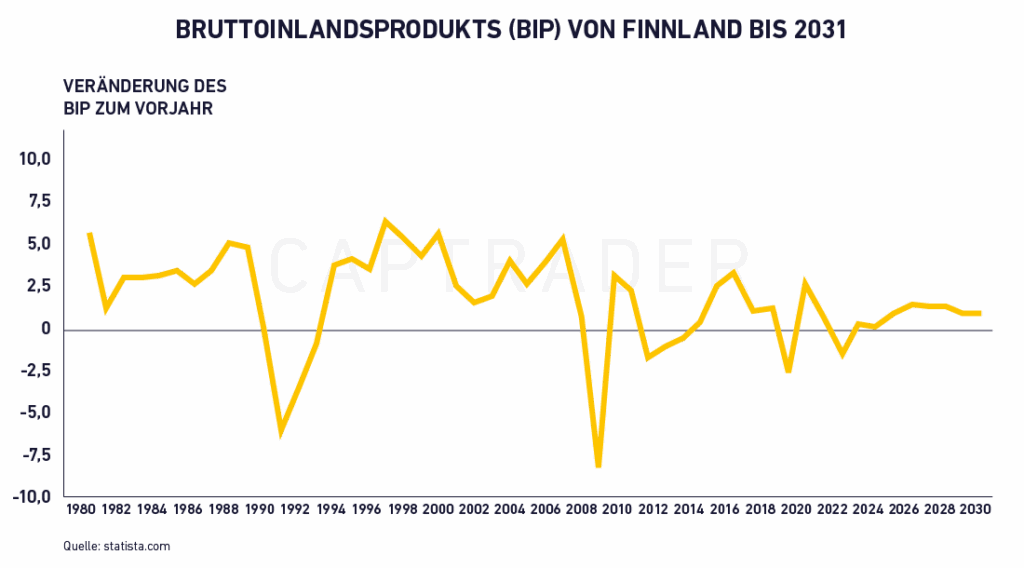
The chart on GDP growth in Finland shows that economic output has been subject to noticeable fluctuations in recent years. Overall, however, the Finnish economy is on a fairly moderate and therefore predictable growth path.
Real gross domestic product is projected to increase by about 1 % in 2026. Analysts expect annual GDP growth to range from about 1.1 % to 1.5 % through 2031.


The OMX Helsinki 25 at a Glance
The central barometer for the Finnish capital market is the OMX Helsinki 25 (OMXH25). It comprises the 25 most traded and most liquid companies on the Nasdaq Helsinki stock exchange.
Compared to pure US tech indices, the OMXH25 is considered a value-strong market with attractive dividend yields due to its mix of financials, industrial pioneers, consumer stocks, and energy shares.
The top 5 companies in the OMX Helsinki 25 are:
| Company | ISIN | Weighting in the index | business model |
| Nordea Bank Abp | FI4000297767 | approx. 17.46 % | Leading banking group in Northern Europe with a strong retail and corporate customer business. |
| Nokia Corporation | FI0009000681 | approx. 13.29 % | Global network and telecommunications corporation focusing on 5G infrastructure, cloud services, and technology licenses. |
| Sampo plc | FI0009003308 | approx. 7.73 % | Leading Nordic property and casualty insurance group (including If Insurance). |
| Kone Corporation | FI0009013403 | approx. 5.92 % | Global technology leader in the manufacturing and maintenance of elevators and escalators. |
| Neste Oyj | FI0009013296 | approx. 5.33 % | Global leader in renewable diesel, sustainable aviation fuels, and circular solutions. |
Finnish stock market: Strong sectors in focus
Investors in Finnish stocks benefit from stable business models, reliable dividends, and global industry leaders in industrial technology and sustainability.
Due to the manageable domestic market, Finnish corporations have been internationally oriented from the very beginning, which offers investment opportunities in highly specialized niche global market leaders.
The most important sectors in detail:
- Forestry, Packaging & BioeconomyFinland is the green lung of Europe. Corporations like UPM-Kymmene and Stora Enso are transforming traditional papermaking into sustainable biomaterials, packaging solutions, and biochemicals.
- Industrial Automation, Elevators & Mechanical EngineeringFinnish engineering enjoys a worldwide reputation. Market leaders such as Kone (elevators & escalators) and Valmet (process systems) benefit from global urbanization and automation trends.
- Renewable Energy & RefineryWith Neste, the country is home to the global market leader in sustainable aviation fuel (SAF) and renewable diesel.
- Finance & InsuranceNordic financials, such as Nordea Bank (Northern Europe's largest financial institution) and insurance giant Sampo, deliver stable earnings and solid dividends.
- Telecommunication & Network Infrastructure: With Nokia, Finland is home to one of the global key players for 5G and 6G mobile networks and industrial IoT infrastructure.
Top Finnish Stocks 2026: Sorted by Market Capitalization
The following overview presents a selection of major publicly traded Finnish companies whose business models are closely linked to the core strengths of the national economy.
| Company | ISIN | Industry | Market capitalization in euros³ |
| Nokia Corporation | FI0009000681 | Telecommunications & Networks | 68 billion |
| Nordea Bank Abp | FI4000297767 | Banking & Financial Services | 55 billion |
| KONE Corporation | FI0009013403 | Mechanical Engineering (Elevators & Escalators) | 26 billion |
| Sampo plc | FI4000552500 | Insurances | 24 billion |
| Neste Oyj | FI0009013296 | Energy & Renewable Fuels | 21 billion |
| Wärtsilä Oyj Abp | FI0009003727 | Mechanical Engineering & Drive Systems | 19 billion |
| Fortum Oyj | FI0009007132 | Energy supply & Utilities | 17 billion |
| UPM-Kymmene Oyj | FI0009005987 | Forestry and Paper Industry | 13 billion |
| Metso Corporation | FI0009014575 | Mechanical Engineering & Plant Engineering | 12 billion |
| Orion Corporation | FI0009014377 | Pharma & Biotechnology | 10 billion |
Open a brokerage account with CapTrader today and invest specifically in Finnish stocks. Benefit from direct access to over 170 international stock exchanges as well as competitive conditions.


List of companies in Finland with the highest dividend yield
After the overview of the 10 most valuable companies in Finland, we will now look at 10 Finnish stocks with the highest dividend yield.
| Company | ISIN | Industry | Dividend yield³ |
| Mandatum Plc | FI4000552526 | Financial Services & Asset Management | 12,1 % |
| Elisa Corporation | FI0009007884 | Telecommunications | 7,07 % |
| Anora Group Oyj | FI4000292438 | Consumer Goods & Beverage Industry | 6,99 % |
| UPM-Kymmene Oyj | FI0009005987 | Forestry and Paper Industry | 6,61 % |
| Nordea Bank Abp | FI4000297767 | Financial services & banking | 5,71 % |
| Tietoevry Oyj | FI0009000277 | IT Services & Software | 5,68 % |
| Fiskars Oyj Abp | FI0009000400 | Consumer Goods & Household Goods | 5,27 % |
| Kesko Oyj | FI0009000202 | Retail & Wholesale | 4,42 % |
| Fortum Oyj | FI0009007132 | Energy and Utilities | 4,57 % |
| Kemira Oyj | FI0009004824 | Specialty Chemicals | 4,43 % |
Do not rely solely on a high dividend yield for your investment decision. Instead, analyze the company's fundamental strength, its growth prospects, and the long-term sustainability of its payout policy before investing.
In the next section, we present 5 interesting Finnish stocks and show how their business models are positioned in the current market environment.
1. KONE Corporation
KONE (ISIN: FI0009013403) is one of the world's leading manufacturers of elevators and escalators, distinguished by an extremely profitable, recession-proof, and sticky service and maintenance business.
The company maintains millions of systems around the globe and benefits from long-term structural megatrends such as progressive urbanization, an aging society, and the need for energy-efficient building technologies.
| Tax year | estimated revenue (in million euros)³ | Change compared to previous year³ |
| 2025 | 11.245 | 1,32 % |
| 2026 | 11.753 | 4,52 % |
| 2027 | 12.440 | 5,85 % |
By focusing on the entire lifecycle of its equipment, KONE ensures predictable cash flows over decades, as elevators, once installed, require maintenance regardless of economic conditions. KONE's dividend yield is 3.65 %.
The combination of technological innovations in the field of predictive maintenance (IoT) and a historically strong foothold in the Asian and European markets makes the company a prime example of a defensive quality stock.
2. Neste Oyj
Neste (ISIN: FI0009013296) has transformed from a traditional oil refinery operator into the world's leading producer of renewable diesel and sustainable aviation fuel (SAF).
The stock, which offers a moderate dividend yield of 1.92 %, operates state-of-the-art biorefineries in Europe, Asia, and the U.S. and supplies the global transportation and aviation sectors with low-carbon fuels derived from waste and residual materials.
| Tax year | estimated revenue (in million euros)³ | Change compared to previous year³ |
| 2025 | 19.016 | -7,85 % |
| 2026 | 21.352 | 12,28 % |
| 2027 | 23.845 | 11,67 % |
Through its early and consistent focus on the circular economy, Neste is benefiting from increasingly stringent global environmental regulations and rapidly rising demand for green alternatives in heavy-duty transport.
The combination of patented technologies for processing low-quality raw materials, global logistics advantages, and strategic partnerships with airlines secures Neste's technological leadership in the energy sector.
3. Sampo Oyj
Following its successful restructuring in recent years, Sampo (ISIN: FI4000552500) is one of the most focused and profitable property and casualty insurers in the Nordic region.
Through its well-known core brands such as If, the company manages a broad portfolio of property and casualty insurance products for private and corporate customers in Scandinavia and the Baltics.
| Tax year | estimated revenue (in million euros)³ | Change compared to previous year³ |
| 2025 | 9.078 | 10,05 % |
| 2026 | 9.684 | 6,67 % |
| 2027 | 10.195 | 5,28 % |
Thanks to an excellent combined ratio, Sampo generates reliable and above-average operating profits even during periods of economic volatility. As a result, the Finnish stock is also able to pay a dividend yield of 4.01 %.
The combination of high customer loyalty in the Scandinavian home market, a lean digital administration, and a clear focus on continuous capital returns makes the stock a classic stability anchor.
4. Nordea Bank Abp
Nordea (ISIN: FI4000297767) is the largest financial services provider in Northern Europe and is considered one of the best-capitalized and most digitalized banking institutions on the entire European continent.
The Blue-chip stock serves millions of individual and corporate customers in the economically stable core markets of Sweden, Finland, Norway, and Denmark with traditional and digital financial products. Dividend investors can look forward to 5.71 % payouts.
| Tax year | estimated revenue (in million euros)³ | Change compared to previous year³ |
| 2025 | 11.743 | -2,82 % |
| 2026 | 12.000 | 2,19 % |
| 2027 | 12.567 | 4,73 % |
Thanks to a digital infrastructure that is exceptional by European comparison, Nordea succeeds in keeping its operating expense ratio low while benefiting from a solid interest rate environment.
The combination of conservative risk management in wealthy economies, a strong market presence, and a historically shareholder-friendly distribution policy makes the institution attractive to value-oriented investors.
5. UPM-Kymmene Oyj
UPM-Kymmene (ISIN: FI0009005987) combines traditional Finnish forestry with cutting-edge biochemistry and is considered a pioneer in replacing fossil raw materials with bio-based alternatives.
The company owns and manages vast tracts of forest and, in addition to traditional paper and pulp products, produces innovative materials such as biofuels, lignin substitutes, and bio-based plastics. UPM-Kymmene also stands out with a 6.61 % dividend yield.
| Tax year | estimated revenue (in million euros)³ | Change compared to previous year³ |
| 2025 | 9.656 | -6,61 % |
| 2026 | 9.922 | 2,75 % |
| 2027 | 10.305 | 3,87 % |
Due to the enormous real asset protection of its own forest holdings, UPM possesses an inherent hedge against inflation while simultaneously securing direct access to the valuable raw material wood.
The combination of high-yield major projects in the pulp sector and the gradual development of a promising division for green industrial chemicals makes the company a highly interesting transformation stock in the industrial sector.
Opportunities for Finnish stocks
Finnish stocks operate in a market characterized by high transparency, technological expertise, and excellent corporate governance.
Precisely these characteristics make Finland attractive to investors who rely on reliable business models, solid balance sheets, and global competitiveness.
Technology with future potential
The technology sector is one of the most important future fields for Finnish equities. Although Finland is not a mass market internationally, it has established itself as a competitive location in several technology-driven niches.
For many investors, this is exciting because specialized technology fields often develop long-term growth stories that depend less on the domestic economy and more on global demand.
A particularly interesting example is quantum technology. The report² published by InstituteQ on the future development of the quantum science and technology labor market in Finland shows that significant employment growth is expected in this field by 2035.
This is not only a signal for research and education, but also for the emerging industrial ecosystem of companies, suppliers, and technology-oriented service providers.
- Growing importance of quantum technology and high-tech applications.
- Strong research base with long-term innovation potential.
- Good prospects for export-oriented technology companies.
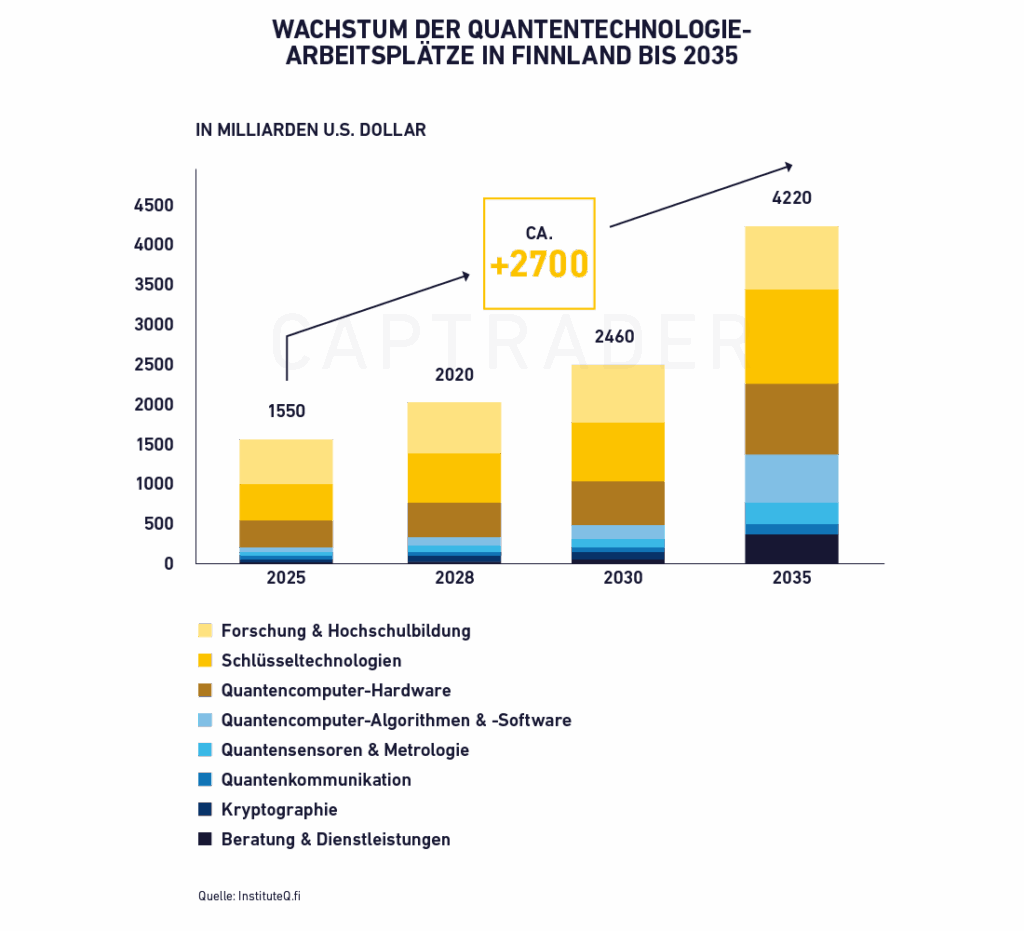
The chart shows that the number of employees in the field of quantum science and technology will increase from 1,550 in 2025 to 4,220 in 2035, meaning that approximately 2,700 additional skilled workers will be needed.
The greatest demand arises in research and higher education, enabling technologies, quantum hardware, and consulting & services, while software/algorithms and cryptography are also growing significantly.
For Finnish equities, this is an important indication that technology is not just a niche topic, but can be a genuine structural growth driver.
Energy as a long-term driver
The energy sector also plays an important role for Finnish equities, as it combines economic stability and structural growth. Finland has been investing in a modern and sustainable energy supply for years, creating new opportunities for utilities, infrastructure companies, and industrial suppliers.
This could be relevant for investors because the energy transition not only has political significance, but also generates concrete investments, orders, and long-term demand.
- Expansion of renewable energies as a structural growth factor.
- Investments in grids, security of supply and infrastructure.
- Opportunities for energy providers, industrial companies, and technical suppliers.
As a result, not only traditional energy companies benefit, but also firms in mechanical engineering, electrification, and infrastructure.
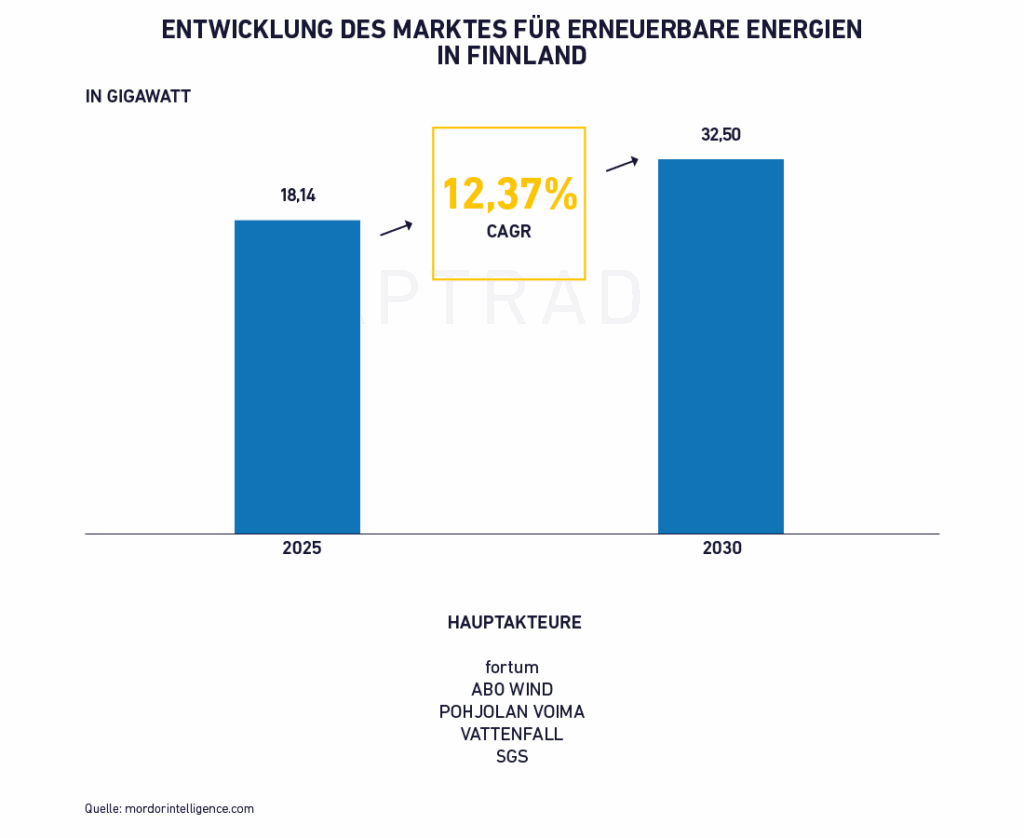
The chart shows that the installed capacity of the Finnish renewable energy market is expected to grow from 18.14 gigawatts in 2025 to 32.5 gigawatts in 2030. This corresponds to an average annual growth rate of 12.37 %.
Risk Factors in Finnish Equities: A Practical Analysis for Investors
Finnish equities are characterized by several structural risk factors that are particularly relevant to long-term investors. At the core are primarily the export-dependent growth structure, demographic change, and political and regulatory influences surrounding energy and climate policy.
You should keep a particularly close eye on the following three risk areas when analyzing Finnish companies.
1. Export dependence and moderate growth
Finland is a small, open economy whose development depends heavily on demand in international markets. Weaknesses in key export regions, such as Europe, can quickly and directly impact the revenue, incoming orders, and profitability of Finnish companies.
At the same time, an aging population and sluggish productivity growth are limiting long-term GDP growth, keeping the structural tailwind for corporate profits moderate overall.
- High dependence on export markets and the global economic cycle.
- Limited structural growth due to demographic and productive factors.
- Above-average earnings impact during global downturns.
In practice, this means that many Finnish stocks are heavily correlated with global economic trends and are less insulated by domestic demand. Anyone investing should closely understand the central role of export markets in a company's earnings performance and factor in scenarios for economic downturns.
2. Demographic change and labor supply
Finland is one of Europe’s fastest-aging economies. The rising old-age dependency ratio and low fertility rate have long-term implications for the labor supply, productivity, and public finances.
Studies show that aging has already had noticeable effects on GDP per capita, productivity, and debt development, which limits the scope for strong growth impulses.
- Shrinking or stagnant labor force.
- Pressure on productivity and potential growth.
- Rising social and fiscal costs that limit economic policy flexibility.
For you as an investor, the demographic trend means that while Finland offers a predictable environment, only limited stimuli are to be expected from the domestic economy.
Long-term successful companies must therefore either significantly increase productivity or be strongly internationally oriented in order to compensate for the demographic brake in their domestic market.
3. Risks for politics and the energy transition
The energy transition opens up opportunities for Finnish companies in areas such as renewable energies, grid infrastructure, and climate-friendly technologies. At the same time, it brings political and regulatory uncertainties, such as in subsidy schemes, levies, emission regulations, and permitting procedures.
In addition, foreign investors bear currency risk, as returns can be influenced by fluctuations of the euro against their domestic currency, regardless of the company's operational performance.
- Regulatory interventions in energy, climate, and emissions markets.
- Uncertainty regarding future funding landscapes, levies, and approval processes.
- Exchange rate risks for international investors due to euro fluctuations.
In practice, this means that energy suppliers, infrastructure assets, and industrial companies in particular depend heavily on the design of energy and climate policy.
Changes in political frameworks can shift investment calculations, delay projects, or necessitate the adaptation of business models, while currency movements influence the actual net return of international investors.
Important note on withholding tax for German investors
Finland levies a standard withholding tax rate of 35 % on dividend payments. Under the double taxation treaty (DTA), 15 % of this amount is directly offset against the domestic flat-rate withholding tax.
The Finnish tax authorities retain the remaining 20 %. Although this difference can generally be reclaimed through the Finnish Tax Administration (Vero), this bureaucratic process (including proof of tax residency) usually isn’t worth the effort unless the dividends are substantial.
Anyone who chooses not to file a tax refund claim effectively pays 45 % in taxes on Finnish dividend payments.
CapTrader can do that:
At CapTrader, the trading fees are extremely low: you can trade US stocks from just 0 $.01 per share (order minimum 2. $ 00), and Finnish stocks from an unbeatable 0.1 (4. % 00 € minimum fee).
Conclusion: Are Finnish stocks worth it in 2026?
In 2026, Finnish stocks offer growth opportunities primarily in sectors such as technology, renewable energy, industry, and sustainable infrastructure. What’s particularly exciting is that many Finnish companies have an international presence and thus benefit more from global trends than from their small domestic market.
The growth prospects also appear solid overall: Finland's economy is expected to see moderate but positive GDP growth in 2026, while future sectors such as quantum technology and renewable energy are likely to grow structurally.
This points to a market that does not rely on short-term momentum, but rather on long-term quality and predictable growth.
If you also want to build long-term wealth with stocks, you have the option to regularly invest a fixed amount via a Aktiensparplan to invest.
Such a savings plan is not only suitable for Finnish stocks, but can also be used for other countries like Belgian stocks, Norwegian stocks, Hong Kong stocks, or Israeli stocks be applied.
List of sources:
(1) Source: Bank of Finland as of 24.06.26
(2) Source: Institute Q dated June 24, 2026
(3) Source: Marketscreener, June 24, 2026
