


Many investors see robotics stocks as an attractive opportunity to make money in the global automation sector. The market is driven in particular by factors such as AI technologies, the search for crisis-proof investments, lower production costs through robots, and the strategic positioning of companies.
In this article, you will learn which companies are currently well positioned and what opportunities and risks are associated with the sector.

The most important facts in brief:
- The robotics market is growing due to a global shortage of skilled workers, aging societies, and increasing automation pressure. Worldwide, industrial robot installations are expected to rise to 708,000 units by 2028.
- The AI robotics market is growing from €24 billion (2025) to €146 billion (2030), with new application areas in service, logistics, and collaborative robotics.
- Established providers with technological expertise in high-growth markets (industrial automation, sensor technology, medical robotics) offer stable returns combined with attractive growth prospects.
What are robotics stocks?
Robotics stocks are shares of companies operating along the robotics value chain. This includes, for example, firms that develop robots, automate production facilities, pioneer new technologies, or produce and market robotics systems. They thus operate at the intersection of technology development, financing, and corporate investment.
The robotics sector remains relevant despite fluctuating markets because it is not only important for industrial production, but is also considered an investment form in economically uncertain times. Robotics stocks are particularly significant for investors who want to profit from rising automation costs, geopolitical uncertainties, and the demand for stable assets.
Robotics stocks can be broadly categorized into different areas of the value chain. These segments react differently to AI development, production costs, and market sentiment.
- pure robotics developersThese include companies that focus exclusively on robot development, such as Ubtech Robotics or Teradyne. Their profits often depend heavily on technological progress. As innovation increases, their margins generally improve as well.
- Tech multiples with robotics as a growth driverLarge tech companies where robotics is a key growth driver, such as Tesla with Optimus or Nvidia with AI chips for robotics. They carry a higher risk, but also offer particularly high price potential in the event of success.
- Industrial automation corporationsEstablished factory automation companies like Siemens or Schneider Electric. Their revenues depend not only on the robotics market, but also on demand in the respective industries.
- Medical robotics specialistsSurgical robot companies like Intuitive Surgical with da Vinci. They often benefit from high market activity and rising demand for medical robotics, especially during uncertain market phases.
- Suppliers and componentsCompanies for sensors, drives, and chips such as Infineon or Elmos. Their business development depends primarily on manufacturers' investments and thus indirectly also on the robotics market.
- Software and AI platformsRobotics software and AI infrastructure companies like Palantir. They benefit from high market activity and increasing demand for automation solutions.
Some robotics stocks operate across multiple stages of the value chain. This allows them to better offset fluctuations in individual business segments and make their earnings more stable.


The market potential of robotics stocks in 2026
Commercial robotics is evolving globally into a key technology for logistics, medicine, defense, and industry. The main driver is the acute shortage of skilled labor combined with the pressure for higher operational efficiency.
Market research firms such as Zion Market Research expect the global commercial robotics market to experience rapid growth. Starting at approximately $25 billion in 2024, the market size is projected to rise to over $160 billion by 2034. This corresponds to a compound annual growth rate (CAGR) of approximately 20.5 %.
Hereby, medical and surgical robots as well as the defense sector currently form the largest revenue generators, while autonomous transport robots are growing particularly strongly in logistics.
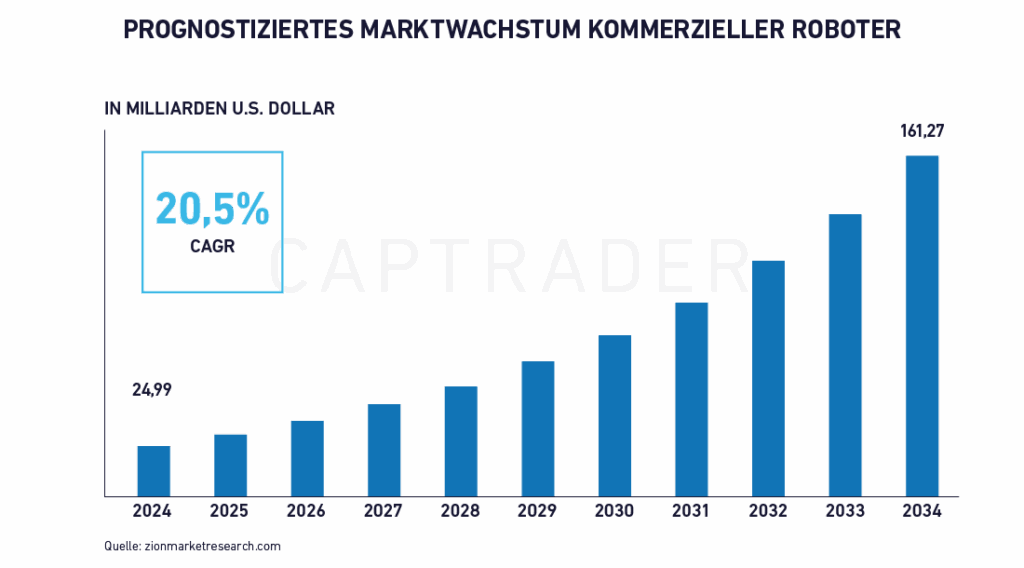
The chart illustrates the long-term growth path of the robotics market over the coming decade. Looking at the annual development steps, it becomes clear that the total market volume will multiply.
This dynamic is driven primarily by two factors: the rapid advancement of AI-powered software and the trend toward flexible rental models such as Robotics-as-a-Service, which make it easier for companies to get started without high upfront investments.
1. Population growth and skilled labor shortages as a long-term tailwind
The long-term framework conditions point to a further increasing importance of robotics. While the world's population continues to grow in the coming decades, the shortage of skilled workers is simultaneously intensifying in many industrialized countries.
For companies, this means that productivity increases will increasingly have to be achieved not just through additional personnel, but through automation, intelligent systems, and robotic processes.
This trend is already clearly evident, particularly in industry, logistics, and the manufacturing sector. Where personnel are scarce, shifts are harder to fill, and at the same time high demands are placed on quality, speed, and reliability, robotics solutions are continuing to gain relevance.
Important aspects in this context:
- The United Nations expects the global population to peak at around 10.3 billion people in the 2080s.
- Aging societies are increasing pressure on the labor market in numerous economies.
- Automation is becoming a central lever for many companies to expand production capacities despite scarce human resources.
As a result, the robotics sector benefits not only from technological progress, but also from a structural environment in which efficiency, scalability, and resilience increasingly determine the competitiveness of companies.
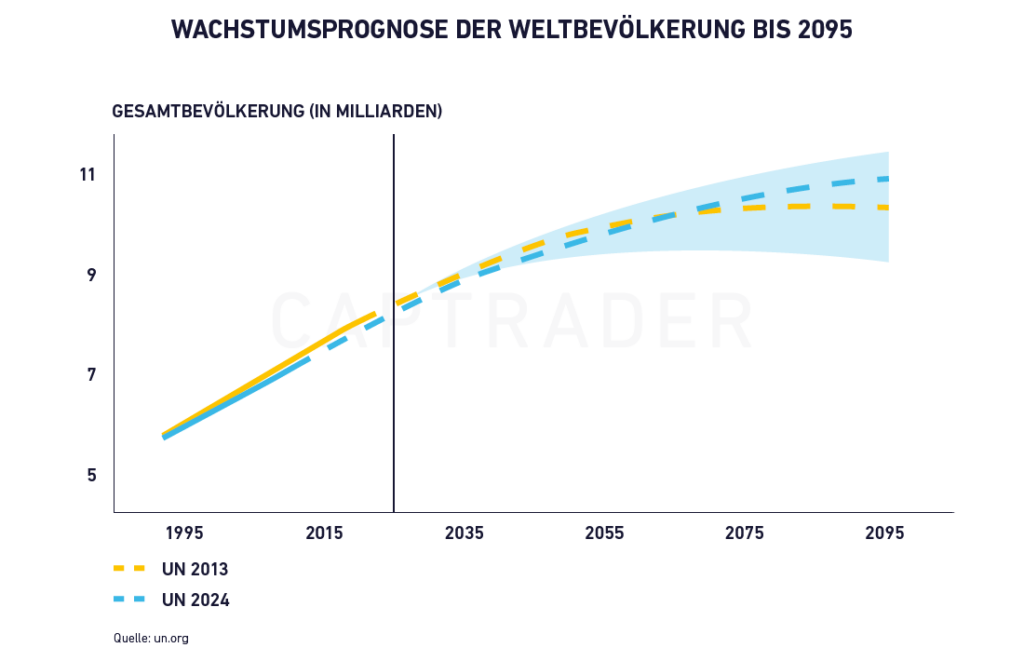
The graphic shows that, according to the UN, the global population will increase continuously in the coming decades. Earlier projections assumed a stronger increase, but the newer estimate is somewhat more moderate, though it does not change the long-term growth trend.
Especially in combination with aging societies and a shortage of skilled labor, this points to a further rising demand for automation and robotics. As a result, the sector remains structurally well supported.
2. Global growth prospects for robotics
Growth prospects in the robotics market remain exceptionally attractive in 2026. A key reason for this is that automation is becoming a strategic necessity in an increasing number of industries.
Companies are investing in robotics no longer just to increase efficiency, but increasingly also to make production processes more robust, scalable, and less dependent on personnel shortages.
This trend is also reflected in the latest industry data. According to the International Federation of Robotics, global installations of industrial robots are expected to rise by 6 % to 575,000 units in 2025.
By 2028, the mark of 700,000 units is expected to be exceeded. This confirms the leading industry source that the robotics market is not just growing in the short term, but is based on a resilient, multi-year upward trend.
Key growth drivers include:
- increasing investments in industrial automation and intelligent manufacturing systems.
- the growing importance of robotics for more resilient and efficient supply chains.
- technological advances in software, sensor technology, and modern robotic systems.
Another argument in favor of the market is that demand is not limited to individual regions or applications. Robotics is gaining importance worldwide in manufacturing, logistics, and industrial process automation.
This benefits not only traditional robot manufacturers, but also companies in the semiconductor, control engineering, and industrial software sectors, which play a central role in the expansion of automated systems.
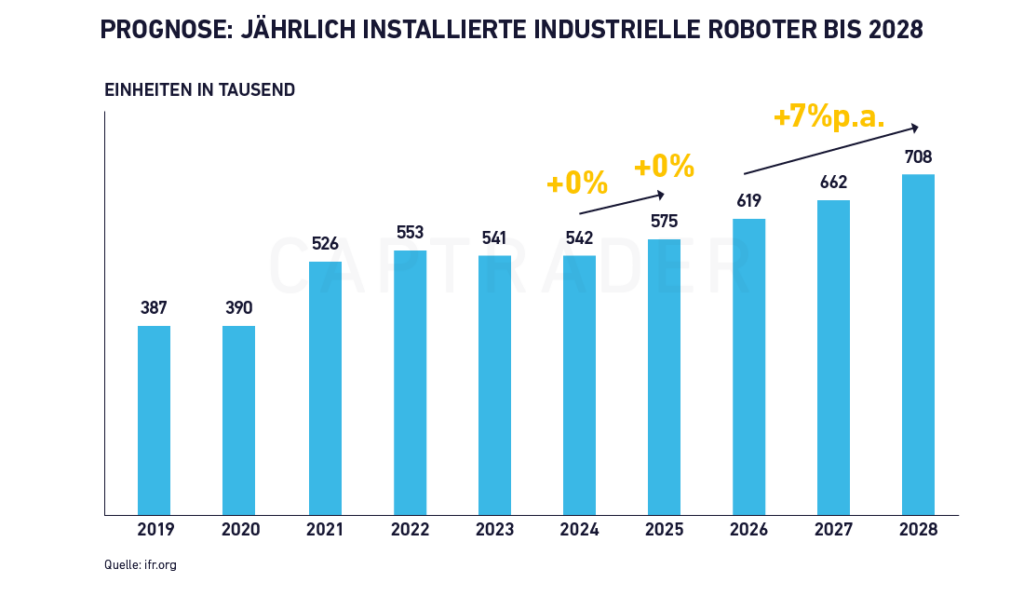
Shown are 542,000 installations in 2024, an expected 575,000 in 2025, and a forecast of 708,000 units by 2028. The chart visualizes the multi-year growth path of the market and supports the statement that robotics is a structurally growing segment with long-term expansion potential.
3. AI robotics opens up new application possibilities
AI robotics is likely to open up significantly more application areas in the coming years than traditional, fixed-programmed systems. The combination of adaptive algorithms, sensors, and automated decision-making makes robots more flexible, adaptable, and economically viable for a broader range of uses.
Of particular relevance is that AI robotics not only improves industrial applications, but also opens up new segments. These include collaborative robots, automated guided vehicles, cleaning robots, and social robots, which can be deployed much more effectively in dynamic environments than conventional machines.
Important future opportunities of AI robotics are:
- More autonomyIn the future, robots will be able to recognize, prioritize, and execute tasks more independently.
- Better adaptation to new environmentsAI facilitates deployment in changing production and service environments.
- New service areasIn addition to industry, cleaning, transport, care, and social assistance are gaining in importance.
- Collaborative useHumans and robots can work together more closely, for example in production or in logistical processes.
For investors, it is particularly important that this not only increases the number of use cases, but also the revenue potential for providers along the entire robotics value chain. The market is no longer growing solely in traditional industrial automation, but increasingly in service-oriented areas with high scalability.
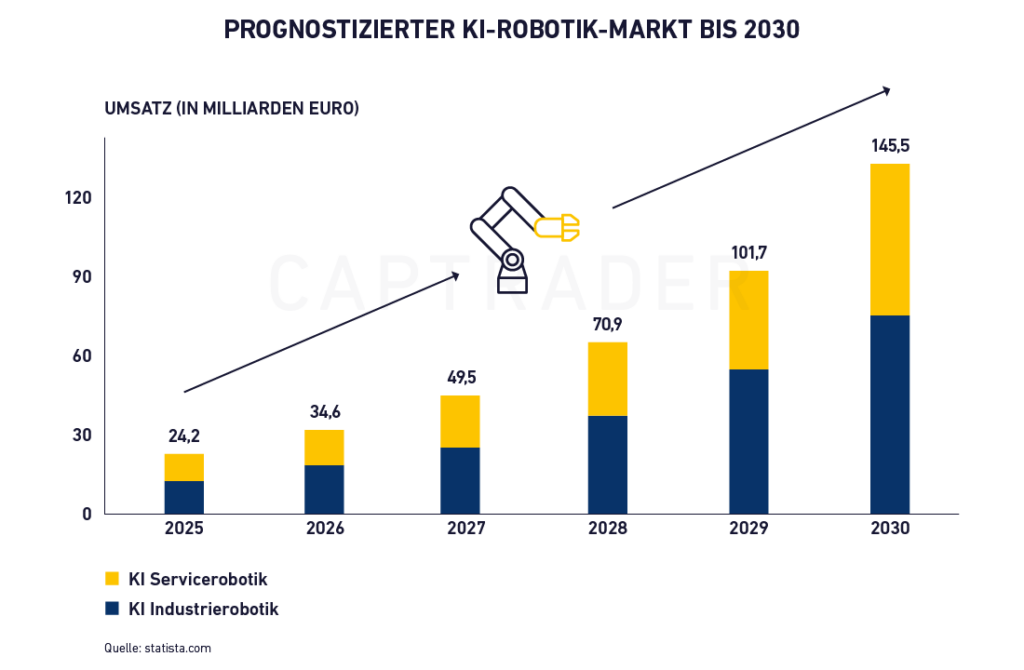
The chart shows that the AI robotics market will grow strongly in the coming years. According to Statista, estimated revenues will rise from around €24 billion in 2025 to around €146 billion in 2030, which is a factor of 6.
The best robotics stocks and robot stocks
The following overview presents a selection of the world's most significant publicly traded robotics stocks whose business models are closely linked to automation, robotics, artificial intelligence, and industrial technology.
| Company | ISIN | Country | Market capitalization in US dollars¹ |
| ABB Ltd. | CH0012221716 | Switzerland | 190 billion |
| Intuitive Surgical Inc. | US46120E6023 | USA | 149 billion |
| Keyence Corporation | JP3236200006 | Japan | 118 billion |
| Emerson Electric Co. | US2910111044 | USA | 77 billion |
| Teradyne Inc. | US8807701029 | USA | 56 billion |
| Rockwell Automation | US7739031091 | USA | 50 billion |
| Fanuc Corporation | JP3802400006 | Japan | 45 billion |
| Yaskawa Electric Corp. | JP3932000007 | Japan | 11 billion |
| Omron Corporation | JP3197800000 | Japan | 8 billion |
| Symbotic Inc. | US87151X1019 | USA | 6 billion |
To invest in stocks, you need a brokerage account. With CapTrader, you can easily open one and gain access to over 170 international stock exchanges. Trade now at attractive commission rates: for US stocks, you pay 1 cent per share, with a minimum of $2.00 per order.


1. Intuitive Surgical Inc.
Intuitive Surgical (ISIN: US46120E6023) is renowned for its pioneering work in robot-assisted surgery. The medical technology corporation is one of the industry leaders, and with its systems, it serves both minimally invasive multiport and single-port procedures.
The company keeps the value chain firmly in its own hands: from development in California and US manufacturing to the worldwide distribution of the da Vinci systems in more than 50 countries.
The flagship of the product range is the da Vinci 5: It scores with over 150 design optimizations and a drastically increased computing power compared to its predecessor, enabling surgeons to have a more precise haptic feel and perception in the OR.
| Tax year | estimated revenue (in millions USD)¹ | Change compared to previous year¹ |
| 2025 | 10.065 | 20,51 % |
| 2026 | 11.706 | 16,3 % |
| 2027 | 13.261 | 13,29 % |
2. ABB Ltd.
As a Swiss industrial heavyweight, ABB Ltd. (ISIN: CH0012221716) covers key areas of automation, electrification, and Industry 4.0 robotics.
The group's network extends across European and US plants and supplies customers in over 100 countries. Together with competitors such as Fanuc and KUKA, ABB leads the market for industrial robots and addresses strategic segments relating to digital infrastructure and power distribution.
In its strategy, ABB is placing industrial AI at the center to intelligently couple automation and electrification. Growth impulses are generated by the worldwide modernization of factories, the demand for energy-efficient technology, and the high-margin service business.
Due to this market position, the stock is a fixed component of numerous robotics ETFs and is considered by many investors to be a core investment in the sector.
| Tax year | estimated revenue (in millions USD)¹ | Change compared to previous year¹ |
| 2025 | 33.220 | 1,13 % |
| 2026 | 37.514 | 12,92 % |
| 2027 | 40.659 | 8,39 % |
CapTrader can do that:
At CapTrader, trading fees are extremely low: You can trade Swiss stocks starting at 0.10 % of the order volume, with a minimum of 15.00 CHF per order.
3. Keyence Corporation
Specialized in sensors, measuring systems, and machine vision for automated manufacturing, the Japanese company Keyence Corporation (ISIN: JP3236200006) has evolved into one of the most profitable players in factory automation.
Unlike traditional industrial corporations, Keyence relies on a highly efficient fabless model. Its own workforce focuses entirely on research, development, and direct sales in Japan and globally.
Specialized partners handle the manufacturing itself. Together with its competitor Cognex, Keyence dominates the market for robotics sensors through advanced image processing technology.
| Tax year | estimated revenue (in millions USD)¹ | Change compared to previous year¹ |
| 2025 | 6.606 | 9,5 % |
| 2026 | 7.292 | 10,4 % |
| 2027 | 8.292 | 13,71 % |
CapTrader can do that:
At CapTrader, trading fees are extremely low: You can trade Japanese stocks starting at 0.10 % of the order volume, with a minimum of 500 JPY per order.
4. Rockwell Automation
As an important pioneer in the digitalization of production chains, Rockwell Automation (ISIN: US7739031091) provides control technology and industrial networking solutions that contribute to increasing efficiency in modern factories.
Made in the USA, programmable logic controllers (PLCs) and automation software form the heart of the portfolio. These systems orchestrate robots and machinery across global manufacturing facilities, regardless of the manufacturer.
On the business front, Rockwell is increasingly shifting its focus toward software subscriptions, AI integration, and cost discipline. Supported by share buybacks, the group generates reliable cash flows.
Industry's continued investments in Industry 4.0 as well as a reliable Dividendenhistorie make the stock a solid value option for automation investors, which is why Rockwell is included in many industry-specific ETFs.
| Tax year | estimated revenue (in millions USD)¹ | Change compared to previous year¹ |
| 2025 | 8.342 | 0,94 % |
| 2026 | 8.960 | 7,41 % |
| 2027 | 9.444 | 5,4 % |
5. Symbotic Inc.
In the growth segment of logistics automation, Symbotic Inc. (ISIN: US87151X1019) has established itself as a specialist. With its AI-based platforms, the company aims to fundamentally transform warehouse processes and e-commerce supply chains.
As a system integrator, Symbotic delivers turnkey, extremely high-density storage systems ("high-density"). The interaction of its proprietary robot fleet and complex control software primarily targets large retail and e-commerce customers. In doing so, the group is sustainably changing processes in modern warehouse management.
Instead of rigid rack-based warehouses, Symbotic relies on high-density storage solutions whose AI-driven processes achieve a precision of over 99.99 %+. The company’s business performance benefits from the booming e-commerce sector, the push toward warehouse automation, and long-standing framework agreements worth billions with major retail groups.
| Tax year | estimated revenue (in millions USD)¹ | Change compared to previous year¹ |
| 2025 | 2.247 | 23,31 % |
| 2026 | 2.794 | 24,33 % |
| 2027 | 3.595 | 28,7 % |
CapTrader can do that:
At CapTrader, the trading fees are extremely low: you can trade US shares from as little as $ 0.01 per share (order minimum $ 2.00) and German shares from as little as 0.1 % of the order volume (order minimum €2.00), options from €2.00, futures from €1.00, ETFs from €2.00 and much more!
Risk Factors in Robotics Stocks: A Detailed Analysis for Investors
Robotics stocks offer you the opportunity to benefit from the development of one of the most dynamic technology markets. At the same time, they are heavily dependent on innovation pressure, investment cycles, and regulatory requirements, as well as supply chains, skilled labor shortages, and competition.
Likewise, cybersecurity, technological scalability, and positioning in high-growth markets play an important role.
1. Innovation pressure and cost structures in robotics stocks
The profitability of robotics stocks depends significantly on how efficiently they can translate research, development, and scaling into marketable products. Particularly in a technology-driven environment, high development costs, long product cycles, and price pressure from new competitors can weigh on margins.
In recent years, several factors have increased pressure on cost structures:
- High expenditures for research, software development, and AI integration.
- Additional investments in hardware, sensor technology, and computing power.
- Scaling effort for new applications before they achieve commercial success.
Even slight delays in market launch or weaker demand can quickly stall planned earnings improvements. For your analysis of robotics stocks, therefore, the research ratio, gross margin, scalability, and the share of recurring revenue are important benchmarks.
Good to know:
R&D-intensive robotics stocks often have to make high upfront investments before products become profitable across the board. The decisive factor is therefore whether innovation can also be translated into stable sales and reliable margins.
2. Structural change through regulation, ESG, and security
The robotics sector is increasingly the focus of new regulatory and societal requirements. In addition to sustainability, product safety, responsible AI use, and robust compliance structures are playing an increasingly important role today.
This results in several risk areas for robotics stocks:
- Additional investments in safety standards, transparency, and sustainable production processes.
- Risk of delays in the approval, certification, or scaling of new systems.
- Reputational and financial risks in the event of weak governance or an inadequate security architecture.
Companies that neglect these requirements risk rising capital costs, operational hurdles, or disadvantages when seeking inclusion in institutional portfolios. For you as an investor, it is therefore worthwhile to take a close look at security concepts, ESG strategy, and regulatory adaptability.
3. Investment cycles, demand, and economic risks
Robotics stocks are sensitive to investment readiness, financing costs, and the overall economic situation. Even though the structural trend toward automation remains intact, companies can postpone or stagger their investments in robotics during phases of economic uncertainty.
Typical risk drivers are:
- Declining willingness to invest in industry and logistics.
- Higher interest rates and stricter financing conditions for companies.
- Fluctuating demand in cyclical markets such as manufacturing or the consumer goods industry.
These factors can weigh on revenue growth and margins, even if the long-term prospects of the sector remain positive. For your investment decision, you should therefore not only consider the technological potential, but also include incoming orders, the customer structure, and the cyclicality of the key sales markets.
4. Supply chains, politics, and technological location risks
Many robotics stocks rely on global supply chains, specialized components, and stable frameworks in international trade. Disruptions in Semiconductor stocks, sensor technology, software infrastructure, or suppliers can therefore directly impact production, delivery capability, and costs.
Important risk factors are:
- Geopolitical tensions, sanctions, or new trade barriers.
- Dependencies on chips, sensors, and critical technology components.
- Safety and cyber risks from increasingly connected robotics systems.
Especially with regard to cloud-based control systems, AI models, and networked production environments, cybersecurity is becoming a key competitive factor. Therefore, always examine how robust a company's posture really is when it comes to supply chains, technology partners, and digital security architecture.
Conclusion: Are robotics stocks worth it?
Robotics stocks are expected to benefit from a long-term structured trend driven by a global shortage of skilled labor, AI technologies, and increasing automation pressure.
Industrial robot installations are projected to rise from 575,000 to 708,000 by 2028, and the AI robotics market could grow from €24 billion to €146 billion by 2030.
It is important that you also consider the risks. Higher development costs could pressure margins, and economic cycles could delay investments. Supply chain dependencies for semiconductors and sensors also represent a potential risk.
You should minimize risk through diversification, for example with a Core-satellite strategy. This allows the risk to be spread so that you can benefit from the long-term robotics trend.
If you are looking for further exciting investment options, the Aktiensparplan An excellent choice. With this, you continuously invest a fixed amount, for example in Dividend shares. The model can be applied flexibly and works for Automotive stocks just as well as in trendy areas like Crypto shares, Gold Stocks, Consumer stocks or AI shares.
List of sources:
(1) Source: Marketscreener from 06/06/2026
