


Travel and tourism stocks are benefiting from global trends such as increasing leisure consumption, digital booking culture, and the constant desire for international mobility. However, not every tourism stock is automatically a worthwhile investment. While some travel stocks have already seen significant price increases in recent years, other companies in the industry continue to offer attractive growth potential.
In this post, you will learn how the tourism stock market is developing, which companies are currently among the top tourism stocks, and what investors should pay attention to in order to benefit from the global wanderlust in the long term without taking unnecessary risks.

The most important facts in brief:
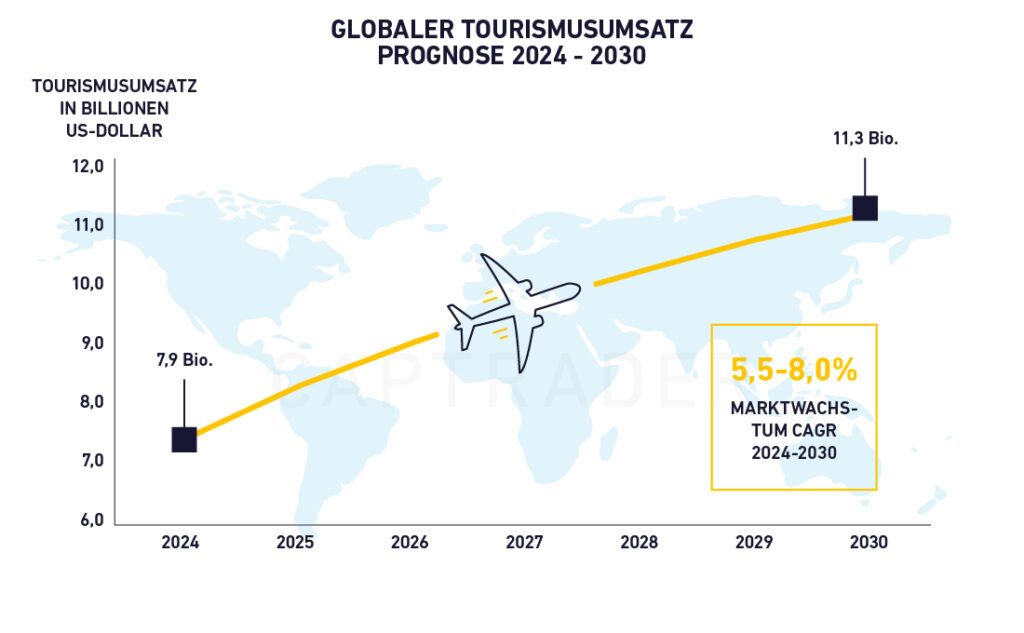
- The global tourism market is experiencing strong long-term growth and is expected to reach a volume of over 11 trillion US dollars by 2030.
- Travel and tourism stocks benefit from megatrends such as growing prosperity, focus on experiences, and the increasing digitalization of bookings.
- Key risks include economic cyclicality, political and regulatory interventions, cost inflation, and geopolitical and external shocks.
What are travel stocks?
Travel and tourism stocks are investments in companies operating in the tourism, leisure, transport, and hospitality sectors. This includes both traditional tour operators and digital providers setting new standards with online booking platforms, innovative business models, and sustainable travel offerings.
The industry is benefiting from megatrends such as growing global prosperity, a greater focus on experiences rather than possessions, and the increasing digitalization of travel offerings.
The tourism sector can be broadly divided into various groups: international tour operators with their own offerings, airlines and cruise providers, hotel and leisure providers with strong brands, and digital platform companies that efficiently manage booking, price comparison, and customer communication.
This diversity offers investors the opportunity to choose between solid dividend payers and growth-oriented tourism stocks.
Well-known publicly traded companies that are considered top tourism stocks and focus on different segments of the global travel market include:
- TUI AG (DE000TUAG505)One of Europe's largest integrated tourism groups with its own airline, hotel, and cruise businesses.
- Booking Holdings (US09857L1089)A global leader in online travel bookings with platforms such as Booking.com, Priceline, and Kayak.
- Carnival Corporation (PA1436583006)The world's largest cruise company, with brands like AIDA, Costa, and Princess Cruises.
- Marriott International (US5719032022)Global hotel giant with a broad portfolio of luxury to mid-scale brands.
- Expedia Group (US30212P3038)Major online travel provider with well-known platforms such as Expedia, Hotels.com, and Vrbo.
If you would first like to familiarize yourself with the basics of shares in general, our guide to Aktien für Anfänger an extensive introduction.


The market potential of travel stocks
The global travel market is undergoing a profound transformation. The predominantly seasonal, highly cyclical business characterized by traditional package tours is being replaced by a dynamic tourism industry shaped by megatrends such as growing prosperity, the digitization of booking channels, and changing travel habits.
Several long-term drivers are acting in parallel, making travel stocks an interesting but also challenging investment field. This diversity not only creates growth opportunities for top tourism stocks worldwide but also distributes risks across different segments such as airlines, hotels, cruise lines, and online platforms.
The most important structural developments include the following three mutually reinforcing trends:
1. Revival of global travel desire
The global tourism industry has made an impressive turnaround and is now on a robust expansion path. After the massive restrictions of recent years, the market has not only stabilized but has already reached a monumental volume of around USD 11.39 trillion in 2024.
This significant recovery highlights the sector's immense resilience and the unwavering importance of travel for the global economy. A sustainable upward trend is emerging for the coming decades: Experts Forecast continuous market growth through 2032/2035 at a compound annual growth rate (CAGR) of between 5.5 % and 8 %.
This positive development is significantly supported by the following factors:
- Massive need for catching upAfter the pandemic-induced forced break, a global trend of „travel at all costs“ is evident, with consumers prioritizing experiences and personal freedom.
- Growing middle class in AsiaIn particular, in countries like China and India, rising disposable income is leading to a whole new wave of travelers fueling the international market.
- Economic StabilizationDespite global uncertainties, the desire to travel remains a key consumer driver, further supported by ongoing digitalization and simplified booking processes.
- Structural ChangeThe market is moving away from pure package deals towards high-quality, individual experiences, which increases the overall value of the industry in the long term.
2. Cruise industry revenue boom
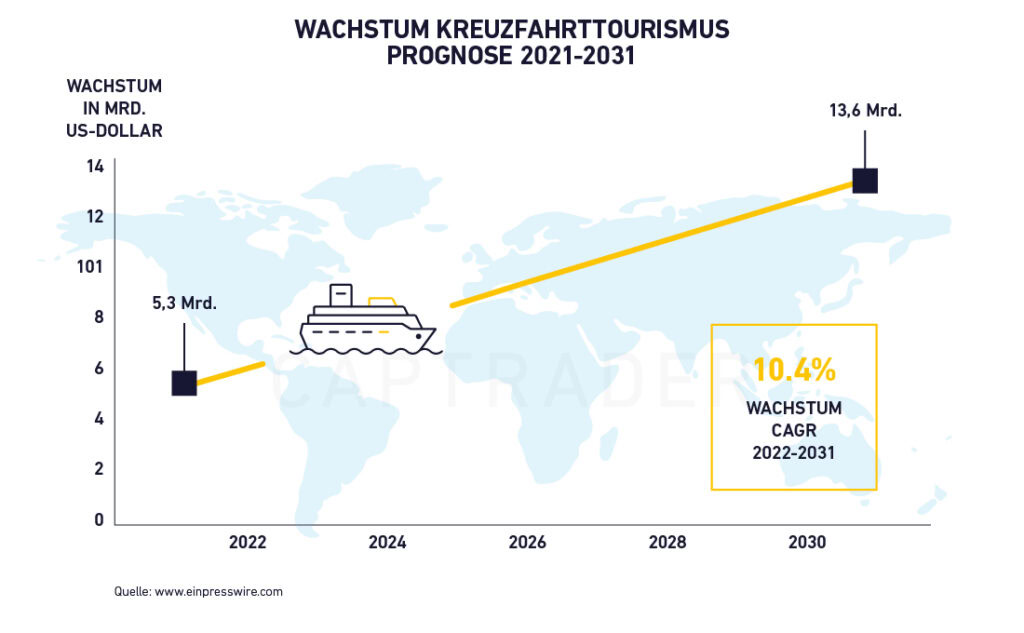
The cruise tourism market is gaining significant global importance and is expected to Forecasts increase from 5.3 billion U.S. dollars in 2021 to 13.6 billion U.S. dollars over a 10-year period, which corresponds to an annual growth rate of approximately 10 %.
North America currently represents the largest market, while Europe is considered to be particularly strong in terms of growth in the coming years. Classic ocean cruises are in high demand, already making up the largest share and also considered the most dynamic segment.
7-day routes are particularly popular, as they can be easily combined with city breaks, thus offering an alternative to individual long-distance trips. The age structure is dominated by 40- to 49-year-olds, but the strongest growth is expected among 30- to 39-year-olds, indicating that cruises are increasingly being perceived as a modern form of combined city break and long-distance travel.
3. Digitalization and Platform Economy
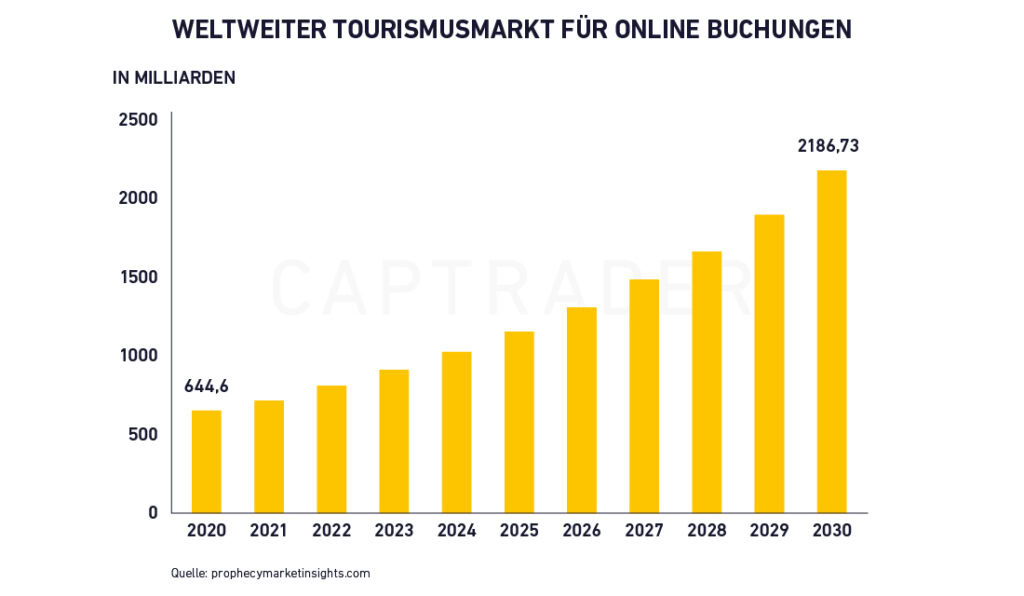
Digitalization has evolved from a supplementary channel to one of the central growth drivers in the travel market. The global online travel booking market is expected to grow according to Forecasts grow to over 2,180 billion U.S. dollars by 2030, which corresponds to an annual growth rate of approximately 13 %.
Online travel platforms, meta-search engines, and booking apps now cover almost the entire customer journey. From initial inspiration through price comparison to booking and payment.
For investors, this means that, in addition to traditional travel and tourism stocks, digital platform companies in particular offer exciting opportunities, as they can strategically control user flows, data, and margins.
Key aspects of this trend at a glance:
- Strongly growing online market: Projected growth from approximately 645 billion U.S. dollars (2020) to over 2.18 trillion U.S. dollars (2030), with a CAGR of about 13 %.
- Increasing online shareThe digital booking share of the total travel market is continuously increasing, as transparency, convenience, and personalized offers are becoming increasingly important.
- Mobile FirstA large portion of the growth comes from mobile bookings; many users now plan and book trips directly through apps.
- Platform dominanceMarket leaders like Booking Holdings, Expedia, Airbnb, and Trip.com bundle enormous reach and achieve economies of scale in marketing and technology.
- Asset-light structureMany of these companies benefit from the tourism boom without owning their own planes, hotels, or ships. This reduces capital commitment and increases scalability.
Three key risks for travel and tourism stocks
Despite the attractive growth story, the travel market remains a challenging investment area with clear risk factors that investors in travel and tourism stocks should be aware of.
The industry is highly cyclical, sensitive to geopolitical developments, cost increases, and changing consumer behavior, and can therefore fluctuate much more sharply in times of crisis than defensive sectors.
The three most important risks can be divided into four central categories, each with a different impact on tourism stocks worldwide:
Regulatory and political interventions
Travel and tourism companies operate in an environment heavily influenced by politics, regulation, and international relations. Many measures have short-term effects, making planning and calculation difficult. Even healthy business models can come under immense pressure within a short period because of this.
Key levers in this regard are:
- Travel advice and warningsStrict warnings often cause demand in affected countries to plummet by double digits.
- Visa Regulations and Border ControlMore complex entry requirements dampen the willingness to travel and cause billions in losses for the tourism industry.
- Climate protection regulations and carbon pricingTicket fees, emissions trading, or kerosene taxes make flights more expensive and change routes and frequencies.
- Consumer protection rulesExtended compensation and cancellation rights increase costs and liability risks for airlines and tour operators.
Geopolitical tensions, sanctions, and regional conflicts further amplify these risks through airspace closures, rerouting, and increased security and insurance costs.
For investors in travel and tourism stocks, this means that political and regulatory factors are a central risk driver that can directly impact occupancy rates, margins, and valuations.
Volatility of demand, costs, and prices
Tourism is a classic cyclical sector and reacts strongly to economic cycles, purchasing power, and sentiment. During periods of economic uncertainty or high inflation, many households postpone trips, shorten stays, or switch to cheaper destinations, while discretionary spending such as long-haul travel and short breaks is disproportionately cut.
The risks for travel and tourism stocks can be well summarized in bullet points:
- Demand cyclicalityDeclines in income and consumer confidence lead to fewer or cheaper trips at an above-average rate.
- External shocksConflicts, terrorism, pandemics, or natural disasters can cause bookings in certain regions to plummet abruptly and trigger price drops.
- Cost inflationRising energy, personnel, food, and insurance costs make flights, hotels, and services more expensive and squeeze margins if prices cannot be fully passed on.
For travel stocks, this combination of demand fluctuation and cost volatility means an increased risk of short-term earnings and stock price swings, even in long-term growing markets.
3. Competition and Structural Change
The tourism market is undergoing structural changes: digital platforms, direct bookings with airlines and hotels, sharing models like vacation rentals, and new forms of travel are increasingly putting pressure on traditional package tour operators.
Companies that are slow to adopt digitalization, personalized offers, and omnichannel strategies risk losing market share to agile online players and specialized niche providers.
In addition, the growing focus on sustainability and climate protection is changing the rules of the game: suppliers with high emissions, little transparency, or lacking adaptation strategies are facing increasing regulatory and societal pressure.
For investors in travel and tourism stocks, this means that competitive position, innovation strength, and ESG strategy are central criteria for stock selection in order to distinguish long-term value drivers from potential losers of structural change.


Top Tourism Stocks by Market Capitalization
This section focuses on the top seven largest tourism stocks, ranked by market capitalization and therefore their significance in the capital market.
| Company | ISIN | Country | Market capitalization in US dollars | Dividend yield |
| Booking Holdings | US09857L1089 | USA | 134 | 0,72 % |
| Airbnb | US0090661010 | USA | 133 | no dividend |
| Marriott International | US5719032022 | USA | 90 | 0,85 % |
| Royal Caribbean Cruises | LR0008862868 | USA | 84 | 1,52 % |
| Hilton Worldwide | US43300A2033 | USA | 81 | 0,21 % |
| Carnival Corporation | PA1436583006 | USA | 43 | no dividend |
| Trip.com Group | US89677Q1076 | USA | 34 | 0,52 % |
Before you select individual shares, you first need a securities account. How to set up a securities account step by step Open an account, you can find out in CapTrader's detailed guide.
One proven approach is the Core Satellite Strategy, with stable quality values forming the core and high-growth stocks added as satellites. This strategy can be used not only in energy stocks but also in other sectors, such as Bank stocks, Oil shares or Consumer Goods Shares be applied.
Four interesting travel stocks with growth potential in 2026
The following presents 4 interesting travel and tourism stocks with exciting growth potential from an investor's perspective for the year 2026, without this being an investment recommendation or advice.
Booking Holdings (US09857L1089)
Booking Holdings is one of the most significant travel and tourism stocks worldwide and is a central player in the global online travel market. The group bundles several well-known platforms for hotels, vacation rentals, flights, rental cars, and travel comparison, thus benefiting directly from the ongoing digitalization of the tourism industry.
- business modelGlobally oriented online travel platform offering accommodation bookings, transportation services, and ancillary travel services through a commission and transaction-based model. Strategic focus on integrated travel chains („Connected Trip“), fintech solutions for payments and protection, and the expansion of alternative accommodations such as apartments and vacation rentals.
- Core customersPrivate and business travelers who plan, compare, and book their trips conveniently online or via app. In addition, hotels, guesthouses, vacation rental providers, and other accommodations gain additional visibility, occupancy, and international reach through the platform.
- USPStrong brand presence and high recognition, particularly of Booking.com in many core markets. As well as distinct technology and data expertise, for example through the use of AI, personalized recommendations, and dynamic pricing to optimize user experience and conversion rates.
As a tourism stock, Booking Holdings is directly involved in the growth of the online travel market, reflecting the shift from traditional travel agencies to digital platforms.
For investors, the stock can be understood as a lever on this structural trend, but it remains subject to typical risks. These include intense competition, regulatory requirements, and cyclical travel activity; this is not investment advice, but a neutral company description.
| Tax year | Estimated revenue (in millions) | Change compared to previous year |
| 2025 | 26.917 $ | +13,39 % |
| 2026 | 29.916 $ | +11,14 % |
| 2027 | 32.476 $ | +8,56 % |
2. TUI AG (DE000TUAG505)
TUI is one of the best-known travel and tourism stocks in Europe and is among the world's leading integrated tourism groups. The company combines tour operators, its own airlines, hotels, clubs, and cruise ships under one roof, thus covering large parts of the tourism value chain.
- business modelIntegrated travel group focusing on package tours, hotels & resorts, cruises, as well as excursions and activities at the destination. In addition, the combination of classic tour operator business, its own airline operations, and a growing platform approach, where additional products and experiences are offered via a central, digital ecosystem.
- Core customersHoliday travelers from Europe and select international markets who prefer all-inclusive packages with flights, hotels, transfers, and activities. Also, loyal customers who value predictable quality, well-known brands, and a consistently organized travel itinerary.
- USPHigh degree of integration with its own fleet, own hotels, and cruise ships, enabling TUI to control large parts of the customer journey from a single source. In addition, a strong brand position in key source markets, as well as the strategic expansion of a scalable, platform-based holiday marketplace, which is intended to unlock additional products and margin potential.
As a tourism stock, TUI offers a direct lever on demand for package holidays, holiday hotels, and cruises, and particularly benefits from a stable or growing booking environment in Europe. At the same time, the business model is susceptible to economic cycles and costs, for example, through energy prices, competition, and geopolitical influences; the presentation is for informational purposes only and does not constitute investment advice.
| Tax year | Estimated revenue (in millions) | Change compared to previous year |
| 2025 | 24.179 € / 28.262 $ | +4,37 % |
| 2026 | 24.696 € / 28.867 $ | +2,14 % |
| 2027 | 25.417 € / 29.709 $ | +2,92 % |
3. Trip.com Group Ltd. (US89677Q1076)
Trip.com Group is an internationally operating online travel platform and is considered one of the key digital players in the travel and tourism sector in Asia. The company operates several brands and platforms for flight, hotel, and rail bookings, as well as package tours, thereby appealing to both domestic and international travelers.
- business modelFully integrated online travel platform focusing on flights, hotels, trains, rental cars, and package tours, generating revenue primarily through commission and transaction-based models. Additionally, the emphasis is on technology, including AI-powered travel planning tools, personalized recommendations, and dynamic pricing to optimize the booking experience and conversion rates.
- Core customersPrivate and business travelers, especially from China and the Asia-Pacific region, who plan and book trips digitally. As well as hotels, airlines, and other travel providers that gain international visibility and additional demand through the Trip.com network.
- USPStrong position in the Asian travel market with a growing international focus and multiple well-known brands under one roof. In addition, high technology and platform expertise, such as AI-based travel planners and recommendation systems, as well as strategic partnerships with destinations and tourism organizations.
As a travel and tourism stock, Trip.com Group offers leverage on the structural growth of the Asian and global online travel market, benefiting from increasing travel intensity and the shift towards digital bookings. At the same time, risks exist, such as regulation in the home market, competition, geopolitical influences, and cyclical travel activity; the description is for informational purposes only and does not constitute investment advice.
| Tax year | Estimated revenue (in millions) | Change compared to previous year |
| 2025 | 62,409 CNY / 9,038 $ | +17,10 % |
| 2026 | 70,745 CNY / 10,245 $ | +13,36 % |
| 2027 | 79,484 CNY / 11,511 $ | +12,35 % |
4. Airbnb Inc. (US0090661010)
Airbnb is one of the pioneering stocks in travel and tourism and has sustainably changed global tourism with its platform for alternative accommodations. The company connects hosts and travelers worldwide, covering a broad spectrum of vacation rentals, private rooms, unique accommodations, and experiences.
- business modelAsset-light platform connecting landlords and guests through a commission-based two-sided marketplace model, focusing on short- and long-term accommodations, as well as bookings for experiences and activities. In addition, the strategic expansion of AI-powered tools for personalized recommendations, dynamic pricing, guest reviews, and seamless booking processes.
- Core customersTravelers seeking flexible, local, and affordable alternatives to hotels, including families, digital nomads, and experience-seeking travelers. Additionally, private and commercial landlords who generate visibility, bookings, and income for their accommodations through the platform.
- USPEnormous network effects from millions of listings and users in almost all countries, combined with a strong brand position as a synonym for „peer-to-peer accommodation.“ The asset-light structure also enables high scalability without owning real estate and a focus on alternative travel forms such as long-term stays and experiences.
As a tourism stock, Airbnb offers leverage on the trend towards flexible, local, and digitally booked accommodations and benefits from increasing travel intensity and diversification beyond traditional hotels. At the same time, risks exist from regulation, competition, cyclical demand, and platform-specific challenges; the description is for informational purposes only and not an investment recommendation.
| Tax year | Estimated revenue (in millions) | Change compared to previous year |
| 2025 | 12.241 $ | +10,26 % |
| 2026 | 13.692 $ | +11,86 % |
| 2027 | 15.065 $ | +10,03 % |
Performance of the 11 most important travel and tourism stocks
Below you will find a detailed overview of the most important players. To show you the most profitable investment trends, we have sorted the list according to their market efficiency.
Here are the top tourism stocks, ranked by their year-to-date performance. The strongest price growth is a robust +21.1 % over the past year.
| Rank | Company | Course (approx.) | 1 year | Focus |
| 1 | Carnival Corp. | 29,15 $ | +12,1 % | World's largest cruise line operator |
| 2 | Royal Caribbean | 300,75 $ | +11,7 % | Cruises (Luxury & Mass) |
| 3 | Marriott | 330,26 $ | +7,3 % | Hotels (Premium Segment) |
| 4 | TUI | 7,46 € | +6,4 % | Tour Operators, Hotels & Ships |
| 5 | Hilton Worldwide | 304,81 $ | +4,2 % | Hotels (Franchise Growth) |
| 6 | United Airlines | 103,10 $ | +1,0 % | US Airline (Growth) |
| 7 | Expedia Group | 213,24 $ | -1,1 % | Online Travel Portal (US Focus) |
| 8 | Delta Air Lines | 64,25 $ | -1,6 % | Airline (Premium Focus) |
| 9 | Airbnb | 133,14 $ | -14,8 % | Private accommodations & experiences |
| 10 | Trip.com Group | 51,44 $ | -21,9 % | Online Travel (Focus Asia) |
| 11 | Booking Holdings | 4.177,00 $ | -24,3 % | Online Travel Portal (Worldwide) |
A proven approach is to Core-satellite strategyShe combines a solid core of reliable quality stocks with riskier growth stocks as a supplement. This approach is excellent not only for tourism stocks but also for sectors such as Banks, Oil or Konsumgüter.
CapTrader can do that:
To invest in the best travel stocks, you first need a brokerage account with access to major international stock exchanges. At CapTrader, trading fees are extremely low: You can trade U.S. stocks starting at $ 0.01 per share (minimum order $ 2.00) and German stocks starting at 0.1 % of the order volume (minimum order 2.00 €), options starting at 2.00 €, futures starting at 1.00 €, ETFs starting at 2.00 €, and much more!


Conclusion: Is it worth investing in travel and tourism stocks?
As an investor, travel and tourism stocks offer you the chance to benefit directly from the globally growing desire to travel, rising incomes, and the industry's ongoing digitalization.
Megatrends like online bookings, sustainable travel offerings, cruises, and the expansion of alternative accommodations mean that many tourism stocks possess structural growth potential.
At the same time, the industry remains dependent on economic trends and events. Political decisions, geopolitical tensions, regulation, cost inflation, and external shocks such as crises or natural disasters can significantly influence prices and profits in the short term.
Therefore, those who include travel and tourism stocks in their portfolio should diversify broadly, carefully examine business models and risks, and only invest with an amount that matches their personal risk tolerance. Ideally, it should be integrated into an overarching investment strategy and be held in a low-cost securities account, as is available at CapTrader.
