Your Broker for worldwide trading

SPX or SPY? Why the exercise method determines your risk

Those who trade the S&P 500 with options have a choice between the index (SPX) and the ETF (SPY). Most people make this decision based on contract size: the SPX is about ten times larger than the SPY, so they take what fits their portfolio.

This is the second most important difference. The most important is what happens on expiration day. Because SPX and SPY differ in the type of exercise and the type of settlement, and both together determine what risks you as an option writer actually bear. Those who confuse this may potentially have a position in their portfolio on Monday morning that they did not expect.

Two terms that are often confused

Type of exercise: American options can be exercised by the buyer at any time during their term. European options can only be exercised on the expiration date. This has nothing to do with the trading venue; it is purely a contract specification.

Billing type: In case of physical delivery, ownership of the underlying asset changes, meaning 100 shares or ETF units per contract. In the case of Cash Settlement only the difference between the settlement price and the strike price flows in cash.

In practice, the combinations usually occur together, but they are two separate questions. The overview for the S&P 500: brig.
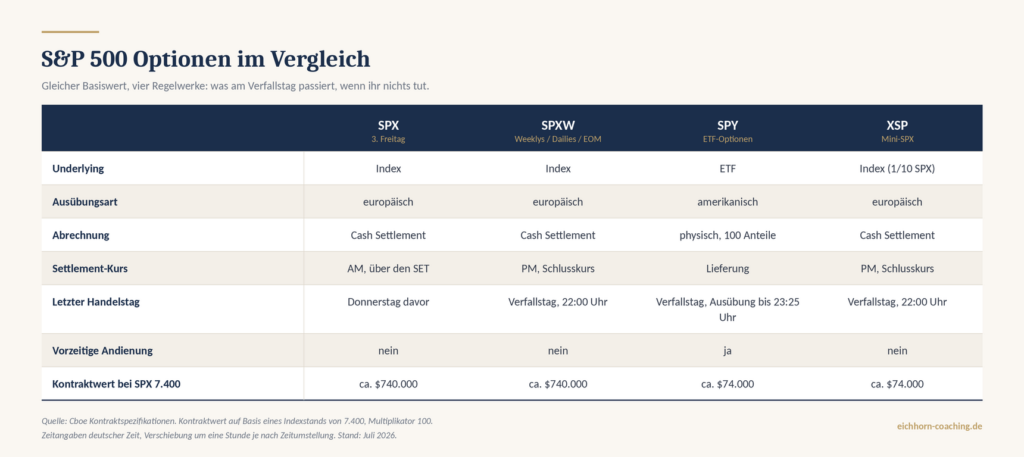
Now for what follows.

SPY: American, physical, available at any time

SPY options are standard ETF options. They can be exercised at any time, and the holder who receives the exercise notice will have 100 shares in their portfolio. With the SPY price at 740, that amounts to approximately $74,000 per contract.

Early exercise only makes sense for the buyer if the option is in the money and has little time value left. Because whoever exercises forfeits the time value. This is precisely why early exercise is not a random event, but is highly predictable in two situations.

The Dividend Trap

SPY pays dividends quarterly. For the second quarter of 2026, the dividend was $1.90 per share; the ex-dividend date was June 18—the Thursday immediately preceding the major June expiration. The next ex-date is September 18, again immediately before the quarterly expiration. That’s no coincidence—it’s by design.

A short call that has become in-the-money and whose time value is less than the dividend will most likely be exercised on the evening before the ex-dividend date. Example calculation: SPY is trading at 740; you are short the 730 call, with an intrinsic value of $10 and a time value of $0.40. The dividend is $1.90. The call holder forfeits $40 in time value and collects $190 in dividends. The decision is trivial.

You will then have 100 shares posted at 730 short, and you’ll also owe the dividend from $190 because you were short the stock on the ex-dividend date. Anyone who isn’t aware of this will be surprised to see a charge that doesn’t appear on any options statement.

The rule against it is simple: for short calls on the SPY that have four ex-dividend dates a year on the calendar. If the remaining time value of your short call is below the announced dividend, you close or roll beforehand. Out-of-the-money strikes are unproblematic because time value dominates there.

After-hours exercise

The second scenario concerns the expiration date itself. U.S. trading closes at 10:00 p.m. German time, but options can still be exercised well past that time—until around 11:25 p.m. at Interactive Brokers and, consequently, via CapTrader as well. During this time window, you can no longer take any action, but the buyer can.

The scenario that costs the most money is a spread. Suppose you’re holding a bear call spread on SPY: short 745, long 750. At 10:00 p.m., SPY is trading at 741; both legs are out of the money, and the trade looks like it will yield a nice profit. After the market closes, news breaks and SPY jumps to 748. The buyer of the 745 call exercises it, while the 750 call remains worthless.

Result: You are short 100 shares in your portfolio, unhedged, over the weekend. The spread had a defined risk of $500; the naked short position no longer has any.

Therefore, the following applies to all active trading structures, that is, Bear Call Spreads, Iron Condors, Butterflies: Close them out actively before expiration. That last percentage point of remaining premium isn’t worth the risk. With a cash-secured put, where you want the shares anyway, the exercise is not a problem but rather the plan. How an exercise works technically and where you trigger it in Trader Workstation is explained in the overview of the Exercise of options summarized.

Pin Risk

If the underlying asset closes exactly or nearly exactly at your strike price on the expiration date, the buyer has a real choice. You won’t find out until Monday what decision they’ve made. Anyone who has a short option on Friday evening that’s within a few cents of the strike price should close it out, no matter how little time value it has left.

SPX: European, cash-settled, but not risk-free

With SPX options, all three of the problems mentioned above are eliminated. There is no underlying asset that could be delivered, so there is no delivery, no dividend trap, and no naked equity position on Monday morning. Options can only be exercised on expiration, and the difference is settled in cash with a multiplier of 100.

This is a real structural advantage and the main reason why many option sellers stick with index options. However, there is a trap, and it is more expensive than anything SPY has to offer.

AM Settlement for Standard Options

Classic SPX options that expire on the third Friday are settled in the morning. The settlement price is called SET and is calculated based on the opening prices of all 500 index components on Friday morning. The last trading day is the Thursday before.

This means you have one night during which your position remains active, but you can no longer trade it.

Example: The SPX closes at 7,400 on Thursday. You’re short the 7,450 call—50 points out of the money—and assume the matter is settled. Overnight, news breaks; the market opens higher, and the SET is quoted at 7,520. Your option is 70 points in the money, resulting in a loss of $7,000 per contract. You were unable to trade during this period.

There’s also a technical detail that’s often overlooked: The SET is not the index’s opening level that you see on the screen. It’s calculated based on the first trading prices of each individual stock, and those don’t all open at the same time. As a result, the SET can differ significantly from any index value displayed that morning. On days with large imbalances in buy and sell orders, its calculation may also be delayed.

SPXW is the clear-cut case

All weekly contracts, all daily expiries, and end-of-month options trade under the ticker symbol SPXW and are settled PM—that is, based on the closing price at 10:00 p.m. on the expiration date. Expiring SPXW contracts are traded until 10:00 p.m.; after that, the matter is settled. No overnight risk, no further exercise, no surprises.

For the vast majority of option holders, this is the more appropriate series. It’s important to note that even during the week of the third Friday, both variants coexist. If you want PM settlement, you must explicitly select SPXW there.

In TWS, you can tell the difference by the trading class in the contract details. It's worth consciously checking this once before you open a position you want to hold until expiration. The option chain displays both series with identical strikes and identical expiration dates.

A note on size

An SPX contract with an index level of 7,400 corresponds to a contract value of approximately $740,000. For a fully collateralized short put, this is an order of magnitude that many investment accounts cannot accommodate. If you want to take advantage of European-style exercise and cash settlement without taking on this position size, you can look into XSP. These are mini-SPX options that are one-tenth the size—meaning they’re on the same scale as SPY—but are European-style and cash-settled. Liquidity is significantly lower than for SPX or SPY, so you should check this in the order book beforehand.

Tax-wise, it's also not the same.

When you exercise an option in SPY, you exit the world of futures trading and end up with the stock position in your portfolio. The option premium and the subsequent sale of the shares are treated separately. With SPX and SPXW, everything remains a futures transaction because no securities ever change hands.

A Practical Summary

  • Before each position, make sure that you SPX, SPXW, SPY, or XSP . Same underlying asset, four different sets of rules.
  • SPY-Short-Calls: know the four ex-dividend days per year. Remaining time value below dividend means exercise.
  • Close any active trading positions on SPY before expiration; do not let them expire. Between 10:00 p.m. and 11:25 p.m., you will no longer be able to make any adjustments.
  • SPX expires on the third Friday: the last trading day is Thursday, and settlement takes place via the SET on Friday morning. If you want to avoid overnight risk, choose SPXW.
  • Short options that are close to the strike price on the expiration date should be closed out. Always.
  • The times will shift by one hour if the U.S. and Europe do not switch to daylight saving time at the same time.

Conclusion

The question isn't whether SPX or SPY is better. Both products are cleanly constructed and intended for different portfolio sizes and strategies. The question is whether you know what happens to your position on expiration day if you do nothing.

With SPY, this could be a stock position you didn't want, including dividend obligations. With SPX, it could be a cash settlement at a price determined at a time when you could no longer trade. Both are manageable, but only if you know about them beforehand, not afterward.

Our own consequence from this: Trading positions generally do not run to expiration with us. They are closed beforehand. The last remaining premium is the most expensive there is.

Video: Important Details on Options Settlement | Practical Example SPX, SPXW, SPY | Alexander Eichhorn

You are currently viewing placeholder content from Youtube. To access the actual content, click the button below. Please note that doing so will share data with third-party providers.

More Information

A man with a shaved head and a short beard, wearing a black t-shirt, stands in front of a neutral gray background. He looks at the camera and smiles slightly, exuding the calm confidence often seen in experienced speakers.
Alexander Eichhorn

Alexander Eichhorn is the founder of Eichhorn Coaching and full-time trader and investor. His educational activities focus on providing optimal support for clients with large accounts. He also shows options traders how to get started quickly with profitable options trading through numerous blog articles and regularly publishes analyses and tips on the Eichhorn Coaching YouTube channel and in his monthly webinar series at CapTrader.

Mandatory information and disclaimer

This is a marketing communication within the meaning of Section 63 (6) of the German Securities Trading Act and does not contain investment strategy recommendations, investment recommendations or financial analyses in accordance with Section 85 of the German Securities Trading Act and Article 20 of the Market Abuse Regulation. It therefore does not fulfill the legal requirements to guarantee the objectivity of investment strategy recommendations/investment recommendations/financial analyses. CapTrader GmbH or its employees are therefore not legally prohibited from trading or providing services in the securities products mentioned therein prior to publication of the information.

Past performance, simulations or forecasts are not a reliable indicator of future performance. Mandatory information and limitation of liability for CapTrader and any third-party content providers can be found at https://www.captrader.com/marketingmitteilung/angaben
Please note that investing in financial instruments involves high risks and take note of our disclaimer and the mandatory legal information at the locations indicated.

  1. Mandatory information

Responsible: CapTrader GmbH, Elberfelder Straße 2, 40213 Düsseldorf; Commercial Register Number: HRB 86537 Düsseldorf Local Court; VAT ID DE323771603; Managing Directors Andreas Weiß, Christian Weiß, Michael Heyder; Tel: +49 211-740786-00, Fax: +49 211-740786-90.

Zuständige Aufsichtsbehörde: Bundesanstalt für Finanzdienstleistungsaufsicht, Graurheindorfer Straße 108, D – 53117 Bonn und Marie-Curie-Str. 24-28 D – 60439 Frankfurt am Main, Tel: 0228 4108 – 0 Fax: 0228 4108 1550 E-Mail: poststelle@bafin.de; Institutsnummer 10156708

Conflicts of interest CapTrader in marketing communications: CapTrader GmbH confirms that it does not hold any positions in the mentioned financial instruments beyond the positions mentioned in the marketing communication itself, if applicable. There are also no other conflicts of interest within the meaning of CapTrader GmbH's Financial Analysis and Marketing Communication Policy.

Conflicts of interest and mandatory disclosures by the third-party content provider for marketing communications with financial instrument recommendations: See under https://www.captrader.com/marketingmitteilung/angaben  to creators of third-party content

The copyright to the marketing communication is reserved. Reprinting and distribution is only permitted with our consent.

  1. Disclaimer

By accepting the content, the recipient accepts the binding nature of the limitation of liability.

a) Disclaimer for third-party content

CapTrader GmbH offers authors - such as editors, guest commentators, agencies and companies - the opportunity to publish comments, analyses, news and company announcements. Their opinions do not necessarily reflect the opinions and views of CapTrader GmbH and its employees. CapTrader GmbH assumes neither liability nor guarantee for this content. This applies in particular to incomplete or incorrectly reproduced reports, incorrect price information and editorial errors. Liability claims relating to material or immaterial damage caused by the use or non-use of the published information or by the use of incorrect or incomplete information are fundamentally excluded.

b) Exclusion of liability for CapTrader's own content

CapTrader has taken its own information in this marketing communication from sources believed to be reliable, but has not verified all such information itself. Accordingly, CapTrader makes no warranties or representations as to the accuracy, completeness or correctness of the information or opinions contained herein. Subsequent changes cannot be taken into account. The marketing communication does not constitute an offer or solicitation to buy shares of the issuer and is in no way a substitute for advice appropriate to the investor and the property. We cannot verify whether the information in the marketing communication is in line with your personal investment strategies and objectives. We recommend that you consult an investment advisor for advice that is appropriate to the investor and the property. The marketing communication cannot and should not replace a securities prospectus and/or expert investment advice required for an investment. It can therefore never be the sole basis for an investment decision. By accepting the marketing communication, the recipient accepts the binding nature of the above limitation of liability.

CapTrader provides the information despite careful procurement and provision only without guarantee for the correctness / completeness, timeliness or accuracy and availability of the stock exchange and economic information, prices, rates, indices, general market data, valuations, assessments and other accessible content held and displayed for retrieval. This also applies to third-party content. Historical observations and forecasts are not a reliable indicator of future developments. The facts presented in particular in connection with product information are for illustrative purposes only and do not permit any statements to be made about future profits or losses. Any conditions stated are to be understood as non-binding indications and are dependent on market developments on the day of conclusion.

CapTrader accepts no liability for any direct or indirect damage caused by and/or related to the distribution and/or use of this marketing communication.

The information, opinions and statements correspond to the status at the time of preparation of the marketing communication. They may be outdated due to future developments without the publication being changed.

CapTrader is not obliged to update, amend or supplement the information in this marketing communication if a circumstance mentioned in this publication or a statement, estimate or forecast contained therein changes or becomes inaccurate. The presentation of the performance of financial instruments over previous periods does not provide a reliable indication of their future performance. No guarantee can therefore be given for the future price, value or income of any financial instrument mentioned in this publication.

Despite careful control of the content, we assume no liability for the content of external links. The operators of the linked pages are solely responsible for their content.

Distribution: This publication may only be distributed in accordance with the laws of the respective countries, and persons in possession of this publication should inform themselves about the applicable local regulations. The information contained herein is not intended for natural or legal persons who, due to their place of residence or business, are subject to a foreign legal system that imposes restrictions on the distribution of such information. The contents are therefore exclusively in German. In particular, this publication contains neither an offer nor an invitation to purchase securities to citizens of the USA, Great Britain and Australia.

Taxes: The tax treatment of financial instruments depends on the personal circumstances of the respective investor and may be subject to future changes, which may also have a retroactive effect.

Historical observations and forecasts are not a reliable indicator of future developments. The facts presented in particular in connection with product information are for illustrative purposes only and do not permit any statements to be made about future profits or losses. Any conditions stated are to be understood as non-binding indications and are dependent on market developments on the day of conclusion.

CapTrader accepts no liability for direct or indirect damage caused by and/or in connection with the distribution and/or use.

The information, opinions and statements correspond to the status at the time of preparation of the marketing communication. They may be outdated due to future developments without the publication being changed.

CapTrader is not obliged to update, amend or supplement the information if a circumstance mentioned in this publication or a statement, estimate or forecast contained therein changes or becomes inaccurate. The presentation of the performance of financial instruments over previous periods does not provide a reliable indication of their future performance. No guarantee can therefore be given for the future price, value or income of any financial instrument mentioned in this publication.

Despite careful control of the content, we assume no liability for the content of external links. The operators of the linked pages are solely responsible for their content.

Distribution: This publication may only be distributed in accordance with the laws of the respective countries, and persons in possession of this publication should inform themselves about the applicable local regulations. The information contained herein is not intended for natural or legal persons who, due to their place of residence or business, are subject to a foreign legal system that imposes restrictions on the distribution of such information. The contents are therefore exclusively in German. In particular, this publication contains neither an offer nor an invitation to purchase securities to citizens of the USA, Great Britain and Australia.

Taxes: The tax treatment of financial instruments depends on the personal circumstances of the respective investor and may be subject to future changes, which may also have a retroactive effect.

Email:

info@captrader.com

Send e-mail

Phone:

Hotline (Germany)
0800-8723370

Hotline (International)
00800-08723370

Further contact options