Cash settlement, also known as cash settlement, is a settlement procedure for forward transactions such as Futures and Options. Instead of a physical delivery, for example of shares, cash settlement involves the transfer of an amount of money. In this blog post, you can find out which products can be cash settled and which important points options traders should bear in mind.
What is cash settlement? Definition of cash settlement
Cash settlement, also known as cash settlement, is a settlement procedure in the financial market in which financial obligations are fulfilled by a cash payment instead of the transfer of physical assets. This means that in the case of a forward transaction, such as an option or a future, the actual asset (such as shares or commodities) is not delivered.
Instead, a Compensation payment in the amount of the difference between the agreed price and the current market price at the time of maturity. Cash settlement enables the uncomplicated and efficient processing of transactions, particularly for products where physical delivery is impractical or impossible.
How does cash settlement work? Example of a cash settlement
In cash settlement, the value of the underlying is determined at the time of maturity. Depending on whether this value has risen or fallen, one of the parties pays the difference in cash to the other party to fulfill the contract. This allows the parties to benefit from changes in the price of the underlying asset without actually having to exchange physical assets.
Example of a cash settlement:
A buyer acquires a call option with a strike price of 20 on the VIX Index. Assuming that the VIX index stands at 40 at expiry, the buyer of the option receives the intrinsic value of 20 (current price of 40 minus strike price of 20) in cash from the seller of the option. There is no delivery of the underlying asset, as the VIX Index itself is not tradable, it cannot be delivered!


Why is cash settlement used?
Cash settlement offers an efficient way of settling profits and losses quickly. In options trading, this method is used in particular when the underlying asset is not directly tradable, which makes physical delivery impossible. One example of this is options on the VIX index: while futures on the VIX are tradable, the index itself is not tradable, so only the cash settlement method is used. This is particularly the case with Index options usual, such as with:
- Major US indices: SPX, RUT, NDX
- European and Asian indices: DAX, EOE, HSI, N225
- Volatility index VIX
In addition to share indices, there are also Commodity futures with options that are settled by cash settlement. An example of this are options on Natural Gas Futures (TWS symbol: NG) with the trading class LNE, which also provide for cash settlement. The settlement method can be easily viewed in the financial instrument information.
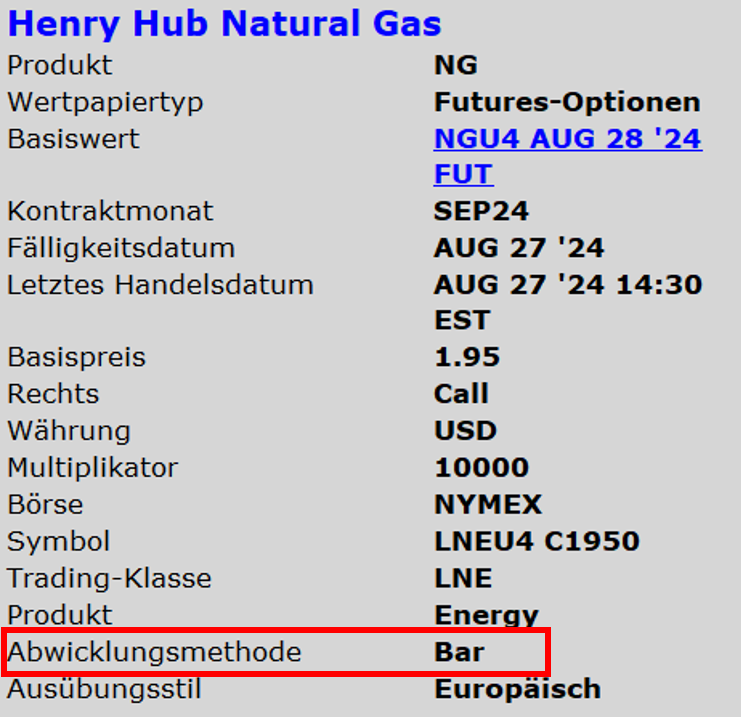
Options that are settled by cash settlement are often covered by the European exercise style. This means that they only be exercised on the due date and not during the term.
Cash settlement for S&P 500 options
If we take a closer look at options on the S&P 500, we see that options on the SPX, i.e. on the index itself, are always settled using the cash settlement method. In the case of options on an S&P 500 future (ES) or an ETF, on the other hand, the physical delivery of the underlying takes place, i.e. the future or ETF is booked in or out.
The issue of exercising 0DTE options, which we discussed in our Managed account trade with CapTrader, we have published a Podcast episode discussed in detail.
Special tax features of options with cash settlement
For option traders in private assets, there is a special tax feature for options that are settled by cash settlement. Losses from the pure sale of options can normally be offset without limit. In the case of cash settlement, however, a special rule applies: losses arising from the cash settlement of options are subject to the loss set-off limit of € 20,000 (BFH judgment of 20.10.2016 - VIII R 55/13 BStBl 2017 II p. 264; Individual questions on flat-rate withholding tax; supplement to the BMF letter dated January 18, 2016)
We take the following DAX option as an example:
- Sell put option at a strike price of 10,000 points
- Option price: 100 €
- Multiplier 5
- Current DAX level: 15,000 points
If the option expires worthless or is repurchased in advance, the retained option premium must be taxed in accordance with the flat-rate withholding tax + solidarity surcharge and, if applicable, church tax.
However, if the option is trading at a loss, cash settlement must be avoided. Let us assume that the DAX falls to 5,000 points at expiry. The following picture now emerges at or shortly before expiry:
- Current DAX level: 5,000 points
- Strike price of the put option: 10,000 points
- Option loss in the amount of € 25,000 (intrinsic value 5,000 points * multiplier 5)
The writer could now either buy back the option at a loss shortly before expiry or have it settled in cash (cash settlement). In both cases, the realized option loss is € 25,000 (the option has hardly any time value before expiry). From a tax perspective, however, the following picture emerges:
- Option is sold (cash settlement): Option loss in the amount of € 25,000 and is therefore to be taken into account in the loss offsetting restriction in accordance with Section 20 (6) EstG
- Option is bought back shortly before expiry: Option loss also in the amount of € 25,000 - but can be offset indefinitely!
The decisive factor is not whether the options can in principle be traded with cash settlement, but whether cash settlement actually takes place.


Conclusion - cash settlement for options
Cash settlement, also known as cash settlement, is a settlement method in which no physical delivery of the underlying asset is made, but instead a cash payment is made. This method is often used for index options when physical delivery is not possible. With such options, the Wheel strategy in the usual form, as the underlying cannot be "optioned". Private investors should also be aware of the special tax situation: It is advisable to close out cash-settled options before they expire.