Your Broker for worldwide trading

Using term structure curves profitably

Term structure curves are only indirectly related to (options) trading. Nevertheless, the topic is relevant for every options trader, which is why Alexander Eichhorn demonstrates the benefits of term structure curves in this blog post.

Range market vs. stock market

There are some fundamental differences between the commodities market and the stock market. While a share represents a small stake in a company, commodities are usually traded via forward products (futures), as there are no shares here. Share indices usually show an upward trend in the long term, as weaker companies are replaced by stronger ones. In contrast, most commodity markets are range markets that often move sideways for decades.

A chart compares the trends of corn futures (red) and the SPX index (blue) from 2000 to 2024 and shows fluctuations and growth over time.
Chart: Corn futures vs. S&P 500 Index

Futures are forward contracts for a specific commodity and have a fixed expiry date. In order to remain continuously invested in a commodity market, investors (as well as ETC providers) must purchase a new future as soon as the existing one expires, which is known as "rolling". This can result in both roll gains and roll losses.

Investors should check the product description of the trading instrument carefully. Take the popular gold ETC GLD, for example: the holdings here consist of 100 % of physical gold, not gold futures. In contrast, the well-known oil ETC USO holds only oil futures, but no physical oil.

- USO: Holds oil futures

- GLD: Holds physical gold

To summarize, it is relatively inexpensive for ETC providers to physically store precious metals such as gold and silver. For commodities such as crude oil, on the other hand, long-term storage is almost impossible or involves considerable costs, which is why ETC providers resort to the futures market. Alternatively, commodities can also be traded indirectly with "commodity" shares, such as Goldminenaktien.

Attention! Although the GLD-ETC is physically based, there is no Tax exemption after a holding period of one year, such as with Xetra-Gold!


A man and a woman look at documents and a laptop advertising stock market trading, account opening and services.

Contango curve

Roll losses occur when futures contracts are extended, known as "rolling", when a contract that is about to expire is replaced by a new contract with a later maturity date. The expiring contract is closed and a new, longer-term contract is opened at the same time. If the underlying value of the future is in a situation in which short-term contracts are more favorable than long-term contracts (a so-called "contango situation"), rolling leads to a loss, which is referred to as a "roll loss".

As a rule, the prices of the underlying assets rise over the term of the contract, which is due to ancillary costs such as storage costs - also known as the "cost of carry". This price structure is referred to as "contango". If the underlying asset of a futures contract is in a contango situation, a loss is inevitably incurred when rolling, as the sale of the expiring contract brings in less than has to be paid for the purchase of the longer-term contract.

Video tip: Successfully use term structure curves for futures! https://youtu.be/EOGoQHlma48

Special situation: Backwardation

In special cases, the term structure curve can tilt. In such a situation, short-term contracts are more expensive than long-term contracts, which is often due to high demand or limited supply of a commodity. If a commodity is urgently needed, prices for short-term deliveries rise and sellers receive a so-called "availability premium". This price situation is known as "backwardation".

Backwardation is a special situation:

- Future contracts are cheaper than current contracts, which can occur in the event of factors such as supply shortages, poor harvests or political tensions. - Commodity traders who need the raw material immediately are dependent on fast delivery.

Chart comparing contango and backwardation with future prices over different time periods. Contango shows rising prices; backwardation shows falling prices. The prices lie between 30 and 90 US dollars.
Contango vs. backwardation

If an underlying asset is in a backwardation situation, rolling a futures contract does not lead to a roll loss, but to a roll profit. This is because the expiring contract is sold for more than the longer-dated contract costs. However, as backwardation situations are usually only temporary, rolling profits cannot be expected on a permanent basis.


An astronaut floats in space next to ad text promoting stock trading features such as global exchanges, short selling and fractional shares. A yellow button reads "Open an account".

Never short a backwardation!

Here is an important rule of thumb: never short a backwardation formation! A backwardation only occurs when there is a significant supply shortage, and prices often shoot up in such situations.

In a backwardation, futures-based ETCs benefit from rolling profits. However, as commodities are usually traded in a contango situation, roll losses predominate in the long term for these products.

When a term structure curve turns (no matter in which direction), this often signals a strong trend reversal in the market. Such market phases are particularly prone to black swan events, which is why traders should never bet against this curve. There have been several examples of this in the past:

- Natural gas price explosion on 14.11.2018: NG futures prices jumped by 20 % within a few minutes. Days earlier, the term structure curve was already in a backwardation.

- VIX explosion during the Corona crisis: The VIX index and the associated VIX futures rose dramatically during the coronavirus crisis. By the end of February 2020, the VIX futures structure was already showing backwardation.

- Oil price plunges into negative territory on 20.04.2020: The oil price fell to -$42, an event that is familiar to many. Shortly before this, the backwardation curve dissolved.

- Oil price increase during the Ukraine crisis: Months before the sharp price increase, the oil futures curve was already showing a backwardation.

- Volatility explosion from 05.08.2024The VIX volatility index rose from 23 to over 65 in the space of a day, with the VIX futures curve in backwardation days earlier.
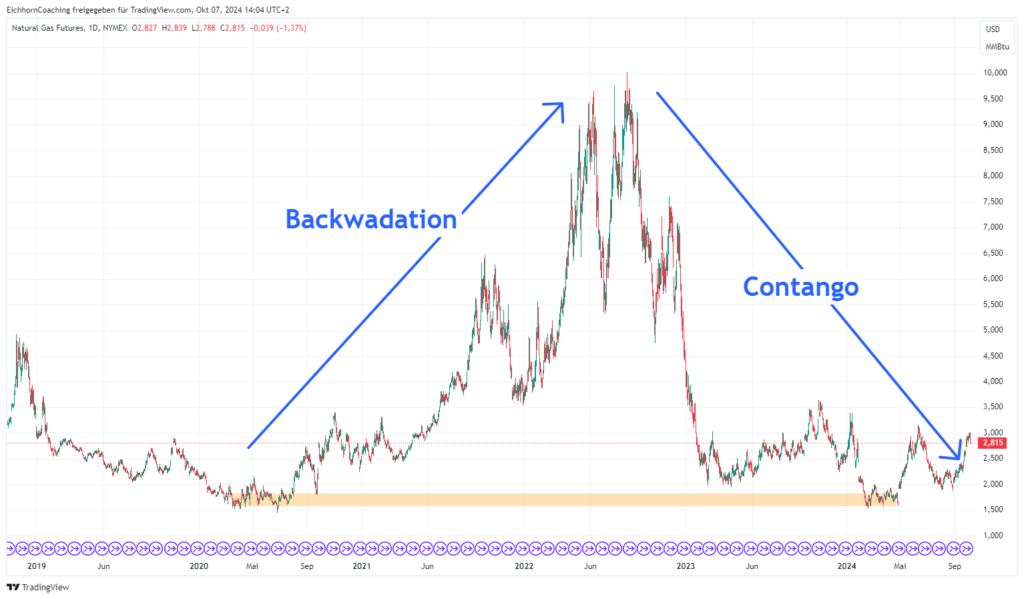
Diagram with market trends and labeled sections: "Backwardation" indicates an upward trend and "Contango" indicates a downward trend and covers the period from 2019 to 2024.
Chart: Natural gas forward curve

Excursus: VIX term structure curve

If share prices correct by more than 20 %, this is generally referred to as a stock market crash. It is of course helpful to recognize such a collapse at an early stage, as we can then avoid or minimize losses by hedging or reducing long positions.

The VIX can be used, especially in combination with other indicators, as a tool for predicting possible stock market crashes. Among other things, we look at the term structure curve. As already explained, the VIX term structure curve usually in a "contango" situation, which means that the subsequent contracts are more expensive than those with a shorter remaining term. In contrast, there is the rather rare "backwardation" situation, in which the front contract is the most expensive. When VIX futures are trading in a backwardation situation, it is often already too late and the correction has already begun. Therefore, the change from contango to backwardation is crucial!

Line chart of historical VIX futures prices showing volatility trends over the days to expiry for February 11 and 25, 2020.
Chart: VIX Term Structure at the Beginning of the Corona Crisis 2020, Source: vixcentral.com. A German-language alternative with all major commodity forward curves on one page can be found for free at tradility.net/term-structure-curves.

A daily look at the VIX futures can help to recognize corrections in the S&P 500 at an early stage. Of course, a change does not necessarily have to result in a crash; prices can also recover and volatility can return to its normal range. However, should a change from contango to backwardation occur, it may be advisable to close long positions or establish suitable hedging strategies.

Podcast tip: Hedging with VIX options - effective protection against flash crashes - listen here

Conclusion - using term structure curves profitably

At first glance, the topic of term structure curves may not seem directly related to options trading, but it is of great importance for traders who operate in the futures market or with exchange-traded commodities (ETCs). The fundamental differences between equity and commodity markets, especially with regard to futures, have a significant influence on trading strategies and decisions.

The analysis of forward structure curves, in particular the differentiation between contango and backwardation, can provide valuable insights and help traders to make informed decisions. Rolling losses and gains when rolling futures contracts must be taken into account, as well as the potential impact of backwardation on prices and market volatility.

An important rule of thumb is that you should never go short against a backwardation, as this is often accompanied by sharp price rises and black swan events. Instead, it is advisable to wait for the backwardation to end before implementing appropriate trading strategies.

Analyzing term structure curves illustrates how crucial it is to continuously monitor the market and be aware of current conditions. This can help traders minimize risks and identify opportunities to trade profitably.

A man with a shaved head and a short beard, wearing a black t-shirt, stands in front of a neutral gray background. He looks at the camera and smiles slightly, exuding the calm confidence often seen in experienced speakers.
Alexander Eichhorn

Alexander Eichhorn is the founder of Eichhorn Coaching and full-time trader and investor. His educational activities focus on providing optimal support for clients with large accounts. He also shows options traders how to get started quickly with profitable options trading through numerous blog articles and regularly publishes analyses and tips on the Eichhorn Coaching YouTube channel and in his monthly webinar series at CapTrader.

Mandatory information and disclaimer

This is a marketing communication within the meaning of Section 63 (6) of the German Securities Trading Act and does not contain investment strategy recommendations, investment recommendations or financial analyses in accordance with Section 85 of the German Securities Trading Act and Article 20 of the Market Abuse Regulation. It therefore does not fulfill the legal requirements to guarantee the objectivity of investment strategy recommendations/investment recommendations/financial analyses. CapTrader GmbH or its employees are therefore not legally prohibited from trading or providing services in the securities products mentioned therein prior to publication of the information.

Past performance, simulations or forecasts are not a reliable indicator of future performance. Mandatory information and limitation of liability for CapTrader and any third-party content providers can be found at https://www.captrader.com/marketingmitteilung/angaben
Please note that investing in financial instruments involves high risks and take note of our disclaimer and the mandatory legal information at the locations indicated.

  1. Mandatory information

Responsible: CapTrader GmbH, Elberfelder Straße 2, 40213 Düsseldorf; Commercial Register Number: HRB 86537 Düsseldorf Local Court; VAT ID DE323771603; Managing Directors Andreas Weiß, Christian Weiß, Michael Heyder; Tel: +49 211-740786-00, Fax: +49 211-740786-90.

Zuständige Aufsichtsbehörde: Bundesanstalt für Finanzdienstleistungsaufsicht, Graurheindorfer Straße 108, D – 53117 Bonn und Marie-Curie-Str. 24-28 D – 60439 Frankfurt am Main, Tel: 0228 4108 – 0 Fax: 0228 4108 1550 E-Mail: poststelle@bafin.de; Institutsnummer 10156708

Conflicts of interest CapTrader in marketing communications: CapTrader GmbH confirms that it does not hold any positions in the mentioned financial instruments beyond the positions mentioned in the marketing communication itself, if applicable. There are also no other conflicts of interest within the meaning of CapTrader GmbH's Financial Analysis and Marketing Communication Policy.

Conflicts of interest and mandatory disclosures by the third-party content provider for marketing communications with financial instrument recommendations: See under https://www.captrader.com/marketingmitteilung/angaben  to creators of third-party content

The copyright to the marketing communication is reserved. Reprinting and distribution is only permitted with our consent.

  1. Disclaimer

By accepting the content, the recipient accepts the binding nature of the limitation of liability.

a) Disclaimer for third-party content

CapTrader GmbH offers authors - such as editors, guest commentators, agencies and companies - the opportunity to publish comments, analyses, news and company announcements. Their opinions do not necessarily reflect the opinions and views of CapTrader GmbH and its employees. CapTrader GmbH assumes neither liability nor guarantee for this content. This applies in particular to incomplete or incorrectly reproduced reports, incorrect price information and editorial errors. Liability claims relating to material or immaterial damage caused by the use or non-use of the published information or by the use of incorrect or incomplete information are fundamentally excluded.

b) Exclusion of liability for CapTrader's own content

CapTrader has taken its own information in this marketing communication from sources believed to be reliable, but has not verified all such information itself. Accordingly, CapTrader makes no warranties or representations as to the accuracy, completeness or correctness of the information or opinions contained herein. Subsequent changes cannot be taken into account. The marketing communication does not constitute an offer or solicitation to buy shares of the issuer and is in no way a substitute for advice appropriate to the investor and the property. We cannot verify whether the information in the marketing communication is in line with your personal investment strategies and objectives. We recommend that you consult an investment advisor for advice that is appropriate to the investor and the property. The marketing communication cannot and should not replace a securities prospectus and/or expert investment advice required for an investment. It can therefore never be the sole basis for an investment decision. By accepting the marketing communication, the recipient accepts the binding nature of the above limitation of liability.

CapTrader provides the information despite careful procurement and provision only without guarantee for the correctness / completeness, timeliness or accuracy and availability of the stock exchange and economic information, prices, rates, indices, general market data, valuations, assessments and other accessible content held and displayed for retrieval. This also applies to third-party content. Historical observations and forecasts are not a reliable indicator of future developments. The facts presented in particular in connection with product information are for illustrative purposes only and do not permit any statements to be made about future profits or losses. Any conditions stated are to be understood as non-binding indications and are dependent on market developments on the day of conclusion.

CapTrader accepts no liability for any direct or indirect damage caused by and/or related to the distribution and/or use of this marketing communication.

The information, opinions and statements correspond to the status at the time of preparation of the marketing communication. They may be outdated due to future developments without the publication being changed.

CapTrader is not obliged to update, amend or supplement the information in this marketing communication if a circumstance mentioned in this publication or a statement, estimate or forecast contained therein changes or becomes inaccurate. The presentation of the performance of financial instruments over previous periods does not provide a reliable indication of their future performance. No guarantee can therefore be given for the future price, value or income of any financial instrument mentioned in this publication.

Despite careful control of the content, we assume no liability for the content of external links. The operators of the linked pages are solely responsible for their content.

Distribution: This publication may only be distributed in accordance with the laws of the respective countries, and persons in possession of this publication should inform themselves about the applicable local regulations. The information contained herein is not intended for natural or legal persons who, due to their place of residence or business, are subject to a foreign legal system that imposes restrictions on the distribution of such information. The contents are therefore exclusively in German. In particular, this publication contains neither an offer nor an invitation to purchase securities to citizens of the USA, Great Britain and Australia.

Taxes: The tax treatment of financial instruments depends on the personal circumstances of the respective investor and may be subject to future changes, which may also have a retroactive effect.

Historical observations and forecasts are not a reliable indicator of future developments. The facts presented in particular in connection with product information are for illustrative purposes only and do not permit any statements to be made about future profits or losses. Any conditions stated are to be understood as non-binding indications and are dependent on market developments on the day of conclusion.

CapTrader accepts no liability for direct or indirect damage caused by and/or in connection with the distribution and/or use.

The information, opinions and statements correspond to the status at the time of preparation of the marketing communication. They may be outdated due to future developments without the publication being changed.

CapTrader is not obliged to update, amend or supplement the information if a circumstance mentioned in this publication or a statement, estimate or forecast contained therein changes or becomes inaccurate. The presentation of the performance of financial instruments over previous periods does not provide a reliable indication of their future performance. No guarantee can therefore be given for the future price, value or income of any financial instrument mentioned in this publication.

Despite careful control of the content, we assume no liability for the content of external links. The operators of the linked pages are solely responsible for their content.

Distribution: This publication may only be distributed in accordance with the laws of the respective countries, and persons in possession of this publication should inform themselves about the applicable local regulations. The information contained herein is not intended for natural or legal persons who, due to their place of residence or business, are subject to a foreign legal system that imposes restrictions on the distribution of such information. The contents are therefore exclusively in German. In particular, this publication contains neither an offer nor an invitation to purchase securities to citizens of the USA, Great Britain and Australia.

Taxes: The tax treatment of financial instruments depends on the personal circumstances of the respective investor and may be subject to future changes, which may also have a retroactive effect.

Email:

info@captrader.com

Send e-mail

Phone:

Hotline (Germany)
0800-8723370

Hotline (International)
00800-08723370

Further contact options