Dear traders, dear stock market friends.
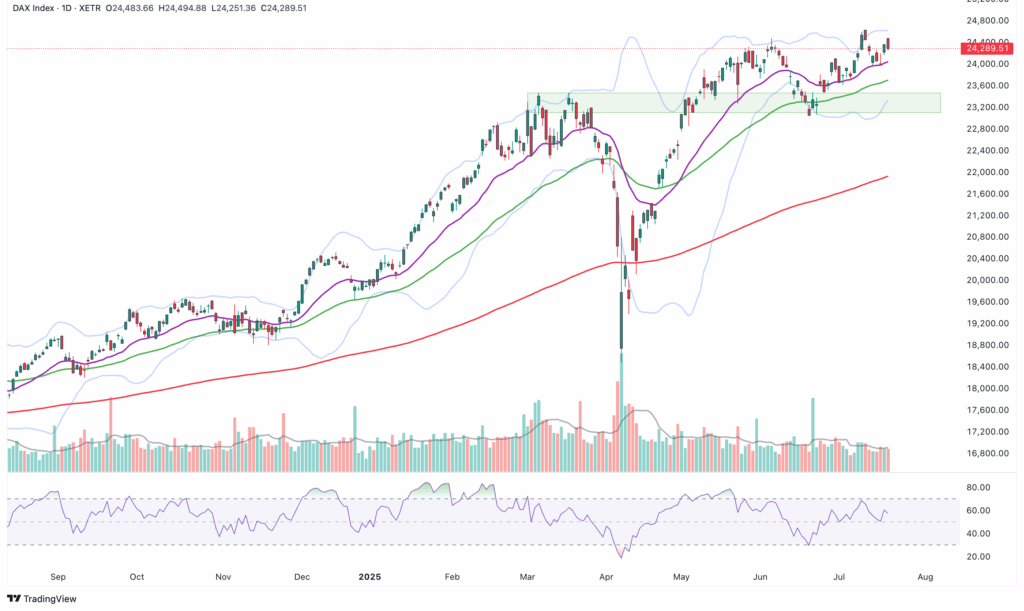
The German share index DAX is currently still trading stably above the 24,000-point mark, close to its all-time high, which was last reached on July 10. Falling inflation rates and a confident economic outlook have provided a renewed tailwind in recent weeks. However, new tariff threats and a possible escalation in the trade dispute have once again cast their shadows in recent days, although the market is currently hardly being unsettled by this.
Economic data provide cautious optimism
The latest economic data signal a cautious easing of the macroeconomic environment. In Germany, headline inflation fell to 2.0 % in June, which is exactly in line with the ECB target. The core rate fell moderately to 2.7 %.
Inflation also fell in the eurozone to 2.0 %. Falling energy prices (-3.5 % on an annualized basis) and easing pressure on food prices confirm the disinflationary trend. Apart from a possible final interest rate cut in early fall, only limited monetary policy stimulus is therefore likely to follow in the coming months.
At the same time, there are increasing signs of a cyclical bottoming out in Germany. At 50.4, the HCOB Flash Composite PMI rose slightly above the growth threshold for the first time in months in June; the manufacturing sector was approaching stabilization at 49 points, while the downturn in the service sector abated. After two weak years, this opens up the prospect of stagnation or moderate growth instead of another recession. Several institutes have therefore slightly raised their GDP expectations for 2025.
Sentiment indicators have also recently painted a more positive picture: the ZEW index of economic expectations climbed to a two-year high of 52.7 in July, accompanied by a significant improvement in the assessment of the current situation (minus 59.5 after previously minus 72). This optimism is being driven by fiscal stimuli (tax and spending package of € 46 billion; additional infrastructure funds and special regulations for defense), combined with a lower interest burden. The expansive fiscal policy thus acts as a psychological and prospective buffer against external risks.
Seasonal weakness in August and September
While July is still one of the seasonally strongest months for the DAX, it is followed by two seasonally weak months, August and September. In August, the DAX has only risen in 47 % of all cases in the past 20 years and the average performance was -1.4 %. September was also one of the weakest months of the year, with an average performance of 0 % and an increase in 53 % of all cases.
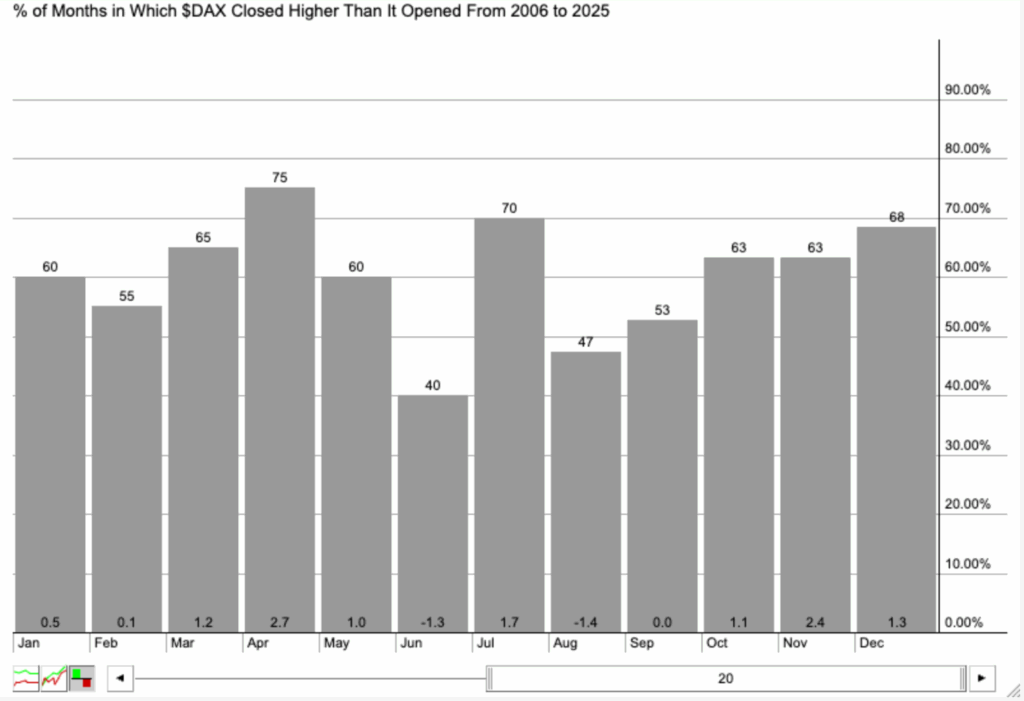
After the strong rally in the DAX so far this year, a somewhat more extended correction would not come as a surprise and would fit in well with the seasonal picture. However, speculating on a correction solely on the basis of seasonality would be a very risky business, as the market is currently in a very strong bull market.
In the event of a correction or consolidation, the end of September or beginning of October would be another seasonally attractive time to enter the market, for which one can already prepare now.
Setups in DAX shares
In a bullish overall market environment, as we are currently seeing, trades in the direction of the overriding uptrend should be favored. In addition to trades at index level, there are interesting setups in many DAX stocks, both for medium to long-term investors or position traders and for short to medium-term swing traders or options traders. A proven strategy is to screen for stocks that are in intact uptrends and generate new bullish signals after a correction.
Munich Re with potential for trend continuation
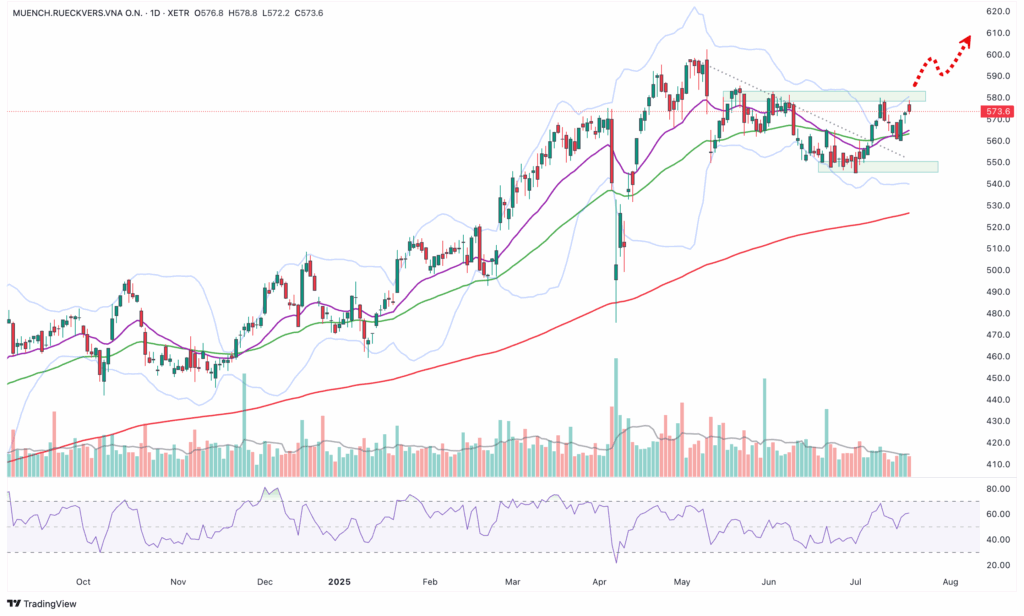
Munich Re shares have been on an exemplary upward trend with very strong momentum for around two years.

In the last three months, the share has corrected slightly more than 10 % and appears to be turning upwards again. A higher low has already formed on the daily chart. A breakout above the horizontal short-term resistance at EUR 580 would signal a renewed secondary uptrend or a new movement phase of the primary uptrend.
Airbus breaks above long-term resistance
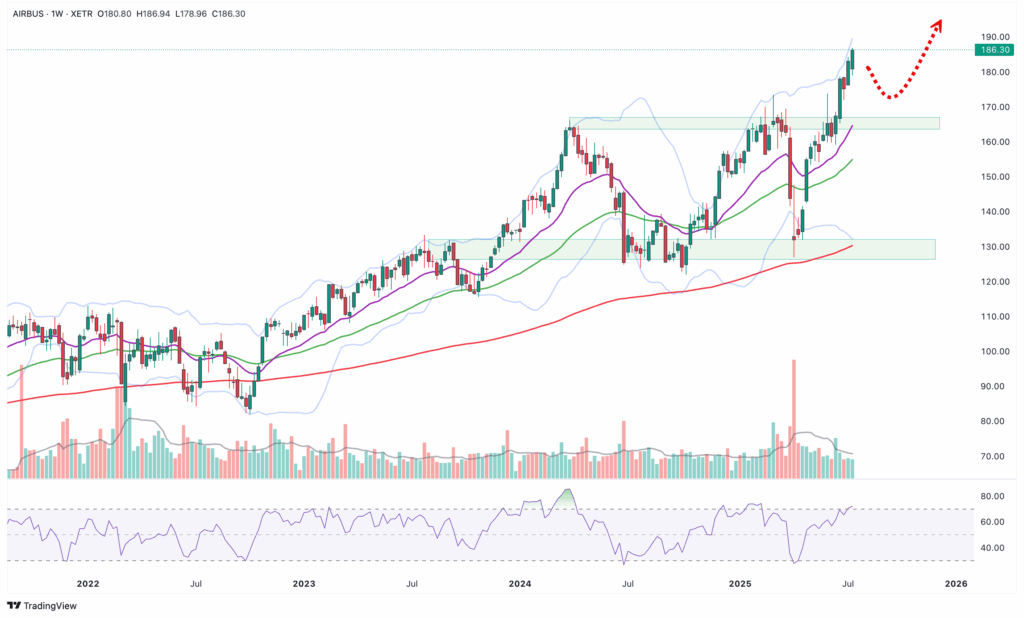
With the rise above the EUR 170 mark, the Airbus share recently managed to break out of a long-term sideways range. In the event of another short-term correction, this would provide an interesting entry setup.
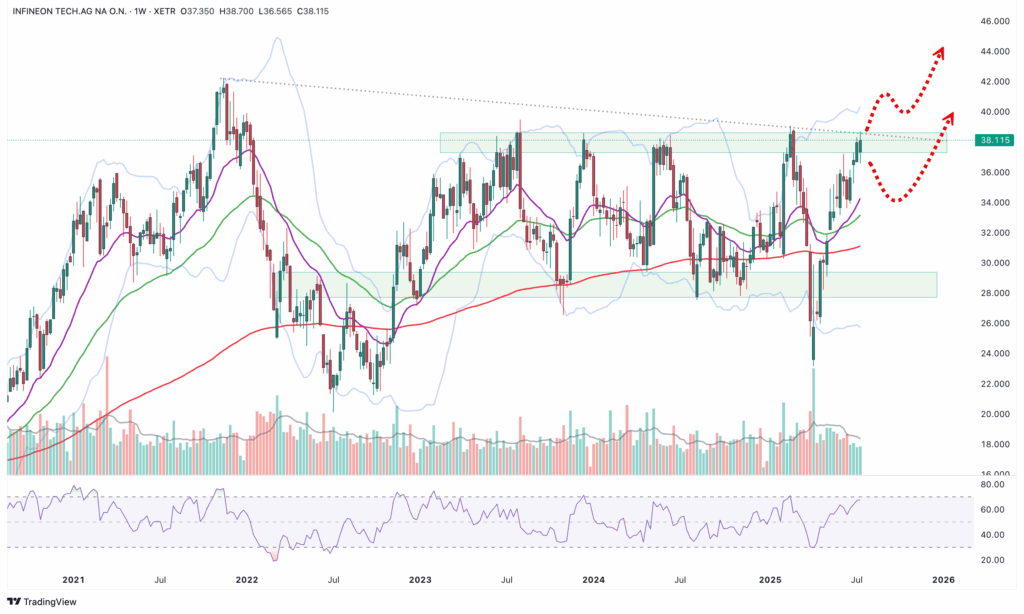
Possible breakout at Infineon?
Although Infineon shares have also risen significantly since the low in April, unlike Airbus shares (see above), they still have an important long-term resistance ahead of them. If this resistance is overcome, new bullish momentum could emerge. On the one hand, an entry would be possible as soon as or if the resistance is overcome; on the other hand, a short-term correction in the next few days or weeks would be a welcome opportunity to take a bullish position before a possible breakout and speculate on a breakout.
Siemens consolidates in an intact upward trend
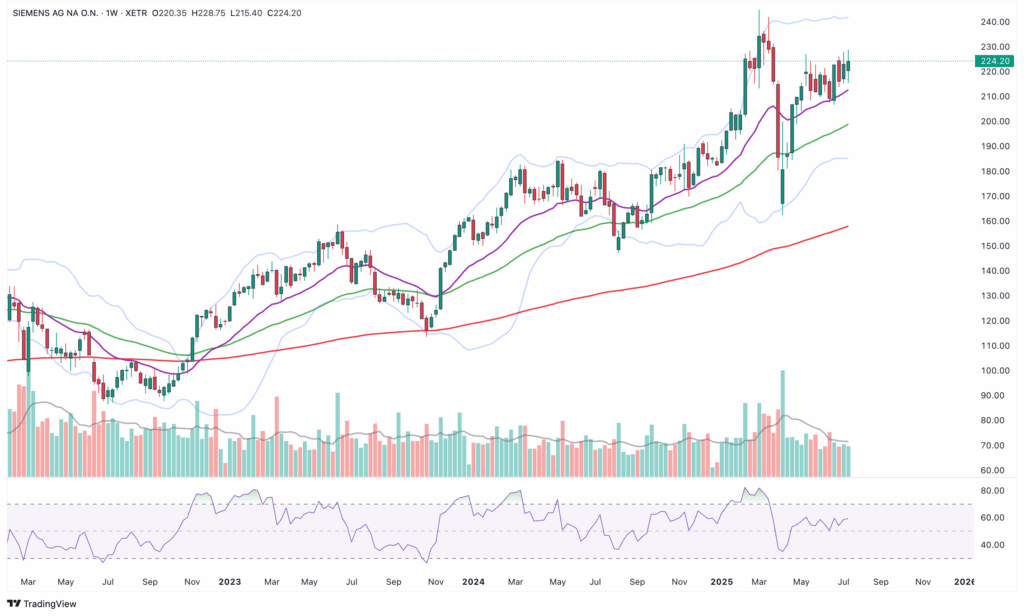
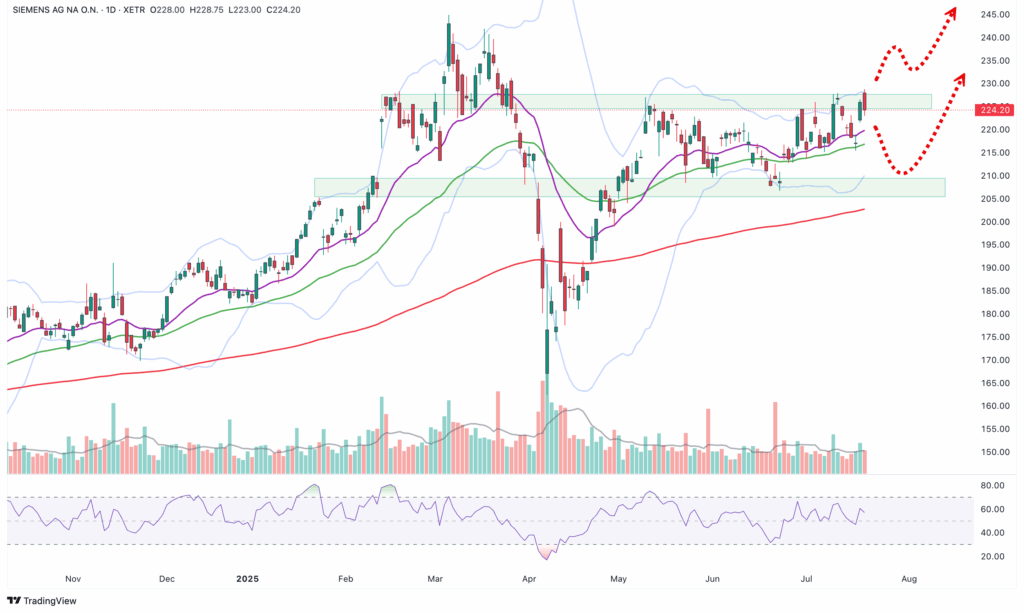
Siemens is another share that is in a clean, long-term upward trend. In the last ten weeks, the share has consolidated sideways and an upward breakout (continuation of the trend) would be the favored scenario.
Author Tobias Schmid
Date: 21.07.2025