- Diageo is one of the world's largest players in the production of spirits and an established market leader in a reliable business model
- The range of strong core brands and the positioning in the premium segment ensure a high level of customer loyalty. In its target market, the British company enjoys an excellent reputation as a quality-conscious producer of alcoholic beverages
- Diageo diversifies along different product lines such as brands and global sales markets and is present in all relevant growth markets
- At the current price level, the British dividend aristocrat, which has been raising its dividend without interruption for 37 years, is convincing with a fair valuation compared to previous years
- Click here for the DGI model portfolio and here to the overview of this series The dividend custody account

Company profile and business model: who Diageo is and what it does
Defining the exact milestone in which the history of Diageo begins is probably a matter of personal interpretation. The roots of today's company, which was formed in 1997 from the two companies Grand Metropolitan and Guinness according to the company website, date back to the year 1627. At least one member of the influential, Scottish-born Haig clans tried out his skills as a whisky distiller. The opening of the first commercially operated whisky distillery is secured John Haig & Co Ltd. in the early 1720s. The family ties stretched across the Irish Sea to Dublin, where the Jameson Distillery was to become a major player in the industry. By the way: Jameson is now owned by Pernod Ricardone of Diageo's main competitors in the spirits business.
Away from this began in the 18th century, in 1759 to be precise, Arthur Guinness with beer brewing in the legendary workplace St. James's Gate in Dublin. The company named after him, Guinness, concluded a 9,000-year (!) lease agreement with the Rainsford family for 45 British pounds per year. The Guinness brewery has been located on the site ever since. Guinness has outgrown the original four-hectare site and has therefore bought up the land, which also invalidated the 9,000-year lease.
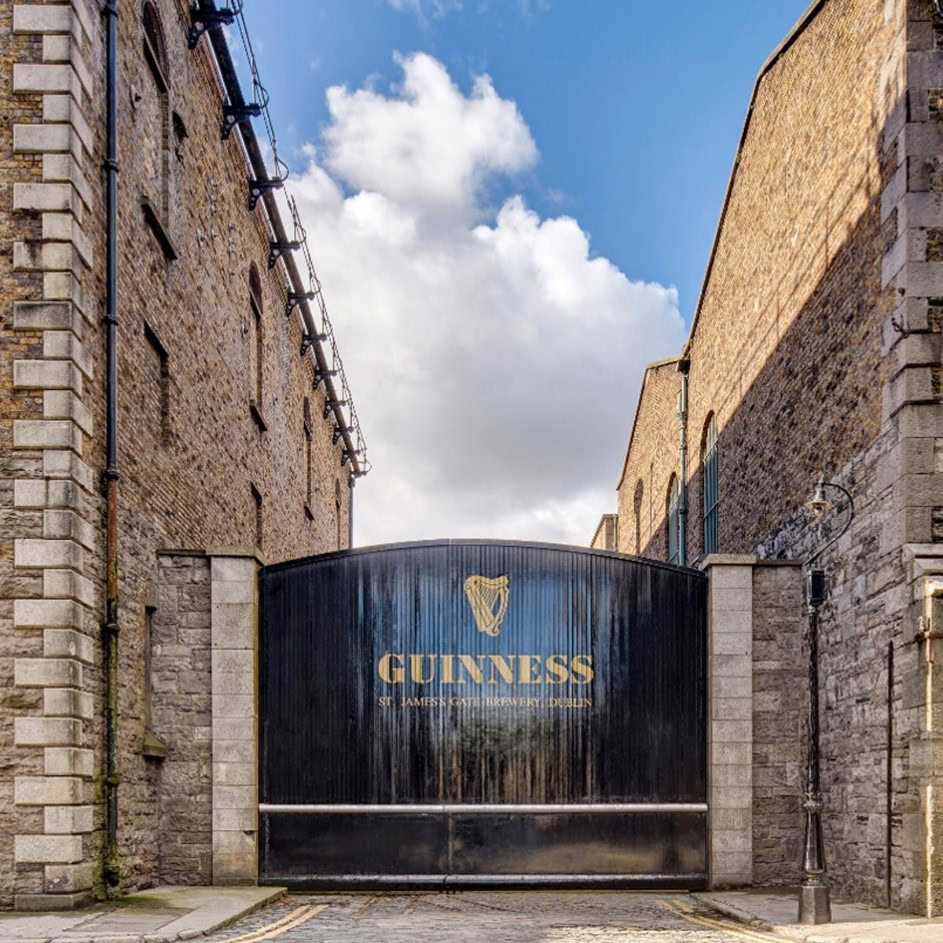
In 1986, the prominent brewery and the world-renowned whisky producer also came full circle. The assets of the Haig distilleries were finally acquired as part of the parent company The Distillers Company from the smaller company Guinness. This transaction was accompanied by the so-called "Guinness share-trading fraud", the judicial investigation of which led to prison sentences for the people involved. Among those convicted was the former CEO of Guinness. As mentioned, Guinness plc merged with Grand Metropolitan in 1997. At that time, Grand Met operated as a conglomerate comprising a wide range of holdings in various sectors. The best-known brands in the drinks sector are probably Smirnoff Vodka and Baileys. Furthermore, most people are probably familiar with the fast food chain Burger King which, however, was divested following the formation of Diageo and the associated strategic focus on the beverage market in 2000.

With over 200 brands and a market presence in more than 180 countries, Diageo has established itself as one of the largest brand manufacturer in the world which employs more than 30,000 people. Diageo also owns a third of the premium champagne and cognac producer Moet Hennessya subsidiary of the French luxury goods manufacturer LVMHas well as a majority stake in the Indian company United Spirits.
After a consolidation phase following the merger and some Deinvestmentswhich were no longer considered part of Diageo's product portfolio, is at the center of the Geschäftsmodells the production and distribution of alcoholic beverages.
As a leading company, Diageo is transforming the business six global brands on. These are Johnnie Walker, Baileys, Smirnoff, Captain Morgan, Tanqueray and Guinness. Diageo refers to these brands as its "Global Giants" in contrast to the "Local Stars" and "Reserve".
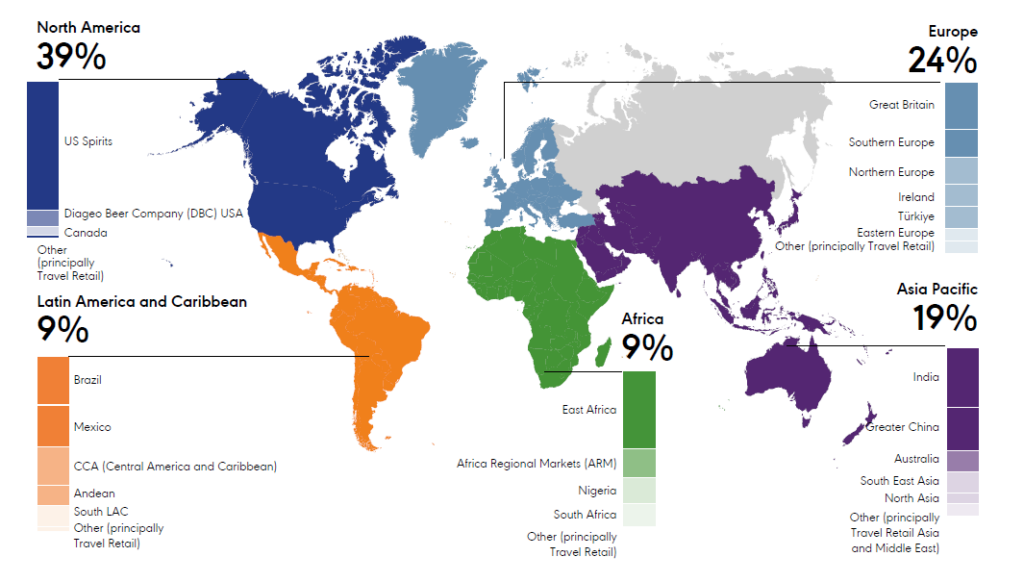
The Geographical diversification of Diageo is illustrated in the following diagram. The largest sales market is North America, followed by Europe and the Asia-Pacific region. While the share of spirits sold dominates in all markets, the disproportionately high share of the beer segment stands out in Europe and particularly in Africa and plays a significant role in sales in these regions.
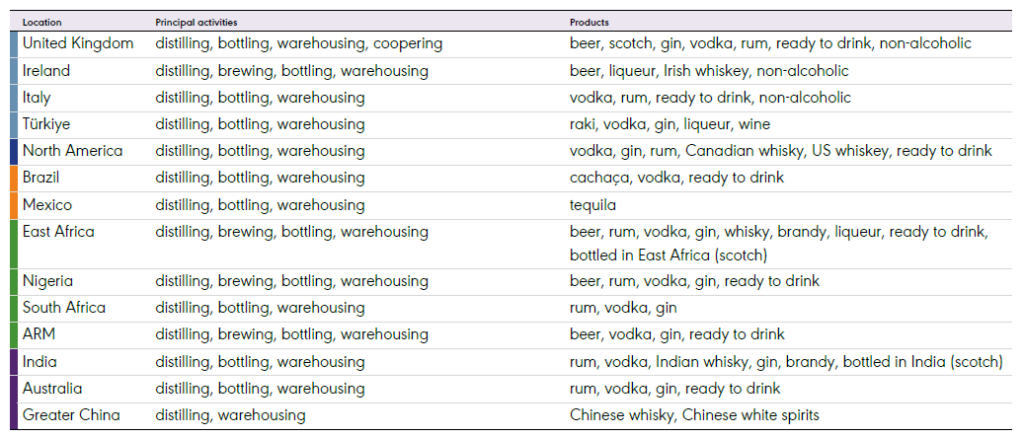
Analogous to the sales side, the Network of production sites reflects the broad diversification of Diageo's geographic footprint. The company owns production facilities around the world, including distilleries, breweries, packaging facilities, maturation warehouses, cooperages and distribution warehouses. Diageo's brands are also produced in facilities owned and operated by third parties and in joint ventures in several locations around the world.
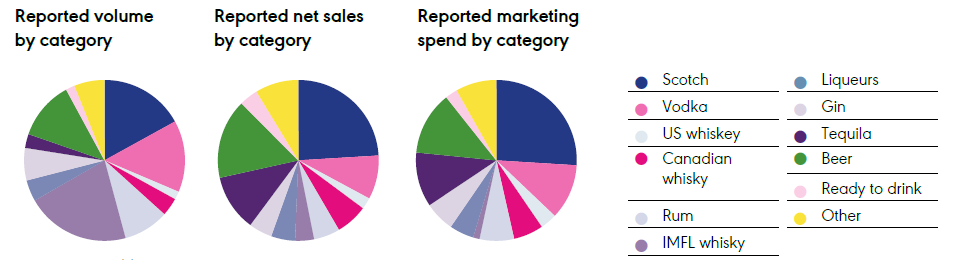
Diversification continues in the Product portfolio continued. One example is the Scotch product group, Diageo's largest spirits categorywhich generates around a quarter of total sales. Diageo's market share of global scotch sales, according to this Presentation 37 percent.
Diversification across all product segments enables Diageo to respond well to temporary changes or new trends in consumer behavior and to take countermeasures.
Another consequence of this strategic focus on the premium market is the targeted Acquisition policy of the British group. Diageo's corporate strategy for inorganic growth is geared towards the continuous acquisition of premium producers, while individual brands from the lower-priced "Standard" and "Value" segments are sold again.

At the ownership structure Diageo, there are no special features to be noted. The share of institutional investors dominates and amounts to just under 70 percent. This usually comes from the "usual suspects" in the asset management industry.
The long-standing CEO passed away on June 7 Sir Ivan Menezes after an emergency operation. Debra Crew, then Chief Operating Officer and Menezes' designated successor, took over as CEO with effect from July 1, 2023. Prior to this, the US native worked in the industry at PepsiCo. Kraft Foods, Nestlé, Reynolds Tobacco and Mondelez International.

Ownership structure of Diageo (source: tikr.com)
Industry profile and competitive situation
The characteristics of the business model of spirits producers such as Diageo makes a comparison with listed competitors possible without major restrictions. Any differentiating factors such as the degree of internationalization, the weighting of the individual sales segments or special features in the product range must be evaluated separately in a detailed analysis. In an initial comparison, I decided on the two competitors as an adequate guide Pernod Ricard and Brown-Forman. I have deliberately refrained from including Chinese spirits producers, as I focus exclusively on analyzing companies from North America and Europe. The following comparison is based on the evaluated fundamental data:
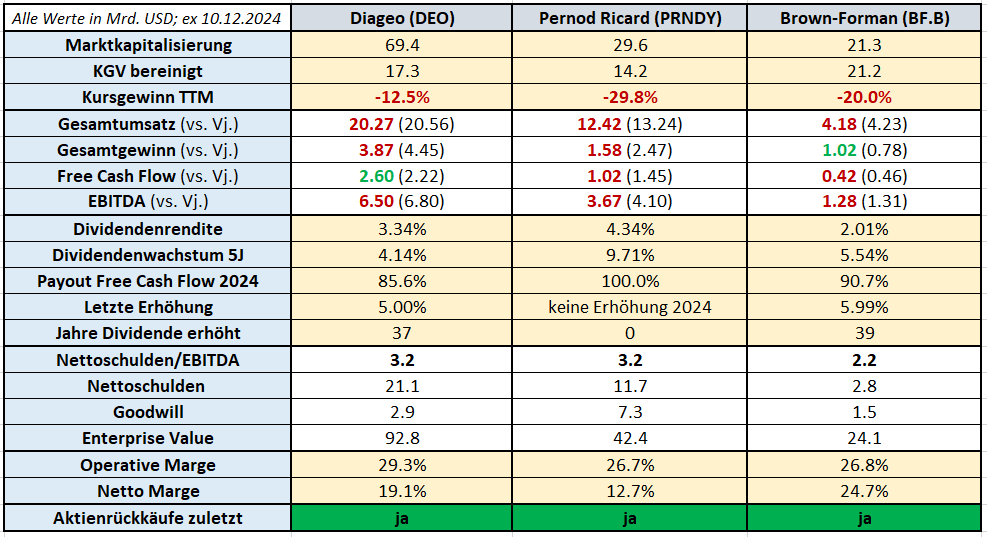
Notes on the values contained in the table:
- Green or red coloring of the figures indicates growth or decline compared to the previous year
- All figures are stated in US dollars, whereby the figures shown as at the reporting date of this comparison of Diageo (GBP) and Pernod Ricard (euro) may differ from the current dollar exchange rate at the respective date of observation
Diageo's financial situation
After gaining an overview of the industry in general and taking a closer look at the company, its management and the competition, we take a look at the balance sheet and the resulting Finanzkennzahlen from Diageo. The focus here is on the aspects Growth, profitability and the Financing.
The first step in analyzing the financial situation is to look at the development of sales, profits and earnings. Free Cash Flow to. I have already discussed the internal distribution of sales per segment in the section on the business model above. On average, the top line has grown in the last five years from around four percent p.a. an.
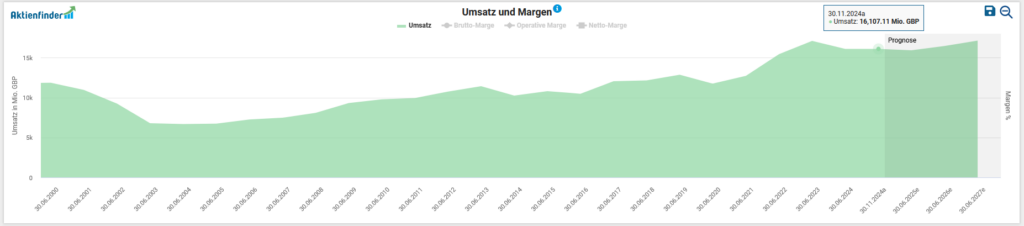
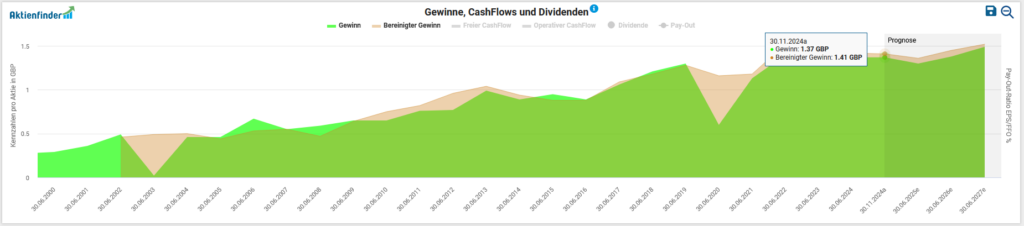
At Earnings per share we have seen a positive upward trend for years. However, if we take the past financial year 2024 as an example, the Adjusted earnings per share by around 13.5 percent (GBP 1.42 vs. GBP 1.64). In the past financial year, Diageo generated a Net profit from USD 3.9 billion (2023: USD 4.5 billion). Note: Diageo has been reporting in US dollars for a year now, whereas previously the figures were reported in pounds sterling.
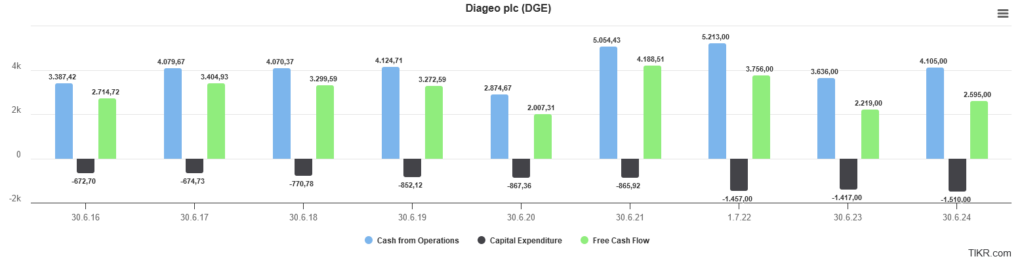
The amount available to the company Free Cash Flow (FCF) can be used for investments in the company for organic growth, repayment of debt, expansion via company acquisitions, distribution of (increasing) dividends or share buybacks. In absolute figures, the financial picture from operating and free cash flow as well as capital investments (CapEx) for the period 2016 to 2023 is as follows. What is striking is the almost doubling of the CAPEX share and the associated effects on FCF since the 2022 financial year:
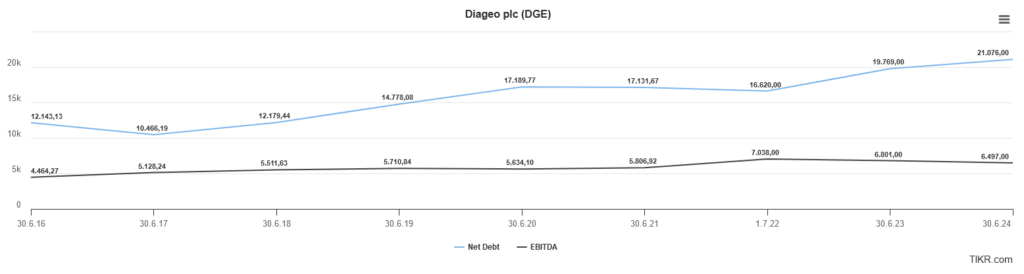
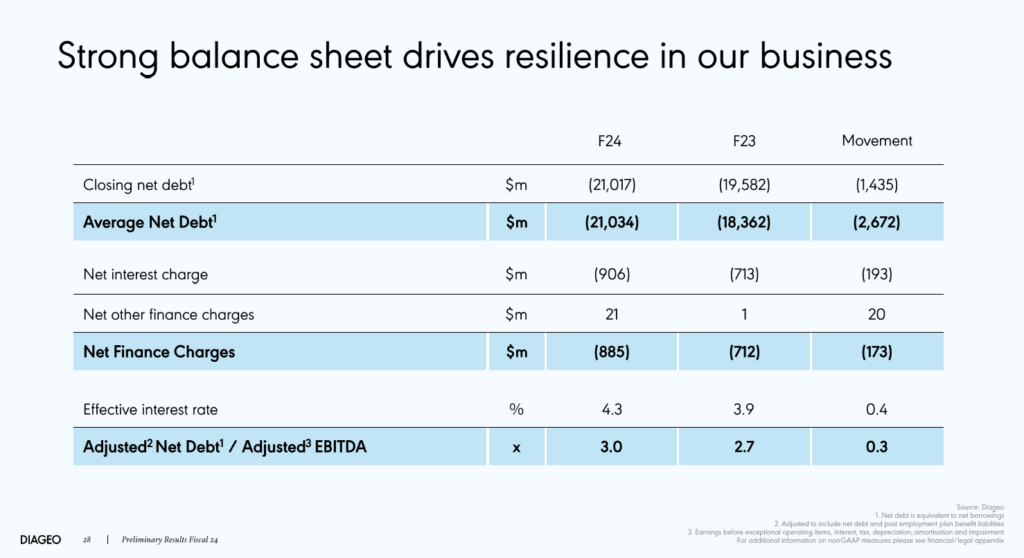
A look at the Debt situation shows us that, based on the last financial year, Diageo has a share of interest-bearing financial liabilities of USD 22.5 billion, which in turn is offset by cash and cash equivalents and securities totaling USD 1.4 billion. Let us now divide the remaining net debt of USD 21.1 billion by the most recently generated EBITDA of USD 6.5 billion results in a ratio of 3.2, which is (still) above the critical threshold of 3 (although this depends on the industry). The company is aiming for a debt level in a target corridor of 2.5 to 3 times EBITDA.
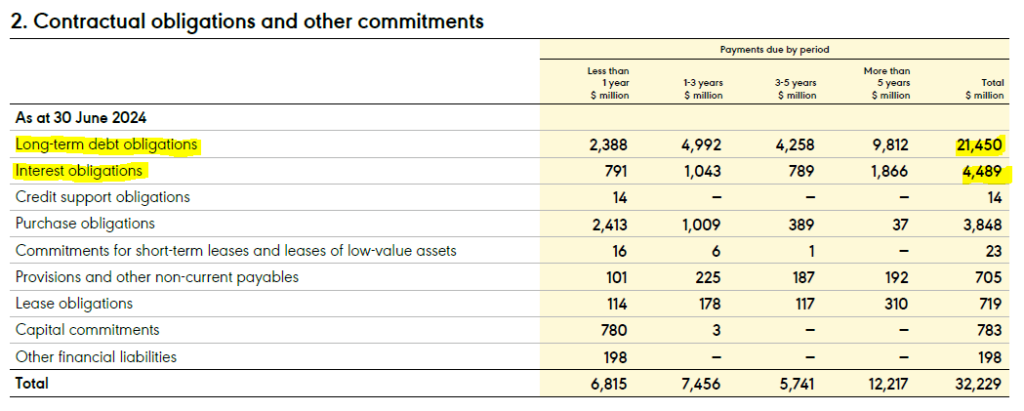
Around the topic Indebtedness and External financing nevertheless, it makes sense to look at the Interest profile and the Maturity structure of current liabilities. Finally, it is important to assess how vulnerable the company appears to be to the development of key interest rates and to what extent refinancing or rescheduling of existing liabilities could become necessary in the near future. The total amount of long-term liabilities maturing within the next three years is around USD 5 billion. Standard & Poor's rates Diageo's creditworthiness with a Credit rating with the rank of Investment Grade A- with a stable outlook.
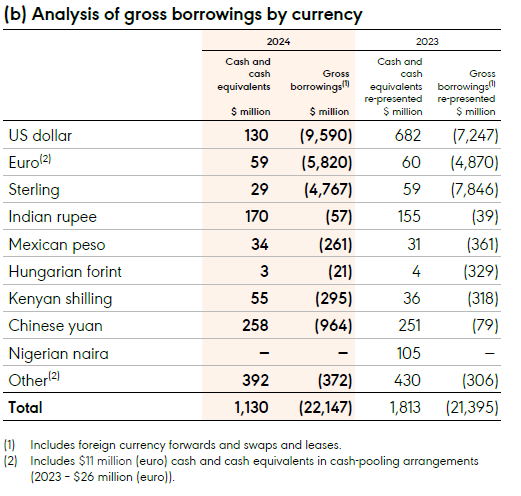
Finally, in connection with Diageo's debt, it should be mentioned that the beverage group raises the majority of its liabilities in three different currencies. The composition of the liabilities denominated in GBP, euros and USD is as follows Debt securities is shown in the chart below:
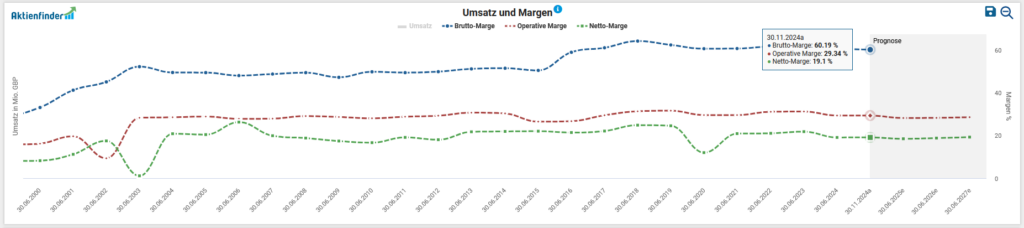
Finally, we look at the Profitability of Diageo based on the development of gross, operating and net margins. The stability of the gross and operating margins at a high level of around 60 and 30 percent respectively is a positive feature. Diageo has the highest profit margin in the industry.
Opportunities & risks
Diageo is represented worldwide with various (premium) brands in different product segments in the spirits sector and has created a global distribution and production network. With over 200 brands and a market presence in more than 180 countries, Diageo has positioned itself as a established global playerwhich employs more than 30,000 people. Diageo also owns a third of the premium champagne and cognac producer Moët Hennessy, a subsidiary of the French luxury goods manufacturer LVMH, as well as a majority stake in the Indian company United Spirits Limited.
The positioning of Diageo's products as lifestyle brands is in Emerging markets such as China and India. In the long term, Diageo is counting on a global improvement in the economic situation and thus on a steadily growing number of people with disposable income who can afford to consume higher-priced alcohol. Furthermore, the products are partly protected from competition due to legal and natural restrictions. For example Scotch a protected designation for a whisky that has been distilled and matured in Scotland. The required maturation process for these spirits also protects Diageo from competition and makes it unattractive for companies from outside the industry to enter the market.
In recent decades, Diageo has gained sufficient experience in acquisitions and the subsequent integration of the acquired companies into the overarching business model without seriously jeopardizing the company's financial health. On the other hand, the interest service is currently higher than in previous years. The maturity structure of the Borrowed capital The financial situation, which can currently be described as solid, may be negatively impacted by higher refinancing costs in phases up to 2025.
Different regulatory provisions, such as those on addiction prevention, as well as the socio-politically questionable framing of "Sin shares", which includes alcohol as well as tobacco and gambling, cannot be dismissed out of hand. The alcohol ban introduced in Germany Special tax on alcopop drinks is a striking example of event-driven legislation, which the state regulator literally boxed its way through. Further changes in this area could represent a difficult-to-calculate obstacle to growth.
Finally, a Changed consumer behavior alcohol as a potential risk factor. Although the reduced consumption of alcohol has less of an impact on the high-priced premium segment, Diageo's beer division (particularly the Guinness brand) is also exposed to this risk, albeit to a lesser extent. It is no wonder that the British company is quite active in Acquisitions of non-alcoholic spirits producers shows.
Current valuation of the Diageo share
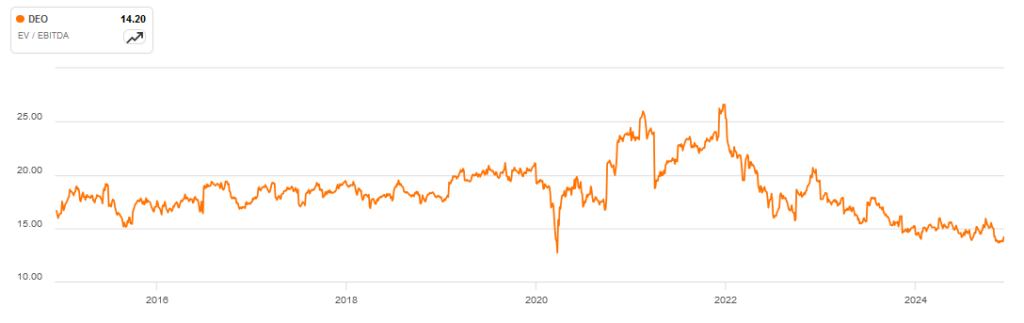
For the valuation of companies, I use the so-called Enterprise Value (EV) is used. In the case of a takeover, the EV indicates the amount required to purchase the assets required for operations and excludes the non-operating assets. I relate this key figure to operating profitability (before interest, taxes and investments (CAPEX)), expressed as EBITDA. The prevailing opinion is that a value of less than 10 indicates a „healthy valuation“ - as is always the case with generic Rules of thumb the company-specific context must be considered in the analysis by the careful investor himself. In the case of Diageo, we have to consider a similar Valuation result of 14.2 look back to the year 2020:
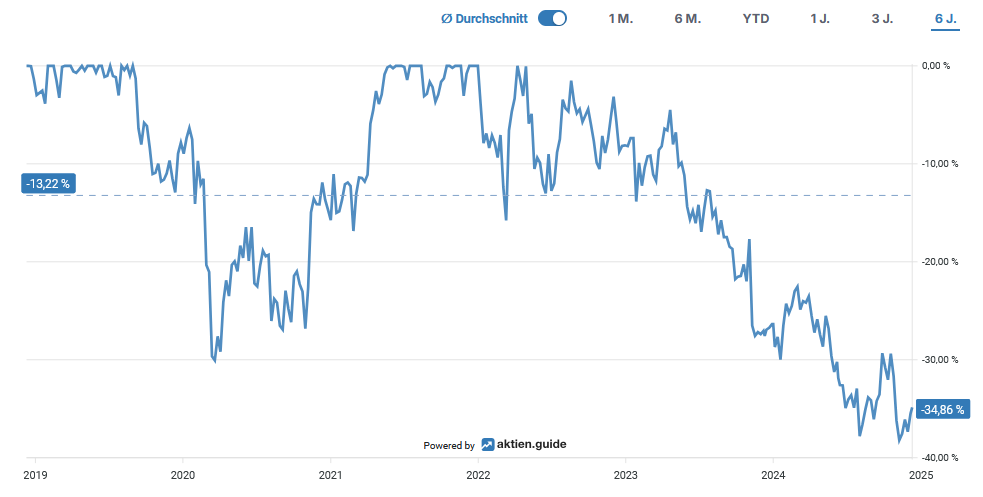
The Maximum decrease in the last six years amounted to approx. 38 Prozent a few weeks ago this year:
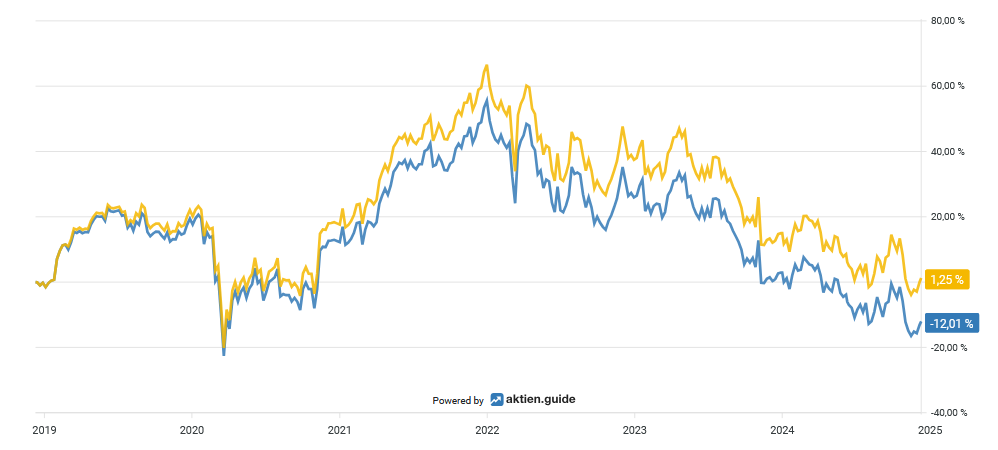
Over the past six years, an investment in Diageo has yielded Total Return, including dividends received, a Overall performance from lean 1.3 percent for the investor. Calculated on the last ten years the total return amounts to no less than 39.7 percent:
Capital allocation of Diageo
Since meanwhile 37 years Diageo pays an annually higher dividend to its shareholders. This allows Diageo to join the illustrious circle of shareholders, whose number is manageable. Dividend aristocrats from Europe that have increased their dividend payments to shareholders every year for at least 25 years. The 37 years can be calculated by adding the dividend history of the predecessor companies. Diageo itself was only officially founded in 1997.
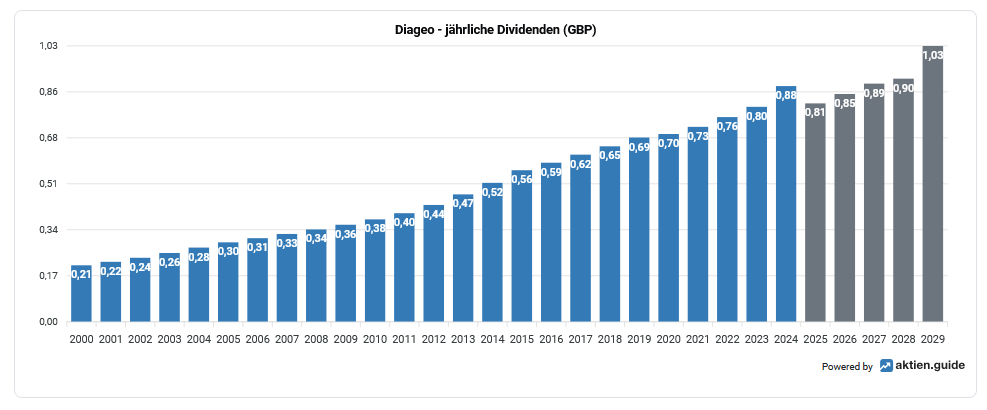
At the current share price of GBP 24.58, this results in a Dividend yield from 3.23 percent. The Five-year dividend growth rate amounts to 4.1 percent p.a. or 5.4 percent p.a. in the Ten-year period. The company last increased its dividend by five percent at the end of July. To round things off, here is an overview of the last five dividend increases:
- 2023: 5 %
- 2022: 5 %
- 2021: 3,8 %
- 2020: 1,9 %
- 2019: 5 %
Dividend payments are made as Intermediate and Final dividend semi-annually in April and October. The ratio of distributions is generally 40:60.
If we take the average value of the Free Cash Flow of the last three years as the basis for determining the Payout ratio we end up with a comfortable result of 77.1 percent for Diageo's payout ratio. Based on the annual result for the 2024 financial year, this results in a value of 85.6%. Over the past six years, the Number of shares outstanding added together by 9.7 percent.
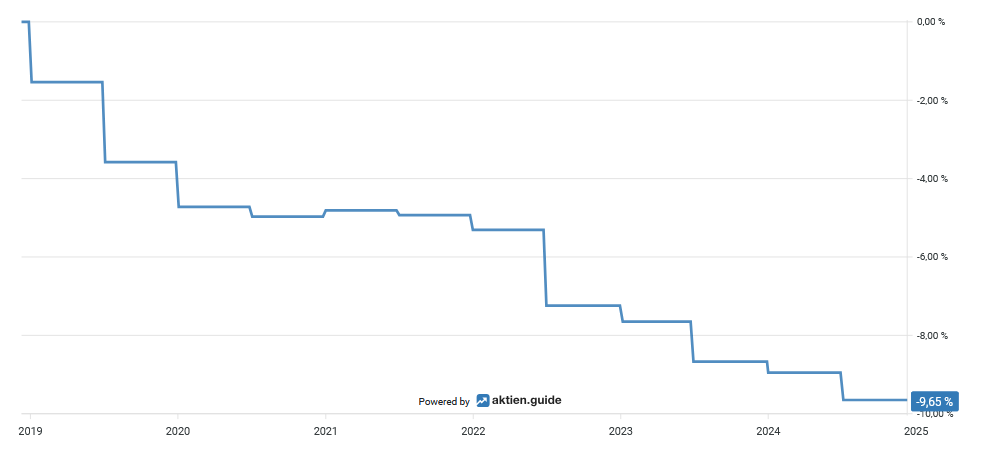
The last Aktienrückkaufprogramm of USD 1 billion was completed at the end of the 2024 financial year (1.7.2023 to 30.6.2024) and all repurchased shares were canceled. Diageo is using this instrument flexibly to return excess capital to shareholders. The current focus is on reducing debt.
Conclusion: Considerations for my decision to invest in Diageo
Thanks to a portfolio of strong brands, Diageo has a market-leading position compared to its competitors in the industry. The British spirits producer has positioned itself in attractive markets with growth opportunities and good geographical diversification. The mix of long-term stable earnings and cash flows from the core business as well as high-quality investments (Moët Hennessy, United Spirits) represent an attractive time to buy at the current valuation level for investors with a long-term investment horizon.
Despite current challenges in the industry and a depressed consumer sentiment, the company has delivered a robust financial performance. Diageo remains a major player in the global beverage market and is well positioned to capitalize on future growth opportunities with premium products in the gin, tequila and whisky categories. A progressive capital allocation policy of acquisitions, dividend growth and share buybacks is on top.