- With its software product range, Microsoft offers its customers a consistent, closely networked offering as an ecosystem that is difficult to replace. This moat is flanked by a historically grown monopoly thanks to the Windows operating system.
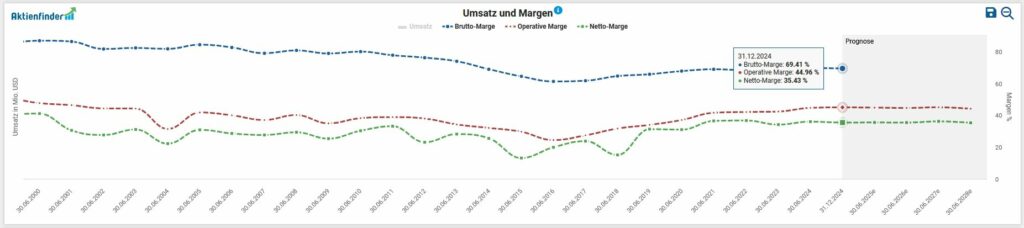
- The sales model based on licenses and subscriptions provides Microsoft with recurring revenue while at the same time ensuring high customer loyalty and high barriers to market entry. Microsoft increased its operating margin from 24 % in 2016 to 45 % today.
- Microsoft is rated by Standard & Poor's with the highest investment grade AAA (the only company in the world besides Johnson & Johnson). The healthy balance sheet with extremely low debt and a moderate goodwill position forms a solid foundation.
- The top management around CEO Satya Nadella has established a diversified product and service portfolio in which different product divisions within the three business segments ensure growing sales. The cloud division has made a lasting impression as a growth driver.
- Click here for the DGI model portfolio and here to the overview of this series The dividend custody account
Company profile and business model: Who is Microsoft and what does it do?
It is no exaggeration to say that Microsoft is a company of superlatives. Founded in 1975 by Bill Gates and Paul Allen founded in Albuquerque, developed into the dominant market leader for PC operating systems (Windows) and Application software for productive work (Office package consisting of Word, Excel, PowerPoint, Outlook, etc.) has become a major player in the Cloud area, social media and in the Gaming division.
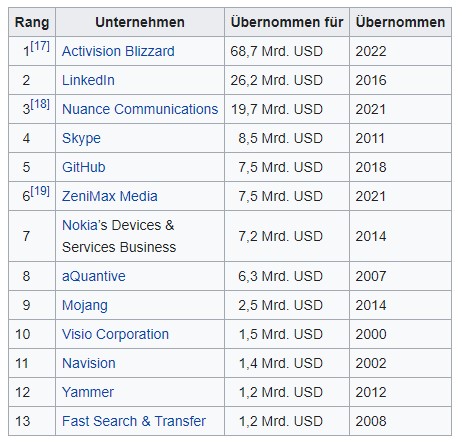
In the almost 50 years of the company's history, Microsoft had only three CEOs. According to the founding father Bill Gates, with Steve Ballmer and Satya Nadella two equally charismatic personalities have been shaping the fortunes of the IT group in their own special way. However, the second most valuable company in the world after Apple is by no means an uncontroversial company. Numerous debates about tax optimization and avoidance as well as high-profile legal disputes about Microsoft's dominant competitive position have accompanied the company based in Redmond, Washington, for decades. This has been accompanied by a large number of AcquisitionsMicrosoft's business model in its current form
The business model from Microsoft is divided into three central segments:
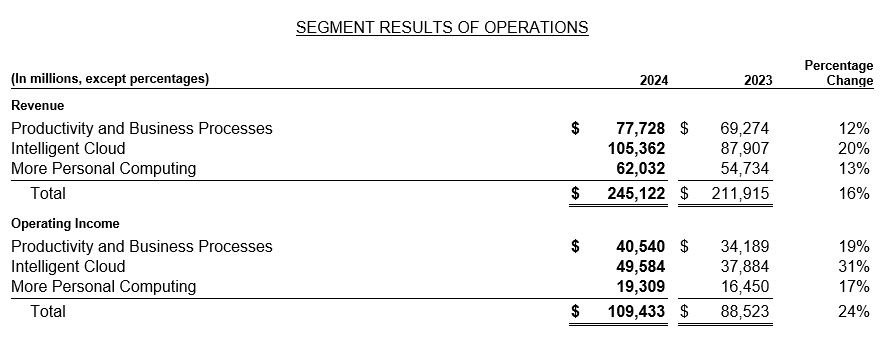
The segment Productivity and business processes consists of Office Commercial (Office 365 subscriptions, individual solutions such as Exchange, SharePoint, Microsoft Teams, Office 365 Security and Compliance) and Office Consumer (Microsoft 365 Consumer subscriptions, OneDrive, Skype) as well as the career platform LinkedIn and Business Intelligence/Customer Relationship Management tools (combined under Dynamics Business Solutions).
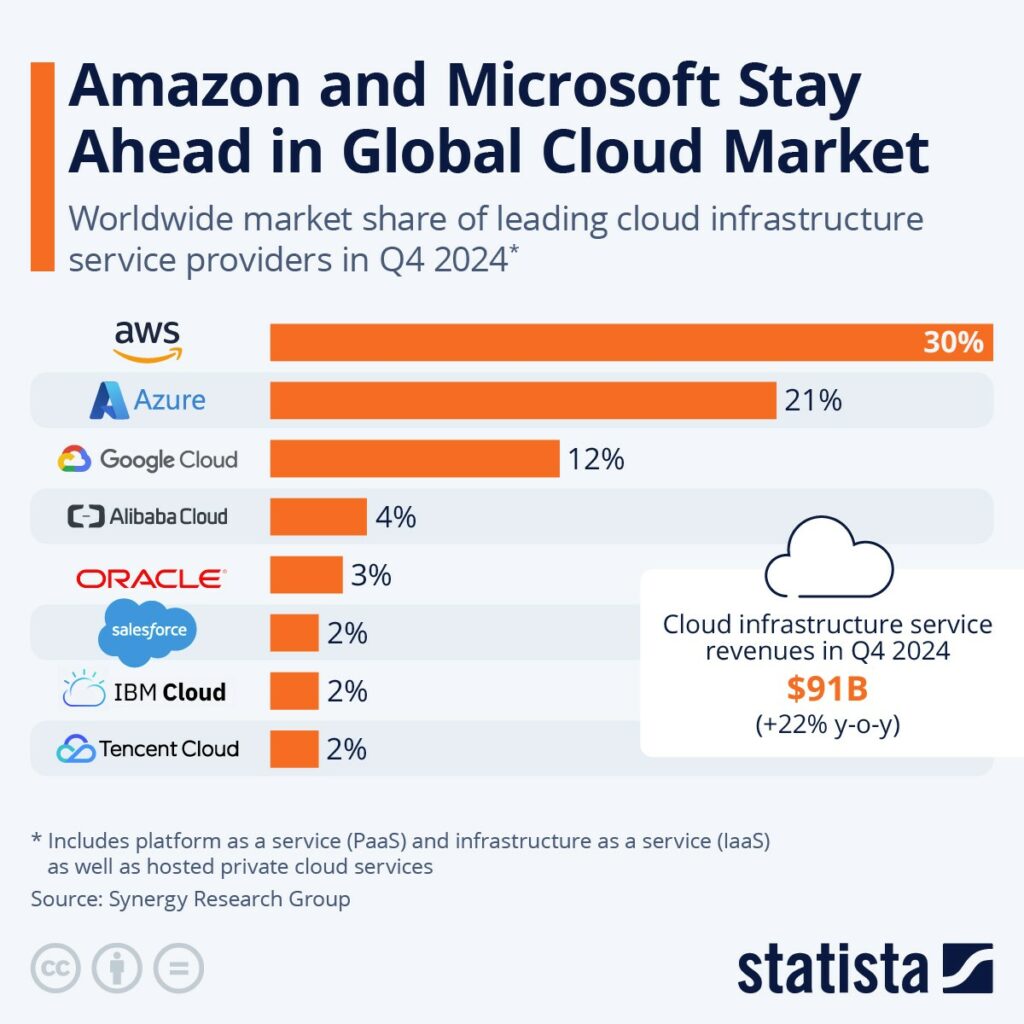
Under the segment Intelligent Cloud the server products and cloud services, including the well-known Azure Cloud or the platform popular in the software engineering community GitHub for version management and better collaborative work. Microsoft Azure is the second-largest service provider in the growing cloud computing market behind Amazon Web Services and before Google Cloud.
The third and therefore last business division called More Personal Computing consists of the nucleus of the company's success in the late 20th century, namely the Windows operating system and all associated license models. In addition, devices such as Surface and other PC accessories, gaming with the Xbox game console, Xbox Game Pass and other subscriptions, video games as well as third-party video game license fees and advertising revenue generated by the search engine Bing recognized in this segment.
Microsoft has a strong position in the gaming sector with the Xbox. With this video game console, they are competing with the other two major players Sony (Playstation) and Nintendo (Switch). Microsoft strengthened this division with the acquisition of Activision Blizzard around imposing USD 68.7 billion.
At the ownership structure from Microsoft, the extremely high proportion of Institutional investors of the market. This amounts to just under 75 percent and is usually fed by the "usual suspects" of asset managers.
About the turnaround story since the CEO position was taken over by Satya Nadella a lot has already been reported in the media. The most striking was certainly the establishment of the cloud business under the leadership of the Indian-born CEO, who celebrated his 30th anniversary at Microsoft in 2022. Hardly surprising, as Nadella was responsible for the cloud business before moving to the top of the Group. Cloud area responsible.

Industry profile and competitive situation
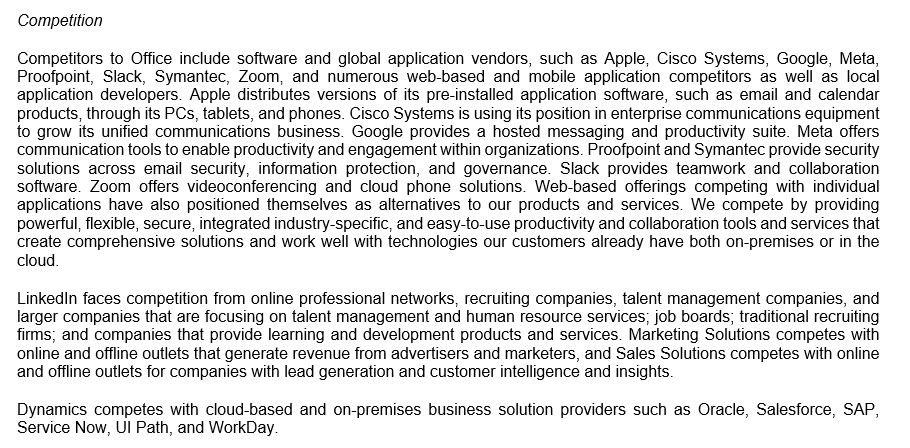
The characteristics of Microsoft's business model shape the Comparison with listed competitors at the overall Group level is not very useful. The peer group is made up of different competitors in the various business segments. Without claiming to be exhaustive, these include Amazon, Alphabet, Apple, Crowdstrike, ServiceNow, Nintendo, Sony, etc. In any case, you can form your own opinion based on the evaluated fundamental data of Microsoft and possibly a segment-by-segment comparison with the leading companies in each business segment.
The financial situation at Microsoft
After gaining an overview of the industry in general and taking a closer look at the company, its management and competition, we take a look at Microsoft's balance sheet and the key financial figures derived from it. The focus here is on the following aspects Growth, profitability and the Financing.
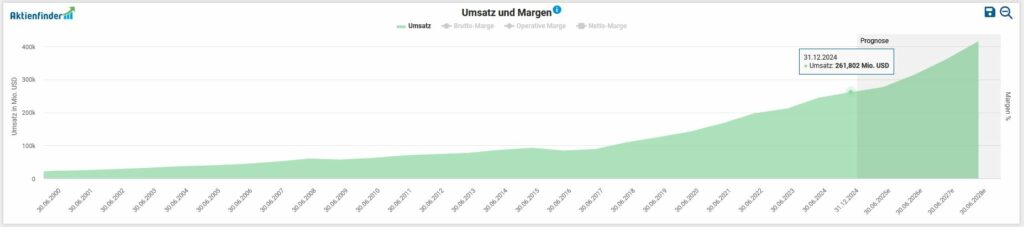
To analyze the financial situation, the first step is to look at the development of sales, profit and free cash flow. I have already discussed the internal distribution of turnover by segment in the chapter on the business model above. On average, the top line has grown over the last five years by 14.3 percent p.a. which is attributable in particular to the impressive growth rates in the booming cloud business.
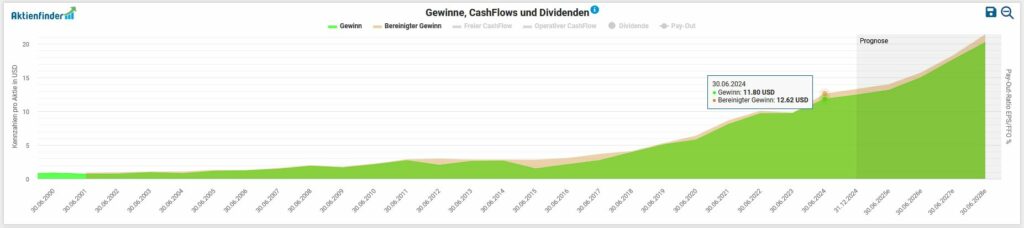
The (adjusted) Earnings per share we have seen an extremely dynamic upward trend for ten years. If we look at the past financial year 2024, the Adjusted earnings per share at 29 percent (USD 12.62 vs. USD 9.81). In the past financial year, Microsoft generated a Net profit from over 88 billion USDif the special effects are deducted from the annual result.
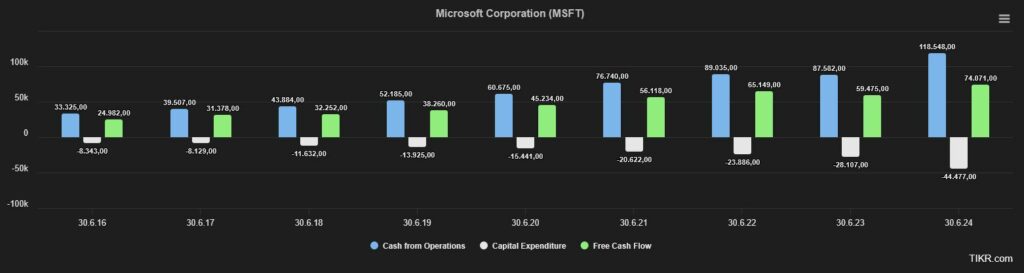
The amount available to the company Free Cash-Flow can be used for capital investments in organic growth, research and development, repayment of debt, expansion via company acquisitions, distributions of (increasing) dividends or share buybacks. In absolute figures - which I primarily like to use - the picture of operating and free cash flow as well as capital investments (CapEx) for the period 2016 to 2024 is as follows:
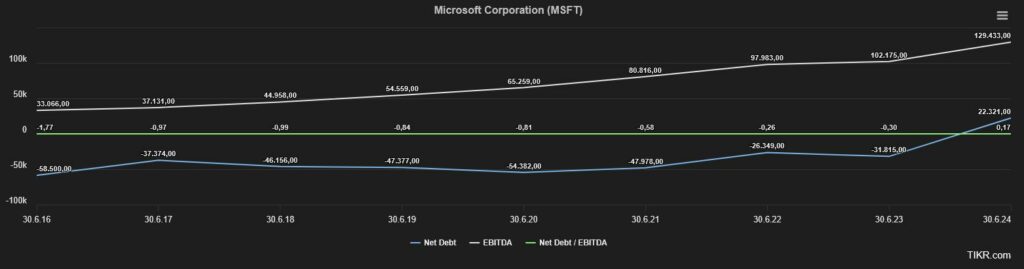
A look at the Debt situation tells us that, based on the last financial year, Microsoft has a share of interest-bearing financial liabilities of USD 97.8 billion, which in turn is offset by cash and cash equivalents and securities totaling USD 75.5 billion. If we now divide the remaining net debt of USD 22.3 billion by the most recent EBITDA of USD 129.4 billion, the result is 0.2. This result is miles below the threshold value of 3, which is considered critical. I will therefore spare myself an in-depth examination of the maturity structure of the long-term liabilities and their interest conditions.
Finally, we look at the Profitability of Microsoft based on the development of gross, operating and net margins. In addition to the impressive net margin of around 35%, the stability of the margins over the years should be emphasized positively. This is an adequate indicator of the IT group's robust business model.
Opportunities & risks
Microsoft's monopoly-like position in the Windows and Office sector based on a highly profitable licensing model provides a certain amount of leeway when it comes to pricing in addition to recurring revenues. In the operating system and application software product segments, alternative applications from the competition or open source have a niche existence. An end to the status quo is not foreseeable in the medium term.
Although the competition in cloud computing with the two largest competitors Alphabet and AWS is fierce, once a decision has been made in favor of a cloud service provider, there is a lock-in effect. Due to the costs associated with switching, the willingness to do so is correspondingly low. Microsoft is represented in all three business segments with high-growth products and services. The increasing focus in the areas of IT security and gaming is benefiting from ongoing investments by business and private customers in these two domains.
Thanks to long-term growth in sales and cash flow, coupled with billions in investment costs in the field of AI, the company has kept its net debt close to zero for years. The highest rating awarded by S&P Credit rating with AAA confirms Microsoft's excellent credit rating.
Microsoft's monopolistic position, which is partly established today, required a number of antitrust court decisions in the past. A good 20 years ago, the Group was faced with the prospect of being split into two separate companies in the first instance, which was ultimately averted. The planned takeover of Activision Blizzard also occupied the Competition authorities inside and outside the United States. The regulatory environment for AI applications is becoming increasingly complex in the European Union and North America.
One of the biggest risks associated with Microsoft is the "priced for perfection" argument. Microsoft's notoriously high valuation can be presented as a risk by weaker growth forecasts in the future, depending on the individual timing of the share purchase.
Finally, the dynamic development of the various attack vectors and the increased intensity of targeted cyber attacks by criminal, professional groups pose a risk to Microsoft's diverse software portfolio that is difficult to assess. Due to its scaling, the technology group is exposed to Cyber attacks considerably exposed.
Current valuation of the Microsoft share
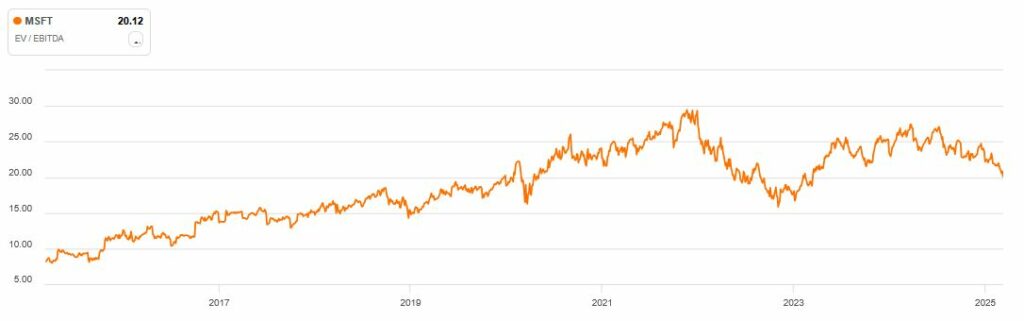
For the valuation of companies, I use the so-called Enterprise Value (EV) is used. In the case of a takeover, the EV indicates the amount required to purchase the assets required for operations and excludes the non-operating assets. I relate this key figure to operating profitability (before interest, taxes and investments (CAPEX)), expressed as EBITDA. The prevailing opinion is that a value of less than 10 indicates a „healthy valuation“ - as is always the case with generic Rules of thumb the company-specific context must be considered in the analysis by the careful investor himself. In the case of Microsoft, we have to consider a similar Valuation result of 20.1 almost exactly two years ago:
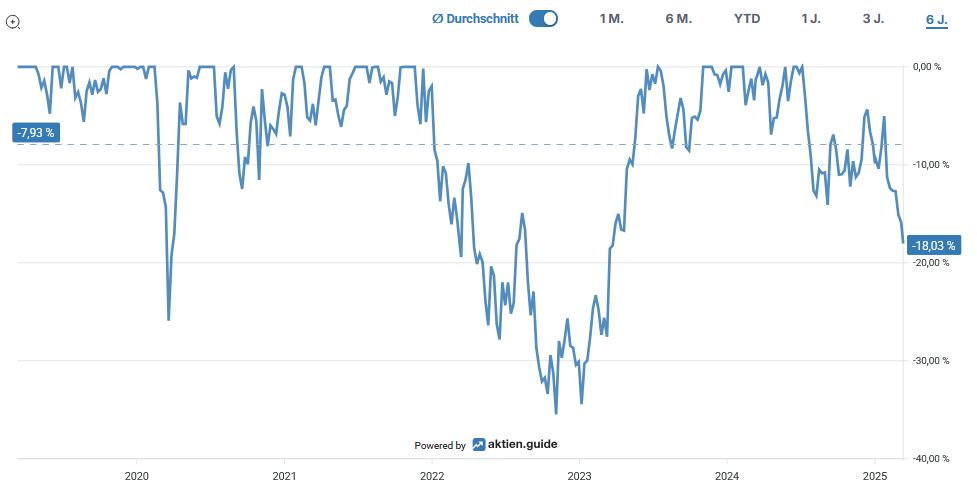
The Maximum decrease in the last six years amounted to approx. 36 percent in the bear market year 2022:
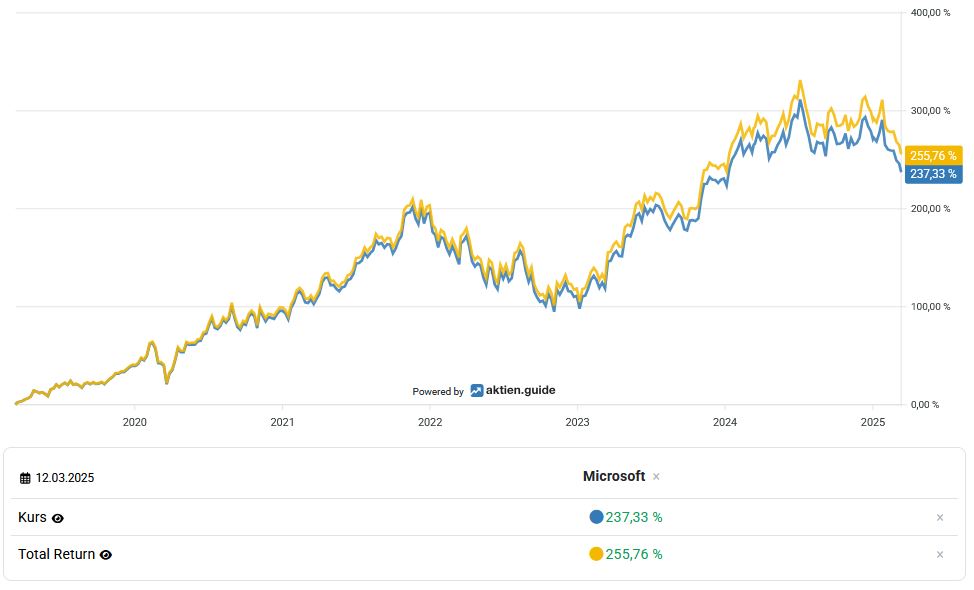
Over the past six years, an investment in Microsoft has yielded Total Return, including dividends received, a Overall performance from 256 percent for the investor:
Capital allocation of Microsoft
Since meanwhile 23 years Microsoft has been paying its shareholders a higher dividend every year. With this impressive series of dividend increases, the IT giant is well on its way to soon becoming the Dividend aristocrat to be able to boast.

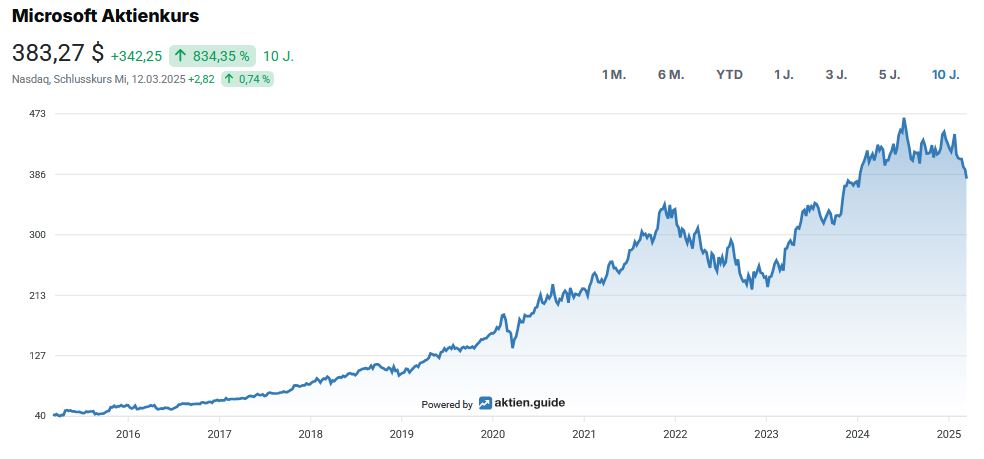
At the current share price of USD 383.27, this results in a Dividend yield from 0.87 percent. The Five-year dividend growth rate amounts to 10.3 percent p.a. or 10.4 percent p.a. in the Ten-year period. The company last increased its dividend by 10.7% in September 2024. To round things off, here is an overview of the last five dividend increases:
- 2023: +10,3 %
- 2022: +9,7 %
- 2021: +10,7 %
- 2020: +9,8 %
- 2019: +10,9 %
The quartalsweise ausgeschüttete Dividende currently amounts to USD 0.83 per share and is paid out at the end of each quarter (March, June, September, December).
If we take the average value of the Free Cash Flow of the last three years as the basis for determining the Payout ratio we end up with an extremely comfortable result of 29.9 percent for the payout ratio of Microsoft.
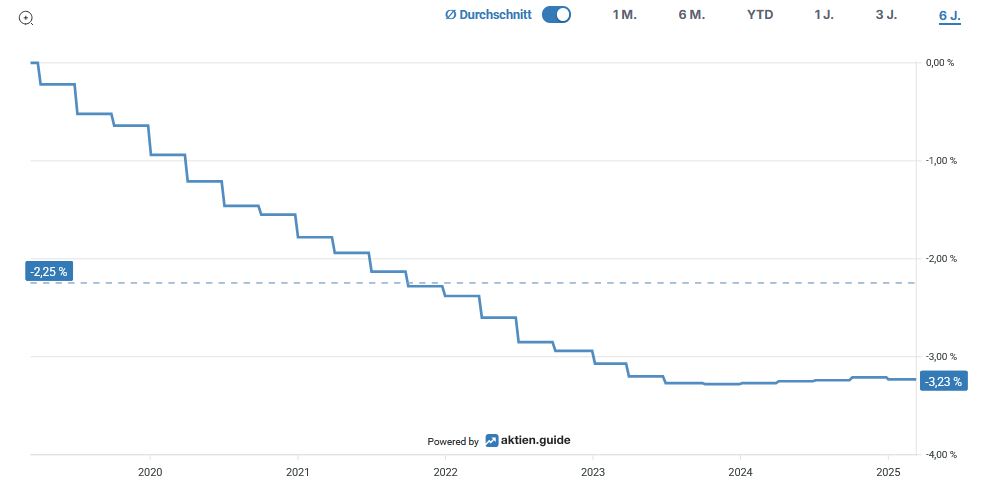
Over the past six years, the Number of shares outstanding added together by 3.2 percent reduction:
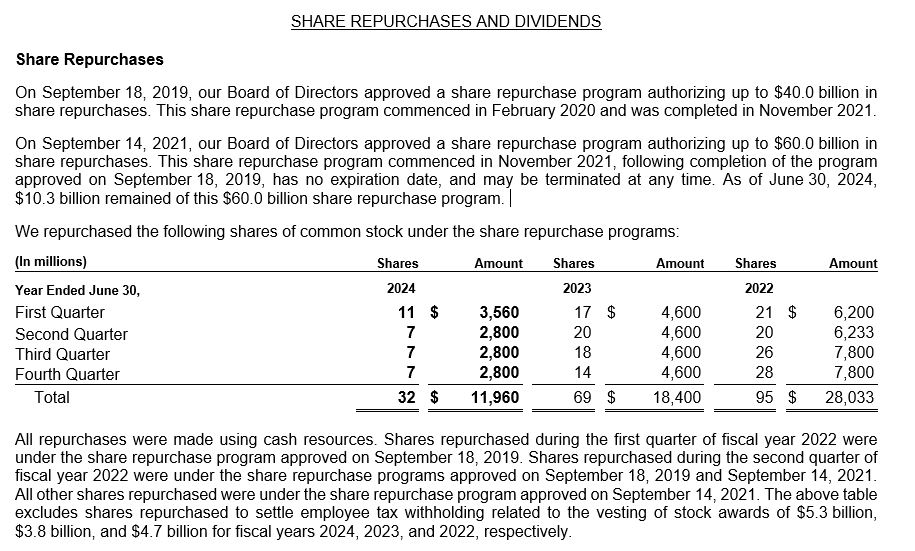
Most recently, the management bought back almost USD 12 billion of its own shares in the 2024 financial year:
Conclusion: Considerations for my decision to invest in Microsoft
In my analysis of Johnson & Johnson I have tried to characterize the investment by analogy with the basic line-up of a soccer team. While the pharmaceutical stock represents the heart of a strong and reliable defense, Microsoft is a reliable mainstay for the portfolio's offense. Long-term growth, a flawless balance sheet and the US group's strategic focus on growing markets in conjunction with the integration of artificial intelligence solutions into the cloud division speak in favor of the IT giant. There is hardly a company in the technology sector that is currently as broadly positioned in the market as Microsoft.
The management team led by charismatic CEO Satya Nadella has established a diversified product and service portfolio in which different revenue streams are managed highly profitably within the three business segments. Although the cloud division is preparing to overshadow the other two segments, there is no danger of critical dependency on a single growth driver. To conclude in soccer jargon: even the best defense needs an accurate offense to win the championship. Microsoft undoubtedly fulfills the quality criteria for an investment in the DGI model portfolio.