Dear traders, dear stock market friends.
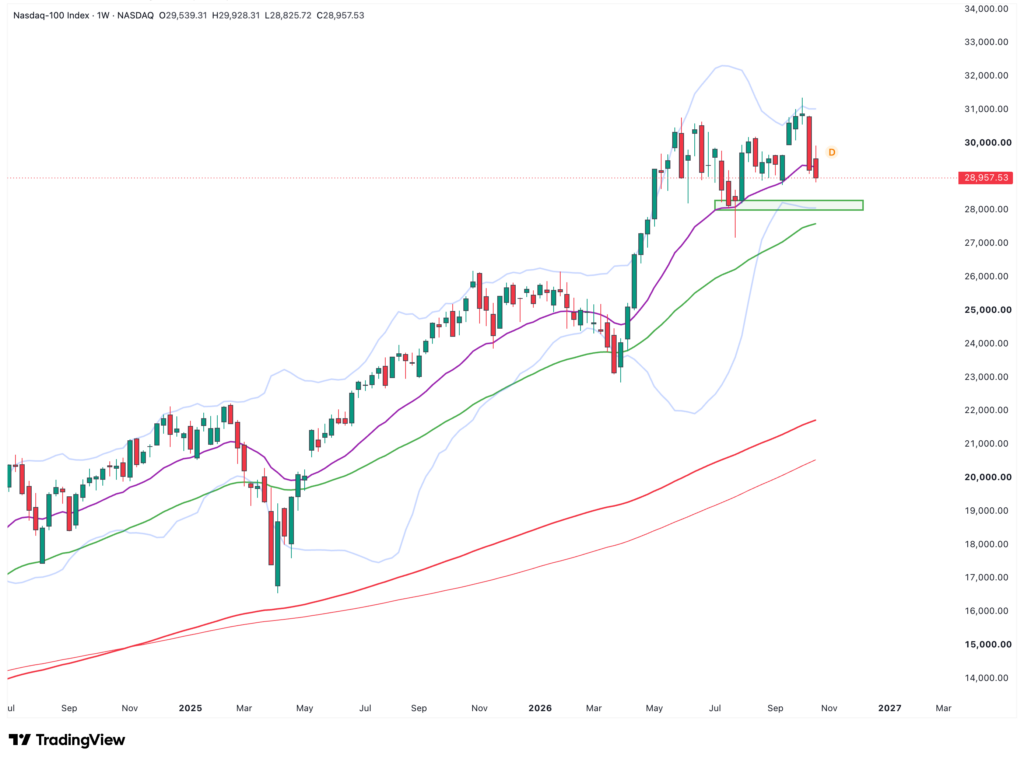
The Nasdaq 100 also ended the past trading week with a loss. Although the loss fell by about 0.8 percent, it was significantly smaller than in the previous week, nevertheless it was already the second consecutive negative week. At the end of the week, the index stood at 28,958 points, which was just under 7.7 percent below its all-time high of October 6.
At first, it seemed like a recovery was underway. On Monday and Wednesday, the Nasdaq 100 rose by more than 1 percent each. However, on Thursday, a further 2.9 percent decline followed. The large technology and semiconductor stocks were once again under pressure.
What is particularly interesting is the reaction to the current reporting season. Many companies continue to deliver strong figures. However, at the moment, that alone no longer seems to be enough for the market.
Meta and Lam Research are being sold despite strong figures
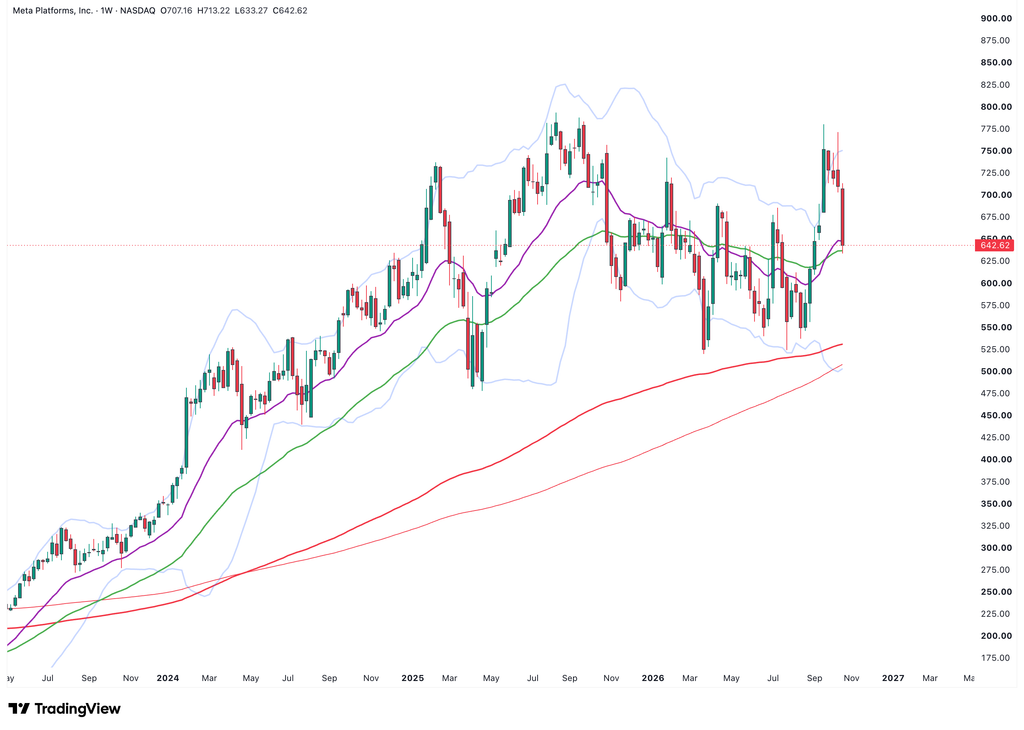
This was particularly evident at Meta. Revenue rose by 26 percent to $64.6 billion in the third quarter. At the same time, advertising revenue continues to grow strongly, and Meta is already seeing additional revenue from its AI investments. Despite this, the stock fell around 7 percent after the figures were released.
The reason lies primarily in spending. Meta now expects investments of 135 to 145 billion US dollars for 2026. In the third quarter alone, just under 35 billion dollars flowed into investments. As a result, free cash flow fell into the negative for the first time in many years, at around minus 2.1 billion dollars.
Lam Research was similarly performing. The semiconductor equipment manufacturer increased its quarterly revenue by 22 percent compared to the previous quarter to a record of $8.2 billion. The operating margin reached 40 percent for the first time. For the current quarter, Lam even announced another revenue increase to around $8.6 billion. Despite this, the stock fell sharply after the figures were released.
On Thursday, the Philadelphia Semiconductor Index lost a total of 6.7 percent. In addition to Lam Research, AMD, Intel, Marvell, and Sandisk were under heavy pressure, among others.
The problem is not so much that AI demand suddenly disappeared. Rather, investors are now paying much closer attention to how much money is being spent on new data centers, chips, and infrastructure, and how quickly these investments are actually paying off.
WTI rises again above 100 dollars
The oil price once again put additional pressure at the end of the week. WTI rose by 3.8 percent on Friday to $103.27 per barrel. On a weekly basis, the increase was around 2.3 percent. The triggers were primarily new attacks by the Houthis on Saudi Arabia and growing concerns about further disruptions to the energy supply in the Middle East.
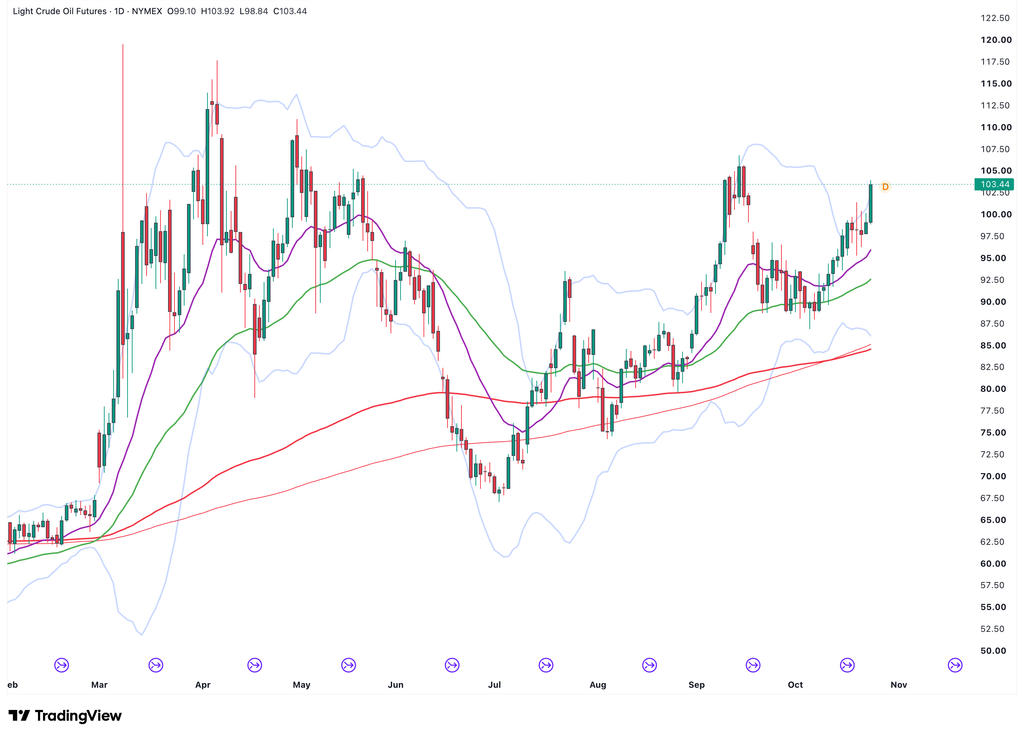
For technology stocks, this is especially relevant in light of inflation and interest rates. If the oil price remains at this level permanently or continues to rise, the recently increasing inflationary pressure could persist and force the Fed to implement further interest rate hikes.
At least there was no additional pressure from the bond market recently. The yield on ten-year US government bonds fell below the 5 percent mark during the tech sell-off.
Nasdaq 100 falls below 29,000 points
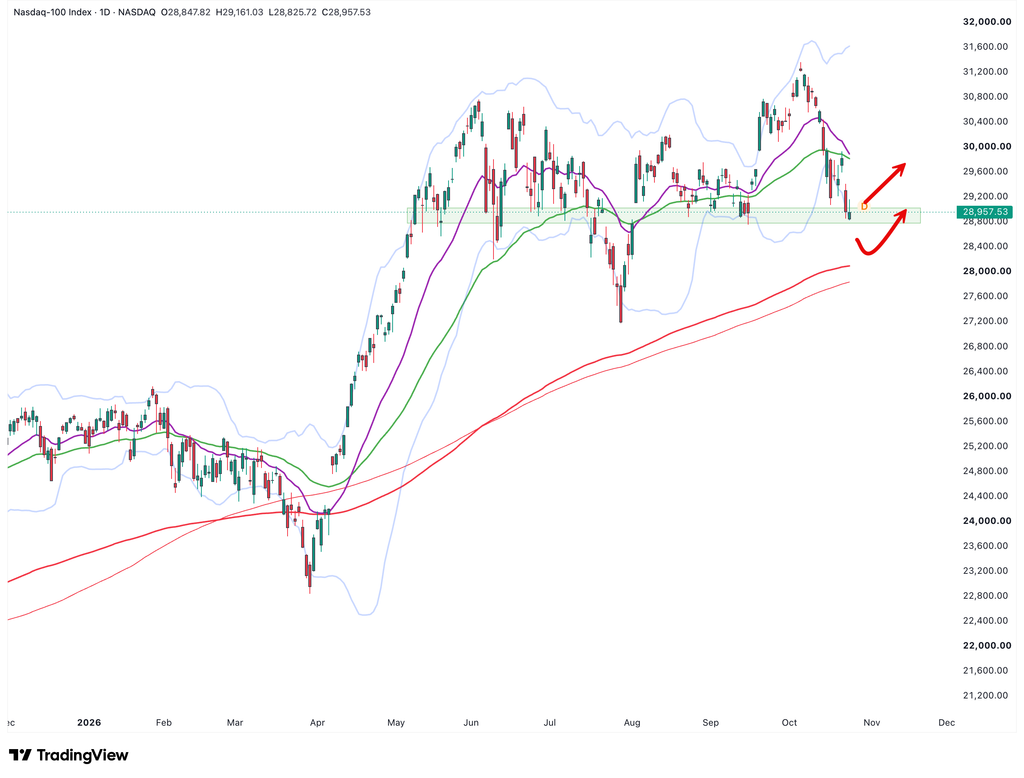
After hitting an all-time high of 31,361 points on October 6, the Nasdaq 100 fell below the round 29,000-point mark last week. With that, the index has lost almost 8 percent in less than three weeks.
However, the support is not yet broken in a sustainable manner and stabilization, based on the current support, is still possible. Should the Nasdaq 100 fall under pressure again this week, the crucial support in the medium term would be around 28,000 points. This is where the daily EMA 200 and the SMA 200 are located, the lower Bollinger band on the weekly chart, as well as horizontal support provided by the weekly closing price of the last correction low from July.
Fed, Microsoft, Alphabet and Amazon in focus
The new trading week is likely to be exciting again for the Nasdaq 100.
On Wednesday evening, the US Federal Reserve will first decide on interest rates. After the interest rate hike in September, what will be crucial is how the Fed balances the recently rising inflation with the weaker labor market.
That same evening, Microsoft and Alphabet will release their quarterly results. Both companies are investing huge sums in AI infrastructure. Following the reaction to Meta, therefore, not only revenue and profit are expected to be looked at, but at least just as much on investments, cloud growth and free cash flow.
On Thursday, Amazon and two other important economic indicators will follow. In addition to the preliminary estimate for the US GDP in the third quarter, the PCE inflation data for September will also be released.
In just two days, this should provide us with quite a few answers to the questions that are currently crucial: Will demand for AI remain strong? Will the additional revenue justify ever-increasing investments? And will inflation in the US Federal Reserve actually leave room for less restrictive monetary policy?
For a new attack on the record highs, the skepticism towards high AI spending in particular would have to subside. Good quarterly results alone do not seem to be enough at the moment. Microsoft, Alphabet and Amazon now need to show that the billions of investments are also producing correspondingly strong growth and increasing cash flows.
Author: Tobias Schmid
Date: 26.10.2026