


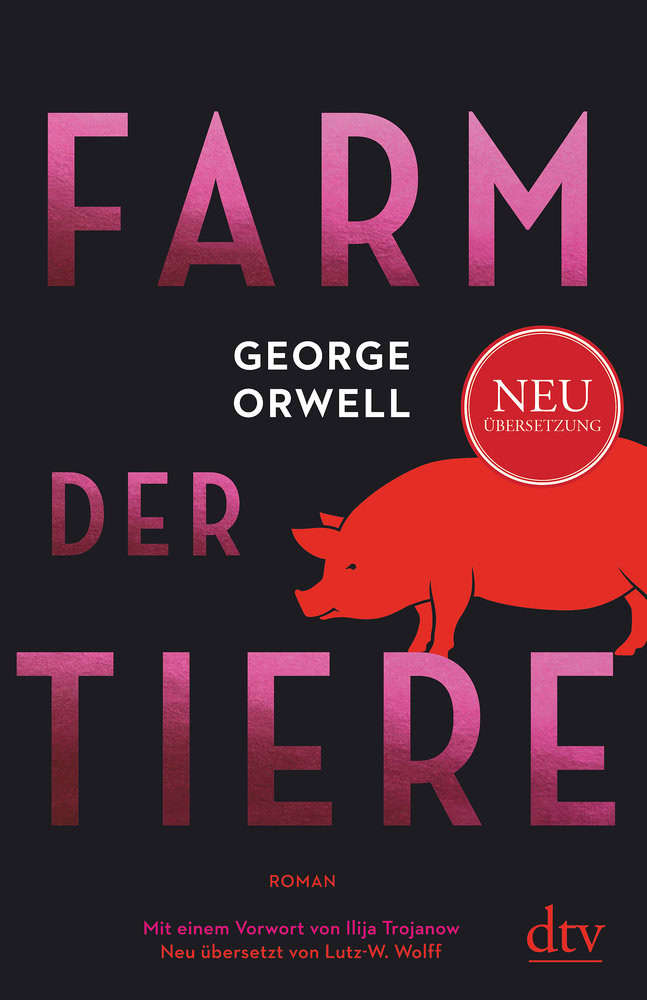

by George Orwell (new translation by Lutz-W. Wolff) is one of the legendary author's two world-famous fairy tales. Even after decades, this work still seems frighteningly topical. Not every reader may be aware of this straight away. But it is well worth taking a closer look at this book and the messages between the lines. Because it is well worth reading.
It could easily be described as one of the most famous and at the same time most haunting political fables in literary history.
This new translation by Lutz-W. Wolff with a foreword by Ilija Trojanow presents George Orwell's classic in a new light. However, the original message is not diluted in the process.

The story takes place on a farm. The animals there suffer under the harsh and violent hand of Mr. Jones, an alcoholic farmer. One day, Old Major, an elderly boar, dreams of a future without humans, where animals are free and equal. After his death, the pigs, led by Napoleon, take over and plan a revolution against Mr. Jones. The rebellion succeeds and the animals take over the farm. But what at first seems like a hopeful liberation soon develops into another form of oppression.
As power becomes increasingly concentrated on Napoleon, his rival Snowball is driven out. The other animals, especially the sheep, are manipulated and intimidated by propaganda. The original ideals of the revolution, symbolized by the seven commandments, are also gradually changed. In the end, nothing of their original meaning remains. The best-known reformulation is that of the last commandment: "All animals are equal, but some are more equal than others."
George Orwell's fable is a masterful depiction of the dynamics of power, propaganda and corruption. It shows how easily ideals can be corrupted, especially in systems of concentrated power, and how abuse of power leads to oppression. The characters, especially the pigs, are allegorical representations of political figures and ideologies. Napoleon symbolizes Stalin and Snowball stands for Trotsky. The other animals also represent different social classes: from the hard-working but gullible Boxer to the intelligent but reserved Benjamin.
The new translation by Lutz-W. Wolff brings a breath of fresh air to the classic without losing the poignancy of the original narrative. The foreword by Ilija Trojanow provides valuable insights into the genesis of the book and emphasizes its enduring relevance. The notes and timeline at the end of the book also provide additional context and background information.
"A few days later, when the horror of the executions had subsided somewhat, some of the animals remembered the Sixth Commandment - or at least they thought they remembered it. Didn't it say: No animal shall kill another animal? Although they were careful not to mention this in the presence of the dogs and pigs, many believed that the executions were incompatible with this. Clover asked Benjamin to read her the Sixth Commandment, and when Benjamin explained, as usual, that he did not want to interfere in such matters, she fetched Muriel. The goat read the commandment to her. It said: No animal shall kill another without cause. Somehow these two words must have slipped the animals' minds. But they now knew that no one had broken the commandment, because of course there were good reasons to execute the traitors who had allied themselves with Snowball.
A few days later, Muriel read through the Seven Commandments again on her own and discovered that there was another one that the animals had misremembered. They had all thought that the Fifth Commandment was: No animal shall drink alcohol. But there were two words they had forgotten. Because on the wall it said: No animal shall drink alcohol to excess."
From the fable Animal farm by George Orwell
At this point a few words about the author:
George Orwell, born Eric Arthur Blair in India in 1903, was one of the most influential writers of the 20th century. His father was a British colonial civil servant. After completing his studies at Eton and Wellington, Orwell joined the Burmese police force in 1922. This experience shaped his critical view of colonialism and authoritarian structures.
Orwell returned to England in 1927 and began to establish himself as a writer and journalist. He lived in Paris and London, where he kept his head above water with odd jobs as a dishwasher and teacher. These experiences inspired his first works, which are characterized by a direct, honest writing style and take up socially critical themes.
Orwell is best known for his novels Animal farm and 1984which have become classics of world literature. Animal farm* is a political fable that depicts the rise and fall of a revolution and criticizes totalitarian tendencies. 1984 is a dystopian novel that paints a frightening picture of a surveillance society. Not least, it has introduced terms such as "Big Brother" and "Newspeak" into the cultural lexicography.
Orwell died in 1950 at the age of just 46, but his literary legacy lives on today. His works are timeless and remain relevant, especially in the context of abuse of power, political corruption and social justice.
"Man is the only creature that consumes without producing. He gives no milk, he lays no eggs, he is too weak to pull the plow, he does not run fast enough to catch rabbits. And yet he has made himself master of all animals. He forces them to work, gives them back just enough so that they don't starve, and keeps the rest for himself. We till the soil with our labor, our manure makes it fertile, and yet there is none of us who possesses more than our bare skin. You cows that I see before me, how many hectoliters of milk have you produced this year? What has become of the milk that should have been used to rear your calves? Every drop has disappeared down the throats of our enemies. You chickens, how many eggs have you laid this year? And from how many of them did chicks ever hatch? Most of them ended up on the market because Jones wanted to make money from them. Where are the four foals you gave birth to, Clover? They should have been the support and joy of your old age. Every single one was sold when it was a year old (...)
So it is as clear as day, comrades, that all the evils in our lives stem from the tyranny of man, isn't it? All we have to do is get rid of man, then the fruits of our hard work will be ours. Practically overnight we could become rich and free. So what do we have to do? We must work day and night, body and soul, to overthrow the human race! That is my message to you, comrades: Rebellion! I don't know exactly when the rebellion will come. It may be in a week or a hundred years, but sooner or later there will be justice, I know that as surely as I see the straw here under my feet. That, comrades, is what you must focus on for the short span of life that remains to you! And above all: pass on this message of mine to those who come after you so that future generations can continue the struggle until victory is ours."
The Old Major from George Orwell's fable

Regardless of the version, this book is a must for me in any well-stocked library. Time and again, it is reissued by different publishers, retranslated and given a new look. These highlight editions also all have a place on my bookshelf.
It's quite possible that the topic is so emotionally present to me because I spent a long time in Cuba in 2019. I recognized a lot of what Orwell describes there.
If you are interested in politics, I recommend a trip to Cuba, Venezuela or another socialist regime. Not to lie on the beach, of course, but to talk to the people. Maybe then you can also find out how they are really doing there and what they want. And perhaps also what it was like there in the past, e.g. before the Cuban revolution by Fidel Castro and Che Guevara.
Again and again I have come across the reformulation of the last commandment from Animal farm I ran into him: "All animals are equal, but some are more equal than others."
This story is therefore not far removed from the reality in some regions of the world. The author succeeds in analyzing a highly sensitive topic with a wonderfully ornate story. The rebellion of the animals against their farm owner is a socialist revolution par excellence.
But all too quickly, our visions of a better world can turn into a totalitarian nightmare. That is the timeless warning of this fable.
As if by magic, the seven rules on the barn wall change. They were actually intended to regulate peaceful coexistence on the animals' farm. But with every rule that changes, so does the life of the animals on the farm. And so their dream of equality and freedom fades. Until, in the end, only one rule remains.
Over time, the situation on the farm deteriorates. Although the animals are now supposedly free, the happiness promised to them by the ringleaders does not materialize. Instead, they suffer and the bad news piles up. George Orwell sketches the impossible feasibility of socialism and the emergence of a socialist dictatorship in an amusing and exciting way.
Reading the book, one senses that centralized power destroys even the best intentions.
The narrative is both entertaining and disturbing. It conveys a profound understanding of human nature and the political mechanisms that lead to tyranny.
Overall Animal farm a masterful work that has influenced generations of readers. And it will continue to play an important role in political literature.
You might think that the author is referring to Cuba, Venezuela, North Korea, China or expropriation debates in Berlin with his story. But no, this book was written in 1943 and is absolutely worth reading! Especially for politically interested and young people who want to question the irresistible pull of socialism.
A clear recommendation for all social science courses in the upper school.
"Animal Farm was published on August 17, 1945, four months after the Allied victory in Europe, when talk of the 'Iron Curtain' between the 'West' and the countries occupied by the Red Army in Eastern and Central Europe was already a household word. The high circulation that the book achieved over the next few years brought Orwell his literary and economic breakthrough and created the basis for the creation of his last great novel: 1984. Animal Farm was a perfect fit for the beginning of the Cold War. The little didactic play was banned in the Eastern Bloc and became school reading in the West. Using dozens of translations, thousands of teachers explained to hundreds of thousands of pupils the horrors of communism, the abomination of the personality cult, the fatal nature of bureaucratic socialism, the brutality of propaganda and the embarrassment of creeping corruption."
From the epilogue
Why is it so difficult to talk openly about socialism?
I really pondered for a long time whether I should even include a book like this on my blog. After all, political topics are always tricky. And criticism of socialism in large parts of the western world even more so. You can always speak out loudly about capitalism in public and still get applause for it. In contrast, criticism of socialist systems is relegated to the back rows. But why is that? Unfortunately, I have not yet found an answer to this question. If you have one, please let me know.
"Somehow it seemed as if the farm had become richer without making the animals themselves richer - except for the pigs and dogs, of course."
From the fable Animal farm by George Orwell
Why such a book is nevertheless extremely important:
George Orwell was recommended to me by quite a few people. Interestingly, mainly from people who had lived in socialist countries and were not supporters of the system. They were able to experience socialism for themselves there. And we know all too well what happens to renegades.
The beauty of this book is the simple and understandable structure of the story. The author knows how to break down supposedly complex issues into their small, trivial components. After almost 250 pages, readers should have realized one thing: Socialism was not only a problem in 1943, but can also become a serious problem in many parts of the world today.
Perhaps the psychological context of the story is not quite clear to you yet. Then I recommend another classic, which is even older: Psychology of the masses by Gustave Le Bon. Otherwise, the much more recent books by Rainer Zitelmann are also highly recommended. On the one hand The 10 errors of the anti-capitalists and Capitalism is not the problem, but the solution.
In my opinion, Orwell and Le Bon should be compulsory reading in our schools. This will encourage our children to grow up to be responsible and free-thinking people. In this way, we can give freedom of opinion more weight again and put a stop to dictatorships and oppression.
Note on this issue:
This is the new translation by Lutz-W. Wolff in a hardback edition from dtv Verlag. It is unadorned inside, but comes with a striking and, for my taste, successful cover. However, I have also reviewed a paperback edition from Diogenes Verlag. I have also reviewed another new translation by Heike Holtsch in hardback from Anaconda Verlag. The content is comparable in all versions. Only the classification in the dtv edition represents real added value for me. That is why I have given this the only version a full five stars. All the others still suffer somewhat from George Orwell's long-winded and sometimes outdated language.
Accordingly, I can recommend all three versions. But if I could only choose one, I would go for the dtv version myself. In the end, however, it's probably a matter of taste which cover you like better.
All versions have a well-deserved place in my library.