


For numerous investors, 5G stocks present a fascinating opportunity to profit from advancements in the global telecommunications industry. The sector impresses with strong growth drivers such as expanded network coverage, edge computing, and innovative frequency technologies.
As an investor, however, you should know that this industry depends significantly on economic cycles, market developments, competitive pressure, and regulatory requirements. Which 5G stocks are currently stably positioned and what potentials and risks exist, we clarify in this article.

The most important facts in brief:
- 5G stocks offer enormous growth potential through network expansion, edge computing, and IoT.
- Top titles like ASML, Deutsche Telekom, Qualcomm, Samsung, and Nokia dominate with stable business models and high market capitalization.
- Opportunities outweigh risks such as margin pressure and regulation for the diversified portfolio via core-satellite.
What are 5G stocks?
5G stocks include shares of companies active along the value chain of the telecommunications industry.
This includes, for example, companies that develop networks, build infrastructure, manufacture devices, or market and distribute services. They operate at the intersection of technology infrastructure, data transmission, and corporate investments.
Despite volatile markets, the 5G business remains a key sector, as it plays a role not only in network expansion but is also in demand across numerous future industries. 5G stocks are particularly relevant for expanded bandwidth, edge computing, and IoT applications.
5G stocks can generally be divided into different segments of the value chain. These areas react differently to economic conditions, demand, and market conditions.
- ProducersThis includes companies that develop 5G technologies, build facilities, and install equipment. Their profits often correlate closely with market growth: as coverage increases, their margins typically increase as well.
- SupplierSuppliers manufacture components such as chips, antennas, or software modules and initiate pilot projects. They carry an increased risk, but offer enormous stock price growth potential if successful.
- Processing and recycling companyThese companies manufacture parts or process components further, for example for high-speed networks or smart devices. Their revenues do not depend solely on the 5G market, but also on demand in various sales sectors.
- Trade and service companyThis includes players that trade, finance, or upgrade hardware. They benefit from high market activity and growing demand for 5G services, especially when the availability of new solutions is scarce.
- Service providerService providers offer technology, software, and services for the 5G industry—such as network optimization, security solutions, cloud integration, or specialized maintenance. Their development depends primarily on the investments of manufacturers and thus indirectly on the overall market.
Some 5G companies operate across multiple stages of the value chain, allowing them to cushion fluctuations in individual segments and keep their earnings more robust.


The market potential of 5G stocks in 2026
Demand for 5G technologies will skyrocket by 2035 as megatrends such as digitalization, IoT expansion, and real-time data processing act synergistically.
The global 5G market started at $97.38 billion in 2025, will reach approximately $140 billion in 2026, and will grow to $5.22 trillion by 2035¹ at a staggering compound annual growth rate (CAGR) of 48.9 %, driven by government investment and infrastructure expansion.
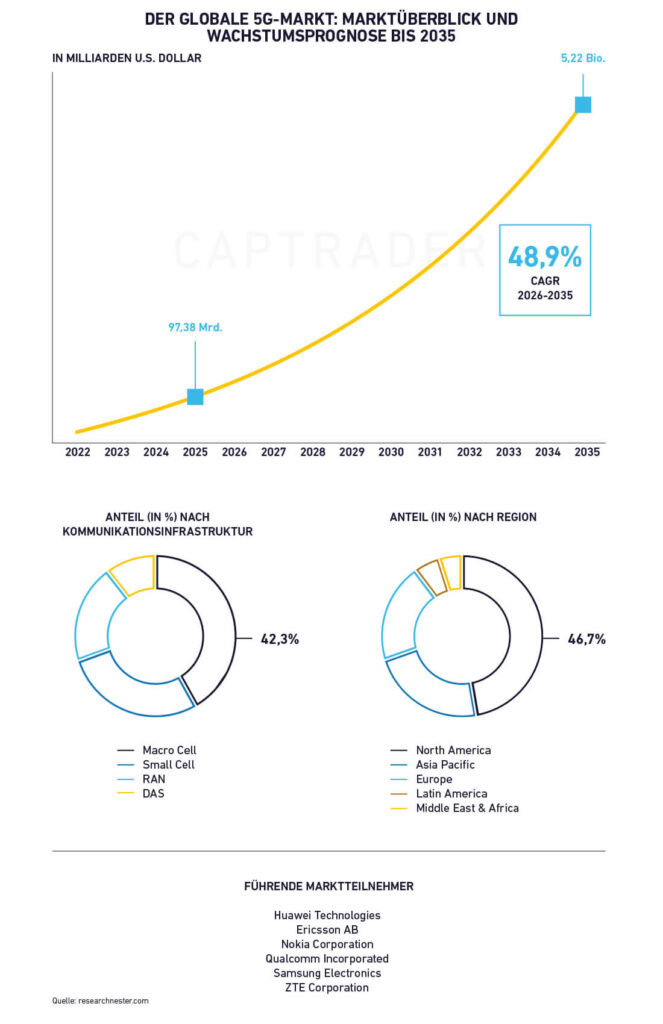
Unlike in established industries, 5G acts as a growth catalyst that generates extra demand during transformation phases, such as for smart cities, Industry 4.0, and connected devices.
Investors are thus faced not only with basic usage but also with massive demand for high-performance connectivity, which is driving subscriptions and device sales. Studies such as those by Research Nester predict that 5G subscriptions will reach the billions by 2030, with 80 % of data traffic carried over the network.
Edge Computing
Edge computing will revolutionize the 5G market by 2035 by enabling decentralized processing for smart grids and sustainable networks.
The edge computing market, which is linked to 5G, is growing rapidly because local data analysis minimizes latency and saves energy: Forecasts¹ project a volume growth of 60 % CAGR for satellite-based 5G edge solutions from 2026 (1.01 billion USD) to 2035 (74 billion USD).
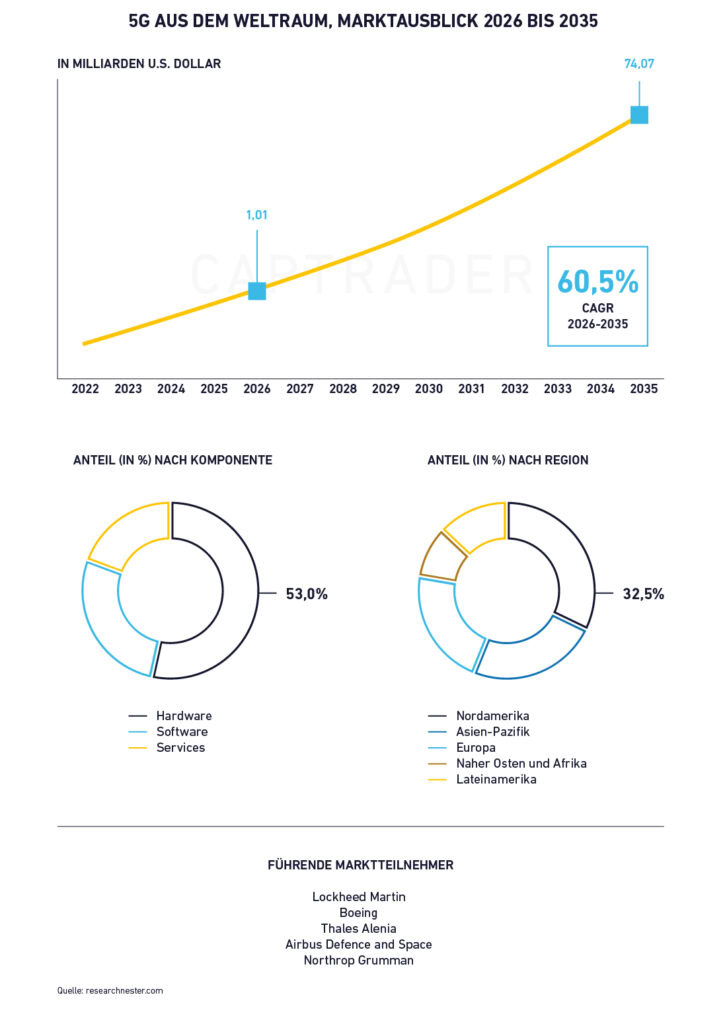
Through 5G-enabled edge solutions, IoT data is processed locally, which reduces energy consumption in data centers and boosts applications such as smart grids or autonomous logistics.
5G chipsets
In addition, the market for 5G chipsets is experiencing steady growth and is projected to grow at a compound annual growth rate (CAGR) of 17.8 % over the forecast period from 2026 to 2034.
While the market is estimated at USD 43.9 billion for 2025, an increase to USD 219.3 billion is projected for the year 2034. This development is crucial for the technological infrastructure, as specialized chipsets form the necessary hardware base for modern communication standards.
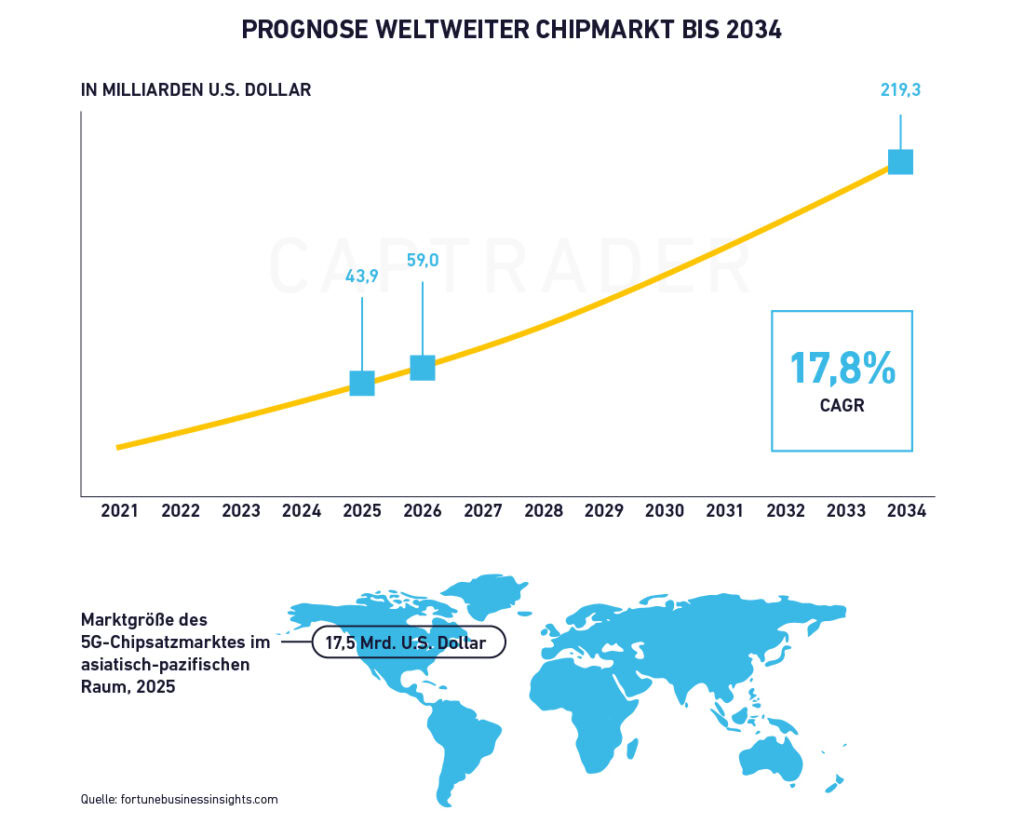
These 5G chipsets are essential for edge computing because they provide the necessary low latency and high bandwidth to process data in real time directly at the source. Without the high-performance hardware provided by 5G chipsets, edge nodes would not be able to evaluate the massive amounts of data generated, for example, by autonomous vehicles or industrial IoT sensors without delay.
Thus, these chips act as technical enablers that make intelligent and fast data processing outside of central cloud data centers actually feasible in the first place.
The best 5G stocks at a glance
The following list provides an insight into selected stocks of companies involved in the deployment, operation, and distribution of 5G networks and related technology. All data is sorted by market capitalization (as of April 2026).
| Company | ISIN | Country | Market capitalization in US dollars² |
| Samsung Electronics | KR7005930003 | South Korea | 978 billion |
| ASML Holding | NL0010273215 | Netherlands | 564 billion |
| Intel Corp. | US4581401001 | USA | 415 billion |
| Verizon Communications | US92343V1044 | USA | 194 billion |
| AT&T Inc. | US00206R1023 | USA | 182 billion |
| Qualcomm Inc. | US7475251036 | USA | 159 billion |
| German Telekom AG | DE0005557508 | Germany | 156 billion |
| Nokia Corporation | FI0009000681 | Finland | 59 billion |
| Ericsson | SE0000108656 | Sweden | 38 billion |
| Vodafone Group | GB00BH4HKS39 | Great Britain | 36 billion |
To invest specifically in 5G stocks, you need a brokerage account. With CapTrader, you can open an account and trade stocks directly on more than 170 international exchanges. The trading fees are particularly low: for US stocks, you pay 1 cent per share, with a minimum of 2.00 US dollars per order.


1. ASML
ASML Holding (ISIN: NL0010273215) acts as a technology pioneer and global market leader in lithography systems for semiconductors. Rather than simply supplying manufacturing machines, ASML masters the complete value chain: from EUV light sources and optics to software optimization and a worldwide service network.
The company uses a hybrid business model: it sells high-priced lithography systems, but generates recurring, high-margin revenue through maintenance, upgrades, and services for AI and 5G chip manufacturing.
| Tax year | estimated revenue (in million USD)² | Change compared to previous year² |
| 2025 | 38.288 | 15,58 % |
| 2026 | 45.612 | 19,12 % |
| 2027 | 55.054 | 20,69 % |
Investors thus participate in the semiconductor revolution with a focus on nanometer chips for 5G, AI, and edge computing. Thanks to its monopoly in EUV technology and automation, ASML achieves superior margins compared to competitors.
2. Deutsche Telekom
The Blue chip share Deutsche Telekom AG (ISIN: DE0005557508) is not a pure hardware provider, but rather the European market leader in telecommunications and 5G network expansion. Instead of limiting itself to basic services, Telekom dominates the value chain: from fiber-optic infrastructure and 5G masts to cloud services and IoT platforms.
The company follows a diversified model: it earns revenue from subscriptions and hardware, but generates high-margin revenue through T-Mobile USA, cybersecurity, and enterprise services such as edge computing.
| Tax year | estimated revenue (in million USD)² | Change compared to previous year² |
| 2025 | 139.586 | 2,86 % |
| 2026 | 143.894 | 3,09 % |
| 2027 | 148.090 | 2,92 % |
For investors, this means participation in the digitization boom with a focus on 5G and data. It is considered a „growth platform for connectivity“ thanks to network expansion and US expansion.
3. Qualcomm
Qualcomm Inc. (ISIN: US7475251036) does not operate as a simple chip maker, but as a global innovation leader in mobile communications and semiconductors for 5G. Instead of merely producing components, Qualcomm controls the value chain: from 5G modems and Snapdragon processors to patent portfolios and software for IoT.
The company operates a dual model: it supplies hardware chipsets for smartphones and cars, complemented by license-based revenue from technologies as well as growth in AI and edge computing.
| Tax year | estimated revenue (in million USD)² | Change compared to previous year² |
| 2025 | 44.141 | 13,34 % |
| 2026 | 43.584 | -1,26 % |
| 2027 | 43.735 | 0,35 % |
For investors, this means shares in the 5G and AI wave with a focus on licensing power and chips.
4. Samsung Electronics
Samsung Electronics (ISIN: KR7005930003) does not act as a mere electronics manufacturer, but as a South Korean giant in semiconductors, displays, and 5G components. Instead of building isolated products, Samsung masters the entire chain: from memory chips and foldable displays to foundry services and a global network.
The company relies on an integrated model: it sells consumer devices such as smartphones, but generates high margins through memory chips, 5G modems, and AI applications.
| Tax year | estimated revenue (in million USD)² | Change compared to previous year² |
| 2025 | 226.250 | 10,88 % |
| 2026 | 426.019 | 88,29 % |
| 2027 | 471.890 | 10,77 % |
Investors are thus tapping into the chip and connectivity revolution, with a focus on 5G and memory. As a „growth platform for the tech future,“ it is leveraging the AI boom and 5G rollout for record profits.
5. Nokia
Nokia Oyj (ISIN: FI0009000681) forms a strong blue-chip stock and does not act as a simple device manufacturer, but as a Finnish specialist for network infrastructure and 5G technology.
Instead of selling end products, Nokia controls the value chain: from base stations and Airscale software to cloud core and optical networks.
| Tax year | estimated revenue (in million USD)² | Change compared to previous year² |
| 2025 | 23.329 | -1,85 % |
| 2026 | 24.362 | 4,42 % |
| 2027 | 25.468 | 4,54 % |
The company combines hardware sales with highly profitable services: licensing, maintenance, and enterprise solutions for 5G private networks and AI edge computing.
CapTrader can do that:
At CapTrader, the trading fees are extremely low: you can trade US shares from as little as $ 0.01 per share (order minimum $ 2.00) and German shares from as little as 0.1 % of the order volume (order minimum €2.00), options from €2.00, futures from €1.00, ETFs from €2.00 and much more!
Risk Factors in 5G Stocks: A Comprehensive Analysis for Investors
5G stocks allow investors to enter the expansion of an entire technology sector. However, they are subject to strong economic fluctuations, technological disruptions, and political influences.
Investors in network operators or technology suppliers must be aware of the characteristic risks of this sector.
Margin pressure and cost structures in 5G stocks
The profitability of 5G network operators and suppliers results primarily from the balance of selling prices, material costs, and plant utilization rate.
In recent years, rising raw material prices and fierce competition have noticeably squeezed the profit margins of numerous companies.
- Increased production expenses due to more expensive semiconductors, antenna components, and electronics, as well as rising energy costs and wages.
- Low price control in the mass market because users are sensitive to tariffs and providers have to use discount campaigns.
- Significant share of fixed costs in infrastructure, research, and sales, meaning that decreases in demand disproportionately impact margins.
- Simultaneous investments in legacy networks and 5G infrastructure, which temporarily reduce the return on capital.
Structural change through expanded bandwidth and IoT
The telecommunications industry is undergoing a massive transformation toward higher speed, networked systems, and data-driven services.
For 5G stocks, this means that past successes are no guarantee of the future, and poor decisions can prove costly.
- Uncertainty in selecting optimal technology strategies and platforms, leading to inefficient spending.
- Heavy reliance on reliable software, as delays in development projects sabotage time-to-market and damage reputation.
- Increasing pressure from tech newcomers and Asian competitors offering low prices and rapid innovation cycles.
- Need for restructuring for suppliers whose traditional products are phasing out and who must transition to chipsets and IoT.
Economic situation, interest rates, and demand risks
5G subscriptions and device purchases often represent costly investments that are financed, which is why 5G stocks are sensitive to economic conditions and interest rates. Even slight shifts in growth or financing conditions noticeably dampen demand.
- Rising interest rates are increasing financing installments for devices and plans, impacting the mass and premium segments in particular.
- Recessions prompt residential and business customers to pause contracts or postpone upgrades.
- 5G upgrades depend partly on subsidies, the reduction of which triggers sudden slumps.
- Weaknesses in key markets such as Europe or Asia directly hit revenue and capacity utilization if diversification is lacking.
Conclusion: Buy 5G stocks - is it worth it in 2026?
5G stocks could pay off for patient investors in 2026 as they massively benefit from global network expansion, edge computing, and the IoT explosion.
The interplay of rising subscriptions, chip demand, and software growth is shifting value creation to innovation-driven players like ASML, Qualcomm, and Nokia.
At the same time, the sector remains cyclical and vulnerable to the economic climate, interest rates, regulation, and Asian competition, which triggers price fluctuations. Margin pressure from semiconductor shortages, high investments in infrastructure, and supply chain risks can curb profits.
However, as an investor, you should not rely solely on semiconductor stocks. For example, 5G stocks can be ideally diversified using a core-satellite approach.
For a balanced portfolio construction, the Core-satellite strategy optimal: Solid core of proven 5G giants with stable Dividendenhistorie, supplemented by dynamic growth stocks as satellites to boost returns. This concept flexibly fits various sectors such as AI shares, Automotive stocks or Silver stocks.
List of sources:
(1) Source: Researchnester dated April 27, 2026
(2) Source: Marketscreener, 04/27/2026
