


Belgian stocks are considered an interesting option for investors who want to benefit from a stable European economy and internationally successful companies. Sectors such as pharmaceuticals, chemicals, and infrastructure in particular shape the market and ensure a solid economic foundation.
In this article, you will learn which Belgian stocks are currently in focus, what opportunities and risks the market offers, and which economic and global factors are influencing price development.

The most important facts in brief:
- As one of Europe's leading life science hubs, the Belgian pharmaceutical market is growing on schedule to 8.89 billion US dollars in 2026.
- Strategic major ports secure resilient goods flows and steady cash flows in the dynamic EU logistics market ($1.79 trillion by 2031).
- Global demand shocks, demographic skills shortages, and strict EU regulatory climate targets require selective stock-picking.
Belgian stocks: What characterizes the market?
Belgium is among the economically most stable First World countries in Europe. According to current forecasts¹ by European institutions, the Belgian economy is growing continuously, albeit at a moderate level. Factors such as an aging population, rising government spending, and structural challenges in the labor market are dampening this momentum.
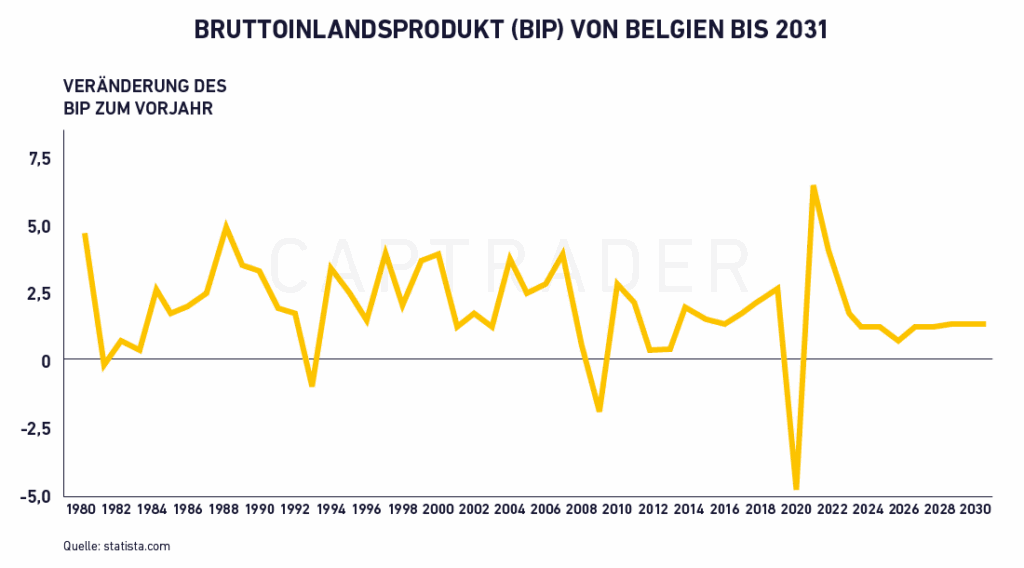
According to current data and forecasts, Belgian GDP will grow only moderately between 2023 and 2025, at annual rates ranging from 1 to just under 2 %. For 2026 through 2030, a similarly subdued but stable growth path in the range of about 1 to 1.5 % is expected.
For investors in Belgian stocks, this means that the years 2023 to 2030 are characterized by limited economic tailwinds, while at the same time featuring a highly predictable environment in which quality companies and solid Dividend stocks could be particularly interesting.


The BEL 20 at a glance
The BEL 20 is the main leading index of the Euronext Brussels stock exchange and reflects the performance of up to the 20 largest and most liquid publicly traded companies in Belgium.
It is weighted based on crisis-adjusted free-float market capitalization, with the weight of any single stock capped at a maximum of 15 % during the annual index review.
Unlike tech-heavy or highly cyclical indices, the BEL 20 is considered a defensive anchor: with a focus on healthcare, consumer staples, and banking/insurance, it exhibits lower volatility in times of crisis than, for example, the DAX.
The top 5 companies in the BEL 20 and their respective weights in the index are:
| Company | ISIN | Weighting in the index | business model |
| argenx SE | NL0010832176 | approx. 12.6 % | Biotech pioneer for antibody therapies against severe autoimmune diseases. |
| UCB S.A. | BE0003739530 | approx. 12.4 % | Biopharma company focused on neurology and immunology. |
| AB InBev | BE0974293251 | approx. 11.8 % | World's largest brewing group (including Budweiser, Stella Artois, Beck's). |
| KBC Group | KBC / BE0003565737 | approx. 11.7 % | Leading banking and insurance group in Belgium and Central Europe. |
| Ageas SA/NV | BE0974264930 | approx. 8.2 % | International insurance group (life and property/casualty insurance). |
Belgian stock market: Strong sectors in focus
Since the domestic market is small, almost all publicly traded companies operate internationally from day one. They thus invest in highly specialized export champions that hardly have to fear global competition in their niches.
The most important sectors in detail:
- Pharma & BiotechCompared to other EU countries, Belgium spends an above-average amount of capital on research and development. Close collaborations between top universities and industry produce global biotech giants (e.g., Argenx, UCB).
- Brewing & ConsumptionBrewing is a Belgian cultural asset and global market leader at the same time: AB InBev, the world's largest beer corporation, is based in Belgium, complemented by lasting successes in Consumer goods stocks like Lotus Bakeries (Biscoff).
- Specialty chemicals & materials technologyInstead of relying on vulnerable basic chemistry, Belgian corporations like Umicore and Syensqo are focusing on catalysts, precious metal recycling, and battery materials.
- Logistics, Infrastructure & Hydraulic Engineering: Thanks to the Port of Antwerp-Bruges (Europe's second-largest seaport), the country is home to global giants in hydraulic engineering (DEME) and specialized real estate companies for logistics (WDP).
Top Belgian Stocks 2026: Sorted by Market Capitalization
The following overview presents a selection of major listed Belgian companies, sorted by market capitalization. You can find more exciting stocks in the Belgian stock index.
| Company | ISIN | Industry | Market capitalization in square euros |
| Anheuser-Busch InBev | BE0974293251 | Brewery & Beverages | 141 billion |
| UCB | BE0003739530 | Biopharma | 49 billion |
| KBC Group | BE0003565737 | Banking & Finance | 48 billion |
| Elia Group | BE0003822393 | Utility company / Power grid | 15 billion |
| Ageas | BE0974264930 | Insurances | 13 billion |
| Lotus Bakeries | BE0003604155 | Food | 10 billion |
| D'Ieteren Group | BE0974259880 | Automotive Services & Investments | 9 billion |
| Syensqo | BE0974464977 | Specialty Chemicals | 7 billion |
| Aedifica | BE0003851681 | Real Estate (REIT) | 6 billion |
| Warehouses De Pauw (WDP) | BE0974349814 | Real Estate (REIT) | 5 billion |
Get more out of your investments with CapTrader. Open your brokerage account today and get direct access to over 170 stock exchanges worldwide. Trade Belgian stocks starting at an unbeatable 0.1 % (minimum fee of €4.00).


List of Companies in Belgium with the Highest Dividend Yields
Now that we've highlighted the 10 most valuable publicly traded companies in Belgium, we'll turn our attention to the 10 Belgian stocks with the highest dividend yields.
| Company | ISIN | Industry | Dividend Yield² |
| Solvay SA | BE0003470755 | Specialty Chemicals | 9,18 % |
| Care Property Invest NV | BE0974273055 | Real Estate (Healthcare Real Estate / REIT) | 8,13 % |
| Solvac S.A. | BE0003545531 | Investment Holding Company | 7,60 % |
| Groupe Bruxelles Lambert SA (GBL) | BE0003797140 | Investment Holding Company | 6,72 % |
| Montea NV | BE0003853703 | Real Estate (Logistics / REIT) | 6,27 % |
| Aedifica SA | BE0003851681 | Real estate (care homes / REIT) | 6,15 % |
| Warehouses De Pauw NV (WDP) | BE0974349814 | Real Estate (Logistics / REIT) | 6,00 % |
| Ageas SA/NV | BE0974264930 | Insurances | 5,56 % |
| NV Bekaert SA | US62943Y1055 | Metal processing / Industrial materials | 5,35 % |
| CMB.TECH NV | BE0003816338 | Shipping / Maritime | 3,75 % |
A high dividend yield alone should not be a sufficient criterion for your investment decision. It is best to examine the fundamental quality of the company, growth prospects, and the sustainability of the payout before you invest.
Below, we take a closer look at five interesting Belgian stocks and examine how their respective business models are positioned in the current market environment.
1. Anheuser-Busch InBev
Following a period of strict debt reduction, Anheuser-Busch InBev (ISIN: BE0974293251) is the undisputed and globally leading brewing group with an unprecedented brand portfolio.
The Blue-chip stock With a dividend yield of 1.77 %, the company manages a vast portfolio of consumer goods through world-renowned core brands such as Budweiser, Stella Artois, and Corona, serving both mature markets and high-growth emerging markets around the globe.
| Tax year | Estimated revenue (in millions of euros)² | Change compared to previous year² |
| 2025 | 51.840 | -0,75 % |
| 2026 | 56.195 | 8,4 % |
| 2027 | 58.370 | 3,87 % |
Through its massive global scale and exceptional pricing power, AB InBev reliably succeeds in passing on increased raw material costs to end consumers and securing stable operating margins.
The combination of a gradually revitalized balance sheet, defensive consumer stability, and a clear focus on free cash flow generation makes the stock a classic core investment for a diversified portfolio.
2. Lotus Bakeries
Following its successful international expansion in recent years, Lotus Bakeries (ISIN: BE0003604155) is one of Europe's fastest-growing and most profitable food manufacturers, with a dividend yield of 0.83 %.
The Value Stock Through its globally expanding core brand, Lotus Biscoff, and a growing segment for healthy snacks, the company manages a focused portfolio characterized by extremely high brand loyalty both domestically and internationally.
| Tax year | Estimated revenue (in millions of euros)² | Change compared to previous year² |
| 2025 | 1.355 | 10,00 % |
| 2026 | 1.507 | 11,24 % |
| 2027 | 1.673 | 11,00 % |
Through an excellent operating margin and the ability to storm new markets, Lotus Bakeries achieves above-average and purely organic profit growth even in economically challenging phases.
The combination of a deep economic moat (brand equity), dynamic innovation, and long-term-oriented leadership as a family-owned business makes the potential Dividend aristocrats into a top-tier quality and growth satellite.
3. KBC Group
Following its strategic focus on highly profitable core regions, KBC Group (ISIN: BE0003565737) is one of the best-capitalized and most efficient bancassurance groups in the European banking and insurance landscape.
Through its established banking and insurance channels, the company manages a broad portfolio of financial services for retail, SME, and corporate clients in Belgium, as well as in selected Central European growth markets such as the Czech Republic.
| Tax year | Estimated revenue (in millions of euros)² | Change compared to previous year² |
| 2025 | 12.200 | 9,25 % |
| 2026 | 13.504 | 10,69 % |
| 2027 | 14.445 | 6,97 % |
Thanks to excellent risk management and a superior digital infrastructure (such as the award-winning Kate app), KBC is achieving reliable, highly profitable results and first-class returns on equity in the current interest rate environment. The dividend yield currently stands at 4.81 %.
The combination of a clear digital leadership role, strong anchoring in the affluent domestic market, and a historically extremely shareholder-friendly payout policy makes the stock an attractive asset for dividend hunters.
4. Elia Group
Elia Group (ISIN: BE0003822393), as a leading transmission system operator in Belgium and parts of Germany, is an indispensable and highly regulated player in European energy infrastructure.
The company, which has a dividend yield of 1.6 %, manages the transmission of high-voltage electricity through its core network areas and, as a key player in the energy transition, carries out massive infrastructure projects, particularly in the area of offshore wind power connections.
| Tax year | Estimated revenue (in millions of euros)² | Change compared to previous year² |
| 2025 | 4.273 | 4,15 % |
| 2026 | 5.364 | 25,53 % |
| 2027 | 6.299 | 17,43 % |
Thanks to state-guaranteed and regulated returns on equity (Regulatory Asset Base), the Elia Group generates extremely predictable and crisis-proof cash flows, independent of economic cycles.
The combination of an absolute monopoly status, the long-term megatrend of decarbonization, and government-guaranteed returns makes the stock an excellent, defensive value investment and stability anchor.
5. Warehouses De Pauw (WDP)
Warehouses De Pauw (ISIN: BE0974349814) stands out with a strong 6 % dividend yield and, following the consistent expansion of its own portfolio, is one of the leading and most successful publicly traded specialists in modern logistics real estate in the Benelux countries and Romania.
Through its prime locations, the company manages a modern portfolio of warehousing and distribution centers that form the logistical lifeline for leading e-commerce, industrial, and retail companies.
| Tax year | Estimated revenue (in millions of euros)² | Change compared to previous year² |
| 2025 | 450,1 | 12,98 % |
| 2026 | 494,8 | 9,92 % |
| 2027 | 544,6 | 10,06 % |
Thanks to very long lease terms (WAULT), inflation-indexed contracts, and a historically extremely high occupancy rate, WDP generates continuously increasing and operating cash flows.
The combination of the structural tailwind from modernized supply chains (nearshoring), a tax-advantageous REIT structure (GVV), and a reliable dividend history makes the stock an ideal core building block for passive income.
Opportunities for Belgian stocks
Belgian companies are characterized by high export ratios, a highly developed infrastructure, and global market leadership in key industries. Those who invest in the Belgian market benefit from the resilience and international orientation of the location.
Above all, two structural strengths offer long-term potential: firstly, the enormous innovative capacity of the chemical and pharmaceutical sector, and secondly, Belgium's indispensable role as a European logistics hub.
Chemicals and pharmaceuticals as an export driver
The chemical and pharmaceutical sector is among Belgium's most important industrial strengths and is particularly attractive to investors because it is driven by global demand, a high capacity for innovation, and a strong export orientation.
Belgium has one of Europe's most significant integrated chemical and life science clusters, where international corporations, specialized SMEs, and biotech companies are closely interconnected.
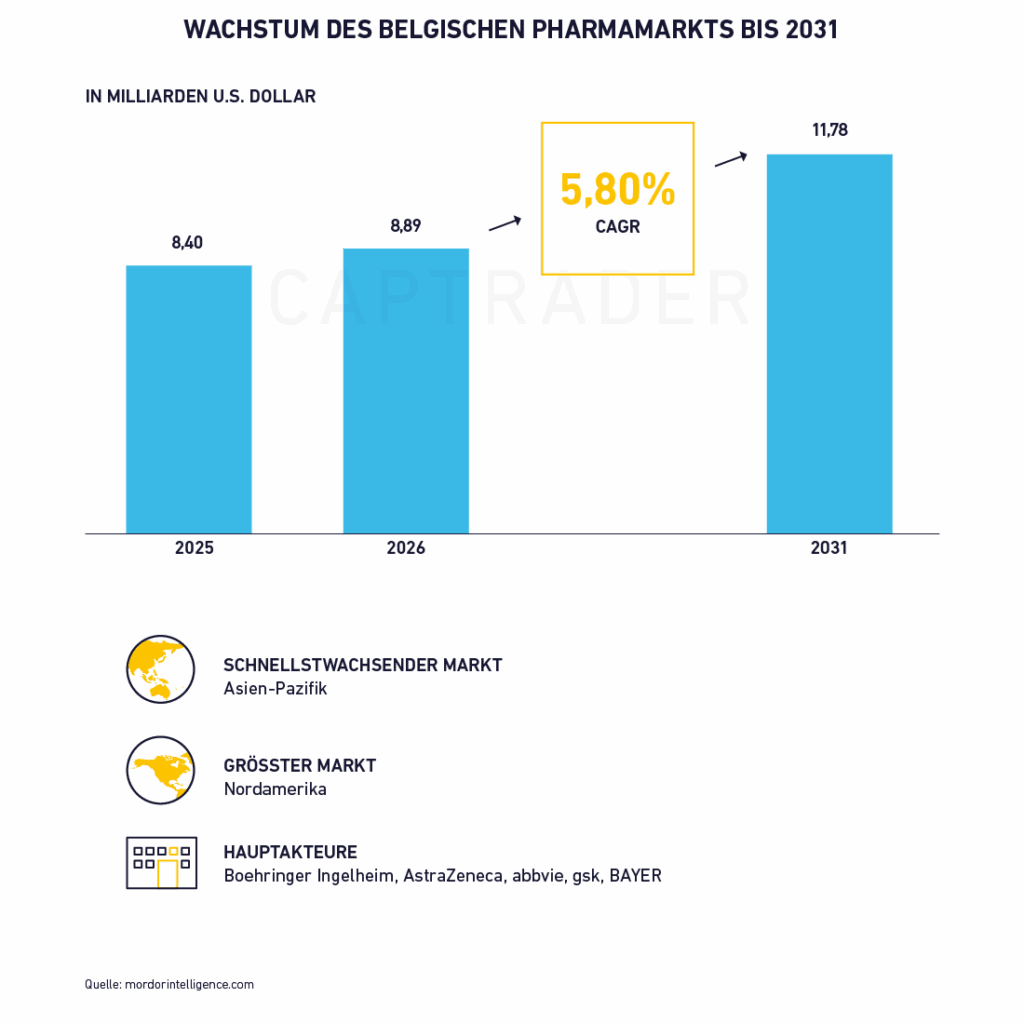
- According to Mordor Intelligence, the Belgian pharmaceutical market is expected to grow from USD 8.40 billion in 2025 to USD 8.89 billion in 2026.
- Further growth is expected by 2031, underlining the long-term attractiveness of the sector.
- Biopharma, specialty chemicals, and life sciences are particularly important as export and growth drivers.
For investors, the combination of research intensity and international competitiveness is particularly exciting. The sector is heavily export-oriented and is driven by high R&D investments as well as a dense industrial value chain of manufacturers, suppliers, logistics providers, and technology-driven service providers.
- Biopharma is one of the most dynamic subsectors of the entire pharmaceutical market in Belgium.
- The high export ratio shows how deeply integrated the industry is into international supply chains.
- The research strength of the location makes Belgium an important European production and innovation hub.
For Belgian stocks, this means that chemical, pharmaceutical, and life sciences companies benefit not only from a stable domestic market, but above all from their integration into global value chains. Especially for long-term investors, this can create structural growth opportunities.
Belgium as Europe's logistics hub
Due to its geographical location in the heart of Western Europe, Belgium plays a pivotal role in international freight transport. The logistics and port sector acts as a central growth driver for the entire national economy.
Through the close integration of global trade, modern industry, and a highly developed infrastructure, the country creates a platform for stable flows of goods. For resident and international companies, this results in a high degree of planning reliability, which is reflected in reliable and continuous cash flows.
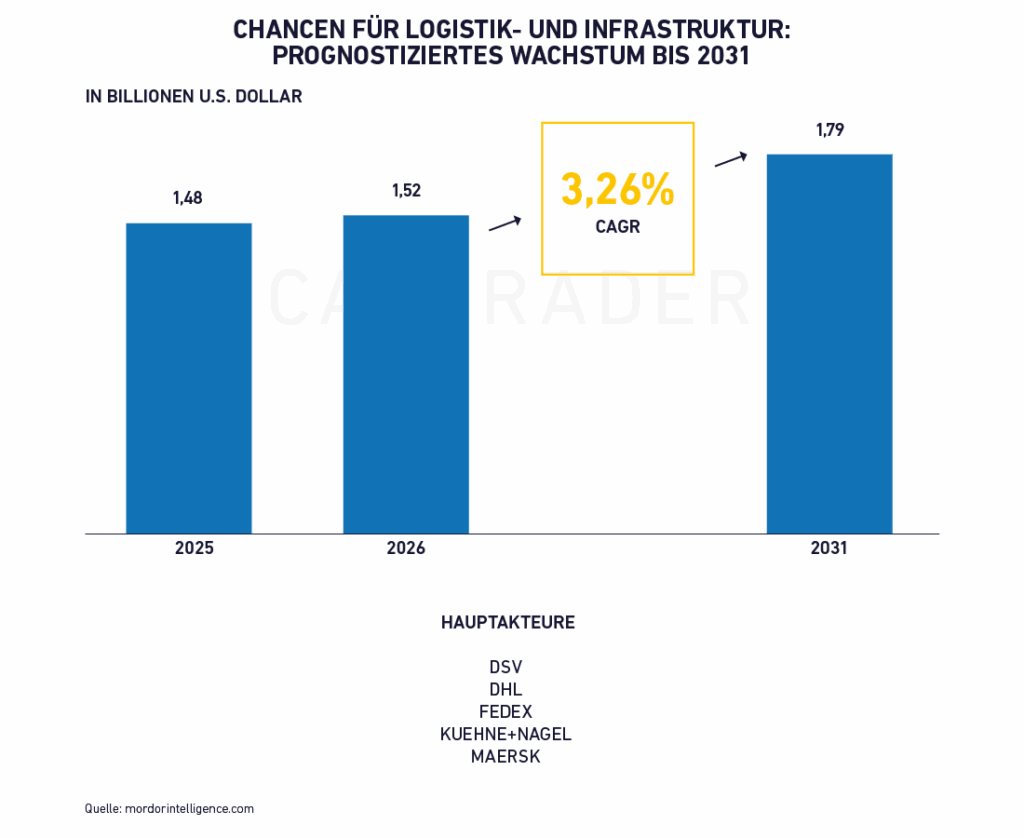
Belgium is not acting in isolation, but is the beneficiary of a superior, strong European trend. The entire European freight and logistics market is on a solid growth path.
- Market size (2026)The market volume in the European freight and logistics sector is projected at 1.52 trillion US dollars for the year 2026.
- Forecast (2031)By 2031, the market volume is expected to rise to around 1.79 trillion US dollars.
- Compound annual growth rate (CAGR): This corresponds to a stable compound annual growth rate (CAGR) of 3.26 %.
By combining strategic major ports (such as the Port of Antwerp-Bruges), a dense rail and highway network, and a specialization in high-margin niches such as pharmaceuticals and e-commerce, Belgium will remain a resilient and attractive logistics hub in the future.
Risk factors in Belgian stocks: A practical analysis for investors
Belgian equities are characterized by several structural risk factors that you, as an investor, should consider when aligning your portfolio for the long term. At the center of this are the strong export orientation, demographic change, as well as energy dependence and regulation within the framework of European climate policy.
You should pay close attention to the following three risk areas when analyzing Belgian companies.
1. Export dependency and economic sensitivity
Belgium is a small, highly open economy whose development depends heavily on trade and exports. Although domestic demand has recently provided stronger support for growth, the economy as a whole remains vulnerable to global demand shocks, supply chain disruptions, and geopolitical tensions.
- High dependence on export markets and international supply chains.
- Moderate structural growth that limits room for strong profit jumps.
- Above-average earnings impact during global downturns and trade disruptions.
In practice, this means that many Belgian stocks are closely correlated with the development of the global economy and share risks stemming from trade policy, tariff issues, and the global economic cycle.
Investors should closely understand the role of export markets and supply chains for a company's business model and price in scenarios for economic and geopolitical periods of stress.
2. Demographic change and labor supply
Belgium (like many Western European countries) has an aging population and a relatively low birth rate. Projections show that the proportion of people aged 65 and over will increase significantly by 2050, while the share of younger age groups will decline, which in the long term shifts the ratio of working to non-working people.
- Long-term stagnant or slower-growing labor force.
- Pressure on productivity and potential growth due to aging and skilled labor shortages.
- Rising social and fiscal costs that could limit economic policy flexibility.
For investors, this means that while Belgium offers a relatively predictable environment, limited momentum is to be expected from the domestic economy.
To remain successful in the long term, companies must significantly increase productivity, leverage automation and digitization, or have a strong international focus in order to offset the demographic drag in their domestic market.
3. Energy dependence, climate policy and regulation
Belgium is heavily dependent on energy imports, particularly for fossil fuels. This makes the economy sensitive to energy price spikes, supply risks, and political changes in supplier countries.
At the same time, EU climate policy is driving the transformation of energy-intensive industries such as chemicals, metals, and logistics through emissions trading, carbon pricing, and strict environmental regulations.
- High import dependency for energy, combined with price and supply sensitivity.
- Regulatory interventions in energy, climate, and emission markets with potential impacts on cost structures and investment decisions.
- Exchange rate risks for international investors due to euro fluctuations.
In practice, this means that chemical, logistics, and industrial companies in particular depend heavily on the design of energy and climate policy. Changes in political framework conditions can alter investment calculations, delay projects, or accelerate decarbonization strategies.
Important note on withholding tax for German investors
Belgium withholds a standard 30 % withholding tax on dividend distributions. Under the double taxation treaty (DTT), 15 % is automatically credited against the German final withholding tax.
The Belgian government retains the remaining 15 % shares. While you can theoretically reclaim them using the Belgian Form 276 DIV, the bureaucratic effort involved (including a certificate of residence) is usually only worth it for large dividend amounts.
Without a refund claim, your effective total tax burden on Belgian dividends is 41 %.
CapTrader can do that:
At CapTrader, trading fees are extremely low: You can trade U.S. stocks starting at $ 0.01 per share (minimum order $ 2.00) and Belgian stocks starting at an unbeatable 0.1 % (€4.00 minimum fee).
Conclusion: Are Belgian stocks worth it in 2026?
Belgian stocks will also represent an extremely attractive addition to a well-diversified portfolio in 2026. While they are less known for speculative high-growth potential, they score points with economic stability, international competitiveness, and defensive business models.
Especially for investors who are a Core-satellite strategy follow, the Belgian market offers excellent building blocks: on the one hand, stable "core" components with reliable cash flows and strong dividends, and on the other hand, highly profitable quality "satellites" with a deep economic moat.
Anyone who carefully analyzes the structural risks and proceeds selectively will find a resilient haven for long-term wealth creation in Belgian equities.
A Aktiensparplan offers you the chance to build wealth in the long term through regular, fixed amounts. You are completely flexible: whether Finnish stocks, Norwegian stocks, Hong Kong stocks or Israel stocks.
List of sources:
(1) Source: Statista as of July 1, 2026
(2) Source: Marketscreener, 07/01/2026
