


For many investors, auto stocks offer an exciting opportunity to profit from developments in the global mobility industry. The sector scores points through strong growth drivers such as electromobility, software, and new propulsion technologies.
However, as an investor, you should note that the sector is heavily influenced by the economic cycle, sales performance, competition, and political framework conditions. You can find out in this article which stocks are currently solidly positioned and what opportunities, but also risks, exist.

The most important facts in brief:
- Auto stocks allow you to participate in key trends such as electromobility, battery technology, software-defined vehicles, and autonomous driving in 2026.
- Demand for vehicles, batteries, and automotive software is expected to grow strongly through 2030/2035, which will particularly benefit manufacturers with a strong e-strategy and software expertise.
- However, the sector remains clearly cyclical and risky, for example due to economic and interest rate risks, high cost and price pressure, regulation, trade conflicts, and fragile supply chains.
What counts as auto stocks?
Auto stocks are shares of companies that operate along the automotive value chain. This includes, for example, firms that develop vehicles, operate production facilities, assemble cars, or market and distribute vehicles. They thus operate at the intersection of industrial equipment, mobility, and corporate equity.
Despite fluctuating markets, the automotive business remains a relevant sector because it plays a role not only in vehicle production, but is also needed in many future industries. Car stocks are particularly important for electromobility, autonomous vehicles, and software development.
Auto stocks can be roughly divided into different areas of the value chain. These segments react differently to economic conditions, demand, and the sales market.
- ProducersProducers include companies that develop cars, build plants, and assemble vehicles. Their profits often depend heavily on the sales market: if registrations increase, their margins usually improve as well.
- SupplierSuppliers develop components such as batteries, motors, or electronics and are launching their first projects. They carry a higher risk, but in the event of success, they also offer particularly high stock price potential.
- Processing and recycling companyThese companies manufacture parts or process components further, for example for electric vehicles or autonomous driving. Their earnings depend not only on the automotive market, but also on demand in the respective sales markets.
- Trade and service companyThis includes companies that trade, finance, or retrofit vehicles. They often benefit from high market activity and increasing demand for mobility services, especially when new models are of limited availability.
- Service providerService providers supply technology, software, and services to the automotive industry. Examples include battery technology, connected car solutions, maintenance, and other specialized services. Their business development depends primarily on the investments made by manufacturers and thus indirectly on the automotive market as well.
Some car companies operate along multiple stages of the value chain. This allows them to better compensate for fluctuations in individual business segments and make their earnings more stable.


The market potential of auto stocks in 2026
Global car demand is expected to develop dynamically until 2035, as several megatrends such as the energy transition, electrification, and digitalization are all pointing in the same direction.
Unlike many traditional industries, the automotive business is not just „production“ for everyday life, but at the same time a growth driver that is in additional demand during phases of transformation.
As a result, investors in auto stocks are faced not only with consumer demand, but also with a growing need for technology and mobility.
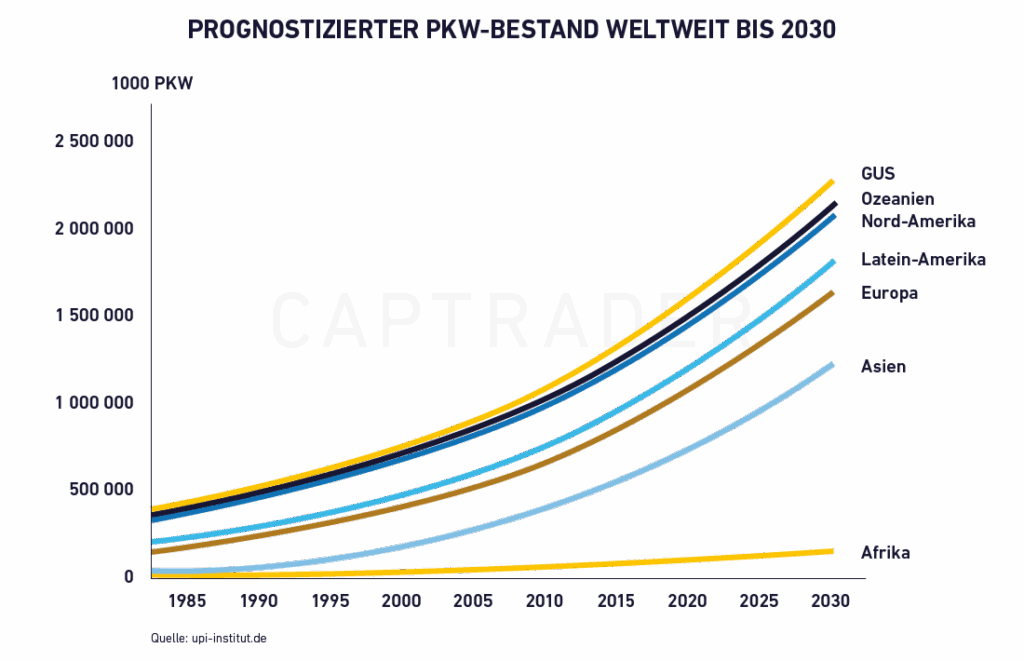
Several studies predict that the global passenger car fleet will grow significantly from about 500 million cars and increase to around 2.3 billion by 2030, which is an almost fourfold increase.
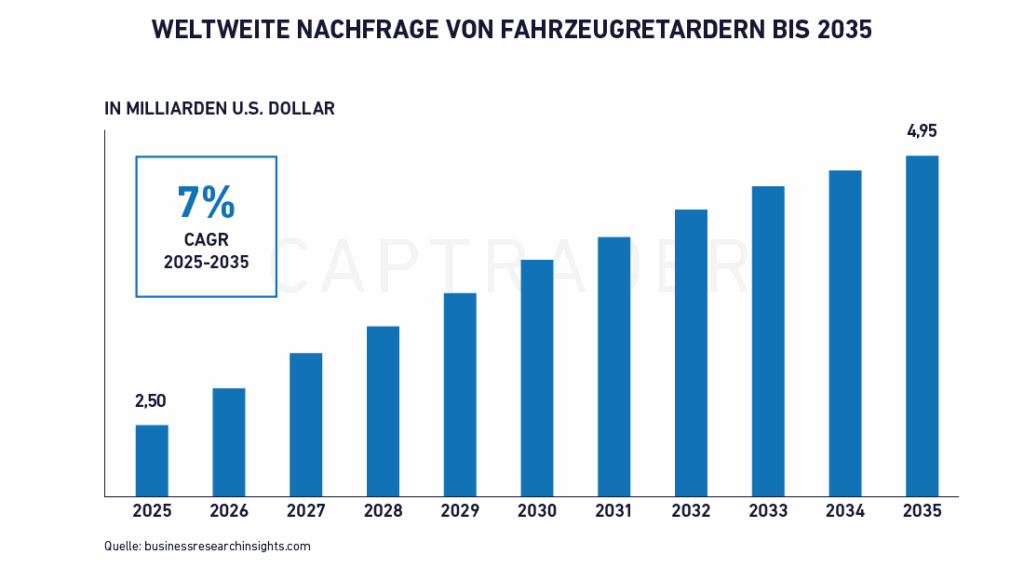
Another Studie concludes that the market for vehicle retarders was worth $2.5 billion in 2025. The market is expected to rise to $2.68 billion in 2026, before growing to $4.95 billion by 2035. This projection is based on a compound annual growth rate (CAGR) of 7 % for the period from 2025 to 2035.
Vehicle retarders are auxiliary brakes in truck and bus traffic that slow the vehicle down safely, continuously, and with minimal wear, such as during descents or continuous speed reduction.
Demand is increasing because freight traffic is growing, resulting in more trucks on the road. These vehicles require reliable sustained-action brakes to avoid frequent and heavy use of the service brakes and to enhance both safety and efficiency.
Electric cars and battery technology
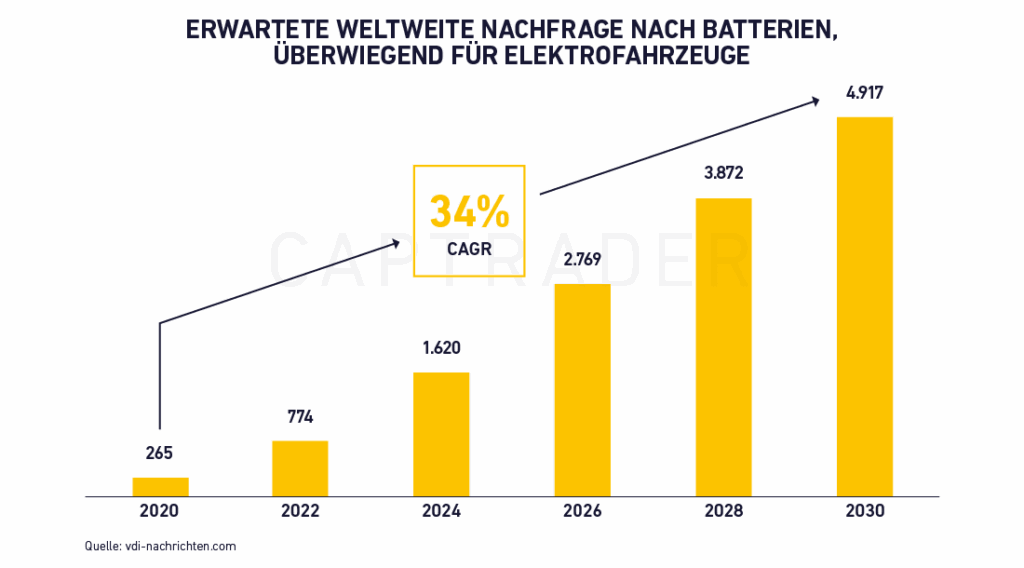
After a Studie The global market for batteries—and especially for electric vehicles—is expected to expand rapidly by 2030. Demand is projected to increase more than eighteenfold between 2020 and 2030, with an annual growth rate of approximately 34 %.
Electric mobility is the main driver here, as battery-electric vehicles account for about 80 % of current and future battery demand. Demand is projected to reach approximately 4,900 GWh by 2030.
In detail, the analysis shows:
- The battery market is growing at an annual rate of about 34 % through 2030.
- Demand will increase eighteenfold between 2020 and 2030.
- Electric vehicles account for about 80 % of battery demand.
- For 2030, a demand of approximately 4900 GWh is expected.
- New production sites are increasingly being established outside of Asia, primarily in Europe and the USA.
- China remains the central player with large capacities and low utilization rates, continuing to put the market under pressure through export and cost pressure.
This means the battery industry will remain a key sector of the automotive transition until 2030, with enormous growth, but also with competitive and structural policy challenges.
Software & Autonomous Driving
The study „Mapping the automotive software and electronics landscape“of the McKinsey Center for Future Mobility shows that software and electronics in vehicles are increasingly becoming the central competitive factor.
The global market for automotive software and electronics is expected to grow by approximately 4.5 % per year through 2035, reaching a volume of about 519 billion U.S. dollars. This growth rate is significantly higher than that of the overall market for passenger cars and light commercial vehicles, which is expected to grow by only about 1 % per year.
This means that an increasingly large portion of the vehicle's value lies in software solutions, control units, and electronic components—not primarily in the engine, body, or chassis.
- The automotive software and electronics market is projected to grow at an annual compound annual growth rate (CAGR) of approximately 4.5 % through 2035.
- Expected volume: around 519 billion US dollars.
- The overall passenger car/LCV market is growing at a rate of only about 1 % per year.
- Growth drivers are ADAS/AD software, power electronics, and operating systems/middleware.
ADAS stands for „Advanced Driver Assistance Systems“, which are driver assistance systems (e.g., emergency brake assist, lane departure warning, adaptive cruise control). AD stands for „Automated Driving“, which means higher-level automation (Level 3 and Level 4).
Power electronics control the electric powertrain in EVs, such as inverters, on-board chargers, and DC-DC converters. Middleware is a software layer between the vehicle/operating system and applications that enables standard interfaces and communication.
Risk Factors in Auto Stocks: A Detailed Analysis for Investors
Auto stocks offer investors the chance to profit from the performance of an entire industry sector. However, they are also heavily dependent on the economic cycle, technological disruptions, and politics.
Anyone investing in manufacturers or suppliers should therefore understand the specific risk drivers of this industry and not just look at sales or profit forecasts.
Margin pressure and cost structures in auto stocks
The profitability of car manufacturers and suppliers depends heavily on the interplay between selling prices, unit costs, and plant utilization rate.
In recent years, rising input prices and intense competition have put significant pressure on the margins of many companies.
- Rising production costs due to more expensive raw materials, semiconductors, electronics, and higher energy and labor costs.
- Limited pricing power in the volume segment, as customers react price-sensitively and manufacturers often have to grant discounts.
- High fixed-cost block in plants, development, and sales, causing drops in demand to have a disproportionate impact on margins.
- Parallel running investments in combustion engine and electric platforms, which dilute the return on capital employed in the short term.
Structural change through e-mobility and software
The automotive industry is undergoing a profound transformation toward electric drives, connected vehicles, and software-based services.
For auto stocks, this means that past strengths do not automatically secure the future and misjudgments can be costly.
- High uncertainty in choosing the right drive strategy and platform, which can lead to misdirected investments.
- Dependency on functioning software, as delays in software projects slow down time-to-market and damage the corporate image.
- Increasing competition from new entrants and Chinese manufacturers appearing with competitive prices and rapid product cycles.
- Transformation pressure on suppliers whose core products depend on traditional powertrains and who must reorient themselves toward electronics and e-mobility.
Economic situation, interest rates, and demand risks
Car purchases are often high-priced decisions and are frequently financed, which is why auto stocks are particularly sensitive to economic conditions and interest rate levels. Even moderate changes in economic growth or lending conditions can significantly shift demand.
- Rising interest rates are making loans and lease rates more expensive and are putting a strain on demand, particularly in the volume and mid-range segments.
- Economic downturns cause private and commercial customers to postpone vehicle purchases or renew fleets more slowly.
- Electric car sales depend in part heavily on subsidy programs, the reduction or elimination of which can lead to abrupt collapses in demand.
- Regional weakness in core markets such as Europe or China directly impacts revenue and utilization if there is no strong diversification.
Regulation, trade policy and supply chains
Automakers and suppliers are closely intertwined with regulatory requirements and international trade relations. Changes in these areas can fundamentally alter business models and significantly impact valuations.
- Stricter emission regulations and CO₂ fleet targets are forcing additional investments in efficient drivetrains and electrification, and threaten penalties if they are missed.
- New tariffs and trade conflicts are making imports and exports of vehicles, batteries, and components more expensive and can call production locations into question.
- The dependence on critical raw materials and semiconductors increases vulnerability to export bans, sanctions, and price spikes.
- Disruptions in global supply chains due to bottlenecks, natural events, or logistical problems can cause production shutdowns and delivery delays.
Different risk profiles by company type
Not every auto stock reacts the same way to these risks, as size, market position, and role in the value chain vary greatly. It is therefore important for investors to distinguish what specific type of company they are dealing with.
- Large OEMs (Original Equipment Manufacturers) usually have strong brands, global presence, and better access to capital, but bear high fixed costs and enormous investment burdens.
- Suppliers are frequently more dependent on individual OEMs and platforms and can suffer particularly from project losses or technology shifts.
- Specialized niche providers in areas such as battery technology, sensor technology, or software offer above-average growth potential, but often exhibit more volatile results and higher individual fluctuations.
Therefore, those who invest in automotive stocks should not only look at sales figures or electric vehicle quotas, but also incorporate margin trends, investment requirements, regulation, and supply chain stability into their analysis. A combination of established manufacturers and carefully selected suppliers can help spread the industry-typical risks more broadly.
An overview of the best-known and largest automotive stocks
The following list provides an overview of a selection of stocks from companies involved in the development, production, and distribution of passenger cars and commercial vehicles. All values are sorted by market capitalization (as of April 2026).
| Company | ISIN | Country | Market capitalization in US dollars¹ |
| Tesla | US88160R1014 | USA | 1.503 billion |
| Toyota | JP3633400001 | Japan | 276 billion |
| BYD | CNE100000296 | China | 135 billion |
| Xiaomi | KYG9830T1067 | China | 105 billion |
| Hyundai | KR7005380001 | South Korea | 85 billion |
| General Motors | US37045V1008 | USA | 73 billion |
| Ferrari | NL0011585146 | Italy | 67 billion |
| BMW | DE0005190003 | Germany | 60 billion |
| Mercedes-Benz | DE0007100000 | Germany | 59 billion |
| Volkswagen | DE0007664039 | Germany | 55 billion |
To invest specifically in automotive stocks, you need a brokerage account. With CapTrader, you can open an account and trade stocks directly on more than 170 international exchanges. The trading fees are particularly low: for US stocks, you pay 1 cent per share, with a minimum of $2.00 per order.


1. tesla
Tesla (ISIN: US88160R1014) is not a traditional automobile manufacturer, but rather considered a technology pioneer and one of the world's leading players in the fields of electromobility and artificial intelligence.
Instead of solely focusing on mechanical manufacturing, Tesla controls the entire value chain: from its own battery and chip development to software and the global charging network (Supercharger).
The company pursues a dual business model: it not only sells hardware in the form of electric vehicles, but also generates additional, high-margin revenue streams via software subscriptions for autonomous driving and energy storage services (Powerwalls and Megapacks).
| Tax year | estimated revenue (in millions USD)¹ | Change compared to previous year¹ |
| 2025 | 94.827 | -2,93 % |
| 2026 | 102.324 | 7,91 % |
| 2027 | 119.746 | 17,03 % |
For investors, this means participation in the mobility transition with a strong focus on software and data. Since Tesla avoids expensive dealer networks and massively automates production, the company often achieves higher margins than traditional competitors.
Through the combination of vehicle manufacturing, AI development, and energy ecosystem, the stock is often regarded as the „growth platform of the transport sector.“.
2. BYD
BYD (ISIN: CNE100000296) is not an ordinary car manufacturer, but an integrated technology giant and the world's largest producer of electrified vehicles. BYD's unique selling proposition is its extreme vertical integration: unlike almost all of its competitors, BYD produces the core components of its cars, especially the batteries (Blade Battery) and semiconductors, in-house.
Originally started as a battery manufacturer, BYD now uses this expertise to achieve cost leadership in the global market. The company covers the entire spectrum, from affordable small cars to the luxury brand Yangwang, and is simultaneously one of the world's most important suppliers of battery technology to other automakers.
| Tax year | estimated revenue (in millions USD)¹ | Change compared to previous year¹ |
| 2025 | 117.861 | 3,46 % |
| 2026 | 137.676 | 16,81 % |
| 2027 | 155.108 | 12,66 % |
For investors, BYD offers an investment in the entire value chain of e-mobility. Through its in-house cell manufacturing, the company is less vulnerable to supply chain issues and raw material fluctuations.
With the massive expansion of its own infrastructure, such as „Megawatt Flash Charging,“ and strong expansion in Europe, BYD is solidifying its role as the dominant challenger to traditional Western brands in 2026.
CapTrader can do that:
At CapTrader, trading fees are extremely low: You can trade Chinese stocks starting at a 0.20 % order fee (with a minimum of 50.00 CNH).
3. Hyundai
Hyundai (ISIN: KR7005380001) is much more than a traditional volume manufacturer. In 2026, the South Korean group has firmly established itself as the world's third-largest automaker and is considered one of the most important drivers of the multi-powertrain strategy. Instead of focusing exclusively on a single technology, Hyundai simultaneously holds top positions in electric vehicles (IONIQ series), highly efficient hybrids, and hydrogen-based mobility.
| Tax year | estimated revenue (in millions USD)¹ | Change compared to previous year¹ |
| 2025 | 126,47 | 6,29 % |
| 2026 | 132,21 | 4,54 % |
| 2027 | 138,11 | 4,46 % |
The company is characterized by enormous technological agility: with the E-GMP platform, Hyundai offers one of the most advanced 800-volt architectures, which enables extremely short charging times. At the same time, through its „HTWO“ division, the group is a global leader in the development of hydrogen fuel cells, giving it a unique position in the heavy commercial vehicle and industrial energy solutions sectors.
For investors, Hyundai represents a value-oriented core investment in the automotive sector. Compared to pure-play EV pioneers, the company offers a more stable dividend history and a diversified portfolio that is less vulnerable to demand fluctuations in individual segments.
Through massive investments in robotics (Boston Dynamics) and software-defined vehicles (SDV), Hyundai is increasingly transforming from a vehicle manufacturer into a comprehensive mobility service provider.
4. BMW
BMW (ISIN: DE0005190003) is one of the world's leading manufacturers in the premium segment. To date, the group relies on flexible production platforms on which electric vehicles, plug-in hybrids, and combustion engines can be manufactured depending on the model. This allows BMW to adapt its production comparatively flexibly to regional demand and the pace of electrification.
| Tax year | estimated revenue (in millions USD)¹ | Change compared to previous year¹ |
| 2025 | 157.087 | -6,27 % |
| 2026 | 158.520 | 0,91 % |
| 2027 | 165.424 | 4,36 % |
With the introduction of the „Neue Klasse,“ BMW is beginning the transition to a new vehicle generation starting in 2026. The focus is on a new electronics and software architecture, more efficient battery cells, and a platform more closely tailored to electric vehicles. Whether BMW can use this to catch up with leading manufacturers technologically and economically, or expand this position, also depends on the demand for electric cars, production costs, and competitive pressure.
For investors, BMW offers an established premium brand, a broad international presence, and continued profitable business segments. At the same time, the company is heavily dependent on the cyclical automotive market. Risks arise in particular from weak demand in individual markets, intense competition in China, high investments in electromobility and software, as well as potential burdens from tariffs and regulatory requirements.
5. Mercedes-Benz
Mercedes-Benz (ISIN: DE0007100000) is one of the best-known premium and luxury automobile manufacturers worldwide. For several years, the group has pursued a strategy of focusing more heavily on high-margin vehicles in the upper price segment. The goal is to secure profitability more through selling prices and the product mix rather than through rising unit sales.
| Tax year | estimated revenue (in millions USD)¹ | Change compared to previous year¹ |
| 2025 | 155.629 | -9,19 % |
| 2026 | 155.742 | 0,07 % |
| 2027 | 160.949 | 3,34 % |
Mercedes-Benz is investing in automated driving features, electromobility, and its own MB.OS operating system, among other areas. With this, the company aims to centrally control more vehicle functions in the future and offer additional digital services. However, high development expenditures will still be required before this translates into relevant and recurring revenues.
For investors, Mercedes-Benz can be attractive due to its strong brand, its position in the premium segment, and its high payouts. However, the focus on high-priced vehicles does not completely protect the company from economic fluctuations or price pressure. Especially in China, Mercedes-Benz and other German manufacturers are facing increasing competition from local providers. Further risks arise from fluctuating demand for electric vehicles, high investments, potential trade restrictions, and dependence on the global luxury goods and automotive market.
Conclusion: Are auto stocks worth it in 2026?
Auto stocks could be attractive to investors by 2026 because they directly benefit from the transformation of global mobility, particularly through electromobility, software, and autonomous driving. The interplay of rising vehicle numbers, growing battery demand, and strong growth in the automotive software and electronics sectors ensures that an increasingly large share of value creation in the industry is shifting toward future-oriented technologies.
At the same time, the industry remains clearly cyclical and heavily dependent on economic conditions, interest rates, regulation, and competition, which can lead to significant price fluctuations. Rising costs, intense price competition in the electric vehicle segment, high investments in new platforms, and risks in supply chains and trade policy can significantly burden margins and valuations.
Therefore, anyone investing in automotive stocks should pay close attention to margin trends, debt, capital expenditure requirements, and technological positioning, in addition to sales figures, as well as assess the dependence on individual markets, technologies, and suppliers.
For the structured building of your portfolio, the Core-satellite strategy proven as a stable foundation: Here, established industry giants with solid Dividendenhistorie the stable core of your portfolio. In addition, you can add more risk-tolerant growth stocks as satellites to increase the return potential.
This proven investment concept is flexible and can be applied just as successfully beyond the automotive sector to other industries such as Tech stocks, Gold Stocks, Crypto shares, green Energy stocks or Oil stocks transfer.
List of sources:
Marketscreener of 04/18/2026
