


A look at the share prices of recent years quickly reveals that the markets are as volatile today as they have been in a long time. For this reason, investors are increasingly looking for stability and sustainable growth. Economic moat stocks offer a solution to precisely this desire.
Through their competitive advantage in the market, they act like economic fortresses and promise investors resilience even in mixed market phases. In this article, we take a closer look at moat stocks and show you how you can use them to make your portfolio more robust.

The most important facts in brief:
- Moat stocks are usually less susceptible to price wars and economic cycles and are therefore suitable as a stable core in the portfolio for long-term investors.
- By 2035, megatrends such as digitalization, platform economies, and the growing importance of intangible assets suggest that the competitive advantages of many moat companies could further strengthen.
- Moats can erode due to technological disruption, poor management decisions, or overvaluation—therefore, ongoing analysis of the business model and valuation is essential.
What are moat stocks?
Moat stocks are companies that possess durable and hard-to-copy competitive advantages. These advantages protect the business model from competition and ensure that the company can hold its ground in the market over the long term.
The „moat“ describes the structural barriers that competitors would have to overcome to gain market share.
Typical characteristics of such companies are:
- High pricing power over customers
- Stable or rising profit margins
- Long-term high returns on capital
- Low substitutability of products or services
- Clear market position within an industry
The stronger these factors are, the more stable revenues, margins, and market shares generally are.
Why moat stocks are attractive for investors
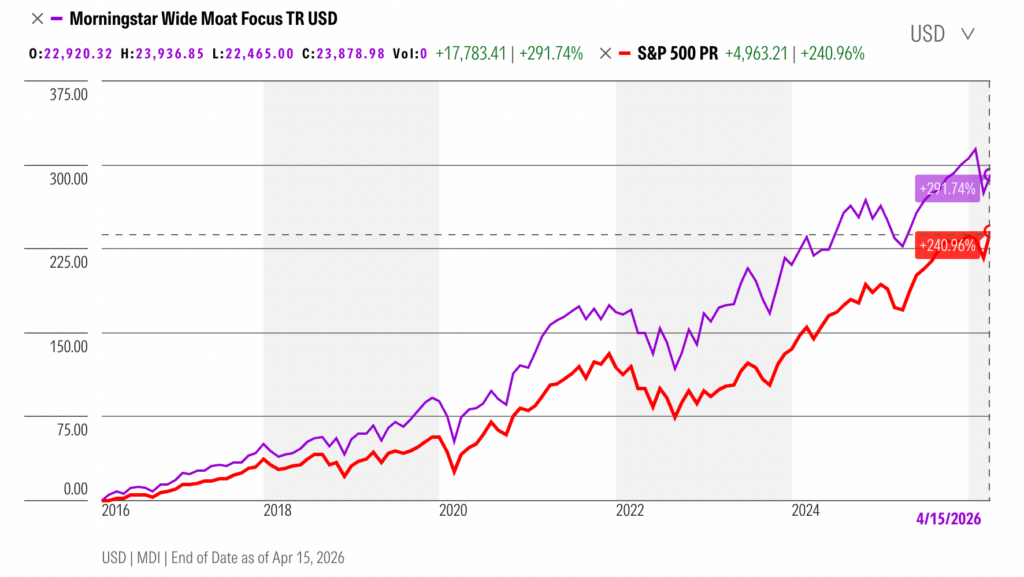
The chart below shows the performance of the Morningstar Wide Moat Focus Index, launched in 2007, compared to the S&P 500 over the past 10 years. The result: Moat stocks (purple line) have clearly outperformed the S&P 500 (red line) overall during this period.
The "Oracle of Omaha," Warren Buffett, popularized the idea of investing in economic moat stocks. He has always pursued the approach of focusing his investments on companies that, through their sustainable competitive advantages be able to protect their profits from the competition. Such companies stand in the market like fortresses surrounded by a moat, hence their name.
Numerous mega-events such as the corona pandemic, the war in Ukraine, inflation, and tariffs have shown in recent years that a Investment in robust stocks can be worthwhile. Also a look at the most significant stock market crashes of all time since 1929 shows that markets are never immune to crises. The topic of moat stocks is therefore becoming increasingly relevant for investors.
- Corporate successes are often short-term and based on factors such as marketing, costs, or innovation that do not automatically create a moat.
- Crucial for moat stocks is the durability of the competitive advantage, especially when technologies are not easily replicable.
- Cost advantages only secure a economic moat if they persist in the long term.
Types of moat stocks in detail
Economic moats originate from various structural sources within a business model. The individual moats differ primarily in how they prevent competition and how strongly they reinforce themselves over time.
The six main types are explained in detail below, complete with specific example stocks for each moat.
1. Network effects
Network effects occur when the utility of a product or platform increases with the number of users. Each additional participant increases the overall value of the network for everyone else. As a result, a self-reinforcing dynamic develops that accelerates growth.
A distinction is made between direct and indirect network effects. Direct effects operate between users of the same group, such as in social networks. Indirect effects occur between two groups, as in marketplaces with buyers and sellers.
A central advantage lies in the so-called „winner-takes-all“ principle. Large networks attract a disproportionately high number of new users, while smaller providers can barely keep up. New competitors frequently fail to achieve critical mass.
Despite their strength, network effects are not invulnerable. User behavior can change, platforms can lose relevance, and regulatory interventions can limit growth. Trust and user experience remain crucial for stability.
- Meta Platforms (ISIN: US30303M1027)Social media platform with increasing utility due to more users
- Visa (ISIN: US92826C8394)payment system where more merchants and customers make usage easier for everyone
- MercadoLibre (ISIN: US58733R1023)Marketplace with more sellers for more buyer choice and more buyers for seller attractiveness
2. Switching costs
Switching costs arise when customers face effort, risks, or additional expenses when changing providers. These barriers ensure that customers often stay with their current provider, even if alternatives appear more attractive.
Switching costs are particularly high in the B2B sector, where software is deeply integrated into business processes. Data migration, system adjustments, and employee training make switching complex and expensive. These factors create long-term loyalty.
An important effect is the so-called lock-in effect. Companies invest time, money, and know-how in existing systems, which reduces their willingness to switch. As a result, providers benefit from stable revenues and a high degree of predictability.
However, technological innovations can reduce switching costs. Cloud solutions, open interfaces, or new standards make switching easier. As a result, a previously strong moat can lose its effectiveness over time.
- Adobe (ISIN: US00724F1012)Creative software ecosystem with data migration and training upon transition
- Salesforce (ISIN: US79466L3024)CRM software with integrated business processes requiring complex adaptations
- Microsoft (ISIN: US5949181045)Office ecosystem with saved documents and implemented workflows
3. Intangible assets
Intangible assets include brands, patents, and licenses that enable a company to clearly differentiate itself. They build trust, protect innovations, and secure exclusive market positions. This often creates strong pricing power.
Brands primarily appeal on an emotional level. They influence purchasing decisions and allow companies to command higher prices. Consumers frequently reach for familiar brands, even when cheaper alternatives are available.
Patents provide legal protection against imitation and secure temporary monopolies. Especially in the pharmaceutical industry, they are crucial as they secure high research investments. Once a patent expires, competition usually increases significantly.
Licenses and regulatory approvals can also act as intangible assets. They grant exclusive access to markets or technologies. Nevertheless, there is a risk that brands may lose their appeal or patents may expire.
- Coca-Cola (ISIN: US1912161007)Global luxury brand with 100+ years of history and enormous pricing power
- L'Oréal (ISIN: FR0000120321)Luxury cosmetics brand with a strong brand image
- Pfizer (ISIN: US7170811035)Pharma patents protect against competition through exclusive drug patents
4. Cost advantages
Cost advantages arise when a company can produce or operate more cheaply than its competitors on a sustained basis. These structural advantages allow for either lower prices or higher margins at the same prices.
A common origin is the size of a company. Large corporations benefit from better purchasing conditions and more efficient processes. These economies of scale have been built up over years and are difficult to copy.
Operational efficiency also plays an important role. Optimized supply chains, automation, and standardized processes reduce unit costs. This enables companies to strengthen their competitive position in the long term.
However, the cost advantages are not unassailable. Technological changes or new business models can put existing structures under pressure. In addition, aggressive price wars can reduce margins.
- Walmart (ISIN: US9311421039)Purchasing power through huge volumes for lower supplier and retail prices
- Amazon (ISIN: US0231351067)Logistics efficiency with automation reduces cost per unit
- Costco (ISIN: US22160K1051)Low-margin, high-efficiency membership model
5. Economies of scale
Scale effects describe a company's ability to reduce the cost per additional unit as its size grows. Digital business models, in particular, benefit greatly from this principle. Products developed once can be replicated almost infinitely.
The key lies in high fixed costs combined with very low marginal costs. As soon as the initial investments are covered, additional growth leads to disproportionately rising margins. This effect is known as operating leverage.
Digital platforms and software companies are typical examples. New users generate hardly any additional costs, but directly increase revenue. This creates highly scalable business models with enormous profit potential.
Nevertheless, such models often require high initial investments. In addition, competition can arise if barriers to entry are low. Without additional moats such as network effects, scaling alone remains vulnerable.
- Netflix (ISIN: US64110L1061)Digital content created once, unlimited times with near-zero scaling costs
- Apple (ISIN: US0378331005)Software ecosystem with apps and services scaled up at minimal cost
- Shopify (ISIN: CA82509L1076)E-commerce platform with more merchants without a proportional increase in costs
6. Regulatory advantages
Regulatory advantages arise from government frameworks that restrict or control competition. Companies benefit from high barriers to entry that keep new competitors away. This often leads to stable market structures.
In many industries, licenses are required just to operate. Banks, insurance companies, or energy providers must meet strict regulations. These requirements make it difficult for new providers to enter the market.
Some companies even benefit from quasi-monopolistic structures. Infrastructure such as power grids or pipelines is usually only built once. The state protects these structures because parallel systems would be inefficient.
However, regulatory moats are heavily dependent on political decisions. Legislative changes can quickly alter the framework conditions. In addition, regulation often limits companies' profits as well.
- Berkshire Hathaway (ISIN: US0846701086)insurance moat with a strictly regulated market and prevents market access
- American Electric Power (ISIN: US0258161092)Energy grid operators with exclusive regions without competition
- JPMorgan Chase (ISIN: US46625H1005)Bank licenses with regulatory barriers for new bank establishment
Combination of multiple moats: The real strength factor
The most successful companies combine multiple competitive advantages that reinforce each other and make them particularly resilient against competition.
Multiple moats create sustainable advantages over decades and are ideal for dividend hunters and long-term portfolios. Five examples of moat combinations are:
| Company | Moat combination | Explanation |
| Apple | Brand strength + switching costs + scale effects | Luxury brand with price premium. iOS ecosystem with saved data makes switching unattractive. Apps and services millionfold with minimal costs |
| Amazon | Cost advantages + economies of scale + network effects | Logistics efficiency reduces costs. AWS Cloud scales without proportional costs. More merchants and buyers create self-reinforcing marketplace dynamics. |
| Microsoft | Switching costs + economies of scale + brand strength | Office documents and processes bind customers. Azure Cloud scales with minimal costs. Long-standing trust in enterprise software |
| Meta Platforms | Network effects + economies of scale + switching costs | Value increases with every user. Digital content scales without proportional costs. Stored contacts and content make switching unattractive |
| Visa | Network effects + economies of scale + regulatory advantages | More merchants and customers make usage easier. Every transaction causes close to zero costs. Banking licenses protect against easy market entry. |
Multiple moats make companies almost insurmountable against competition. A single moat can be attacked, but multiple reinforcing advantages create a stable defensive position for long-term returns.

Risk factors for moated stocks
Moat stocks are rightly considered particularly robust because they stand behind an economic „moat,“ such as through strong brands, high switching costs, network effects, or economies of scale.
Many of these so-called „fortresses“ therefore regularly appear in moat lists and stock recommendations and are traded as core components for long-term portfolios. Yet the future remains uncertain, even for companies that appear invulnerable today.
Even giants with global market power can lose their moats if they fail to adapt, are bought at overvalued prices, or if external shocks severely impact their business models.
1. Erosion of the moat caused by climate change
The biggest risk for moat stocks is the erosion of the moat itself. A once-impenetrable competitive advantage can become weak or even completely obsolete due to technological change, disruptive innovations by new competitors, or changing consumer preferences.
Examples like Kodak and Nokia show how quickly entire business models can come under pressure: once dominant market leaders in film and mobile communications respectively missed the digital shift and were displaced by new players like Apple, resulting in severe drops in revenue, profit, and ultimately market capitalization.
Such cases demonstrate how important it is not to analyze the moat just once, but to continuously question whether the competitive structure, the technology base, or customer preferences are changing in such a way that old advantages suddenly disappear.
2. Overvaluation and Overpaying for Strong Stocks
Even an outstanding company with a wide moat is not a good investment if the entry price is too high.
During phases of great enthusiasm for quality and moat stocks, valuations (e.g., P/E ratio, EV/Ebitda, or Discounted Cash Flow fair value range) can detach significantly from fundamentals, leaving virtually no room for further price appreciation.
In this case, even a stable cash flow profile becomes a disadvantage because the market has already set expectations extremely high. Even a moderate setback or slightly slower growth will then lead to severe price corrections.
3. Misinterpretation of a moat or a pseudo-advantage
Another central risk is misinterpretation: companies and investors often identify a moat even though it is only a temporary lead or a short-term competitive advantage.
Strong margins, rapid growth, or apparent network effects can, upon closer inspection, be attributed to favorable environmental conditions, government subsidies, one-time efficiency gains, or temporary market gaps.
As soon as these external benefits disappear or competitors with similar business models catch up, the „strong moat“ argument collapses. And the stock price can drop sharply, even if the company remains profitable.
Top Economic Moat Stock List in 2026
Below we have a Moat stock list created, which provides an overview of some of the strongest moat stocks per sector.
| Company | ISIN | Sektor | Moat |
| Meta Platforms | US30303M1027 | Communication services | Network effects, data advantage |
| Amazon | US0231351067 | Consumer Discretionary | Cost advantages, network effects, switching costs |
| Microsoft | US5949181045 | Information technology | Switching Costs, Network Effects |
| HEICO | US4228061093 | Industry | Regulation, efficient scale, niche strategy |
| ASML | NL0010273215 | Information technology | technology leadership, efficient scale |
| Axon Enterprise | US05464C1018 | Industry | Switching Costs, Ecosystem |
| Intuitive Surgical | US46120E6023 | Healthcare | Switching Costs, Brand |
| Vertex Pharmaceuticals | US92532F1003 | Healthcare | Patents, intangible assets |
| Costco | US22160K1051 | Consumer staples | Cost advantages, brand |
| GE Aerospace | US3696043013 | Industry | Switching Costs, Regulation |
| Palantir Technologies | US69608A1088 | Information technology | Switching Costs, Data Advantage |
| Cloudflare | US18915M1071 | Information technology | network effects, economies of scale |
| Rollins | US7757111049 | Industry | brand, efficient size |
To invest in stocks, you need a brokerage account. With CapTrader, you can easily open one and gain access to over 170 international stock exchanges. Trade now at attractive commission rates: for US stocks, you pay 1 cent per share, with a minimum of $2.00 per order.
In the following, we examine moat stocks that may not yet be in your portfolio, but often distinguish themselves as valuable players through several wide moats, while presenting 5 companies from different sectors in detail.
1. HEICO
HEICO's business model in the aerospace aftermarket and in specialty electronics is characterized by high barriers to entry.
The company produces certified spare parts for aircraft and engines as well as highly specialized electronics for aerospace, defense, and medical technology. For airlines, HEICO offers approved, more affordable alternatives to expensive original parts from Boeing and Airbus, without the need to build new aircraft.
The moat lies in the high Certification barriers, of the strong aftermarket demand and the many years of technical expertise. HEICO is one of the largest independent manufacturers of engine parts and has established itself in niches where only a few suppliers can provide the necessary certification and quality.
Furthermore, airlines and maintenance facilities benefit from high switching costs, because their processes and logistics are oriented towards HEICO in the long term. The company is growing through Stable demand and targeted acquisitions and in recent years repeatedly record revenues and Record profits achieved.
The economic moats for this stock are intangible assets through exclusive patents and licenses for aerospace and electronic components, as well as cost advantages due to specialized production with high barriers to entry for newcomers.
| Tax year | Estimated sales (in US dollars) | Change compared to previous year |
| 2025 | 4.485 million | 16,26 % |
| 2026 | 5.070 million | 13,04 % |
| 2027 | 5.501 million | 8,51 % |
2. ASML
ASML is an exciting candidate for moat stocks because the company through several very strong competitive advantages can set itself apart from the competition.
ASML's focus is on the production of lithography systems: machines that are essential for the manufacturing of chips. Without these machines, there would be neither smartphones nor data centers.
The decisive advantage is EUV lithography (Extreme Ultraviolet Lithography). ASML is the only provider worldwide, which can supply these machines, giving the company a monopoly.
Furthermore, ASML benefits enormously high switching costs, since chipmakers now build entire factories around ASML's systems. In addition, the company has built a massive over the decades know-how and a valuable Ecosystem constructed, which deepens the moats further.
This stock has multiple economic moats: intangible assets through unique patents on chip manufacturing technology, economies of scale because each additional system causes hardly any further costs, and regulatory advantages through a government-protected technology monopoly.
| Tax year | Estimated sales (in US dollars) | Change compared to previous year |
| 2025 | 32.667 million | 15,58 % |
| 2026 | 38.288 million | 17,21 % |
| 2027 | 45.481 million | 18,79 % |
3. Axon Enterprise
Axon Enterprise develops an integrated Law enforcement system, such as hardware like Taser and Bodycams with a cloud-based software platform combined. The goal is to digitally record operations, securely store evidence, and standardize processes surrounding documentation and analysis.
The business model is increasingly based on recurring revenue. Authorities usually receive hardware bundled with Software subscriptions for cloud, data management, and AI-powered analytics. This makes Axon an integral part of the operational infrastructure rather than just a one-time equipment supplier.
The close integration of devices, data, and software means that with their use, the Dependence rises. Collected operational data, established workflows, and legal requirements are tied directly to the system, making alternatives increasingly unattractive.
There is a combination of switching costs, intangible assets, and regulatory advantages. Switching costs arise from deeply integrated systems and sensitive data, intangible assets from protected technologies such as tasers, and regulatory advantages from high barriers to entry in the security sector.
| Tax year | Estimated sales (in US dollars) | Change compared to previous year |
| 2025 | 2.780 million | 33,47 % |
| 2026 | 3.589 million | 29,12 % |
| 2027 | 4.633 million | 29,10 % |
4. Intuitive Surgical
Intuitive Surgical is among the leading companies in the development and sale of surgical robots, which are used to perform minimally invasive procedures.
The economic moat consists not only in the sale of the highly specialized robots, but also in the sale of consumables that are required for every operation, as well as ongoing maintenance and servicing the devices.
Hospitals worldwide are investing millions in Intuitive Surgical systems and are therefore also training their doctors on them. Switching to a competitor would consequently entail enormous Switching costs (risks and costs) connected.
Furthermore, the increasing use of the products enlarges the Network effect, which creates yet another moat. Because: More installed systems lead to more data from which knowledge can be derived, which in turn leads to better operational results and increasing demand.
The economic moats of this stock consist of switching costs through integrated robotic systems in hospitals with stored patient data, intangible assets through patents on surgical robot technology, and economies of scale in software updates for existing systems.
| Tax year | Estimated sales (in US dollars) | Change compared to previous year |
| 2025 | 10.065 million | 20,51 % |
| 2026 | 11.526 million | 14,52 % |
| 2027 | 13.093 million | 13,60 % |
5. Costco
Costco is a wholesaler with a unique business model that helps the company create wide moats.
Probably the strongest moat is in Cost advantage. Through its massive purchasing volumes, Costco achieves strong bargaining power with suppliers. Combined with the company's efficient logistics, this leads to extremely low prices.
Besides price leadership, Costco is known for its Membership program known for charging customers an annual fee just to be able to benefit from the low prices in the first place. This, in turn, leads to high switching costs in the form of strong customer loyalty.
Investors appreciate the wide-moat stock due to its high customer loyalty, stable cash flows, and consistent growth.
For this stock, the economic moats are cost advantages through purchasing power in the membership model, switching costs because members do not want to lose their discounts and established processes, and economies of scale because more members further increase the purchasing power.
| Tax year | Estimated sales (in US dollars) | Change compared to previous year |
| 2025 | 275.235 million | 8,17 % |
| 2026 | 298.675 million | 8,52 % |
| 2027 | 321.603 million | 7,68 % |
CapTrader can do that:
At CapTrader, the trading fees are extremely low: you can trade US shares from as little as $ 0.01 per share (order minimum $ 2.00) and German shares from as little as 0.1 % of the order volume (order minimum €2.00), options from €2.00, futures from €1.00, ETFs from €2.00 and much more!


Conclusion: Why are moat stocks an exciting topic?
Even Warren Buffett recognized the importance of sustainable competitive advantages and has always invested in companies that possess an economic moat while being attractively valued. Such companies stand in the market like fortresses surrounded by a moat.
Economic moat stocks are interesting for investors who want to expect a steady return and want to trust companies that can maintain their competitive advantage from 10 years (narrow moat) up to 20 years and beyond (wide moat).
Learn more about how to manage your portfolio in a Stock market crash secure themselves and be able to profit from a crisis. If you want to learn more about the long-term building of a portfolio with moat stocks, the Core-satellite strategy In the stable core, you bundle established Blue chip stocks with solid earnings and Dividendenhistorie, while higher-growth stocks or specialized themes are added in the „satellite“ segment to increase returns.
Here you will find further exciting insights into the industries surrounding Lithium stocks, AI shares, Automotive stocks or Silver stocks apply.
