


Anyone investing in the stock market usually asks themselves dem Depot open The question: When is the right time to take profits on stocks? Is it worth realizing profits now? Or would it be better to stay invested?
In this article, you will get a well-founded overview for taking profits on stocks. You will learn when it's truly worth selling, and how to simultaneously minimize risk and optimize your returns.

The most important in a nutshell
- Taking profits in stocks means turning paper gains into real money., by selectively selling shares
- The timing of the sale should align with your strategy.: for example, during rebalancing, target achievement, or reduced risk appetite
- Emotional traps like the disposition effect often lead to premature sales. A technical analysis helps to decide rationally.
Profit-taking in stocks
Profit-taking is a central concept in the field of capital investment. Key terms include:
- Price gainsArise through appreciation, must be actively realized through sale.
- Profit-takingSelling securities to convert paper profits into real money.
- Book prizeArises with a price increase, but theoretically remains as long as it is not sold.
- Real profitThe capital gain is only realized and paid out upon sale.
- DividendsRegular payouts credited directly, independent of sales.
What distinguishes book profits from realized profits?
A book profit (as also occurs with a Shares savings plan can arise) arises when the price of a stock is above the purchase price (plus order fees). It shows how much your investment is currently worth. However, this profit remains purely on paper as long as you continue to hold the stock in your account. So, it is a theoretical profit.
Only when you decide to sell will this amount actually be credited to your account. Then we speak of a realized profit. It is important to understand this difference. You should have a clear plan for when to realize your profits.


Dividends and capital gains: two different sources of income
Dividends And capital gains are both forms of return from stock investments. However, they work completely differently. A dividend is a regular payout that a company makes to its shareholders.
This payout occurs regardless of whether you sell your shares or continue to hold them. Therefore, dividends are real income that will be automatically credited to you.
Conversely, capital gains arise from an increase in the stock's market value. To realize the profit from this, you must actively sell. This distinction is important not only for your personal financial planning but also for tax considerations.
While dividends are taxed regularly, taxes on capital gains are only due upon sale.
In practice, this means that dividends can represent a stable source of income, while capital gains are more likely to be used for targeted adjustments or planned expenses.
If you're interested in the topic of dividends, you should definitely check out our article on Shares with a monthly dividend to read.
When is taking a profit sensible?
The optimal time to take profits depends heavily on your individual situation. There is no one-size-fits-all rule. Nevertheless, the following points offer good guidance:
- Strategy adjustmentProfit-taking allows for a redistribution into lower-risk investment vehicles.
- Individual factorsThe ideal time depends on your goals, life situation, and risk tolerance.
- Planned capital requirementFor large expenses such as property, a car, or starting a business, you should sell in good time.
- Security gainTaking profits early protects against short-term market fluctuations.
- Changed Risk tolerancePersonal upheavals can lead to a stronger perception of risk of loss.
- Depot reconciliationOverweight positions can be reduced by taking profits, and concentration risk can be lowered.
However, there are typical scenarios where realizing profits appears particularly sensible. These primarily concern your liquidity planning, your emotional stability, and your portfolio structure.
If you need the money for concrete plans
A common (and very understandable) reason for a Profit-taking is a Planned financial needs in the near future. This could be many things:
For example, buying a property, a car, or a renovation. Or your life circumstances change, as often happens with the start of a Whether it's starting a business or starting a family.
In such situations, you should consider realizing profits in a timely manner. This is because financial markets are volatile. Price declines can occur at any time and suddenly. And if you need to access your capital within a few months, you are exposing yourself to uncontrollable risk.
Early profit-taking offers:
- SecurityYou do not make your plans dependent on market developments.
- LiquidityYou will have the money you need in time.
- room to maneuverYou can plan calmly and strategically. Without stress or time pressure.
Good to know:
If you know you'll need money soon, it's best to act proactively. This way, you'll stay in control and be prepared for any eventuality.
If your personal risk tolerance decreases
Life rarely goes in a straight line. Events such as starting a family, changing jobs, health changes, or even retirement can influence your attitude towards financial risks.
What you once found acceptable may now feel burdensome. If you find that market volatility is making you increasingly nervous or even preventing you from sleeping soundly, it makes sense to reconsider your portfolio.
Taking profits can help reduce risk. You can reallocate the freed-up capital into less volatile investments and thus regain your sense of security. At this point, for example, a switch to Short-term bonds sinnvoll sein.
Your financial strategy should always align with your current life situation. Adjustments are not a sign of weakness but of responsible and thoughtful behavior.
When individual positions become too dominant
Another sensible situation for taking profits arises when individual stocks or sectors are overweighted compared to the rest of your portfolio. This phenomenon can occur due to particularly strong price performance.
The problem is that your portfolio becomes unbalanced. Instead of a broadly diversified risk profile, your assets become concentrated in a few holdings. This significantly increases concentration risk.
A decline in the share price in precisely this segment can then cause disproportionately high losses. By strategically taking profits, you can bring your portfolio back into the desired balance.
Such a scenario highlights the importance of careful consideration Money Management.
Psychological Aspects: Why do we often sell too early?
The stock market isn't just a world of numbers, as it's a mirror of human emotions. Especially when it comes to taking profits, Stock market psychology a central role.
Please keep the following points in mind:
- Strategy before emotionTrue security comes from clear rules, not spontaneous reactions.
- Emotion over strategyMany investors do not sell rationally, but out of fear or a desire for security.
- Disposition effectProfits are realized too early, losses are held too long. A classic fallacy.
- Safety illusionRealized gains feel good, but can prevent long-term growth.
- Self-reflectionThose who know their inner patterns make more informed decisions.
- Long-term ThinkingSuccessful investors act in a structured manner and not impulsively.
The Disposition Effect as an Investor Trap
A particularly widespread behavior is the so-called disposition effect. It describes the tendency of investors to, Selling winning stocks too early and Holding losing stocks for too long.
But why do we do that? Because a realized gain feels good. It validates our actions. A loss, on the other hand, is demotivating. We don't want to acknowledge it and hope the situation will improve.
This often leads to letting losses ride while realizing gains too early. In the long run, the disposition effect causes average returns to decline. To avoid it, clear strategies, objective criteria for buying and selling, and a healthy degree of self-reflection are needed.
The Illusion of Security
A realized gain feels like a genuine success. Money in the bank feels tangible and secure. Especially when compared to stock market fluctuations. But this perceived security can be deceptive.
Typical emotional Reactions that investors don't want to lose the perceived success again. Because it already feels like a win. This is why many investors sell too early.
Unfortunately, this usually happens out of fear of losses rather than strategic conviction. This leads to missing out on potential price gains in strong uptrends, which results in lower returns in the long run.
Long-term successful investors act differently: You . Because they clearly distinguish between short-term security and sustainable wealth building.
It is advisable to keep the following points in mind regularly:
- SecurityTrue security arises not from constant winning, but from a clear strategy that incorporates emotional impulses.
- EmotionsThose who let themselves be too guided by emotions often lose sight of the big picture.
- Self-reflectionAsk yourself: Am I acting out of fear or with a plan?
- PerspectiveAsk yourself: Would I still make this decision if I were seeing the course for the first time today?
By learning to recognize and classify emotional impulses, you create true security. This security is based on structure rather than spontaneous decisions. based on spontaneous decisions.


The Importance of Investment Strategy
The question of whether and when to take profits makes sense cannot be answered independently of your chosen investment strategy. Your personal strategy is the framework within which your investment decisions can be categorized in the first place. The following play a particularly important role:
- Clarity of purposeA strategy defines your investment goals, time horizon, and risk tolerance.
- Behavioral protectionA clear strategy protects against impulsive actions and emotional misjudgments.
- OrientationShe helps to remain structured and calm, even in times of crisis.
- Strategy dependencyThe right time for taking profits varies depending on the strategy. For example, buy and hold versus growth.
- Planning securityOnly your strategy (and not your mood) decides if, when, and why you sell.
Why a Clear Strategy Provides Security
Many private investors trade situationally. They buy Stocks Based on a tip, sell when uncertain and get caught up in daily stock market events. The problem with this: Without fixed rules, uncertainty, stress, and bad decisions arise.
A well-thought-out investment strategy provides direction. It defines why you are investing, how long you want to remain invested, and when it makes sense for you personally to take profits.
If you are approximately Dividend strategy If you invest in value stocks, you know that capital gains are secondary and you don't have to sell at the first increase. On the other hand, if you invest in growth stocks, it can be part of your strategy to sell at certain target levels.
So your strategy isn't just a plan. It's a shield against emotional decision-making.
Different strategies and their stance on profit-taking
Not every strategy considers profit-taking equally.
- A Long-term buy-and-hold approach aims to hold quality companies for decades. Selling is rare here. It only happens with fundamental changes or for rebalancing.
- A Dividend strategy By contrast, it relies on ongoing distributions. Here, taking profits on stocks can become relevant if the dividend yield deteriorates or the company changes its distribution policy.
- Growth-oriented Strategies approximately Growth Aktienfocus on price increases. It is common here to take partial profits when a price target is reached or after strong price increases.
- Value investors Conversely, they buy undervalued stocks and sell when they are considered fairly valued.
Good to know:
Your strategy decides When, why, and how much you sell. Taking profits on stocks without a strategic connection is often a sign of uncertainty or pure speculation.
Profit-taking strategies for stocks
Taking profits in stocks can take many forms. It's not enough to simply sell when a price has risen well. Rather, it's about developing a clear approach in advance.
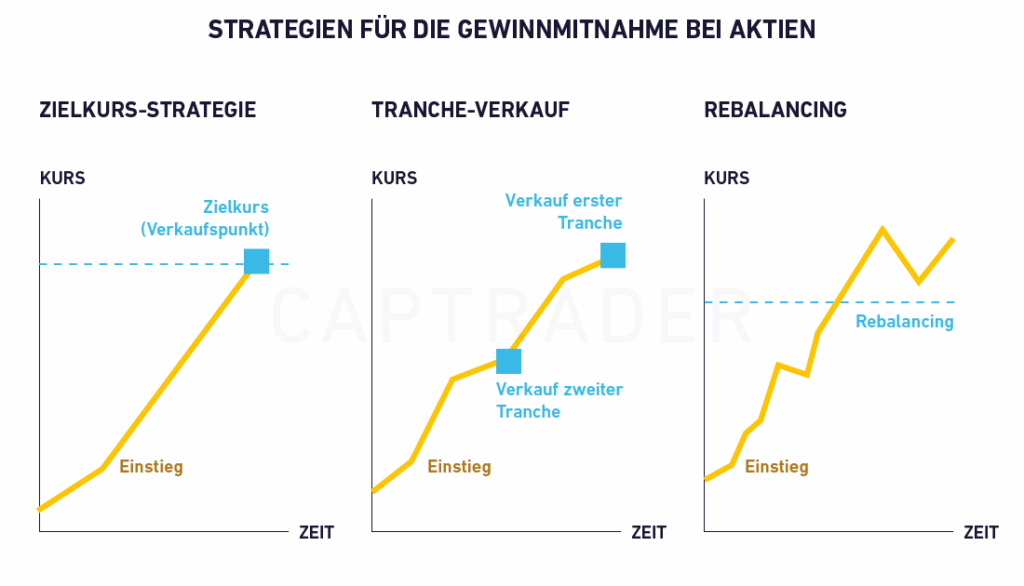
- Target course strategySale occurs upon reaching a previously set price target, regardless of the market environment.
- Tranche Sale: Phased withdrawal in several stages to combine security and flexibility.
- RebalancingStrategic profit-taking to restore the original portfolio structure and risk control.
- Tax advantagesPartial sales over several years can be more tax-advantageous.
Target price strategy: Sell when a predefined price target is reached
One of the classic methods for taking profits is the so-called Target course strategy. When you buy the stock, you already set a price target that you consider a fair value.
Once this target is reached, the sale will occur. This will happen regardless of whether the market is reacting euphorically or cautiously. The advantage of this method lies in its discipline.
It protects against greed, because you have considered beforehand what value you consider realistic and appropriate. This method is particularly suitable for investors who focus on fundamentals and value companies based on their intrinsic worth.
Here's an example: You buy a stock at €80 because you see its fair value at €120. Once it reaches that price, you sell. Even if the price continues to rise afterward, you consistently stick to your plan. This approach protects you from unrealistic expectations in the long run.
Tranche Sales: Exiting in Stages to Stay Flexible
Not every investor wants to sell a position all at once. Especially with larger investments or significantly increased values, it can make sense to Profit-taking in stocks to be carried out step-by-step.
This method is called Tranche sale. For example, you sell a third of your position at a certain profit, another third at an even higher target, and let the last third run. This strategy combines security with flexibility.
You secure a portion of the profits, while at the same time leaving the door open to benefit from further price increases. Tranche sales also help to overcome emotional blockades.
If you're hesitant to sell all your shares at once, selling a portion can be a good compromise. Furthermore, this allows you to spread out tax exemptions over several years, offering additional benefits.
Rebalancing: Taking Profits to Restore Your Portfolio Structure
A particularly strategic and disciplined approach for profit-taking is the so-called Rebalancing. The primary focus is not on realizing profits, but rather on Return to the originally chosen custody structure.
Background:
- Performance differencesIndividual stocks or sectors can perform significantly better than others.
- Depot displacementThe weighting in the portfolio changes automatically. Often without you noticing.
- Example RiskThrough price developments, a 60/40 split can become an equity-heavy portfolio with higher risk.
Rebalancing means that you strategically and systematically take profits, avoid concentrated risks, and maintain a balanced risk-reward ratio.
For example, you hold a portfolio with 20 stocks, initially equally weighted, each with a 5 % allocation. One stock performs better than average and suddenly accounts for 18 % of your entire portfolio. As a result, your risk now depends heavily on a single company.
Now you sell off a portion of this overweight position and reallocate the freed-up capital to other lagging stocks.
This way you achieve three things:
- You secure your profits.
- You reduce the risk.
- You are rebalancing your portfolio.
Technical analysis for profit taking
Besides the Fundamental analysis, with which companies are valued based on key figures and business data, technical analysis is also available to you as an investor.
- Technical AnalysisUses price charts, volume, and patterns to determine buy and sell points.
- Sliding AveragesSignal trend reversals.
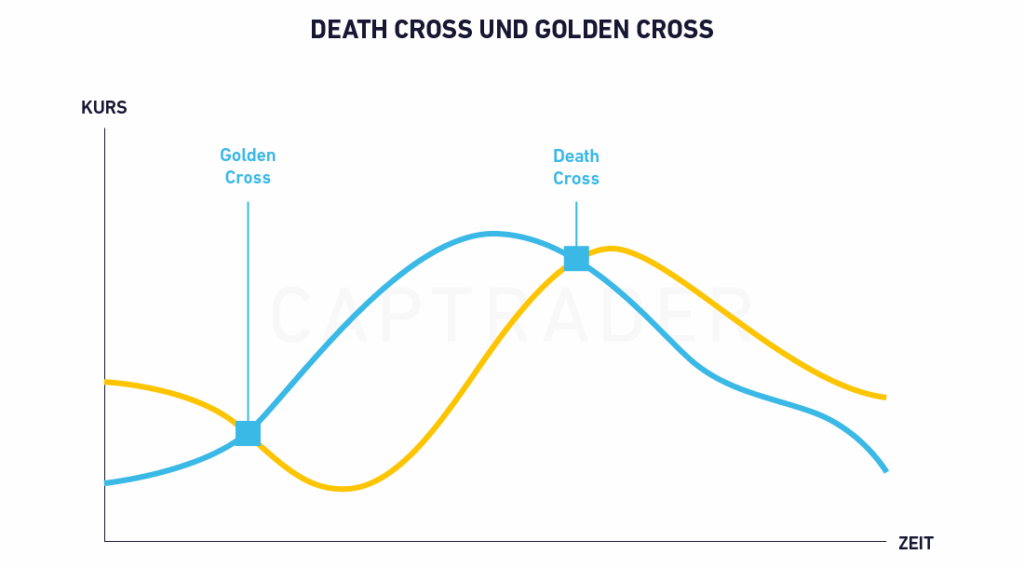
- Death Cross & Golden CrossTwo strong signals for selling or buying decisions.
- Resistance linesPsychological course levels where profit-taking frequently occurs.
- RSI & IndicatorsShows overbought or oversold market phases.
Moving Averages as Exit Signals
If you want to strategically secure your positions or selectively realize profits, you can moving averages a valuable tool for you. You belong for good reason to the most frequently used instruments technical analysis.
What moving averages can help with:
- TrendlineThey smooth out price fluctuations and identify the medium-term trend.
- Trend analysisShe makes trend breaks visible that remain hidden in daily volatility.
- Average valuesParticularly relevant are the 50-day and the 200-day moving averages.
A possible sell signal is a price drop below the moving average. Many investors use this moment to take partial profits or exit completely.
A particularly strong signal is the so-called Death Cross. This occurs when the short-term average (e.g., 50 days) falls below the long-term average (e.g., 200 days). Such a scenario is often interpreted as a warning signal for trend reversals or stronger corrections.
The opposite of a golden cross is usually considered a buy signal, and it occurs when the short-term average crosses above the long-term average from below.
Your benefits from using moving averages:
- Objective decision-making basisYou don't act on impulse, but with a system.
- Emotional responses are reduced
- Early detection of trend changesThis way you can think about taking profits in time.
If you regularly monitor these indicators, you will keep a cool head during turbulent times and recognize early on when it makes sense to reduce positions or secure profits.
Resistance lines as psychological barriers
Another important tool in technical analysis is the identification of Resistance lines. These are price ranges where the stock has repeatedly bounced back in the past because many investors have realized profits there.
Such zones act like invisible barriers. When a stock approaches a known resistance level, it's worth being particularly vigilant. This is because it's quite possible that the price will stall there again. Or even fall.
For you as an investor, this means: Taking profits on stocks in the area of strong resistance can be strategically clever. Especially if there is also an overbought condition, for example indicated by the RSI, the probability of a correction increases.
Resistance levels are relatively easy to spot on a chart and are a helpful tool for sales not by feeling, but rather planned based on market patterns.


The RSI and other indicators for assessing overheating
The Relative Strength Index (RSI) is a widespread Day Trading Indicator, which indicates whether a stock is currently overbought or oversold. It moves on a scale of 0 to 100.
Values above 70 indicate an overbought market situation. This means many investors have bought in a short period of time and a correction is likely. Values below 30 signal the opposite.
Therefore, a high RSI after a rapid price increase can be a reason to consider taking profits. Especially in combination with other signals, such as resistance or a falling moving average, the interpretative power is strengthened.
Besides the RSI, there are also other indicators such as the MACD (Moving Average Convergence Divergence) or Bollinger Bands, which are used in practice to identify trends and trend changes.
Technical indicators are not a guarantee, but they help, To find objective criteria for withdrawal, instead of letting emotions guide them.
CapTrader can do that:
Wir stellen Ihnen kostenlos verschiedene Plattformen für den Handel bereit. Dazu zählen zum Beispiel die leistungsfähige Trader Workstation, the best Trading app, the TraderFox Tradingdesk, which allows direct integration of TraderFox signals and much more.
Conclusion: When is taking profits on stocks sensible?
Taking profits on stocks is an active component of any long-term investment strategy. It is important that you do not sell based on gut feeling, but rather on objective criteria such as target price, portfolio weighting, life situation, or market analysis.
Taking profits is particularly effective in conjunction with rebalancing or for securing liquidity for planned expenses. Avoid impulsive decisions driven by fear or exuberance.
Instead, you should observe your emotions, regularly reflect on your strategy, and act consciously. This way, you not only secure profits but also long-term investment success.
