


Have you amassed a large fortune or dedicated yourself to an important life's work? Then you may be toying with the idea of Establish a foundationto obtain this.
This step offers Unique advantages and disadvantages - In some cases it may therefore be worth setting up a foundation, in others not. We explain when and for whom a foundation is suitable, what you need to bear in mind and what costs you will incur when setting up a foundation.

The most important in a nutshell
- A foundation follows a defined purpose, with its own assets and organization
- Foundations are generally established for eternity, but time limits are also possible
- Foundations fulfill their objectives by investing the contributed assets
- They can be used for positive purposes and offer tax and other benefits
- However, the capital is tied up in the foundation and is very difficult to free again
What is a foundation?
Foundations are organizations that are endowed with their own assets. You invest this capital and use the income from it to pursue a defined purpose.
You can completely Different legal forms, characteristics and objectives have. Their purpose is determined by the founder or a founding group.
Through Dividends, Zinsen, Mieteinnahmen und andere Einnahmequellen kann die Foundation generating profits; the However, the basic capital itself is not availablebecause it is now part of the foundation. Not even the person who set up the foundation can touch it. Nor can it be reduced.
In addition to the purpose and the company's own capital, a Statutes and a foundation agreement must be present if you want to set up a foundation. The founder(s) themselves can play an active role and, for example, chair the foundation.
Foundations are predominantly (approx. 95 percent) non-profit. They pursue objectives such as the promotion of education, culture, science or international cooperation. But they can also be used to protect assets, companies or life's work.
For example, you can set up a foundation because there is a risk of your assets being split up after the death of a responsible person. You can also set up a foundation to benefit from the tax and legal advantages can be an important reason.
With the exception of some special forms such as the consumer foundation, such organizations are designed to be as long-term as possible. When you set up a foundation, it should usually exist for all eternity and continue to pursue its purpose.
Particularly old foundations in Germany can look back on a history of more than a thousand years! To make sure that a foundation actually fulfills the purpose for which it was established, it must render account to the foundation authorities.
Here, for example, activity reports or annual accounts are required. Other Authorities, such as the tax office, can monitor foundations.
There are also slight regional differences: setting up a foundation in Bavaria may be slightly different than in Berlin, for example. However, the basic rules and requirements are the same.


How to set up a foundation
Anyone wishing to set up a foundation must do so with a sufficient assets to equip the company. As the income from this is used to finance the actual Purpose of the foundation to be realized, some capital is required.
The exact The amount depends on the type of foundation you want to set up and what objective it should pursue. There is no general legal requirement.
In order to establish a charitable foundation 100,000 euros as a guideline established. Other forms, however, manage with less. It is even possible to set up a foundation with minimal assets and only add to these later through regular "deposits".
The foundation authority checks on a case-by-case basis whether the available funds are sufficientin order to be able to meet the set target in a meaningful way. Some authorities specify 25,000 euros or higher as the minimum value.
Conveniently, you can also tangible assets or company shares to the founding assets.
In Germany, a natural person of at least 18 years of age or a legal entitysuch as an association or a company, a Establish a foundation. Groups can also set up a foundation together - this is known as "Zustiften". It is even theoretically possible to set up a foundation in your will after your death.
To set up a foundation, you must also have the create the necessary organization and draft bylaws. A foundation board of at least one person is the minimum. This is often the founder himself or herself. Other bodies, such as an advisory board, are possible and common.
The articles of association must include at least the following points:
- Name of the foundation,
- Seat of the foundation,
- Purpose of the foundation,
- assets of the foundation and
- Regulations on the formation of the Executive Board
The exact requirements vary depending on the legal form you have chosen and the purpose to be pursued.
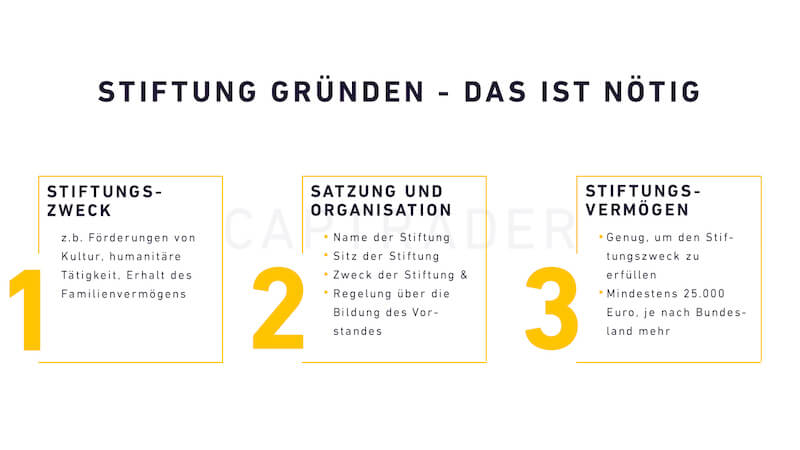
This is necessary for setting up a foundation
For example, it is usually much more complex to set up a charitable foundationthan a family or company foundation. The latter also come with fewer tax and other advantages.
Due to the many different forms and characteristics, a Expert advice highly recommendedif you would like to set up a foundation.
If you are thinking about setting up a foundation, your The first step should therefore be to consult a specialist lawyer. You should also place the management of the foundation's capital in professional hands, as the return on assets determines how effectively your organization can operate.
CapTrader can do that:
CapTrader offers maximum security, reliability and a dedicated customer service specifically for foundations. We have been successfully managing the assets of numerous foundations for years.
Types of foundation
In Germany No specific legal form for foundations prescribed. Foundation GmbHs, foundation AGs, foundation associations and other forms are common. This provides a great deal of flexibility when setting up a foundation.
However, there is less freedom when it comes to legal capacity, as there are only two options here: You can create a rlegal capacity or non-legal capacity (also "fiduciary") foundation establish. All organizations fall into one of these two categories.
| Foundation with legal capacity | Fiduciary foundation | |
| Capital | Min. approx. 50,000 euros | No minimum capital |
| Asset commitment | Permanent | Permanent |
| Control by supervisory authorities | Yes | No |
| Foundation time expenditure | Up to 6 months | Up to 2 months |
| Changes | Amendments to the articles of association are difficult to make | Amendments to the Articles of Association possible |
| Duty to inform | Supervisory authority and tax office | Tax office only |
A further distinction between foundations based on the Legal area is possible. For example, foundations can be established that private, public or ecclesiastical sector and are subject to the relevant laws.
Of particular importance is the Non-profit status of a foundation. It is given if the purpose of a foundation is the Promotion of the general public on material, moral or spiritual terrain.
In practice, this could be objectives such as the promotion of culture or science, environmental protection or humanitarian aid. To achieve a charitable foundation is the Recognition by the foundation authorities necessary.
Also a Assessment notice from the tax office, confirming the non-profit status is required. Ideally, you should work closely with the authorities during the foundation phase to ensure a smooth foundation process.
Do you want a private-benefit foundation your organization does not have to go through this recognition process. For example, it serves the Preservation of family assets or protection of individual persons. Thus, no purpose that promotes the general public is recognizable.
Apart from that, you set up private-benefit foundations with an almost identical process. The big disadvantage: Private foundations do not have the same tax advantages as charitable foundations.


Day-to-day business of a foundation
Once a foundation has been established, the actual work of the institution begins: it starts to to pursue the purpose set out in the Articles of Association. Depending on the size, capital and objective, different types of work are involved.
Due to the sometimes quite high time requirements and the necessary qualifications often professional foundation administrators committed.
For example, committee meetings must be prepared, bookkeeping and donation accounting must be carried out and accounting, including the annual financial statements, must be taken care of.
Particularly in the case of larger foundations, public relations work can generate considerable additional expenses. Such organizational activities must be carried out in addition to the actual core business - the purpose of the foundation.
Depending on the objective set, funding projects must be selected and managed. This often requires extensive communication with the project managers. Requests for support are also received regularly and must be checked accordingly.
If, for example, the focus of the foundation is on maintaining and promoting a company, considerable expenses can also be incurred here.
A particularly An important core task for all foundations, however, is the management of the capital invested: Anyone who sets up a foundation must endow it with sufficient assets so that it can finance its work from the income generated by this capital.
When setting up a foundation, you should always consider the Keeping an eye on profitabilityThe better your organization manages the available capital, the better it can fulfill its purpose.
Financial expertise and a Skill with investments are particularly helpful when managing a foundation. Individuals who are not qualified or willing to manage the finances of their foundation can also Foundation manager and financial advisor consult.
CapTrader has been operating a Own customer service departmentwhich deals exclusively with the needs of foundations. We support organizations in this, minimize expenses and increase their returns through lucrative investments.
Due to the extremely low fees and the extensive range CapTrader offers the ideal environment for your foundation with its wide range of lucrative investments. Because every amount that your foundation saves or earns in its day-to-day business directly benefits the foundation's purpose.
CapTrader can do that:
At CapTrader, foundations can find a variety of investments that offer an attractive return and thus help to fulfill the foundation's purpose. At the same time, you will find the necessary security and support that such an organization needs.
Advantages and disadvantages of a foundation
Establishing a foundation has unique advantages and disadvantages. Depending on the chosen legal form, the purpose of the foundation and the available capital, different points in the following list may apply:
Advantages
You can set up a foundation to promote your life's work or a cause close to your heart in the long term. Even after their own death, founders can work on their goals in this way and ensure that their memory is kept safe.
This can also include the preservation of hard-earned assets or a family business.
Anyone wishing to set up a charitable foundation benefits from a number of tax advantages. For example, such organizations are exempt from corporation tax, trade tax, capital gains tax, inheritance tax and gift tax.
The result is a lower burden and therefore more capital that can be used for the foundation's purpose. Setting up a foundation can therefore also make sense from a purely financial perspective.
A foundation can also be used to manage your own estate. If there is a threat of a dispute between descendants, for example, you can prevent such problems by setting up a foundation.
If you are nervous about leaving your assets directly in the hands of your heirs, a foundation is also a sensible option. This ensures that the capital is preserved and supports your family in the long term.
Sie können auch eine Stiftung gründen, um langfristig Geld anzulegen. Sollten Sie ihre Anlagestrategie ohnehin auf Cash flow fokussiert sein (z.B. Dividendenstrategie), kann eine Stiftung diesen Zweck ebenfalls erfüllen.
Disadvantages
Your assets are tied up in the foundation for the long term. Only in rare cases can capital be withdrawn at a later date or the foundation dissolved. If you want to set up a foundation, you should therefore be able to do without the money in the long term.
The dissolution of a foundation is generally possible, but is subject to very strict conditions. In all cases, the foundation authority must approve the dissolution. One possible reason is, for example, that it has become impossible to fulfill the purpose of the foundation.
It is also difficult to change the purpose of the foundation. So before you set up a foundation, you should be aware that this is a very long-term decision.
A large amount of capital is required to set up a functioning foundation, as such an organization may only use the income from the assets, but not the assets themselves. For this reason, 100,000 euros has established itself as a benchmark.
Although there is no prescribed minimum amount, the assets must be sufficient to pursue the set purpose. Special forms and regulations allow you to set up a foundation even with comparatively little capital; however, this step is particularly recommended for larger assets.
You need a high level of expertise in financial markets and investments. This is the only way to generate attractive returns with the foundation's assets, which in turn are necessary for the foundation's work. Working with an experienced service provider such as CapTrader can simplify this task.
Anyone wishing to set up a foundation must then comply with a number of information obligations. Non-profit organizations in particular have to report to the foundation authorities. You should plan for this effort before you set up a foundation.


Conclusion: When is it worth setting up a foundation?
The decision to set up a foundation should not be taken lightly. The foundation capital is tied up for the long term and the administration and organization require time and energy.
Even the actual establishment of a foundation involves considerable effort, as the articles of association have to be drawn up, bodies appointed, the foundation business established and the conditions of the foundation authority fulfilled.
A foundation can only pursue the purpose it was set up for with income from the capital - you cannot touch the assets. Such organizations therefore benefit in particular from efficient management and investments that generate high returns.
Anyone wishing to set up a foundation has the choice between numerous legal forms and the legal capacity of the organization.
However, the question of charitable status is particularly important: if the foundation serves the public good, this must first be proven at great expense; however, the institution then benefits from considerable tax advantages, among other things.
But even without the benefits of charitable status, it can make sense to set up a foundation to secure your own estate or the continued existence of a family business, for example. However, due to the complexity of this area, expert advice and the help of experienced partners is highly recommended.
Unfortunately, we cannot tell you whether it makes sense for you to set up a foundation - you should consult a specialist lawyer, for example. However, if you have decided to set up a foundation, CapTrader is the ideal partner!
We support you in the responsible and at the same time profitable use of your capital. Our award-winning service includes a dedicated customer service team that specializes in foundations.
