


Dividends are back in focus. While many investors have focused primarily on growth and tech stocks in recent years, interest in regular dividends is now growing again. The idea behind this is simple: companies that regularly pay out a portion of their profits offer investors a constant cash flow, regardless of share price fluctuations.
But how well does it really work? Which shares pay particularly high dividends? And are these dividends sustainable in the long term? In this article, you will find the best dividend payers for 2026, with specific tables, studies and practical tips for your Equity portfolio. Clearly explained and easy to implement.

The most important in a nutshell
- Top yields up to 8 %Hochtief, Enbridge & BAT will be among the strongest dividend payers in 2026.
- Stable sectors are crucialEnergy, telecoms, insurance & consumption ensure reliable distributions.
- Quality beats heightOnly through solid profits and healthy cash flow are high dividends sustainable.
- Investing globally pays offInternational stocks offer additional stability and diversification.
- Use the compound interest effectReinvested dividends significantly increase the total return.
Why invest in shares with high dividends?
Dividend shares are particularly interesting for long-term investors who want to build up stable assets and generate regular income. They combine security, reliability and growth potential in one form of investment. The most important advantages are
- Regular distributionsDividends ensure a constant income stream, independent of short-term market fluctuations.
- Protection in weak market phasesDividends offer stability and psychological security in sideways markets or when prices fall.
- Use the reinvestment effectReinvested dividends lead to compound interest effects and significantly higher total returns.
- Disciplined investment strategy through savings plansRegular purchases smooth out the entry price and reduce the timing risk.
- Focus on qualityThose who pay attention to sustainable dividends automatically invest in solid, profitable companies.
- Long-term asset protectionDividend shares contribute to capital preservation and growth even in volatile times.
Dividend shares are one of the most effective ways of building up a growing and stable income over the long term. They offer you as an investor real added value that goes far beyond mere price gains.
However, it is important to make a distinction: a high dividend yield alone is not enough. The question is much more important, whether the company can distribute the dividend on a permanent basis. In other words, whether the distributions are covered by sustainable profits.
This is why a well-founded Analysis. Ideally in combination with a Stocks Savings planwho invests regularly and thus also compensates for fluctuations in the purchase price. You can find out which criteria are important in the next section.
How do you recognize the best stocks with the highest dividends?
Dividend shares are particularly interesting for long-term investors. But be careful: A high dividend yield alone is not a sign of quality. If you are guided solely by this, you will quickly fall into a trap. This is the case, for example, if the dividend is not financed sustainably.
The really best dividend stocks are characterized by a combination of several decisive criteria. Only the combination of these factors makes a share attractive in the long term:
- Check the dividend yield for its substanceHigh percentages often seem tempting, but are often a warning signal.
- Ensure a healthy payout ratioIdeal values are between 30 and 60 percent.
- Analyze the free cash flowOnly real cash flow can be used to service dividends in the long term.
- Take the dividend history into accountA stable payout over many years is a strong sign of quality.
- Watch the dividend growthOnly companies that regularly increase their dividends offer rising returns in the long term.


Why the dividend yield alone is not enough
The Dividend yield is probably the best-known key figure for dividend shares. It indicates the percentage of dividends you receive in relation to the current share price. A share that pays a dividend of five euros per year and costs one hundred euros will give you a return of five percent.
However, this figure can be deceptive. If the share price has fallen sharply, the return suddenly seems very high. In many cases, however, the company is in financial difficulties. The high yield is then often just a mathematical snapshot. In practice, it is not uncommon for dividends to be cut or even canceled.
You should therefore always ask yourself why the return is high. Is it the result of solid figures and successful business development or merely a consequence of a sharp fall in the share price? You should always question dividend yields above seven percent critically.
Remember. The level of return is not a value in itself. It only makes sense if it is backed up by entrepreneurial strength and financial substance.
How much of the profit is distributed: The importance of the payout ratio
The payout ratio shows what proportion of the company's profit is paid out to shareholders as dividends. A ratio of fifty percent means that half of the profit is used for dividends.
A solid payout ratio is generally between 30 and 60 percent. As a shareholder, the company gives you a share in the profits, but at the same time retains sufficient capital to invest, repay debts or build up reserves.
If the odds are consistently above 70 percent, you should pay attention. It becomes particularly critical with odds of 100 percent or more. In this case, more funds are distributed than were actually earned. Financing is then often provided from reserves or new debt.
Also consider sector-specific differences. Real estate companies or so-called Reits often have higher ratios, as they are legally obliged to make extensive distributions. Technology companies, on the other hand, invest heavily in growth. Lower ratios are common and sensible there.
Why free cash flow is more important than reported profit
While many investors focus on profits, the Free cash flow often the much more meaningful key figure. This is because only what arrives in the account can be distributed as a dividend. Free cash flow shows how much money the company has at its free disposal after deducting all costs and investments.
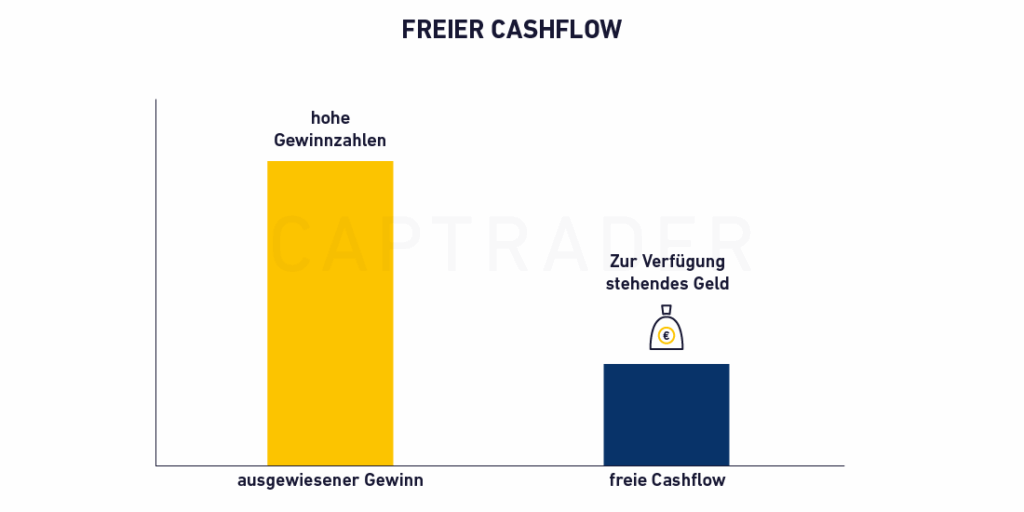
If a company reports high profits but generates little or no cash flow, caution is advised. The dividend may then have to be financed via loans or balance sheet tricks. This may work well in the short term. In the long term, however, it is an alarming signal.
A positive and stable free cash flow over several years is a strong sign of a company's economic stability. It proves that the operating business is viable and that the dividend payment does not have to be covered by reserves or borrowed capital.
You should therefore not rely solely on the profit figures. Take a look at the cash flow statement and check whether the free cash flow is high enough to finance the dividend in the long term.
What the dividend history says about the reliability of a company
The past is a very good indicator of the quality of a dividend share. If a company has paid dividends regularly over many years, this shows reliability. It is even better if the payments have not been suspended or reduced even in difficult economic times.
Companies that have paid their dividends even in crisis years such as the 2008 financial crisis or the 2020 coronavirus pandemic demonstrate particular strength. They stand for responsible corporate governance and sound finances.
Companies that increase their dividends annually are particularly recommended. In the USA, this is referred to as Dividend Aristocrats. These companies have been increasing their dividends for at least 25 years without interruption.
But a stable payment history over 5 or 10 years is also a very good sign. You can assume that such companies take their shareholders seriously and are pursuing a long-term plan.
Dividend growth: the key to permanently increasing income
In addition to the amount of the dividend, its long-term growth is also crucial. This is because regular increases not only increase your annual payout, but also what is known as your personal dividend. Dividend yield on your entry-level course.
A company that increases its dividend by 5 percent every year will double its payout in around fifteen years. And without any additional investment. This principle is also known as "yield on cost".
Dividend growth shows you that a company is growing, generating increasing profits and that its shareholders are participating in this. It is a sign of economic strength, a focus on the future and a high standard for its own capital policy.
If you want to invest for the long term, you should focus on dividend stocks that not only pay today, but also increase regularly in the future.

Sectors with high payouts
Not all companies are equally suitable for a dividend strategy. Companies from stable, high-margin sectors have proven particularly successful.
These include above all:
- Energy supplier
- Telecommunications
- Financial service provider
- Companies from the basic consumption sector (food, household or health)
These business models are characterized by relatively constant income, regardless of economic fluctuations. This is crucial for a reliable dividend payment. Because in times of crisis, many cyclical companies cut their payouts, while defensive sectors continue to deliver.
A good example is the telecommunications sector: companies such as AT&T (ISIN: US00206R1023) or Deutsche Telekom (ISIN: DE0005557508) have been paying high dividends for years, supported by recurring income. Insurers such as Allianz (ISIN: DE0008404005) or Swiss Re (ISIN: CH0126881561) are also traditionally among the strong payers.
However, investors should not only look at the return, but also at the substance. So Debt ratio, Earning power and Balance sheet quality. Our contribution to the topic Fundamental analysis provides further insights.
Good to know:
Depending on the fundamentals, high dividends can become a dangerous trap.
Top international shares with high dividends
The best Aktien mit hoher Dividende are not only to be found in Germany, as international markets also offer attractive opportunities.
- Diversity of dividend payersNumerous companies around the world offer stable and reliable dividends.
- Attractive regionsDividend stocks from the USA, the UK, Switzerland and Germany are particularly convincing.
- Decisive framework conditionsPolitical stability, a secure legal system and transparent markets are key success factors.
Many US companies pay quarterly dividends and increase them regularly over decades. In the UK, dividends are traditionally high, while in Switzerland the focus is on stability and continuity.
If you think globally, you can not only benefit from higher returns, but also offset the currency risk through geographical diversification. The broader the selection, the more important clear quality criteria and regular reviews of the securities are.
The following table provides a quick overview of top stocks with attractive dividend yields in 2026.
| Country | Company | Dividend 2026 (per share) | Yield (approx.) | ISIN | Currency of the dividend |
| USA | AT&T | 1.11 USD | 6,5 % | US00206R1023 | USD |
| UK | British American Tobacco | 3,00 USD | 7,1 % | GB0002875804 | USD |
| Germany | Hochtief | 5,23 EUR | 3,6 % | DE0006070006 | EUR |
| Switzerland | Swiss Re | 7.35 USD | 5,6 % | CH0126881561 | USD |
| France | Tota lEnergies | 3,40 EUR | 6,4 % | FR0000120271 | EUR |
| Canada | Enbridge | 3.66 CAD | 7,5 % | CA29250N1050 | CAD |
Notes:
- DividendThe values relate to the last announced or expected payments for the 2026 financial year.
- YieldCalculated on the basis of current prices (May 2025). The actual return may vary depending on the price.
- CurrencyThe dividend currency does not always correspond to the home currency.


American dividend aristocrats with high yields
The United States is the home of the so-called dividend aristocrats. These are companies that have increased their dividend payout every year for at least 25 years.
The best dividend aristocrats for May 2026 are characterized by their ability to offer stable and growing dividends, even in uncertain economic times.
Their strong financial position and proven business models make them attractive options for long-term investors who value reliability and steady income streams.
The top 10 stocks with high dividends from the USA are listed below (as at May 2025).
| Company | Industry | Dividend yield | ISIN |
| AbbVie Inc. | Healthcare | 3.8 % | US00287Y1091 |
| Brown & Brown Inc. | Insurance | 1.0 % | US1152361010 |
| Consolidated Edison Inc. | Utility companies | 3.5 % | US2091151041 |
| Abbott Laboratories | Healthcare | 1.6 % | US0028241000 |
| Procter & Gamble Co. | Konsumgüter | 2.5 % | US7427181091 |
| Johnson & Johnson | Healthcare | 3.3 % | US4781601046 |
| The Coca-Cola Company | Drinks | 3.0 % | US1912161007 |
| PepsiCo Inc. | Food & Beverages | 2.8 % | US7134481081 |
| 3M Company | Industrial goods | 2.1 % | US88579Y1010 |
| McDonald's Corporation | Gastronomy | 2.2 % | US5801351017 |
These companies offer a combination of reliable dividend payments and solid financial health, making them attractive options for investors looking for stable sources of income.
Shares with high dividends in Europe
In Europe, too, there are numerous shares with high dividends that offer stable long-term payouts.
The "Noble 30" is a carefully compiled list of 30 European companies that have paid or increased their dividends continuously for at least 20 years. Even during economic crises such as the dotcom bubble, the 2008 financial crisis and the COVID-19 pandemic.
These companies are characterized by a market capitalization of over EUR 5 billion and have maintained their dividend policy even in difficult times.
Its members include renowned companies such as Nestlé (ISIN: CH0038863350), L'Oréal (ISIN: FR0000120321), Unilever (ISIN: NL0000388619), Munich Re (ISIN: DE0008430026), Roche (ISIN: CH0012032048) and SAP (ISIN: DE0007164600).
The list serves as a source of inspiration for investors looking for stable and reliable dividend payers in Europe.
The world's 10 best stocks with high dividends in May 2026
The dividend yields refer to the respective national currencies and the current share price at the beginning of May 2025.
| Company | Country | Dividend 2025 | Yield | ISIN |
| British American Tobacco | UK | 2.76 GBP | 8,1 % | GB0002875804 |
| Hochtief | Germany | 5,23 EUR | 7,0 % | DE0006070006 |
| Enbridge | Canada | 3.55 CAD | 6,8 % | CA29250N1050 |
| AT&T | USA | 1.11 USD | 6,5 % | US00206R1023 |
| TotalEnergies | France | 3,01 EUR | 6,4 % | FR0000120271 |
| Swiss Re | Switzerland | 6,40 CHF | 6,2 % | CH0126881561 |
| Freenet | Germany | 1,97 EUR | 5,6 % | DE000A0Z2ZZ5 |
| Realty Income | USA | 3.07 USD | 5,3 % | US7561091049 |
| BASF | Germany | 2,25 EUR | 5,1 % | DE000BASF111 |
| Alliance | Germany | 15,40 EUR | 4,4 % | DE0008404005 |
As attractive as individual dividend stocks may be, those who rely exclusively on individual stocks are also taking a higher risk.
One example: While a company may still be paying out solid dividends today, a sudden drop in profits or a change in dividend policy can change everything. It becomes particularly dangerous if the high dividend yield is due to a sharp fall in the share price.
This is often a warning signal. It is therefore important not to blindly follow returns, but to focus on diversification.
A balanced portfolio with shares from different sectors and countries reduces the risk considerably. Anyone who also invests regularly, for example via a Shares savings plansmoothes the entry price and consistently exploits price weaknesses. This protects against timing errors and reduces the emotional component of investing.
Good to know:
In the long term, a combination of discipline, diversification and analysis is much more beneficial than chasing the highest percentages in the short term. This is why quality is more important than quantity when it comes to dividends.
How to achieve a kind of additional dividend with options
Options offer you as an investor a valuable addition to the classic dividend strategy. Used correctly, they not only enable additional income, but also a strategically better entry or exit from shares.
You can increase your return in a targeted manner by selling options, particularly on equities, without changing your long-term portfolio concept.
The most important advantages are
- Generate additional incomeWith option writer transactions (e.g. Covered calls or Cash Secured Puts), regular premiums can be achieved.
- Take advantage of better entry prices: By selling put options, you can buy the shares you want at a lower price.
- Secure attractive sales pricesWith call options, you sell shares in a controlled manner at a predetermined price.
- Improve risk management in the portfolioOptions help you to make targeted use of price fluctuations instead of being at their mercy.
- Actively supplement dividend strategyYou can also "rent out" your existing dividend shares and thus double the distribution.
How to achieve an additional dividend with covered calls
If you already hold dividend shares in your portfolio, you can generate additional income by selling so-called covered calls. This involves selling the right to buy your shares at a predetermined price in the future. You receive a premium for this right. Regardless of whether the buyer ultimately exercises the right or not.
This premium acts like an additional dividend. It flows directly into your account and can be reinvested immediately. This strategy is particularly effective in sideways markets or slightly rising prices. This is because you keep the dividend and also earn from the option premium.
It is important that you are prepared to sell your shares at the selected strike price. This price is usually higher than the current share price. If the share does not reach this price, you keep the share and still collect the premium.
Good to know:
With Covered calls increase your current income without having to buy new shares. This strategy is particularly suitable for investors with a long-term portfolio.
How to get into quality stocks cheaply with put options
Would you like to buy a particular dividend share but are waiting for a better entry price? Then selling a put option is a sensible strategy. You commit to buying the share at a predetermined price. You receive a premium in return.
If the share price remains above the agreed purchase price until the expiry date, nothing happens. And you keep the premium. However, if the price falls, you have to buy the share at the agreed price. In this case, you have achieved exactly what you wanted: You get the share cheaper than when you sold the option.
The advantage is obvious. Either you buy the share at the desired price or you receive money that you would have been prepared to buy. In both cases, you benefit.
CapTrader can do that:
With us, you can profit from securities trading in a variety of ways! In addition to high-dividend shares, we also offer options, futures and ETFs!
Conclusion: For whom shares with high dividends are worthwhile
High-dividend shares are an attractive way of generating regular income and building up a stable portfolio over the long term. Especially in uncertain market phases, dividend stocks offer psychological stability and real returns, even if prices fluctuate.
If you want to build up assets sustainably, you should focus on companies that not only pay out large dividends, but also have solid business models, healthy balance sheets and a convincing dividend history.
It is important to take a strategic approach: diversify, invest regularly and reinvest income wherever possible. Platforms such as CapTrader offer access to international markets and make it possible to invest specifically in strong dividend payers worldwide.
With the right selection and discipline, investors can benefit from attractive long-term returns.
