Trading VIX options offers investors the opportunity to hedge market risks and hedge an equity portfolio. In this blog post, Alexander Eichhorn takes a closer look at VIX options trading and how it works, highlights possible strategies and discusses the risks and special features.
What is the VIX index?
The VIX is the best known Volatility index weltweit. Er wird auch als "Fear Index" oder "Angstindex" bezeichnet, da er die erwartete Volatilität des US-Aktienmarkts (S&P 500) misst. Der VIX wird von der Chicago Board Options Exchange (CBOE) berechnet und veröffentlicht. Er wird anhand von Optionspreisen mit 30 Tagen Restlaufzeit auf den S&P 500 berechnet. Ein hoher Wert weist oft auf einen unruhigen (fallenden) Markt hin, während niedrigere Werte auf einen gesunden Bullenmarkt schließen lassen.


How is the VIX index calculated?
Der VIX wird auf Basis der Preise von Optionskontrakten auf den S&P 500 (Index) berechnet. Dabei werden die Kurse von Put- und Call options auf den S&P 500-Index berücksichtigt. Der VIX gibt die erwartete Volatilität in Prozent an, die für den nächsten 30-Tage-Zeitraum erwartet wird. Je höher der VIX, desto größer ist die erwartete Volatilität und damit auch die Unsicherheit auf dem Markt.
If the S&P 500 rises, volatility (VIX) falls - if the S&P 500 falls, volatility (VIX) rises, as many traders say. As a volatility index, the VIX tells us - in simple terms - how strong the fluctuations we can expect in the S&P 500 will be. A rise in share prices is generally associated with falling volatility. Conversely, the VIX usually increases in times of falling share prices.
Tip: You can find out more about the VIX index in this blog post!
How can the VIX index be traded?
The VIX index itself is not tradable, but can be traded on the CBOE in the form of Futures and options can be traded. There are also numerous ETFs and ETNs that track the VIX and thus offer an opportunity to trade the VIX indirectly. However, investors should note that the VIX is not a "traditional" asset like a share or a bond, and therefore has different risks and characteristics.
As the VIX index itself is not tradable, traders and options traders must take a close look at the VIX index futures curve. All prices of futures and options products always refer to the respective VIX future and not to the VIX index!
The forward structure curve shows the prices of successive forward contracts. Normally, the subsequent contract is more expensive than the current front contract due to a premium (storage costs, interest, forecast uncertainty) of the later delivery date. Such a forward structure curve is called "contango":
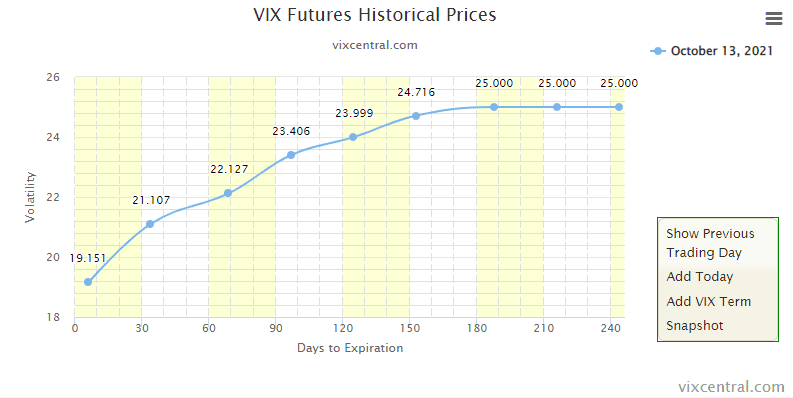
There is also the rather unusual situation of the "backwardation" forward curve, where the front contract is the most expensive. In the following example, the VIX futures are in a backwardation situation during the 2008 financial crisis:

During stronger price declines in the S&P 500, the VIX futures move from a contango to a backwardation forward curve. This change can be used to recognize high points at an early stage.


How VIX options trading works
In contrast to futures, options have a multiplier of 100. Although the options refer to the index, pricing follows the futures. Assuming an option writer writes a put on the VIX with an expiry date in February, the price of the February future is decisive for the pricing of the option and not the current price of the VIX index.

Key facts about VIX options:
- TWS symbol: VIX (VIX Index)
- Multiplier: 100
- Exercise method: European
- Settlement method: Cash settlement
- Tick size: 0.01
VIX-Optionen haben außerdem einen europäischen Ausübungsstil, sind also nur bei Verfall ausübbar und werden bar abgerechnet. Warum es für Privatanleger wichtig ist, das Cash-Settlement zu vermeiden, erfahrt ihr in this blog post.


Advantages of VIX options
Here are some of the benefits that trading VIX options can offer:
- Portfolio hedging: VIX options offer investors the opportunity to hedge their portfolio against unexpected market movements. They are therefore particularly suitable for investors who wish to minimize their risk appetite.
- Flexibility: VIX options offer investors flexibility as they can be traded in different ways. For example, they can be positioned as "long" or "short" to profit from falling or rising markets.
- Diversification: Trading VIX options can be a useful addition to a portfolio as they represent a different asset class to equities or bonds, for example. They can therefore help to reduce the risk of a portfolio.
- Easy to trade: The VIX is a liquidated market and VIX options are therefore easy to trade. They can be traded on the Chicago Board Options Exchange (CBOE) and there are numerous ETFs and ETNs that track the VIX, providing a way to indirectly invest in this asset class. In addition, there is no issuer risk.
- Volatility forecast: The VIX is an important indicator for the expected volatility on the market and can therefore be used as a forecasting tool. Investors who trade VIX options can therefore derive their strategies on the basis of current volatility expectations.
Gute Neuigkeiten: Das Handelsvolumen der VIX-Optionen nimmt in den letzten Jahren immer weiter zu. Die CBOE hat deshalb auch die Tick-Größe von 0,05 auf 0,01 gesenkt, somit ist ein noch liquiderer Handel möglich!
Disadvantages of VIX options
Here are some disadvantages that trading VIX options can bring:
- Price fluctuations: The VIX is a volatility index and is therefore itself volatile. This means that the prices of VIX options can fluctuate significantly and thus increase the risk for investors.
- Not a "traditional" asset: The VIX is not a "traditional" asset such as shares or bonds. Rather, it is a synthetic value that is calculated on the basis of option prices. Investors who invest in VIX options should therefore be aware of the special features of this asset class.
- Counterproductivity: In some market situations, the VIX and thus also the prices of VIX options may not move in the expected direction. This means that in some cases VIX options may not help to reduce the risk of a portfolio, but rather increase it.
- Short-term nature: VIX options generally have a term of only a few months and are therefore more suitable for short-term trading.

Conclusion on trading VIX options
Overall, VIX options offer investors the opportunity to hedge market risk and their portfolio. They are particularly suitable for investors who want to minimize their risk appetite and hedge against unexpected market movements (rising volatility).
However, investors should also be aware of the risks and special features of trading VIX options and obtain sufficient information before investing in this asset class. Trading VIX options can be a useful addition to a portfolio, but should always be considered in relation to the investor's individual objectives and risk tolerance.