


The VIX is undoubtedly the most important Volatility index and attracts attention among stock market traders worldwide. The index, known as the "fear barometer," usually rises when there are price losses on the stock markets.
Below you will learn what the VIX is, how it is calculated, what use the VIX has for analysis, and what products can be used to trade the VIX.
What is the VIX?
The Cboe Volatility Index (briefly: VIX) measures the short-term growth expected by the market. Fluctuation range (implied volatility) of the S&P 500 Index. The index is calculated from the option prices of options on the S&P 500 and published by the Chicago Board Options Exchange (CBOE).
Calculation of the VIX
For the calculation of the VIX Call- and Put options on the S&P 500 Index with an average term of 30 days. In order to achieve the target term of 30 days, two subsequent months are taken into account and the actual term of each of the individual securities used in the formula is calculated. Options is between 23 and 37 days. The calculation takes place in real time by querying the bid and ask prices of the SPX options every 15 seconds. In The Money options are not taken into account for the calculation of the VIX.
VIX analysis
As mentioned at the beginning of this article, the VIX is often referred to as the "Fear Barometer" is the name given to the volatility index. The volatility index has acquired this nickname because it always rises when there are price losses on the stock markets.
The correlation between VIX and S&P 500
If we compare the VIX with the S&P 500, we can clearly see that the two indices are fundamentally in opposite directions tend.

Understanding the negative correlation between the VIX and the S&P 500 requires an understanding of options characteristics.
Options are instruments used to hedge against price fluctuations and are increasingly traded on the stock markets when market participants wish to hedge against falling prices. The need for hedging increases as soon as prices start to fall. The further prices fall, the greater the demand for put options.
When the Demand for put options on the risetheir prices become more expensive, which is mathematically reflected in an increased implied volatility of the options is expressed.
Thus, the VIX is nothing more than a measure of the implied volatility of the options on the S&P 500. Since the implied volatilities of the options rise primarily when there are price declines on the stock markets, the VIX rises when the stock markets fall.
Interpretation of the VIX
Basically, the VIX can be interpreted as a kind of sentiment indicator. A low score signals little need for hedging and optimism of market participants. Therefore, a very low VIX is often observed in bull markets.
A high score of the VIX on the other hand can be used as increased need for security or interpreted as fear, uncertainty and pessimism.
In order to be able to assess which score is considered high or low, many market participants are guided by the mark of 20 points. Values above 20 are interpreted as high volatility; values below 20 are interpreted as rather low volatility.
The long-term average value is around 15 points. In bull markets, it can be observed that the VIX can also show very low quotations in the range of 10-12 points over a period of several months (e.g. 2017).
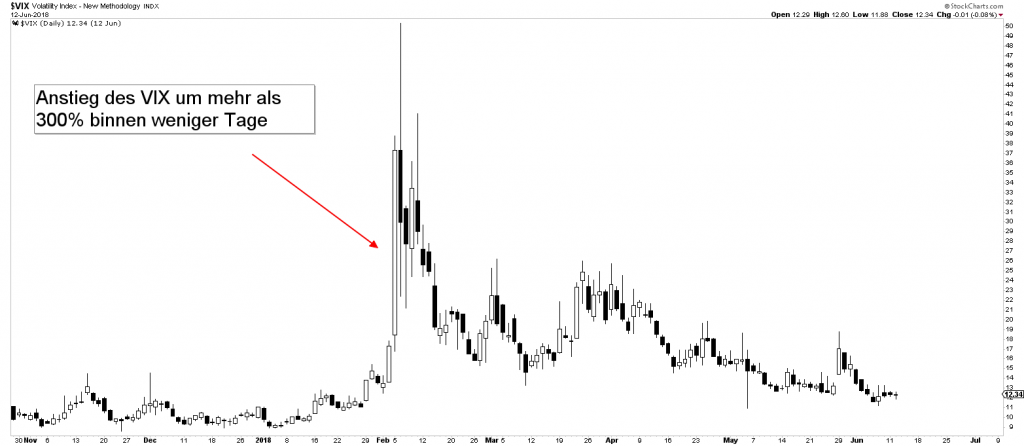
In case of sudden uncertainty or panic, the volatility index is known for this, to increase by leaps and bounds and reach very high values within a short period of time. For example, at the beginning of 2018, the VIX more than quadrupled within two weeks, rising from around 12 points to around 50 points.
Volatility trading - products on the VIX
The volatility index is not only useful for analysis purposes; there are also some products available to trade volatility for speculative purposes or hedging.
VIX Futures
Since the VIX is an index and an index itself cannot be bought or sold, the futures exchange Cboe launched forward contracts (futures) on the VIX with a monthly expiration date in 2004. Since 2015, there are also VIX futures with a weekly expiration date. Thus, VIX futures can be used for directional trades (long or short).
VIX options
As the VIX futures enjoyed great popularity after their introduction, Cboe launched VIX options in 2006. These relate to the VIX index (not the futures) and are settled in cash. Options with weekly and monthly expiration dates are available.
Volatility ETFs (VXX)
In addition to futures and options, there are also some volatility ETFs (or ETNs). One of the most popular is the VXX (S&P 500 VIX Short-Term Futures ETN). This buys the VIX futures with the next expiration date and the one after that. Since the futures have to be rolled continuously and the price of the futures with the longer maturity is usually higher, there is a rolling loss, which is why the VXX tends to go down in the long term, which some traders like to exploit.