


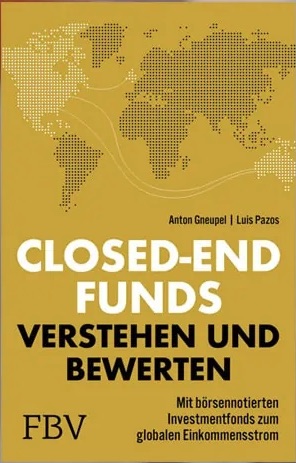

by Anton Gneupel & Luis Pazos is once again a typical Luis Pazos book. Because the authors have chosen an exciting niche topic, worked it up really well and continue to pursue a clear focus on income streams or distributions. For whom this is particularly important and who is aware in terms of time that it is, however, often rather inefficient from a tax point of view, but nevertheless appealing, can always reach for books by Luis Pazos without fear. Thereby there are then again and again topics, which one did not get to see so yet in the breadth.
This time we are talking about closed-end funds. These are basically a combination of traditional mutual funds and ETFs. CEFs try to combine the simplicity and active management of traditional mutual funds with the exchange listing and ongoing tradability of ETFs.

This is intended to minimize the administrative effort for management and administration with maximum transparency and liquidity for investors. In contrast to the open-ended investment fund, however, there is no direct trading with daily price fixing and, unlike the ETF, there is no cooperation with market makers or authorized participants and thus no index tracking or creation/redemption process.
Luis Pazos is always about creating a global income stream. However, CEFs are a largely unknown fund type in continental Europe.
"Continental European investors looking at the key figures of CEFs for the first time will notice two things after a short time: First, the comparatively high cash yields, and second, the distribution policy, which rarely provides for a semi-annual payment regime, usually a quarterly or monthly one, and which is the attraction of this financial instrument, especially for income-oriented investors."
Anton Gneupel & Luis Pazos
In this book, the two authors present the background, developments and functionalities of this financial instrument in detail. This book does not overload even slightly advanced readers, because it gently picks up over a somewhat longer introduction. Only absolute beginners will certainly have to crack in some places, but then the book was not written for them.
They explain what is important when evaluating CEFs, which different investment strategies are pursued by the respective management and which criteria private investors can use to make an individual stock selection. A detailed look at opportunities and risks and a compilation of CEF model portfolios round off the book's content.

The first chapter deals with the historical background of closed-end funds. The similarities and differences of the currently most important collective investment schemes are the subject of the second chapter. The third chapter discusses the emergence of CEFs as an independent instrument with separate regulation, the current legal structure, any country-specific features of CEFs and their primary target group. This concludes the rather theoretical first part of the book.
From chapter four, the more practice-oriented part begins with the typification of the fund class according to the investment strategy practiced, including a concrete sector representative in each case. This is followed in the next chapter by an overview of the most important capital markets for CEFs, which for historical reasons are to be found in the Anglo-Saxon region. Of course, a look at the opportunities and advantages as well as the risks and disadvantages is also part of the consideration of potential investments, which is carried out in chapters six and seven, before proven tools are provided in chapter eight to evaluate CEFs. Typified CEF model portfolios and the inevitable tax issues round off this first German-language publication on closed-end funds.
For me, closed-end funds are not a financial instrument I will use in the future. However, this is not so much because they are not interesting, but because my focus is more on the overall performance of my portfolio and less on optimizing individual sub-segments. So, from a purely scientific point of view, to increase overall performance, it makes no sense to increase distributions. On the contrary, it is rather - due to tax legislation - to be viewed negatively.
However, those to whom distributions are particularly important for emotional or other reasons may find here another interesting vehicle to increase them in a structured way or to diversify them even more broadly. So I would like to close this review with words of the authors in this direction, but can again emphasize that this is an exciting and well prepared book:
"In fact, the majority of CEFs - with a few exceptions confirming the rule - are aimed at income-oriented investors, i.e. investors who engage in income investing. Income investing refers to an investment strategy in which the investor's focus is on the income that can be generated from a portfolio without selling the securities themselves. The income itself is derived [...] from dividends, option premiums, realized price gains, interest and other income from, for example, concessions, licenses and patents, so-called royalties. In the case of a CEF, these are collected at fund level and distributed to the shareholders at regular intervals."
Anton Gneupel & Luis Pazos