


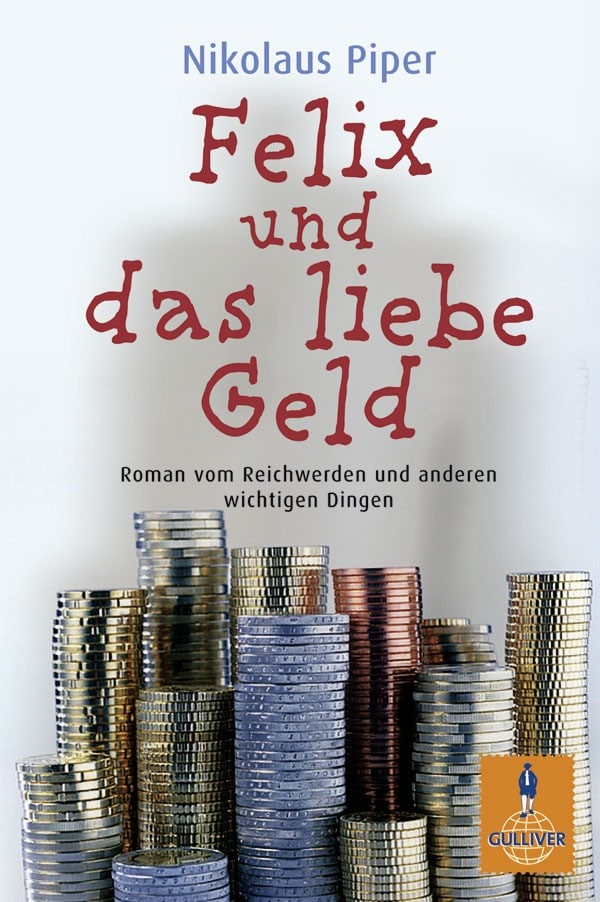

by Nikolaus Piper is an exciting and educational story that will captivate both young readers and adults. The subtitle "Novel about getting rich and other important things" already indicates that this is far more than just a simple tale about the pursuit of wealth.
The story revolves around twelve-year-old Felix Blum and his best friend Peter, who decide to get rich. Their adventure, ridiculed by many adults, begins with countless odd jobs, creative business ideas and their first joint ventures. One day, they also luckily find a not inconsiderable treasure that opens the door to financial opportunities.
On the recommendation of an adult, they invest their money in shares and initially make considerable profits. But their luck quickly turns when they fall victim to a fraudulent commodities futures transaction. The novel impressively addresses the challenges and risks of the financial market, self-employment and entrepreneurship, as well as human weaknesses and the temptation of quick money.

Felix Blum is a multi-layered character whose motivation is deeply rooted in family and social circumstances. He lives in a family that constantly struggles with financial problems, which only intensifies his desire to become rich. Nikolaus Piper's portrayal of the family dynamics, particularly the relationship between Felix and his father, a business editor who himself basically has the knowledge but ultimately not much money, adds depth and emotion to the story.
The dialogs between Felix and Peter are not only lively and realistic, but also full of philosophical and moral considerations. At many points, I honestly couldn't stop laughing because I could see the situations so vividly in front of me.
One example of this is the discussion about property and theft, which shows readers how the two boys try to understand complex economic and ethical issues. This also highlights the naivety and idealism of youth that makes the narrative so charming and accessible.
The author succeeds in explaining economic and financial topics in a way that is accessible and understandable to children, without coming across as lecturing or repelling adults. This is a remarkable achievement as it encourages readers - especially young readers - to think critically about money, wealth and the moral issues involved, while still being an exciting book for advanced readers who either want to pass on the knowledge to future generations or simply read it for entertainment.
"Money has to work. It was on a Monday, on May 4 to be precise, at dawn, when Felix Blum decided to get rich. [...]
Felix wanted to be rich. If you were rich, you were also strong. And free. "If you've got something, you're something," his father always said. And why shouldn't a boy of twelve be able to become rich on his own? His father had told him about famous people who already owned a company at eighteen or, like Wolfgang Amadeus Mozart, had composed an opera at twelve. So basically, it was high time he started."
Nicholas Piper
At this point a few words about the author:
Nikolaus Piper is a renowned German journalist and author. Born in Munich in 1952, Piper studied economics and political science before entering the world of journalism. He worked for many years at the "Süddeutsche Zeitung", where he was business editor and correspondent in the USA.
Besides Felix and the love of money Nikolaus Piper has published several non-fiction books dealing with financial topics and global economic trends.
"There was confusion in his head, there was no denying that. Yesterday, at the dinner table, his parents had told him in passing that they wouldn't be going on summer vacation this year. Just like that. Because there was no money. "You have to face facts," his mother had said. "We can't afford the trip. No money. That's it. Other families stay at home on vacation too." Then they had told him about the new car they would need soon and about the roof of the house that needed to be repaired. His father said that maybe they could catch up on their vacation next year. What nonsense! "Save, save, always save in this idiotic fucking family," he had shouted in his father's face. Then he'd run into his room and locked himself in."
Nicholas Piper

For me, this book is far more than just an adventure story; it is an educational, exciting and amusing novel that encourages young readers to think about the importance of money and the ethical implications of wealth. The novel shows that while money is important, it should not be the only goal in life. Nikolaus Piper's story teaches us that true contentment and happiness cannot be bought and that moral integrity and human relationships are ultimately more important than material wealth alone, but also that the two are compatible and not mutually exclusive.
I personally love financial books for children anyway, which is why I was incredibly excited about this book. For just 8.95 euros and over 350 pages, it's also a real bargain and a clear recommendation from me anyway. But unfortunately that's the way it is sometimes in the book industry with books and their prices. The best sometimes cost almost nothing, whereas other works are offered at 50 euros and people confuse price and performance.
"Felix Vater should actually have known a lot about money matters, if only because of his profession. Gerold Blum was a journalist at the Schönstädter General-Anzeiger, where he was responsible for all the articles that had to do with banks, factories, money and suchlike - he was head of the newspaper's business section. Unfortunately, his knowledge of money didn't mean that they had more of it at home. "You could always use the clever things you write for your family," Felix's mother used to say whenever there was an argument."
Nicholas Piper
For me Felix and the love of money by Nikolaus Piper is in a way the German version of Rich Dad Poor Dad and, from my point of view, written a little better and, above all, much funnier. The conversations between the child characters were simply so incredibly authentic every time and so sweet to read that I really enjoyed this book. I've really enjoyed reading a financial book again for a long time.
"And his father laughed along: "Getting rich, my dear Felix - don't you think that's a bit early?" Felix could have cried with rage. At himself, at his father and at this whole stupid bank. His great plan had ended after just half a day with the adults finding it ridiculous. And he himself too. "Don't take it tragically," said Mr. Fischer as he handed him his savings book. "He who does not honor the penny is not worth the thaler. Only those who start saving early can become rich later. I had my first savings book when I was seven ..."
"So, have you become rich?" Fortunately, Felix had remembered this question. Mr. Fischer's grin froze.
"Hmm, well, I'm satisfied." The branch manager smiled sweetly as Mr. Blum pulled his son out to the counter. Felix was boiling inside. "Come on, don't sulk," said his father. "I don't want you to laugh at me. That was mean of you. Besides, I think it's really stupid about the interest: waiting so long and earning so little interest."
Nicholas Piper
Unfortunately, the cover has aged quite a bit since 2008 and the book is hard to find, but that's just a side note. Because that shouldn't detract from the fact that, in my opinion, it is one of the best financial books for children that I have ever read. I wish I'd had a book like this myself when I was 12. Including the helpful little dictionary of economics at the end of the book, in which all sorts of terms marked with an asterisk in the book are explained.
"And of course fishing was also forbidden. Old Mr. Becker from the lower town had leased the fishing rights and nobody was allowed to get trout there except him. "Don't be a chicken," said Peter. "Let old Mr. Becker catch us first. Besides, he doesn't deserve the right to fish. Property is theft, Robert says." Peter's brother had just graduated from high school and knew a lot of clever sayings. And some less clever ones too. Felix laughed and shook his head. "If property is theft, then everything is somehow theft."
"It is," Peter replied. "You have to look at it this way: Who made the trout? The good Lord. And who did he make the trout for? For people who are hungry. And who is hungry? You and me. It's quite simple." "If all the hungry people fished here, the Krebsbach would soon be fished out. So it's necessary for things to belong to someone, otherwise there will soon be nothing left to steal. That's logical. My father says that in the old days, when pupils had to buy their own school books, they would have taken much better care of them. What belongs to everyone belongs to no one.""
Nicholas Piper
Nikolaus Piper has worked with Felix and the love of money has created a remarkable novel. A truly heartbreaking story that has everything a good financial book needs to be both entertaining and educational. The story of Felix and his pursuit of wealth is a tale of the complexities of life, the risks and rewards of the financial market and the true meaning of happiness.
For young readers, the book is an exciting introduction to economic topics, while adults will appreciate the depth and subtle criticism of our consumer society and will certainly be made to smile at times. An absolutely recommendable book for all age groups.
"Dad, do girls only like rich men?" His father didn't say anything, but his mother burst out laughing. "Where did you get that idea?" "Peter's brother said that." "He has some strange views! Let me tell you something. If girls only liked rich men, you wouldn't even exist, son. When I met your father, he was as poor as a church mouse. He couldn't even take me out to dinner after the movies. I think if I hadn't translated books back then, we would have starved to death as students. No, no, you should forget about the rich men. And anyway," she added seriously, "your father gave you permission to earn money with Peter. All right. But remember what the American saying goes: money can't buy happiness. In other words, you can't buy happiness. You should remember that. And you too, Gerold.""
Nicholas Piper