


The short put is a bullish to neutral Option strategywhich, however, has a virtually unlimited loss potential if the underlying falls sharply. Through the purchase of a further Put option the maximum loss can be limited. This option strategy is called Bull Put Spread - or put credit spread or short put vertical spread.
Definition Bull Put Spread
A bull put spread is an option strategy that consists of a put option sold (short put) and a purchased put option (long put) with a lower strike price and the same remaining term.
The Bull Put Spread belongs to the category of Vertical spreads and is used when the market opinion is bullish to neutral. Since the short put is closer to the money than the long put, a net credit, i.e. a premium income, is generated when the trade is opened. Compared to a short put, this is lower, in return for which the downside risk is limited.
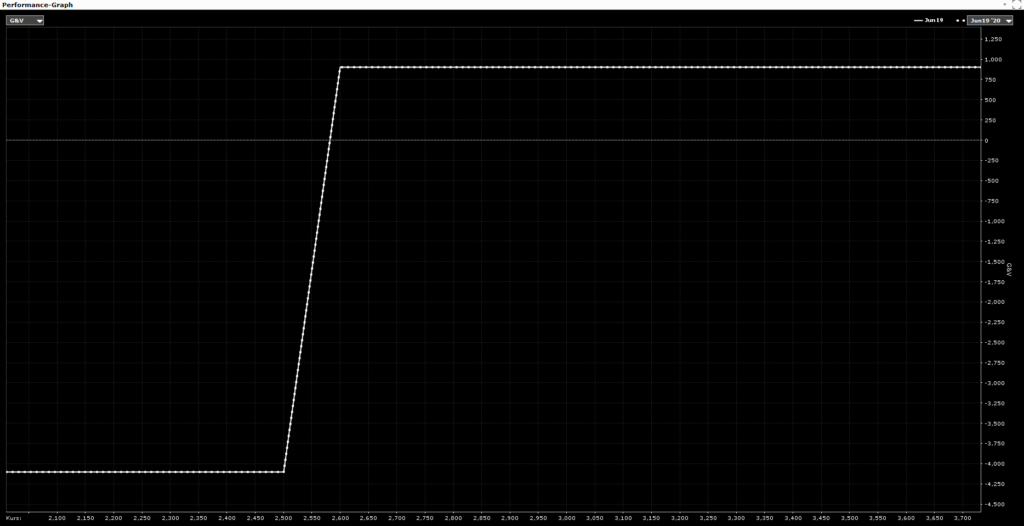
P&L diagram of a bull put spread
In the profit and loss diagram, you can see that the maximum profit occurs when the underlying is quoted above the price level of the short put on the expiration date. The maximum loss occurs when the underlying falls below the level of the long put.
What to look for when trading a bull put spread?
The Bull Put Spread is a bullish to neutral option strategy. Similarly to a short put, the objective is to gain by taking the Option premium to generate a profit. By choosing the strike prices and the width of the spread, the trade can be adjusted to your own market expectations and risk appetite.
Maximum loss
The maximum loss is limited to the Width of the spread minus the option premium collected (Net Credit) and arises if the underlying is quoted at or below the price level of the long put on the expiration date.
Maximum loss = strike price short put - strike price long put - net credit
Maximum and realized profit
The maximum profit corresponds to the Amount of the option premium collected (net credit) and can be realized if both options expire worthless. The underlying must therefore be quoted at or above the price level of the short put on the expiration date.
If the underlying is quoted on the expiration date between the base prices of the two options, the short put results in a loss, which can be partially compensated by the option premium collected. The gain (or loss) is:
Profit = Net Credit - (strike price short put - price underlying)
Break Even Point
If the loss of the short put is exactly equal to the option premium, the break even point has been reached.
Break Even Point = Strike Price Short Put - Net Credit