


The Short Straddle is a Option strategytraders on a sideways movement of the underlying and/or a fall in the implied volatility speculate. Similar to a short strangle, one of each of the following Call option and a Put option sold, but not with different base prices, but the same.
Definition Short Straddle
A short straddle consists of a sold call option (short call) and a sold put option (short put) with the same strike price and the same expiration date. The options are usually sold at the money (At The Money); however, it is also possible to choose a strike price above or below the current market price of the underlying.
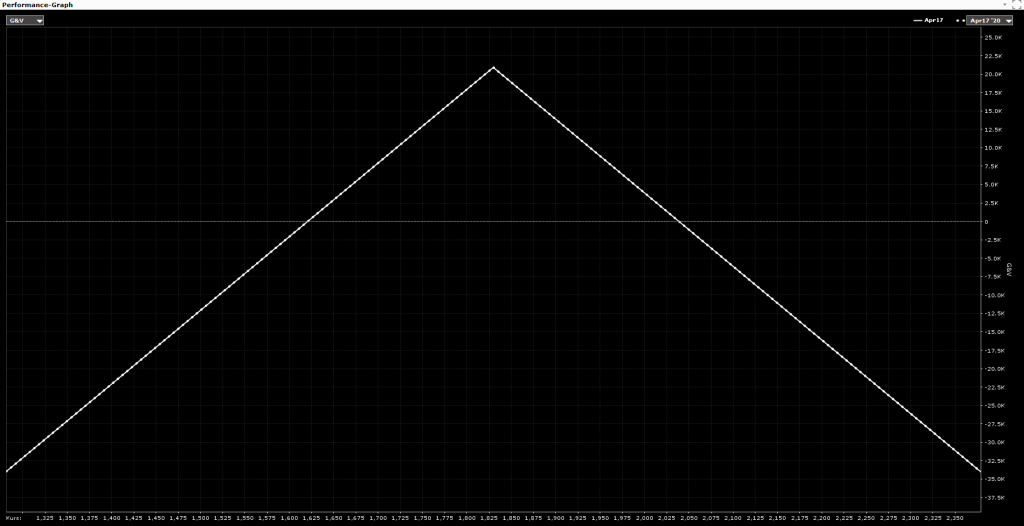
P&L diagram of a short straddle
The P&L diagram of a short straddle resembles a Tent. The marquee peak visualizes the strike price of the sold options. This is where the maximum profit is made on the expiration date. The further the underlying moves in any direction, the smaller the profit becomes, until finally the break even points are crossed and the trade runs into the loss zone.
What should I pay attention to when trading a short straddle?
A short straddle has a unlimited loss potential. The further the underlying moves away from the strike price of the sold options, the greater the loss. During the term of the options, the trade reacts sensitively to changes in the implied volatility; a declining IV has a positive effect, whereas an increase in IV hurts the trade. In addition, the decline in time value has a positive effect on the Short Straddle off.
Maximum and realized loss
The maximum loss is not definedsince the underlying can theoretically rise indefinitely or fall to zero. If a strong price movement takes place, the actual loss on the expiration date by calculating the difference between the price of the underlying and the strike price of the options, and then subtracting the option premium collected at the beginning (net credit).
Loss in case of bullish development of the unerlyings:
Loss = underlying price - strike price - option premium Straddle
Loss on bearish development of the unerly:
Loss = strike price - underlying price - option premium Straddle
Maximum and realized profit
The maximum possible profit of a short straddle is limited to the amount taken at the beginning of the straddle. Option premium and arises when the underlying on the expiration date At The Money quoted. Since this happens relatively rarely, the actual profit is usually much lower and can be determined by calculating the distance between the price of the underlying and the strike price of the sold options and then subtracting this from the option premium collected.
Profit in case of bullish development of the unerlyings:
Profit = option premium straddle - (price underlying - strike price straddle)
Gain on bearish development of the unerly:
Profit = option price straddle - (strike price straddle - price underlying)
Break Even Point
The two break even points are at the price level where the loss of the long call or long put is equal to the option premium paid.
Break Even Point (1) = Straddle strike price + Straddle option premium
Break Even Point (2) = Straddle strike price - Straddle option premium