


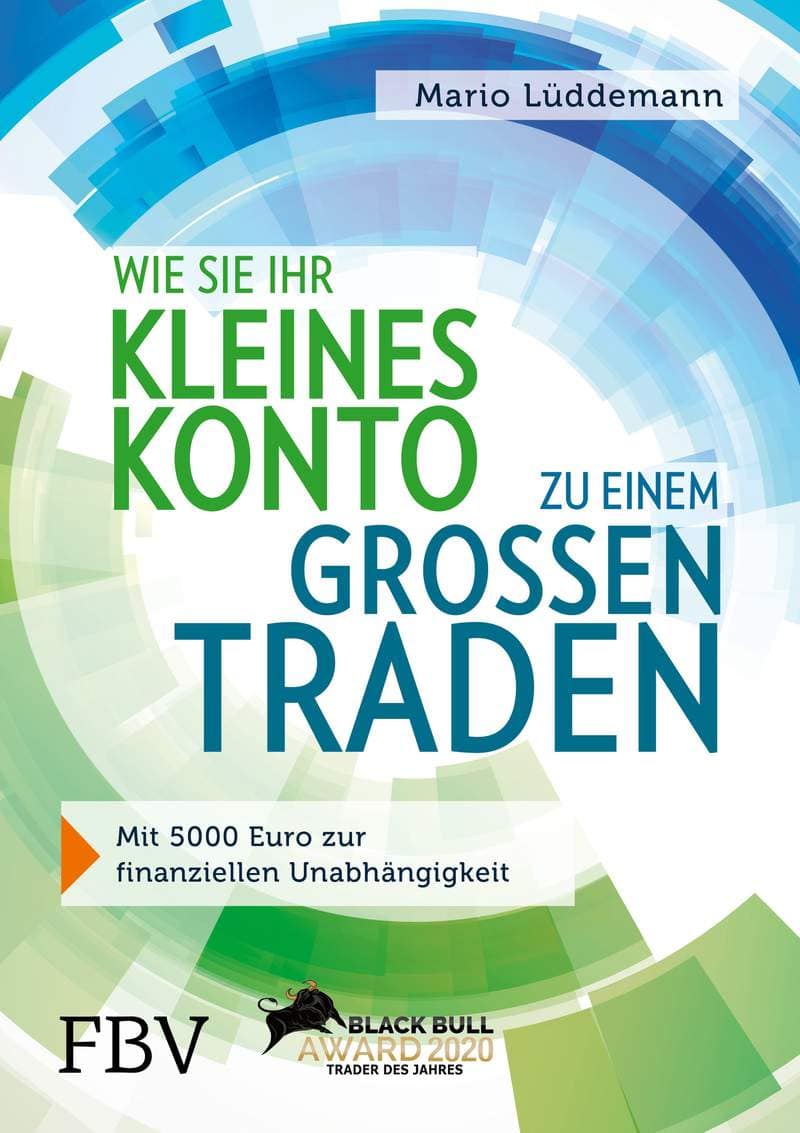
HOW TO MAKE YOUR SMALL ACCOUNT A BIG TRADE by Mario Lüddemann is a very successful trading guide for beginners. Even if the lower part with the ambitious goal on the cover does not appeal to me so much, the author then knows how to convince with the essential contents. From 5,000 EUR to financial independence, the reader should not take too literally, otherwise greed and exuberance threatens to ruin the performance.
The cry for fast money is too often accompanied by a quick crash or at least a quick disillusionment. André Kostolany once said, "I can't tell you how to get rich quick, but I can tell you how to get poor quick: Namely, by trying to get rich quick."
This is then also the biggest criticism I have of this book, although it is probably due to the marketing. Also, the first calculated scenarios with returns of 20 to 40 % p.a. over 22 years are then a bit daring. Especially when you consider that this book is still aimed at beginners.
The book gets much better when the author starts to talk about his own practice:
"My aim is to show beginners and experienced traders the path to success on the stock market. Each of them should find their own personal path with the help of the knowledge imparted here."
Mario Lüddemann

Accordingly, the author is nowadays more and more engaged in coaching traders and in his own seminars he visits the sobering record of most of them. According to this, up to 90 % show not only returns below the benchmark, but even negative returns.
Moreover, these disappointing results are achieved with a comparatively high effort. According to the author, trading times of more than 6 hours per day are not uncommon.
Mario Lüddemann now tries to help exactly these people not only to be able to live from trading, but to grow successively. Because the book is then also aimed at beginners, he makes clear guidelines regarding the implementation and breaks down his strategy to the essentials.
- It should be possible to achieve the targeted return even at low trading frequencies.
- The amount of time required should also allow for part-time trading.
- For simplicity and risk avoidance, he limits himself to stocks, ETFs and CFDs.
This requires some routine and preparation and this is exactly what the author wants to help with. When choosing the right broker and the appropriate software, he pays particular attention to consistently limiting fees and other charges. He then guides readers through the creation of an initial trading plan, the use and construction of a clean trading journal and proper risk and money management.
His basic strategy is then based on trend following, directly warning readers not to go too high:
"A strong uptrend, for example in the index, won't help you at all if you pick weak stocks, and you won't succeed even if you miss the exit after a strong rise in the period up to 2000."
Mario Lüddemann

The core of the book is the recognition of trend signals. He tries to bring the screening closer to the readers and above all to pay attention to the reversal and the right entry and exit. Seasonalities also play an important role for him.
Finally, of course, the psychology factor should not be overlooked. Inexperienced stock market players in particular will always have to struggle with their emotions. Especially when their own account has already grown and more money is at stake.
In conclusion, I must say that for me it is a really good book for beginners in the world of trading. It covers all the important aspects that you should know at the beginning.
In addition, the author has really put a lot of effort into explaining things simply and using as few technical terms as possible. Accordingly, even absolute beginners are not beaten to death, as would be the case with many other trading books.
Anyone who has thought about the step to trading will do very well with this book at the beginning. Whether you then want to stay with it or dive even deeper into the world of the stock market is up to you. The entry should be laid.