


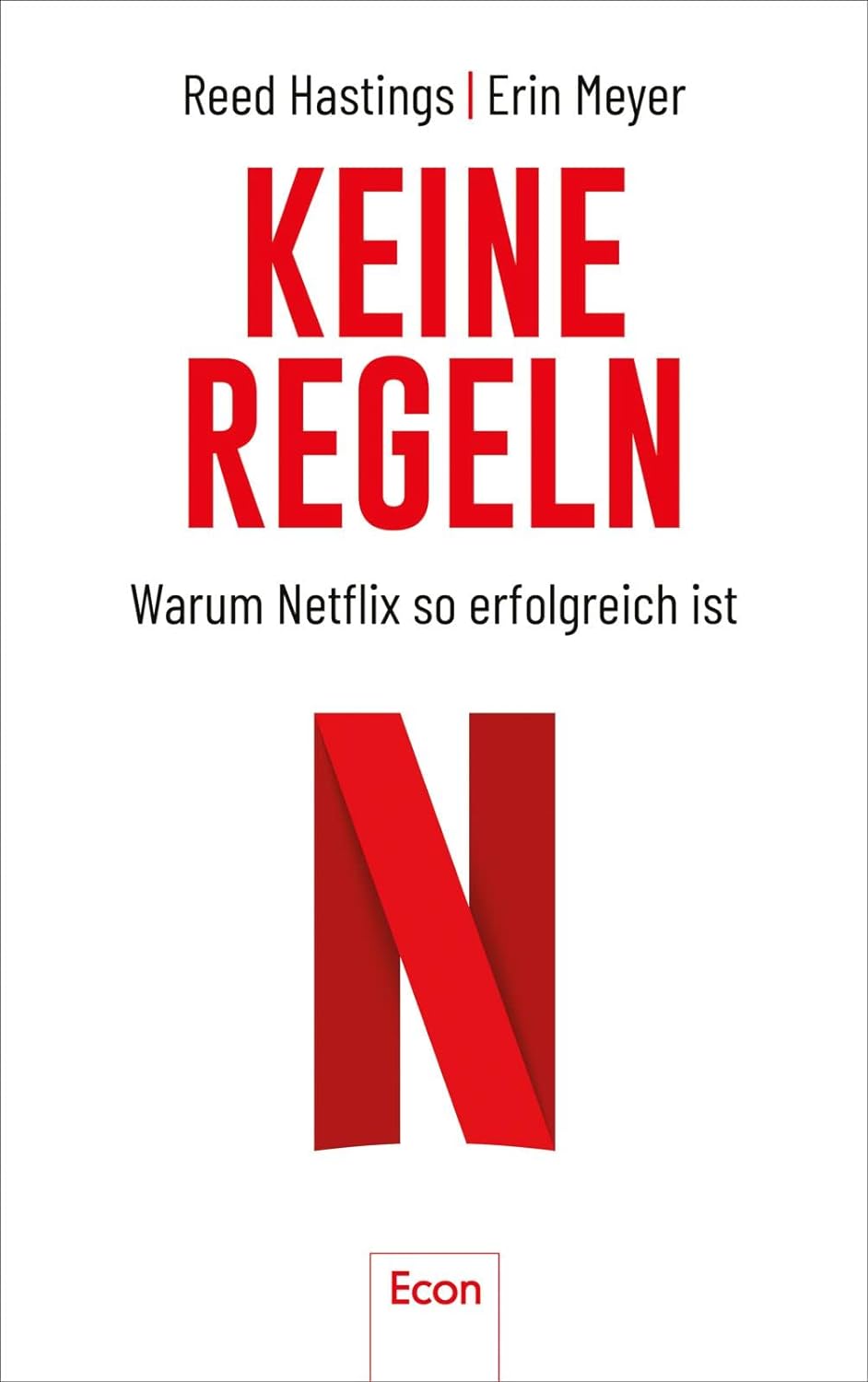

by Reed Hastings and Erin Meyer is a truly impressive work. We are almost used to tech giants tending to break new ground. Netflix is no different.
"Be radically honest. Remember that this is a team, not a family. And never try to talk down to your boss."

These are some of the basic principles for Netflix employees. In addition, there are no guidelines regarding working hours or vacation days and, and, and.
For some, it looks like a paradise at first glance, where you can take 360 out of 365 days of vacation. But for others, it's a spiral to burnout. Netflix lives in a bubble of performance, freedom and recognition. However, these are paired with intrinsic and extrinsic pressure and a hire-and-fire mentality. This is also familiar from Silicon Valley.
In this book, the founder and CEO of Netflix, Reed Hastings, talks for the first time about the characteristics of their employee management. And about the strategies with which the company has transformed itself from a mail order company for DVDs into a successful streaming platform.
"Netflix is different. It has a culture where only one rule applies: no rules."
Reed Hastings
For me, it is above all a story of incredible freedom. But with that comes enormous responsibility for everyone. And, as we all know, many people can't really handle that. This is precisely why the results are not necessarily always positive. Despite top salaries, a culture of openness and transparency and the consistent abolition of control mechanisms.
Netflix's bar is set very high, the focus on increasing talent density is enormous. Those who can handle it and are attracted by it will find themselves in paradise. Everyone else leaves the company as quickly as they arrived.
A definitely controversial, but enormously interesting approach for me. I read every single chapter with great interest. Especially as the two authors could not have been more different in their original perception of the subject. Erin Meyer only recognized the advantages of Reed Hastings' ideas after a deeper examination of them. Nevertheless, she is the critical voice in many places in this book.
"Netflix culture, on the other hand, is famous - or infamous, depending on which way you look at it - for calling a spade a spade. Millions of business people have studied the 'Netflix Culture Deck', a collection of 127 slides that were originally intended for internal use before Reed posted them online in 2009. Sheryl Sandberg, COO of Facebook, said the 'Culture Deck' was 'possibly the most important document ever written in Silicon Valley'. I loved the 'Netflix Culture Deck' for its candor, and I loathed it for its content.
Leaving aside the question of whether it is morally right to throw talented employees out on the street because they fail to deliver something exceptional, these slides struck me as really bad management. They violate the principle that Amy Edmondson of Harvard Business School calls 'psychological safety'. In her book The fearless organization she explains that if you want to encourage innovation, you need to create an environment where people feel safe enough to dream, speak their minds and take risks. The safer the atmosphere, the more innovation.
Apparently no one at Netflix had read this book."
Erin Meyer
I have never read such an approach before. Here, the main author is not simply allowed to present his theses and ideas freely and without doubt. Instead, he is critically scrutinized by a former critic and economist.
"You hire the best people and then instill fear in your talented employees by telling them that you will throw them out on the street with a 'generous severance package' if they don't excel? That sounded like a sure-fire way to kill any hope of innovation."
Erin Meyer

There is no doubt that even after almost 400 pages, I still have a lot of unanswered questions. I have not yet been able to form a final opinion on many of the approaches and would like to let them sink in first. However, this is always a particularly good sign for me in a non-fiction book. If a carousel of thoughts starts going round in my head afterwards, then the book has done everything right. This work is definitely one of them. It showed me new perspectives and is now allowing me to work on previous convictions. And it allows me to broaden and sharpen my own perspective.
Even if some of the ideas presented here are bizarre: At the end of the day, I would much rather read a book like this than the hundredth business guidebook that rehashes the same ideas as generations before it in a lukewarm manner.
Especially in times when I am continuing to build and scale my own company, books like No rules significantly more valuable.
A few words about the authors:
Reed Hastings is the founder and CEO of Netflix. He graduated from Bowdoin College and holds a Master's degree in Artificial Intelligence from Stanford University. In between, he served as a Peace Corps volunteer in Swaziland.
Erin Meyer is a professor at INSEAD Business School in Paris, one of the most prestigious private business schools in the world. She is the author of The Culture Map and was included in Thinkers50's ranking of the 50 most important management thinkers in 2019.
The book was translated by Stephan Gebauer.
Netflix is undoubtedly one of the most successful companies in the world. It is admired by many for its innovative strength, flexibility, speed and entrepreneurial courage. The transformation from a mail order company for DVDs to a streaming provider was certainly not to be underestimated. Especially at a time when broadband expansion was nowhere near as advanced as it is today. Anyone who had bet on Netflix back then and invested in the share would have made a fortune from this speculation. But it would have been just that: a speculation.
The company had already been declared dead by many, but today it is even competing with Hollywood. It produces its own blockbusters and series, which now receive some of the most Oscar nominations. An incredible transformation, a crazy success story and all the more interesting to listen to the thoughts and ideas of the founder.
"But bit by bit, the world changed. Our company held its own and grew. In 2002 [...] we took Netflix public. Blockbuster was still a hundred times bigger than us (with an annual turnover of 5 billion compared to our 50 million). Plus, Blockbuster was owned by Viacom, which at the time was the most valuable media company in the world. But in 2010, Blockbuster filed for bankruptcy. Nine years later, there was only one Blockbuster store left in the world, in Bend, Oregon. The company had failed to make the leap from DVD rental to streaming.
In 2019, our film Roma was nominated for an Oscar in the 'Best Picture' category and won three statuettes, which was a great success for director Alfonso Cuarón and underlined Netflix's transformation into a true entertainment company. It had been a long time since we had not only gone from DVD rental by mail to an internet streaming service with over 167 million subscribers in 190 countries, but had also become a major producer of TV series and movies around the world. We've had the honor of working with some of the most talented filmmakers, including Shonda Rhimes, Joel and Ethan Coen, and Martin Scorsese."
Reed Hastings
The company guidelines, which are the benchmark for the work of employees and managers alike, are particularly exciting. Guidelines that would send any trade unionist up the wall:
"Netflix is not a family, but a team of high performers. They don't need complicated regulations and approval processes, but more personal responsibility. Nobody should talk at the mouth of their boss. Everyone can take as many vacation days as they deem appropriate. It is not working hours and working methods that count, but results. Everyone gives each other open and sometimes painful feedback - even employees give their superiors feedback. Netflix pays the best salaries and consistently separates itself from low performers and self-promoters. It is clear to everyone that such a concept, which is based on trust, is completely worthless if the ideas are not exemplified by management.
Honesty and excellent employees are the main keys to above-average results. If both are present, a company can dispense with rigid rules, petty control and even decision-making hierarchies."
Reed Hastings
Top marks for this book because it's just so different: super exciting, controversial and stimulating. You definitely don't have to approve of everything Netflix has made its own standards. But it's really interesting to read. And the book is structured in a thoroughly self-critical way, which makes it even more valuable.