


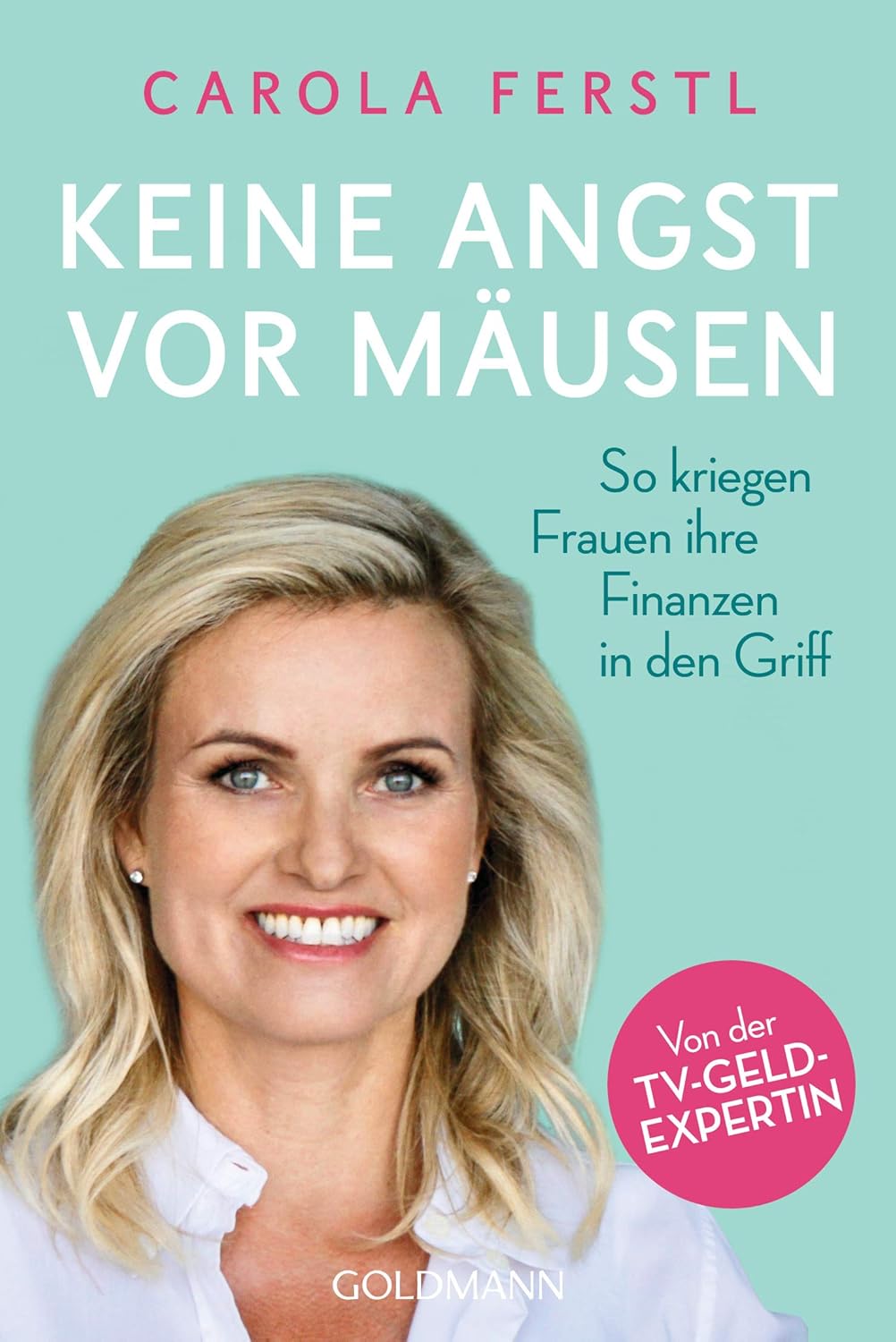

by Carola Ferstl is a practical guide aimed specifically at women to help them achieve financial security. The author combines her personal experience with general financial knowledge to offer her readers understandable solutions for dealing with money that are suitable for everyday life.
A new look at finances
Carola Ferstl opens her book with an inventory of the most common fears and insecurities that women have when dealing with money. She sheds light on how cultural and familial imprints influence the so-called "money mindset" and shows ways to successively question and change these thought patterns. Through numerous interviews with prominent women, the author illustrates how different life paths and financial decisions can lead to greater self-confidence in dealing with money.
Carola Ferstl's readers learn how they can ruthlessly reflect on their personal attitudes to finance and make lasting improvements. This focus on psychology and self-awareness is initially intended to create the basis for the second part of the book, in which concrete strategies and tips follow.
Seven life hacks for financial stability
The main part of No fear of mice is divided into seven so-called life hacks, each of which sheds light on different financial aspects. They do not necessarily build on each other, but complement each other and cover a broad spectrum of personal finances. At the very least, Carola Ferstl's readers are given suggestions for organizing their finances, reviewing insurance policies, conducting salary negotiations and building up long-term wealth.

1. eliminate financial chaos:
Carola Ferstl emphasizes how important it is for her to have a clear overview of income and expenditure. She explains how readers can use budget books and digital tools to control their financial situation. She particularly emphasizes the importance of emergency reserves to avoid financial bottlenecks.
2. take out insurance:
Readers learn which insurance policies are necessary from the author's point of view and how to avoid expensive overinsurance. She also provides some practical tips for optimizing existing policies in order to reduce costs in the long term.
3. conduct salary negotiations:
Another central chapter deals with the question of how women successfully negotiate their salaries. Carola Ferstl addresses common inhibitions and provides her readers with concrete argumentation aids.
4. money education for children:
The author emphasizes the importance of starting financial education at an early age. She explains how parents can introduce their children to handling money in a playful way. Her readers are given practical examples to teach financial skills in everyday life.
5. investing for the future:
Carola Ferstl dispels the preconception that investing is complicated or risky. She explains simple principles that even beginners can implement. The focus is on long-term strategies such as ETFs and sustainable investments that ensure financial security in old age. Unfortunately, in my view, her arguments are sometimes far too euphoric and not sufficiently factual and scientifically sound. But more on that later.
6. use tax optimization:
Another chapter is dedicated to the often neglected topic of taxes. Carola Ferstl shows how readers can get money back through targeted tax returns and which tools can help. Unfortunately, there is also too much vague wording and advice here, which I cannot endorse. Basically, however, it goes in the right direction.
7. managing money in relationships:
The last chapter deals with finances within partnerships. Carola Ferstl encourages her readers to talk openly about money and make clear agreements. She gives practical tips for joint accounts and fair splits.
Financial independence as a wellness goal
Carola Ferstl sees financial stability not only as protection against hardship, but also as the basis for a fulfilling life. Her readers should learn how financial wellness boosts self-confidence and reduces stress.
"In preparing this book, I spoke to many women. With successful and less successful women, with women who always have enough money and with women who never make ends meet and are sitting on a mountain of unpaid bills. Why is it that one woman's money sticks to her hands while the other's just slips through her fingers? In my experience, it is largely due to the attitude, the inner attitude towards money, the 'money mindset'. It is essentially shaped by the beliefs that we were all given and internalized in our childhood."
Carola Ferstl
An dieser Stelle ein paar Worte zur Autorin:
Carola Ferstl is probably one of the best-known faces on the German financial scene. Since 1993, she has been explaining the world of finance on ntv in programs such as Money, Taxes and law and Real estate the world of finance.
In addition to her work as a presenter, Carola Ferstl also regularly holds lectures and seminars in German-speaking countries. Her books Money is really good for women (together with Bodo Schäfer) and Women are the better investors achieved bestseller status. Carola Ferstl lives in Berlin with her husband and three children. With her many years of experience, she wants to help women manage their finances successfully and secure their financial independence.
"It starts with the fact that women like to choose social and other professions that are close to people. Unfortunately, these professions are generally not particularly well paid. It continues with the fact that women tend to take a back seat professionally when they have a child. On the one hand, because they usually earn less than the father of the child and the loss of earnings due to childcare is therefore smaller for the family. Secondly, because it is still considered the norm in society that family work is a mother's job."
Carola Ferstl
My first impression of the book was initially neutral. Over the years, I have become more cautious about financial guides as I have read many of these books. While some were outstanding, others remained rather average.
Price and design
For 12,00 Euro offers No fear of mice almost 300 pages in a high-quality paperback binding with a designed cover. In my opinion, the price is very fair, especially in a genre where books are often significantly more expensive. Inside, readers can expect a simple and functional design. Even if it looks a little pale in places, this is absolutely justifiable in this price range.

Classification of the author
The publisher describes Carola Ferstl as "the most competent and convincing woman on the German financial scene". I personally find this formulation exaggerated. It doesn't seem very reflective and could cause skepticism among readers. Especially in the financial sector, I expect restraint and a down-to-earth presentation in order to radiate seriousness. As the author was unknown to me until this book, this self-description did not leave the best impression.
Language and target group
The book is clearly aimed at beginners and conveys financial knowledge in a relaxed language. It deals with many topics, but tends to stay on the surface. The subject areas are wide-ranging, which is why some content is teased rather than explained in depth. The first part of the book contains personal anecdotes from the author before moving on to the seven life hacks.
The 7 life hacks - helpful approaches
The seven life hacks cover key financial topics, which in my view are well chosen. They provide an overview of important issues that women should take care of sooner rather than later. They deal with financial chaos, insurance, salary negotiations, money education, investments, taxes and money in relationships. It is precisely this broad range of topics that makes the book a good introduction to the world of finance.
Strengths and weaknesses in content
In terms of content, the book often remains quite general and avoids complex details. This superficiality may disappoint some readers who want to delve deeper into individual topics. One example of this is the section on investments. The author writes:
"As you go about your day, you'll soon realize: It's not rocket science to find companies that are practically constantly present in your life. It is precisely these companies that earn a lot of money from your consumer behavior - and from the consumer behavior of other consumers."
Such statements can be problematic, as they almost trivialize investments in individual shares. They sound as if buying shares is comparable to a spontaneous online shopping experience. Although I understand the basic idea, I still find the presentation of individual investments as a simple and risk-free strategy questionable.
Also the statement ...
"Would you like to take a closer look at the topic of stock selection? Then go ahead, it's worth it!"
... could tempt readers to make impulsive decisions. Beginners in particular often lack both the specialist knowledge and the time and financial resources to keep up with professional investment strategies. Here I would have liked to see a clearer emphasis on lower-risk alternatives such as ETFs.
Tax return and income tax assistance associations
Another example of superficiality can be found in the section on tax returns. The author mentions income tax assistance associations and emphasizes their benefits. Unfortunately, she remains superficial here too and, in her euphoria, barely addresses the pitfalls. Readers are given a rough overview, but in my opinion they are not adequately prepared for practical challenges.
"Talking about money or even just thinking about money is totally unromantic, especially for women. It destroys princess dreams right at the beginning of a relationship. Surprisingly, many women retain this way of thinking even when the prince and the castle in the clouds have long since become a life partner or husband in a shared apartment and everyday life is anything but fairytale-like. Money is usually a taboo subject in a relationship. Talking about who contributes what share of the household income, who does what share of the unpaid housework and what a fair financial balance might look like is often avoided."
Carola Ferstl
Conclusion
No fear of mice is a good, but not an outstanding financial guide. It offers newcomers an initial overview of important financial topics and inspires them to take a closer look at money issues. The seven life hacks cover key topics and provide helpful food for thought for concrete steps.
However, readers who already have in-depth knowledge of finance or are looking for specific strategies may be disappointed in some places. Superficial explanations and simplified recommendations, especially for investments, require the reader to think critically.
Despite some minor weaknesses, the book is still recommended for anyone looking for an uncomplicated introduction to financial topics and who is prepared to continue their own education afterwards.