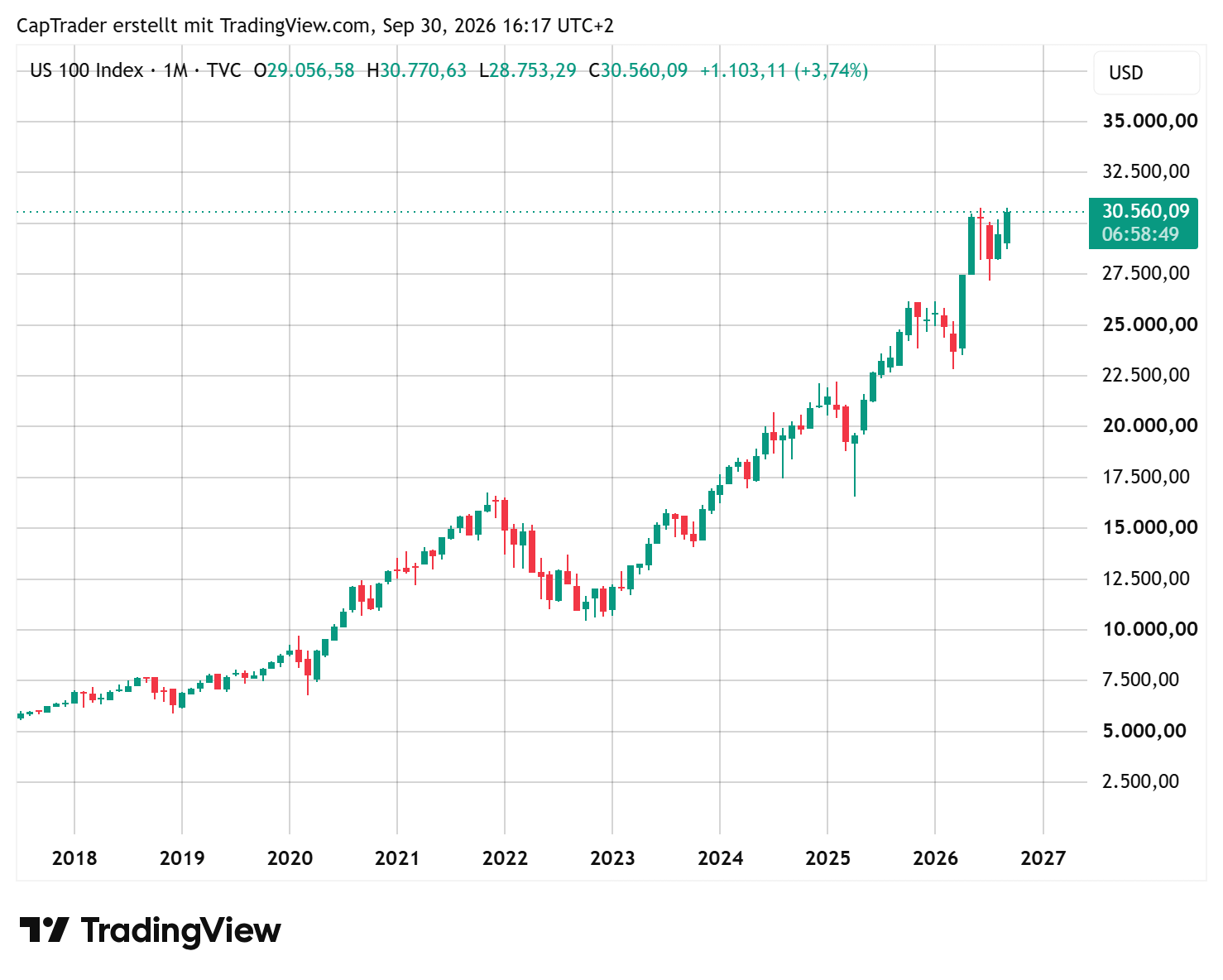
After the release of new U.S. price data, investors are once again looking for risk in the U.S. technology exchange Nasdaq. Investors hope that the adverse monetary policy effects beyond the Atlantic will not be as severe in the future.
At the same time, investors are not yet entirely sure how to classify Trump’s recent statements regarding the AI sector. The hope that the regulatory screws in the AI sector might not end up being tightened as strongly as feared could serve as a double-edged sword. On the one hand, investments and innovation could be encouraged. On the other hand, the risk that the risks and side effects of artificial intelligence might act as a boomerang is growing.
Nasdaq 100 
Trump wants to rely on self-control in artificial intelligence
This news is also likely to have provided some encouragement, as US President Donald Trump still wants to avoid regulating the AI industry and for AI companies to voluntarily self-regulate.
According to Trump, companies would control themselves, it was said after a meeting with representatives of major tech companies in Washington. Furthermore, self-regulation of the AI industry would be sufficient, it was further stated.
US price data weaker than expected – monetary policy concerns ease somewhat
The core rate for personal consumption expenditures fell by 0.2 percentage points (compared to the previous month), which was weaker than expected (0.3 percent), after 0.1 percent previously. In this context, interest rate concerns may have lost some momentum. According to the CME Group’s „Fed Watch Tool,“ currently 65.1 percent of market participants expect a pause in interest rates at the upcoming meeting on October 28, and 34.9 percent expect a pause in interest rates. A day ago, about half of the participants still expected a total interest rate hike of a quarter of a percentage point.
Accordingly, on Friday the US labor market data (Non-Farm Payrolls) will be on the agenda (14:30). According to the latest data, economists expect a creation of 90,000 new jobs (previously: 162,000 new jobs). The unemployment rate is expected to remain at 4.1 percent.