


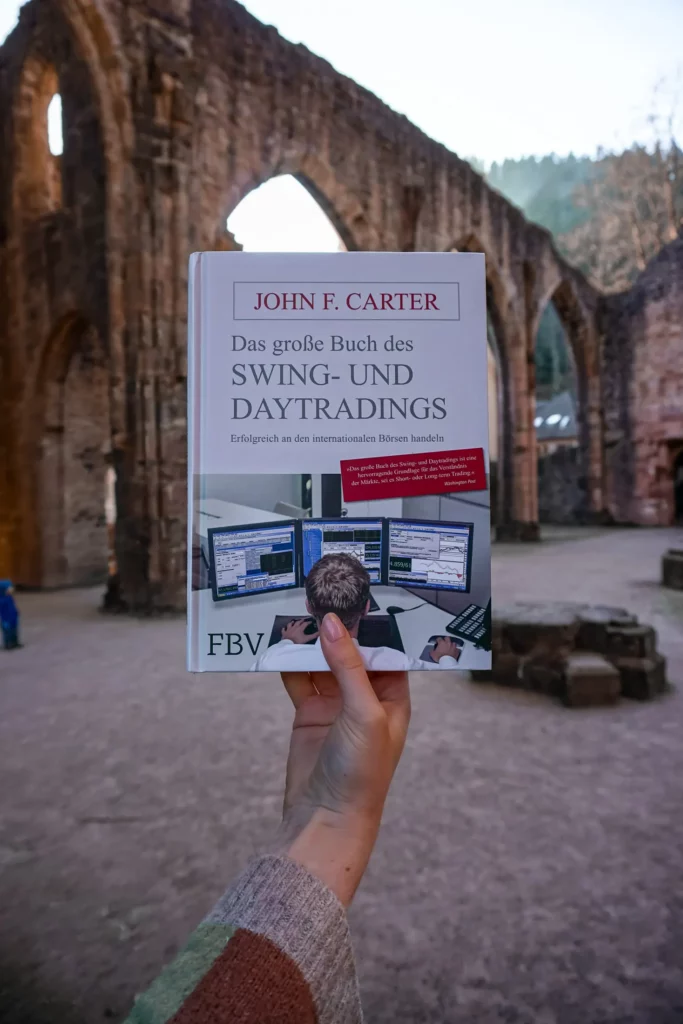
...by John F. Carter is a book that might put off the first people already from the layout, because it is written very small on very large pages and really wants to be read carefully. Not for everyone, I am aware of that. And so it is also transferable to the topic. Swing and day trading are two forms of trading that require a lot of courage, work and especially luck to be able to do it successfully over a long period of time.
Thus, the author also begins his book with the sentence: "This book is dedicated to all those who courageously face the task of becoming a professional trader." Unfortunately, in reality this picture very often does not look so rosy, but much more often ends in a fiasco.

He then introduces the first part with a nice anecdote from rafting, which taught him a few things about trading. Because swing and day trading are two approaches that aim to exploit the volatility of the market or individual securities. Thus, in these cases, the trader tries to exploit and master the up and down swings, similar to a rafting team in their boat on the way through the wild water.
At this point I must also place my big criticism of this book. Because the language with which this book was written, you really have to like or simply ignore. You can call it partly martial, arrogant and insulting. If you leave this aside, the author offers you a really comprehensive smorgasbord of trading strategies in both areas, which are the real added value of this book.
However, for my taste, the life of a trader is glorified too much and greed and cockiness are fueled with statements such as "The only way to become a professional trader is to call upon those skills that set you apart from the rest of the flock of sheep". I view this so critically because a trader is in a work environment where such emotional behavior usually leads to financially unfavorable scenarios.
Thus, the topic of psychology is not neglected before the author moves on to the perhaps much more interesting topic of hardware and software. Every active trader will be able to browse almost endlessly here and will certainly get his money's worth.

If you can overlook the literary skills of the author, which I criticized, then you will find some very interesting food for thought, especially in the back chapters. For example, the sometimes unbelievably high transaction costs in some markets or with some brokers, which mean that a trade can become unprofitable even if you were actually right on the money. The clearly formulated fact that trading is certainly not used to build up personal retirement provisions. And beyond that, countless special intraday and swing setups such as pivot points, tick fades, etc. which are discussed in great detail and with many diagrams in order to discuss the essential characteristics.
In the last part of the book, there are all kinds of tools for daily trading in practice. From checklists to the conception and construction of strategies, as well as channeling and eliminating emotions. Just everything a professional trader needs.
If you don't mind the author's language, are completely convinced of the idea of trading and are looking for some new impulses regarding markets, strategies, setups and the like, you will do really well with this book.