


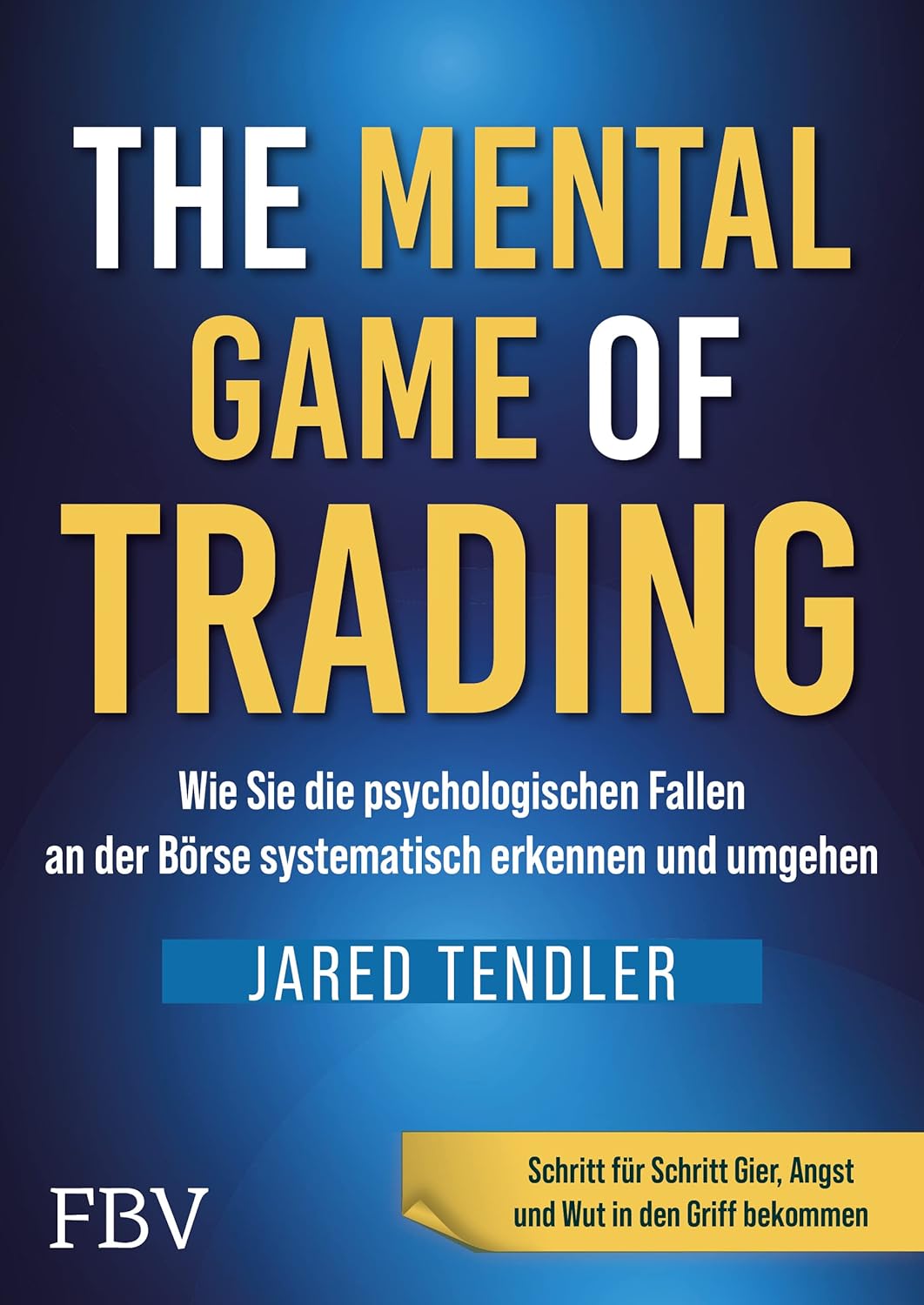

by Jared Tendler offers a holistic approach to recognizing and overcoming the psychological pitfalls of trading. The author explains how emotions such as greed, fear and anger cause trading mistakes on the one hand. On the other hand, they also serve as signals that can point to underlying problems. The book provides a practical step-by-step approach to identifying and, ideally, solving these problems.
Jared Tendler begins by analyzing the mental challenges that the vast majority of traders face on a daily basis. And he explains why conventional approaches to overcoming these challenges are often not particularly effective. He emphasizes the importance of a systematic approach. This is the only way to identify the root of the problems, develop long-term solutions and integrate them into everyday life in a meaningful way.

A central and, in my view, really exciting aspect of the book is the perspective on emotions. The author does not see them as an obstacle, but as important signals for unresolved problems. He encourages readers to use emotions as an additional "data source" that points to unconscious patterns of thought and behavior. This applies both to ourselves and to other market participants. He is convinced that by recognizing and examining these patterns, traders can identify and address their performance weaknesses.
The book guides the reader through different performance levels in trading, from A to C. Level A is the goal, where traders are emotionally stable and can make good decisions. By working specifically on the underlying problems, you can take your trading game to the next level.
Another important aspect of the book is its emphasis on a systematic approach to improving the mental game. Jared Tendler presents a step-by-step system that aims to tackle problems at the root and achieve long-term improvements. Through practical exercises and real-world examples, he shows how traders can identify and overcome their psychological problems.
"If you want to have even the slightest chance of solving problems such as greed, loss aversion or perfectionism, you must first understand what you are actually fighting against. To do this, you need to take a different look at the role that emotions play as causes of trading mistakes."
Jared Tendler
At this point a few words about the author:
Jared Tendler is a renowned expert in the field of mental performance optimization. His influence extends to the world of poker and golf as well as entrepreneurs and hundreds of institutional and independent traders.
With a Master's degree in Counseling Psychology and a license as a mental health counselor, he has in-depth knowledge. He coaches people in various areas of life with professional competence. For over 17 years, he has been helping people from all over the world to overcome their mental barriers and achieve peak performance.
"It's not true that emotions such as anger, greed and fear are the root cause of your bad decisions on the stock market. In reality, these feelings are signals. This change of perspective is crucial. Don't fight against your emotional state. Instead, look at emotions as signals and find out what they are trying to tell you. After all, that's what we do when we have physical complaints. And as with our feelings, the actual cause is not always obvious. Let's say you get a headache at the end of a trading day. At first you think it must be caused by trading stress. Family and friends confirm this view. But you also have a headache at the weekend, even after a week's vacation. You have been taking over-the-counter medication for months now and are trying to live with it. You still don't know where the pain is coming from. Sooner or later, at the end of a trading day, you notice that you are squinting your eyes when you make the last entry in your trading book. You make an appointment with an ophthalmologist. It turns out that your eyesight has steadily deteriorated over the last six months. You are getting headaches because your eyes are strained. You get a new pair of glasses prescribed and your problem is solved. The headache was not the problem, but merely a signal that you had to interpret correctly. Similarly, negative emotions are signals that point you to an unresolved problem."
Jared Tendler

In its hardcover binding, the book makes a good first impression. The cover is quite plain, but expressive. The back cover could have used a little more attention.
Inside, readers can also expect a simple, unobtrusive layout, but a wealth of text. In the end, there are almost 300 pages in which the author delves deep into the subject matter. 35 euros is not cheap, but in my opinion it is reasonable for a hardcover.
In terms of content, this is not a typical trading book. The author does not present himself as a guru or make disparaging remarks about self-proclaimed financial experts. Instead, his focus is entirely on the mental challenges that all active investors face. However, I would not reduce his statements to traders. Because although I don't actively trade myself, I was also able to take away some valuable thoughts.
I found his descriptions of the positive power of emotions and feelings on the capital market particularly interesting. He quite rightly writes that these are far too often and carelessly dismissed as negative - even by me so far. Yet they can also have the opposite effect:
"Since the focus is so much on how emotions affect your stock market success, it is tempting to dismiss them out of hand as harmful. However, they are the decisive prerequisite for you to be able to perform at your best. They are an essential source of strength for your success. Seen in this light, emotions are neither good nor bad.
Even feelings that are generally seen as negative are not always so; anger, for example, can be an enormous source of energy. Michael Jordan was motivated by anger: Because he was kicked off his school team, he ended up becoming the greatest basketball player of all time. Some traders only reach their best form when they are really angry, others when they have their backs to the wall and the pressure is high. Viewing emotions as inherently bad is not very helpful - and the results prove the opposite."
Jared Tendler
In my opinion, the author deliberately tries not to construct castles in the air. Rather, he accepts human nature. He even offers concrete approaches to utilize it instead of suppressing it by hook or by crook.
Overall offers The Mental Game of Trading an interesting and particularly practice-oriented approach to overcoming the psychological challenges of trading. Frankly, I was pleasantly surprised by it. The book can definitely help you to improve your own mental game and ultimately improve your own trading performance. Even though I'm still not a firm believer in active trading.