


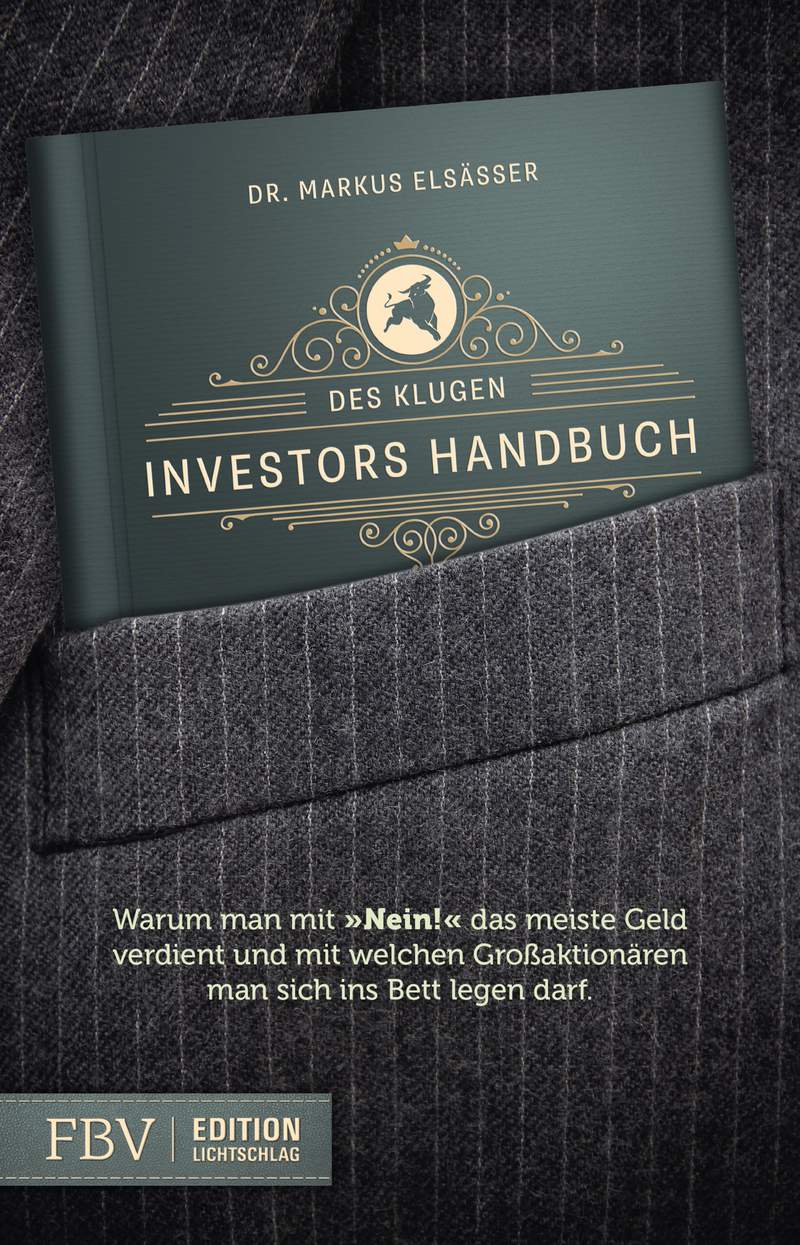

The Clever Investor's Handbook by Markus Elsässer is a small but excellent book as an introduction to the topic of value investing. Right from the start, I was struck by the author's pragmatism. He tries to approach things a little differently to the usual industry experts. Away from the familiar technical jargon of the scene, he asks the all-important question: "Speculator or Investor?"
And he is absolutely right about that. Most of us are somehow both at the same time or there will be moments when we slip from one side to the other or even worse: justify the decisions of a speculator with the arguments of an investor. This is a tricky issue. Because it has an immense impact on the time input you put into your investments, but also on the subsequent investment strategy and, above all, on the resulting outcomes. That is why, according to the author, you should clarify this question for yourself once and for all as soon as possible.

His appeal is for prudent and rational action on the capital market. In his book, he attempts to cover all the relevant psychological and technical areas of an investor in short, concise sections. Logically, he cannot go into depth in this attempt in just 160 pages, but the chapters make a well-founded and pointed impression. In general, I have the feeling that this author is one of the more capable, rational and realistic investors.
If you are completely new to the stock market, have not been in it for long or are simply too lazy to read, this book is the right choice for you. It is very easy to read, has a beginner-friendly structure and is not overloaded. If you are interested, you can always delve deeper into the individual sections afterwards.
As the title suggests, this is a small handbook designed to guide investors through the many situations they will inevitably encounter. This is definitely a good and helpful guide. Anyone who wants to become active on the stock market - even if it is only passively with a broadly diversified ETF - will get tips and advice from an expert who has no interest in motivating excessive trading. The book is reasonably priced and provides these guidelines in a few pages.

All in all, this makes it a good financial book to start with. Towards the end, it also becomes a bit more interesting for value investors. Because, after the general chapters have been worked through, the author gives us at least a superficial look at his own analyses. We learn roughly how he acts and what effects external events have for him. These are tips and tricks that he can pass on to other value investors from his long history.
It is undoubtedly well written and certainly capable of providing a good initial overview of the capital market or consolidating existing knowledge. For my taste, some of the content could be formulated a little more vividly, but if that is not so important to you, you can concentrate on the content. Unfortunately, it comes across as a little pragmatic at times.