


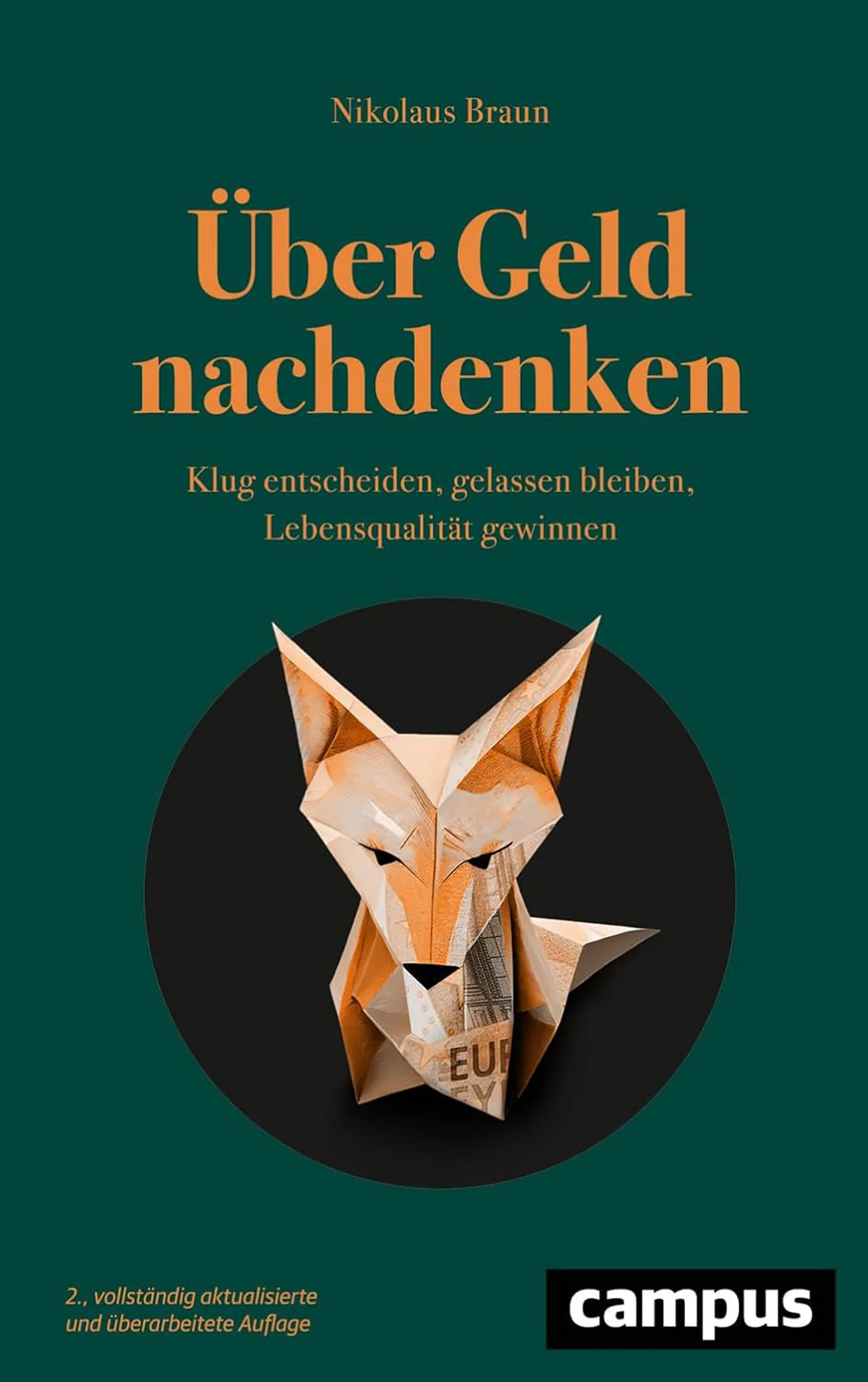

by Nikolaus Braun (2nd fully updated and revised edition) continues to be a refreshing approach in the often opaque world of financial guides. Instead of dry investment tips and complex financial strategies, the author focuses on how money affects our lives. He describes how we can make smart, serene decisions about it that lead to a better quality of life.
The book begins with a fundamental but sometimes life-changing question: Why is money important to us? This question leads to a profound reflection on how our attitudes to money affect our quality of life and our relationships. The author argues convincingly that it is not about being rich. Rather, the goal is to be financially independent and calm in dealing with money.

A central theme of the book is the wealth strategy, which Nikolaus Braun describes as transparent, simple and manageable in the long term. He unmasks the empty promises of the financial industry. Instead, he offers his readers a clear path to a personal wealth strategy that is in line with their life goals.
His approach to implementation is particularly valuable: in addition to wealth accumulation, he also deals with emergency and succession planning and emphasizes the importance of powers of attorney and wills. He also shows how smart budget planning ensures long-term financial security.
What makes the book stand out is its holistic approach. The author repeatedly emphasizes that money should not be an end in itself, but a means to improve living standards and promote personal satisfaction. He links financial decisions with quality of life and emphasizes the importance of successful human relationships.
Braun's writing style is always accessible and practical. He illustrates complex financial concepts with stories from his consulting practice, which underline the realism of his advice. This makes the book more than just a financial guide: it is a life guide that encourages you to proactively shape your own financial future.
"Money is a central and immensely important part of our lives. I want to help you deal with money more wisely and calmly in the future and make competent decisions. Decisions that will enable you to lead a better life. However, one thing must never be lost sight of: It is not money, but successful human relationships that are the real focus of a fulfilled life. So you shouldn't take the subject of money too seriously. Worrying too much about money will make you dissatisfied, unhappy and probably a more unpleasant person. Good and simple money decisions are urgently needed."
Nikolaus Braun
At this point a few words about the author:
Dr. Nikolaus Braun has been a border crosser between the humanities and the financial sector for almost two decades. With a doctorate in history, he began his career at a major bank rather by chance. However, he left disappointed when he became a pure financial salesman.
Today, Braun is a senior partner in an asset management company and co-founder and co-director of Neunundvierzig Honorarberatung in Munich.
There he uncompromisingly implements his idea of independent and holistic investment advice. He has already published two successful financial guides with Campus Verlag, including Money or life - How to stop doing nonsense with your assets* (click here for my review).
"There are dozens of financial guides. A lot of bad ones, but also some pretty good ones. Most are intellectually devastating, but some are technically outstanding. But for private investors, toxic waste and highly rational advice often sound equally plausible. What's more, the various authors' recipes for success are often extremely contradictory. As a result, readers of these guides potentially dilute or overturn their strategy with each new book."
Nikolaus Braun

Of course, I noticed the new cover right at the beginning, which I really like visually. Although to be honest, I have to say that the old cover was probably the bigger eye-catcher. I think this cover is nicer, but the old cover would certainly have found more buyers in a bookshop. But at least the work has a very striking title that attracts attention and invites interested readers to take a second look.
The solid softcover binding - which is always the most comfortable to read - and above all the contents of the back cover are completely convincing. Especially if you take a look at the table of contents, you quickly realize that the author is pursuing a sincere, scientifically sound and, above all, reflective approach with his work.
In terms of content, it is simply a book as it should be. One that imparts knowledge without obtrusively drawing attention to the author's further offers. Basically, it's sad that I have to emphasize this positively. But anyone who reads a lot will know how the publishing industry has changed in recent years.
Is it worth buying a new copy of the book if you have already read the first edition? In my opinion, only for readers who always want to be up to date. Nevertheless, it does of course make sense to update such a work from time to time. But even in the first edition, many of the analyses and insights were timeless. Of course, I also know from my blog the target group that only reads new books. Per se, these people label even 5-year-old works as outdated and uninteresting.
"But even when I meet people who follow good financial guides: They regularly fail to implement them. Why is that? As the name suggests, financial guides deal with money. The fundamental question of all financial guides is: What should I do? What are the best investments, what is the best strategy, how do I keep up to date, when should I get in or out, should I buy a property and how do I finance it...? It's about complex techniques and approaches, and since money is apparently something rational, the factual level dominates (at least apparently). Sooner or later, the reader finds himself on an unsettling search for an unattainable optimum. A search that tends to make them dissatisfied and is unlikely to lead to success. The question "What should I do?" is not bad in itself, but it falls far too short. The much more important question is: Why is money important to me? Next: What does my money have to do with my life, with who I am? How can it contribute to a successful life, to the success of human relationships? What scope for action should it open up for me? How can I prevent my money from dominating me, worrying me, perhaps even bullying me? How can it make me more satisfied, in the best case happier?"
Nikolaus Braun
To summarize Thinking about money by Nikolaus Braun is an enrichment, especially in its completely revised second version. Especially for people who want to build a healthy and sustainable relationship with money with a well-founded and at the same time empathetic guide. This book not only promotes financial education. It also encourages people to talk about money and reflect on its importance in their lives. Braun manages to present complex topics in a simple and understandable way. In this way, he offers valuable guidance in the often confusing world of finance.
Because there are people who are looking for more than just a quick buck. They want to enrich their lives by making smart decisions instead of handing them over to their bank advisor. For them Thinking about money by Nikolaus Braun can therefore be recommended without reservation.
"Irrational decisions are encouraged by a devastating lack of general financial education - in all levels of education, from warehouse clerks to chief physicians. Compound interest, the basics of the capital market, a rational approach to risk: Not a thing. Instead, there is a lot of half- and quarter-knowledge. Nothing is taught at school, the financial industry has no interest in well-informed customers - although many stupid decisions could be prevented with a calculator and basic arithmetic. Not only is the rational understanding of money limited, the emotional approach to the topic is also mined. What's worse, while ignorance can easily be overcome through education - such as reading one or two sensible guides on the subject of money - the emotional distortions run deeper."
Nikolaus Braun