


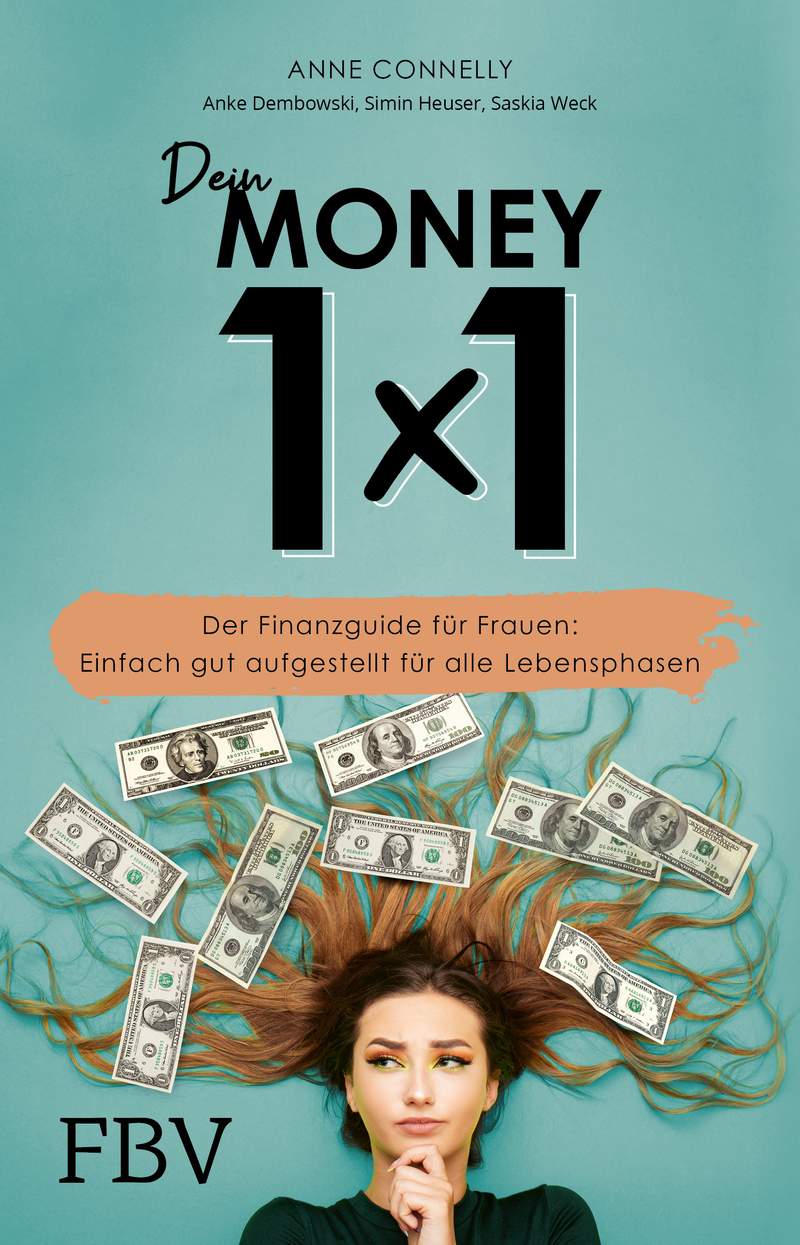

by Anne Connelly, Anke Dembowski, Simin Heuser and Saskia Weck is a financial guide explicitly aimed at women. This is not only evident from the subtitle, but also from the layout and the focus of the content and speeches in the book itself. This book is advertised as a guide to help women to be well positioned in all phases of life.
Although the book makes a good visual impression and also presents the most common and general topics relating to the world of finance for beginners really well in terms of language, it lags enormously as soon as it goes deeper into the topics and, due to a host of QR codes and recommendations on its own behalf and its own guild, becomes less like a book that wants to answer many questions and more like one that is intended to be a targeted funnel towards its own products.

Personally, after almost 300 pages, I didn't have the impression that I had completely ticked off the topic. On the contrary, the authors themselves write that it is only intended as a starting point for delving deeper into the topic afterwards or seeking help from experts.
In principle, neither is a bad thing. It's almost impossible to cover everything relevant in one book and why not get additional expert help. It just seemed a bit strange to me that "independent insurance brokers" were always recommended in countless places, but not once was it even mentioned that there is such a thing as fee-based advice.
"First things first: there's no one-size-fits-all answer to the question of which insurance you need and which you don't need. It depends entirely on your circumstances. But rest assured that you don't need all the insurance policies offered to women in this country. So you may be through with the topic sooner than you think.
This chapter is intended to provide you with an overview of the various types of insurance. It does not have an advisory function. During your research, you will find that there are many different tariffs. Seek the advice of an independent insurance broker if you would like expert support in finding the right policy."
Anne Connelly, Anke Dembowski, Simin Heuser and Saskia Weck
You can guess how vague and misleading this chapter is. The tips and tricks are all much more detailed, well-founded and easily accessible free of charge on consumer portals on the Internet. Nevertheless, the advice of insurance brokers and tax consultants is always recommended in this book, even for the most trivial topics.
However, there are other points that I find much worse about the book. I have already referred above to the countless QR codes in the book. QR codes are not in themselves a completely demonizable tool for a guidebook. They just have to make sense by transporting valuable additional content that was not included in the print version for the sake of topicality or would have gone beyond the scope of the book.
However, this can only be applied to very few QR codes. Rather, in countless places they primarily served one idea: to generate reach for your own homepage and your own podcast. In addition, one thing should be completely undisputed: If I include such QR codes, then they should also be kept up to date and work, right? That's not the case here. I didn't check every single one, but I checked 15 of them and only one of them worked. All the others gave me this message: "Go Back Home".
Of course, that's not possible and the publishers and authors need to take it upon themselves to sort out the problem. It must not have been my cell phone, because I tested it with 3 other devices. A no-go for me.
But not only were there far too many pointless and non-functioning QR codes in my opinion, but statements were also made that made my hair stand on end.
"On the capital market, more risk is always rewarded with more potential returns! Distrust anyone who claims otherwise and tells you, for example, that there is an investment opportunity with little risk and huge profit prospects."
Anne Connelly, Anke Dembowski, Simin Heuser and Saskia Weck

Please what? I understand the basic intention of this statement and it is correct, but the assertion that more risk on the capital market always equates to more potential returns is simply nonsense. Conversely, this does not mean that there are investment opportunities with little risk and huge profit prospects. The two are not connected.
What would have been much more important to emphasize is the risk/return ratio. This should be the pivotal point in this consideration and of course there are forms of investment that promise a higher return with lower risk. People who contradict this and claim that more risk always(!) leads to higher potential returns should be distrusted.
Especially since the book was not written by just one person and there is a whole company behind herMoney, I can't understand why this sentence got lost in here. It should have been obvious and I assume that the authors will be aware of the diversification effect, which makes their statement scientifically verifiable ad absurdum.
And the authors do not even refer to the stock market alone. They make this statement for the entire capital market, including all other asset classes that are traded.
But that's not the only passage that gave me a headache.
"The BU is the top class of insurance. Just work out how much salary you would earn on average by the time you retire. Now you might come up with a six- or seven-figure sum. And then imagine something happens tomorrow that makes it impossible for you to continue doing your job.
Do you have 500,000 or a million euros in your bank account? No? Then who will pay for you? Who will make up for the lack of your salary? Your partner? And what if your better half leaves at some point? Financial independence looks different! The health insurance? They usually only pay for 78 weeks within three years for the same illness. After that, you get unemployment benefit. And even with the full statutory reduced earning capacity pension, you would only receive half of your net salary, to put it mildly.
[...] In short: your survival would be taken care of, but financially you would have to fear relegation."
Anne Connelly, Anke Dembowski, Simin Heuser and Saskia Weck
I'm usually only familiar with this kind of series of questions from the insurance industry, but it gets much more exciting when you read on:
"As you can see, it's usually not possible without a BU. If you don't have this type of insurance yet, you should think about taking out a disability insurance policy. Because the monthly premiums will increase from year to year.
It could be a good idea to take out occupational disability insurance while you are still at school, studying, training or starting your career. Because: at a young age, you probably don't have any health problems and are therefore an interesting candidate for insurers."
Anne Connelly, Anke Dembowski, Simin Heuser and Saskia Weck
You just have to let that last sentence melt in your mouth and ask yourself whether you want to be "an interesting candidate for insurers". Basically, this means nothing other than that the insurance company is very likely to cash in on me. Because every single insurance policy is a bet on the (non-)occurrence of an event that I enter into with an insurance company.
No insurance company will enter into a contract with me on terms that are on average to the detriment of the insurance company. On the contrary, they will always weigh up the risk and take the margin and their own fixed costs into account. If I am particularly interesting, that means nothing other than that I am particularly lucrative.
You should keep that in mind. Continue with:
"One in four people have to give up their job for an extended period or even permanently before retirement age. One in four! Reason enough to take a closer look at the topic, don't you think? If you are unsure which product is most suitable for you, you can contact an independent insurance broker."
With this book, the authors want to give women a plan to help them organize their finances. "You will find out which insurance policies you really need, how to protect yourself from poverty in old age and how to build up a small financial cushion to fulfill your dreams. This book is a practical guide that will help you to finally tackle the topic of finances." I would still subscribe to this intention until the middle of the book. But towards the end at the latest, it becomes increasingly vague and then passages like this tend to shine:
"herMoney tip: It's good to talk to others. This is especially true when things get hot on the stock market. That's why it's a good idea to join a community of like-minded people (for example the herMoney Facebook group). This is not only a way of exchanging ideas, but also a way of cheering each other up when prices fall sharply." Anne Connelly, Anke Dembowski, Simin Heuser and Saskia Weck
Anne Connelly, Anke Dembowski, Simin Heuser and Saskia Weck
And if you haven't understood it yet:
"To find such a good rate structure, you can contact an insurance broker, for example." Anne Connelly, Anke Dembowski, Simin Heuser and Saskia Weck
"If you are interested in a Rürup contract, you could make an appointment with your tax advisor and a pension expert. That's particularly valuable in this case because it's a very tax-driven product." Anne Connelly, Anke Dembowski, Simin Heuser and Saskia Weck
After 100 pages at the latest, it should be clear: This book was not written primarily to answer questions, but rather to create a need, as they like to say in the insurance industry. "We only want to arouse the customer's interest in the first meeting, not advise them."a friend of mine always gave me along the way.
Incidentally, you should never(!) take out a financial product solely for tax reasons and you certainly don't need a tax advisor for a Rürup, but beware, it will be recommended again later on a much more banal topic.
A few words about the authors at this point:
Anne Connelly is the founder of herMoney, a financial portal for women. She is a long-time manager in the investment fund industry.
Anke Dembowski has a degree in business administration and is a financial journalist. She is the founder of Fondsfrauen, a career network for women in the financial sector, and writes regularly for herMoney.
Simin Heuser studied economics and came into contact with the fund industry early on. Her voice can be heard in the "herMoney 1x1" podcast and she takes part in events and the herMoney Academy.
Saskia Weck started to take a closer look at her finances a few years ago. She was a herMoney customer and became an employee. Today, she writes about money and family topics, can be heard on the "herMoney 1x1" podcast and can be seen at events.
"Overall, you should make sure that you are as broadly positioned as possible when it comes to investing. That doesn't mean you have to invest in every asset class. But having your money exclusively in an overnight money account or investing in shares is not a particularly sensible strategy. We don't want to "put all our eggs in one basket", as the saying goes."
Anne Connelly, Anke Dembowski, Simin Heuser and Saskia Weck
This is not how the quote was originally intended and no, you should not necessarily invest as broadly diversified as possible across all asset classes. And not necessarily in timber either, which was listed as a potential form of investment on the previous page. It has to make sense. You could get a FOMO-style feeling that you have to be involved in everything and buy everything just to be as diversified as possible.
Unfortunately, no sources are given for such statements in the book. There are only banal sources on demographic developments, inflation, insurance, etc. in the appendix, but none that would verify the investment tips.
This is how such nonsense comes about in the end, even without any derivation:
"Whether an accumulating or a distributing fund is better for you depends on what your investment objective is. If your goal is to build up your assets as quickly as possible, you should opt for an accumulating fund. Because the income is reinvested here, you benefit from the compound interest effect.
If, on the other hand, you want to spend the fund's current income and only let the capital continue to work for you, a distributing fund is probably better for you."
Anne Connelly, Anke Dembowski, Simin Heuser and Saskia Weck
Choosing a distributing fund in order to consume the current distributions is generally a pretty bad decision, as distributions are the least favorable type of income from a tax perspective. It would make much more sense to sell units as and when required - ideally by means of a deposit swing in order to exploit the FIFO principle. And what the phrase "building up assets as quickly as possible" has to do with this passage is also not clear to me.
The decision between an accumulating and a distributing fund should only have tax reasons, but for some people it also has emotional reasons, but that has absolutely nothing to do with the fact that I would build up assets more quickly with one or the other choice ...
The comments on the cons of ETFs are also interesting:
"With an ETF, you cannot limit risks or achieve "excess returns". Your assets fluctuate with the market. Good fund managers, on the other hand, only invest in the most promising stocks. They can also limit risks by selling individual securities. Here is an example: before the financial crisis began in 2008, bank shares were very heavily weighted in the most important European index, EURO STOXX. While good management was able to sell the risky stocks early on, the losing stocks remained in an ETF until they were kicked out of the index."
Anne Connelly, Anke Dembowski, Simin Heuser and Saskia Weck
Of course, good fund managers only invest in the most promising stocks. The only interesting thing is that no study can prove this and the authors themselves write in the previous section:
"Only a few fund managers beat the market in the long term. Many don't even dare to deviate from their "benchmark index" - and are therefore not worth the high management costs."
Anne Connelly, Anke Dembowski, Simin Heuser and Saskia Weck
But these are certainly not the good fund managers. It's a shame they didn't print a list of them here. It would have been very informative. Joking aside. There is no scientific evidence for this. On the contrary: studies suggest that nobody can predict which stocks are particularly promising and which are not. The expected return on an individual share corresponds to that of the market as a whole, with a significantly higher risk.
Furthermore, it has also been examined several times that in the 2008 financial crisis, which is cited here, active funds did not perform better, although this "advantage" that they could intervene in principle is repeatedly cited. It simply does not get any more correct if it is claimed more often and where are the sources in this chapter, please?
Just not right for me. The questionable tips continue:
"Index composition: never without know-how! Do you know exactly what you are investing in? The "world index" MSCI World, for example, pools around 1650 companies from 23 industrialized nations. The fast-growing emerging markets are hardly represented at all. And depending on the market phase, individual countries or sectors are particularly heavily weighted. Here is an example: in 1989, Japan had an index weighting of 45 percent, seven Japanese banks were among the ten most valuable companies in the world - until the stock market bubble burst. Incidentally, Germany is only included in the MSCI World with just over 3 percent. The US market has the largest weighting. If you invest in the index, well over 50 percent is invested in US shares. In short: before you invest in an index, you should know its composition!"
Anne Connelly, Anke Dembowski, Simin Heuser and Saskia Weck
At no point is it explained what the consequences of this are. Nor are we told how to interpret the 50 percent US shares. If you just write a point without explaining it in any detail and the conclusion is simply: "you should know the composition", then in my opinion you can delete it altogether.
But it gets really abstruse further back:
"You should be more careful if your savings plan has been running for a while and you have already saved a considerable sum. This is because the larger the sum you have saved, the more serious the impact of a stock market crash will be for you. This also means that the longer your savings plan runs, the more your fund investment behaves like a one-off investment. However, you have already gained experience over a longer period of time and therefore know your way around better. Nevertheless, with long-term savings plans, you can consider transferring part of the sum to a less dynamic fund."
Anne Connelly, Anke Dembowski, Simin Heuser and Saskia Weck
Why should I transfer more into less dynamic funds as my assets increase? First of all, there is no mention here that a transfer triggers tax liability, transaction and opportunity costs, and then the only suitable explanation for this is completely missing: Namely, that I have reached a certain age and am now reallocating due to my shorter investment period.
The reallocation has absolutely nothing to do with the amount of my assets. That is absolute nonsense and is again not derived here.
But a little further on, the reference to tax advice is important again:
"For more in-depth tax issues, it's best to consult your tax advisor."
Anne Connelly, Anke Dembowski, Simin Heuser and Saskia Weck
However, anyone who has dealt with the topic in depth should know that the stock market in particular is very simple in terms of taxation if you don't drift off into bizarre spheres. It should be possible to explain withholding tax, capital gains tax, advance taxation and the like in 300 pages. Especially if almost one page of the book is used solely to refer to insurance brokers and tax advisors and the countless source references for the investment tips are saved.
Even in places where it would fit, there is no mention of advance taxation or the tax exemption for equity funds, etc:
"Taxation is based on the so-called inflow principle. This means that you are taxed as soon as you receive money from your fund. In other words, when you receive a dividend payment or sell your fund unit at a profit."
Anne Connelly, Anke Dembowski, Simin Heuser and Saskia Weck
According to the authors, I am only taxed when I receive or sell distributions. Interesting, but completely wrong. But did you know that you can add a few more funds from a custody account volume of EUR 50,000?
"If, in addition to basic investments, you also want to focus on specific regions, sectors or themes with a larger amount, you could supplement your portfolio accordingly. In this section, we explain both the basic portfolio, which could be useful for many women, and the focus portfolio, which you could use to set special priorities."
Anne Connelly, Anke Dembowski, Simin Heuser and Saskia Weck
Needless to say, the reason for this is not explained either. But a little later comes this abstruse justification for it:
"Ultimately, you should think about how much time and inclination you have to deal with your investments.
Since you are reading this book, we assume that you are interested in finance. The question is: do you only want to look at your portfolio twice a year and possibly rebalance it? Or do you want to look at what's happening on the stock market more often and reorganize your portfolio accordingly? If you only want to spend a little time on your investments, you could be well served with a broadly diversified basic portfolio. If, on the other hand, you would like to engage more intensively with the capital market, you could also try out unusual strategies with a smaller part of your portfolio and build in a small "specialty corner", so to speak. However, you should keep an eye on this at all times so that you can quickly reallocate if necessary."
Anne Connelly, Anke Dembowski, Simin Heuser and Saskia Weck
And once you're playing in the top league (from EUR 200,000), you can almost work full-time on the stock market! How wonderful:
"Wow, you're playing in the big leagues! Good that you've picked up this book. Because with large amounts of money, you can earn a good additional income with your assets! It could be a suitable strategy for you to set up the basic portfolio and add a few accents. This would allow you to diversify your assets. It would also give you the opportunity to delve deeper into the stock market world. The fact is: if you have a few special funds in your portfolio, you don't just let the whole thing run its course, but observe the stock market much more closely!"
Anne Connelly, Anke Dembowski, Simin Heuser and Saskia Weck
But why should I do it again? No justification, especially not a scientific one. Just as little in relation to the basic portfolio, which interestingly is split 75:25 between industrialized and emerging countries, although science is more like 70:30. But maybe I'm just being too critical on balance.
So in the end it remains a solid book, which does a number of things right in the beginning, but as soon as it gets more intense, it no longer provides any answers, shows weaknesses in content and seems more like a marketing funnel than a non-fiction book.