


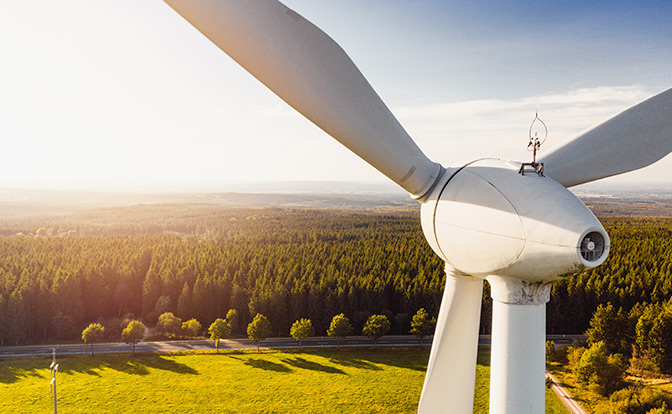
The energy transition and the growing global demand for renewable energies are increasingly bringing wind energy into the focus of investors. The global wind energy market has grown rapidly in recent years and numerous forecasts by various organizations point to further growth in the coming years. In this article, we present the wind energy sector in general and a selection of wind energy stocks in detail.
HOW DOES WIND ENERGY WORK?
Wind energy is a renewable energy source that is generated by converting wind into electrical energy. Wind turbines use the kinetic energy of the wind to set rotors in motion. This movement is then transmitted via a gearbox to a generator, which produces electrical energy. The energy generated can be fed directly into the power grid or stored in batteries for later use.
Advantages and disadvantages of wind energy
The most important advantages of wind energy include its renewability, independence from fossil fuels and the fact that it does not cause any direct greenhouse gas emissions. In addition, the operating costs of wind turbines are low compared to conventional power plants.
However, wind energy is more volatile, as electricity generation is subject to natural fluctuations in wind speed. Other disadvantages include the large areas required and possible negative effects on local residents (noise pollution, shadows cast, aesthetic concerns) and wildlife.
IMPORTANCE OF WIND ENERGY FOR THE ENERGY TRANSITION
Even if wind energy is currently only a supplementary energy source, it plays an important role worldwide in the energy transition, which aims to significantly increase the share of renewable energies in the energy mix while reducing the consumption of fossil fuels.
Wind energy plays a central role in this, as it is one of the most cost-effective and fastest-growing renewable energies. The continuous improvement of wind power technology and the increasing efficiency of wind turbines are helping wind energy to become ever more competitive and make an important contribution to achieving climate targets.
THE WIND ENERGY INDUSTRY AT A GLANCE
The wind energy sector is characterized by a large number of companies operating in different areas. These include manufacturers of wind turbines and components, project developers, wind farm operators and service companies. The size of the competitors ranges from small companies to large, multinational corporations that operate their wind energy business as a division or subsidiary.
Onshore and offshore wind energy
There are two main types of wind energy: onshore and offshore wind energy. Onshore wind turbines are installed on land, while offshore wind turbines are installed at sea. Offshore wind farms generally have higher investment costs, but also offer higher yields due to stronger and more consistent wind conditions.
Market development and growth potential
The wind energy market has seen considerable growth in recent years, both in the onshore and offshore sectors. Various studies predict that this growth will continue, driven by the global demand for renewable energies and the political will to achieve climate targets.
Political framework conditions and funding programs
One factor that plays an important role in this is the political framework and support programs. Governments around the world are increasingly focusing on renewable energies in order to achieve their climate targets and reduce dependence on fossil fuels. Incentive systems such as feed-in tariffs, tax breaks or grants for the development of wind power projects are often used for this purpose. These measures help to create a favorable investment climate for wind energy and promote the growth of the industry.
OPPORTUNITIES AND RISKS OF WIND ENERGY SHARES
Rising global demand, the positive environment for companies and the resulting growth potential of the wind energy sector also offer numerous attractive investment opportunities for private investors. In addition, technological advances and innovations can help to increase the efficiency of wind turbines and improve the profitability of wind energy companies.
However, wind energy companies are often dependent on subsidies and support programs in order to be profitable. Changes in these subsidy programs or the political framework can affect the profitability of the companies and therefore pose a certain risk for investors in the long term. Other renewable energies such as solar energy and hydropower can also play a role and lead to increased competition on the market. Finally, the construction of wind turbines requires considerable investment, which can be an obstacle for companies that do not have sufficient capital.
SELECTION OF WELL-KNOWN AND LARGE WIND ENERGY SHARES AT A GLANCE
Below you will find a selection of the best-known and largest wind energy stocks worldwide. These include companies that are active at various levels of the value chain, from the development and manufacture of wind turbines to the planning and construction of wind farms, energy generation and the operation of the plants.
Top 10 wind energy stocks, sorted by market capitalization
| Company | Symbol | Country | Market capitalization |
| Nextera Energy Inc | NEE | USA | 152.79 billion USD |
| Iberdrola S.A | IBE | Spain | 81.58 billion USD |
| Orsted A/S | ORSTED | Denmark | 39.31 billion USD |
| Vestas Wind Systems A/S | VWS | Denmark | USD 28.19 billion |
| Brookfield Renewable Partners | BEP | Bermuda | USD 19.95 billion |
| Siemens Gamesa Renewable Energy | GCTAY | Spain | USD 12.77 billion |
| Northland Power Inc. | NPI | Canada | USD 6.08 billion |
| Xinjiang Goldwind Science & Technology | 002202 | China | USD 6.02 billion |
| Nordex SE | NDX1 | Germany | USD 2.51 billion |
| TPI Composites Inc | TPIC | USA | USD 0.4 billion |
NORDEX
- Company: Nordex SE
- Symbol (TWS): NDX1
- ISIN: DE000A0D6554
- Stock exchange: XETRA
- Country: Germany
- Currency: EUR
- Market capitalization: CAD 2.28 billion / USD 2.51 billion
- Turnover (TTM) in USD: 6.27 million
As a leading manufacturer of wind turbines, Nordex plays an important role in the renewable energy sector and in the wind energy industry in particular. Nordex is a major player in the global market for wind turbines and offers various turbine models suitable for use in different environments and applications. In addition to the production of wind turbines, Nordex also offers comprehensive services in the field of project development and the construction and operation of wind farms. This includes the planning and implementation of wind energy projects as well as the maintenance and servicing of wind farms. Headquartered in Hamburg, Nordex has branches and production facilities in Europe, Asia, North America, Latin America, Africa and Australia.
Brief analysis & outlook
The Nordex share price has been very volatile in recent years. After the slump at the beginning of 2020, the share price quadrupled in value before another slump of around 70 % followed. A new price rally started in October 2022, which led to a doubling of the share price. In March and April, however, the share lost a third of its value again. Nordex recently announced that it expects business to improve again, particularly in the second half of 2023, and held out the prospect of an operating profit after closing the 2022 financial year with a loss of EUR 498 million.
TransAlta Renewables
- Company: TransAlta Renewables Inc
- Symbol (TWS): RNW
- ISIN: CA8934631091
- Stock Exchange: Toronto Stock Exchange
- Country: Canada
- Currency: CAD
- Market capitalization: CAD 3.37 billion / USD 2.52 billion
- Turnover (TTM) in USD: 0.42 billion
TransAlta Renewables is a Canadian-based company that owns and operates renewable power generation assets, including wind, hydro and natural gas power plants. The company was founded in 2013 and is a subsidiary of TransAlta Corporation. In 2021, TransAlta Renewables acquired solar assets in the U.S. state of North Carolina for nearly $100 million.
Brief analysis & outlook
TransAlta Renewables shares were in a downtrend in 2022, which accelerated in December and caused the shares to fall by a further 25 % when the company announced a poor outlook for 2023. For long-term buyers looking to invest in the wind energy sector, the stock now appears to represent a favorable buying opportunity and with a dividend yield of 7.5 %, it also looks attractive to investors pursuing a dividend strategy. The TransAlta share has already risen by 18 % since December, but the downward trend on the chart has not yet been broken.
VESTAS WIND SYSTEM
- Company: Vestas Wind Systems A/S
- Symbol (TWS): VWS
- ISIN: DK0061539921
- Stock Exchange: Nasdaq Copenhagen (formerly: Copenhagen Stock Exchange)
- Country: Denmark
- Currency: DKK (Danish Krone)
- Market capitalization: DKK 190.55 billion / USD 28.19 billion
- Turnover (TTM) in USD: 2.19 billion
Vestas Wind Systems is a Danish-based wind energy company that designs, manufactures, installs and maintains wind turbines for power generation. The company serves customers around the world and employs over 25,000 people worldwide. Vestas Wind System's business is divided into two segments: Power Solutions and Service. The Power Solutions segment sells wind turbines, wind turbines, development sites, etc. The Service segment deals with the sale of service contracts, spare parts and related activities.
Brief analysis & outlook
In terms of the long-term price trend, Vestas Wind Systems is a real growth stock that has performed spectacularly over the last 10 years. The last all-time high was reached in January 2021. After a correction of around 50%, the share price bottomed out in the fall of 2022 and then rose again. In the current year 2023, the trend has so far been sideways and an important technical resistance level is located at around DKK 220. Breaching this resistance would signal a new primary upward trend and increase the probability of further price rises. A fall back to the DKK 140 - 150 level, on the other hand, could represent a favorable long-term buying opportunity.
NORTHLAND POWER
- Company: Northland Power Inc
- Symbol (TWS): NPI
- ISIN: CA6665111002
- Stock Exchange: Toronto Stock Exchange
- Country: Canada
- Currency: CAD
- Market capitalization: CAD 8.12 billion / USD 6.08 billion
- Turnover (TTM) in USD: 1.83 billion
Northland Power is a power generation company focused on building and operating clean and environmentally friendly global power infrastructure assets. The company was founded in 1987 and is headquartered in Toronto, Canada. Northland Power's facilities produce electricity from renewable resources, including wind, solar and efficient natural gas. In August 2021, the company announced that it had completed the previously announced acquisition of a Spanish portfolio of onshore renewable energy projects. The acquired assets include onshore wind, solar photovoltaic and concentrated solar power. Northland Power paid $411 million for the acquisition and also assumed $846 million in debt.
Brief analysis & outlook
The Northland Power share price has recently been very weak. Following a downward trend between August 2022 and January 2023, the share price is currently stabilizing (at least in the short term). However, the overall chart picture still gives little cause for hope and a continuation of the downward trend currently seems just as likely as a trend reversal. However, the most recently published results for the past fourth quarter and for the full financial year 2022 were strong. Sales in the fourth quarter amounted to CAD 641 million, which is roughly in line with the previous year. For the full year, however, sales rose to CAD 2.45 billion, compared to CAD 2.09 billion in 2021. Net income increased to CAD 324 million in the fourth quarter, compared to CAD 130 million in the previous year, and rose to CAD 955 million for the full year, compared to CAD 270 million in 2021.
TPI COMPOSITES
- Company: TPI Composites Inc
- Symbol (TWS): TPIC
- ISIN: US87266J1043
- Stock exchange: Nasdaq
- Country: USA
- Currency: US Dollar
- Market capitalization: USD 0.4 billion
- Turnover (TTM) in USD: 1.52 billion
TPI Composites is a global manufacturer of composite wind blades for the wind energy market. The company also provides composite solutions for the transportation industry, as well as inspection and repair services for OEM (original equipment manufacturer) customers and wind farm owners and operators. TPI Composites was formerly known as LCSI Holding, Inc. and changed its name to TPI Composites, Inc. in 2008. The company is headquartered in Scottsdale, Arizona.
Brief analysis & outlook
While TPI Composites achieved rising sales between 2017 and 2020, sales have not only fallen in the last two financial years; earnings per share have also been negative for the last four years and the company has had to contend with various problems: questionable management decisions, a difficult business environment, excessive expenditure and financial problems. The share price has therefore only moved in one direction and is currently trading at a very low level of around USD 11 per share. The valuation based on turnover also reflects the very low expectations. As the world's largest independent manufacturer of rotor blades, TPI nevertheless remains an important player on the global wind energy market. An investment at the current time is certainly very speculative, but also offers great opportunities in the long term if the company can solve its problems quickly and become profitable.