The jungle of shares and indices around the world is vast and confusing. But the US indices Dow Jones, Nasdaq and others are hard to ignore. These are regarded as the driving force behind the stock markets on both sides of the Atlantic and form the backbone of trading on Wall Street.
Below you will find an overview and all the background information on the most important US indices.
The most important facts in brief
- The best-known US indices are the Dow Jones Industrial Average Index, the Nasdaq 100 and the S&P 500, as well as the Russel 2,000, which tracks second- and third-tier companies.
- The New York Stock Exchange (NYSE) is considered the most important and largest Stock Exchange in the world in terms of trading volume, with a trading volume of around USD 26.4 trillion in 2023, followed by Nasdaq with around USD 23.7 trillion.
- The Russel 2000 accounts for around 10 per cent of the market capitalisation of the Russel 3000.
Dow Jones Industrial Average Index
When was the Dow Jones Industrial Average Index published?
The Dow Jones Industrial Average Index (DJII, hereafter: Dow Jones) is the oldest and largest stock market index in the world in terms of trading volume.
The DJII was founded by Charles Henry Dow and Edward David Jones, who published the Wall Street Journal at the end of the 19th century. The stock market barometer was first published in 1896 with the twelve most important companies. The index has reflected twenty US stocks since 1916 and thirty since 1928.
How is the Dow Jones calculated?
The Dow Jones is calculated using what is known in the trade as price weighting according to the average method. The sum of all 30 companies is then divided by the "Dow Divisor", which is intended to compensate for changes such as dividend distributions.
Which companies are in the Dow Jones?
The Dow Jones comprises 30 major US companies, but these do not necessarily represent the most important companies in the United States.
The best-known representatives include, for example:
- Microsoft
- Apple
- Amazon
- JPMorgan Chase
- Coca-Cola
- McDonalds


What are the trading hours of the Dow Jones?
The trading hours of the Dow Jones are weekdays from 09:30 to 16:00 EST, which corresponds to 15:30 to 22:00 in Germany (CET/MEZ). On weekends, i.e. Saturdays and Sundays, the stock exchange doors remain closed.
Notice: There will be deviations during the summer time changeover, so that the trading hours in the period from 8 March 2024 to 9 March 2024 and from 25 October 2024 to 1 November 2024 will be from 14:30 to 21:00 (CET).
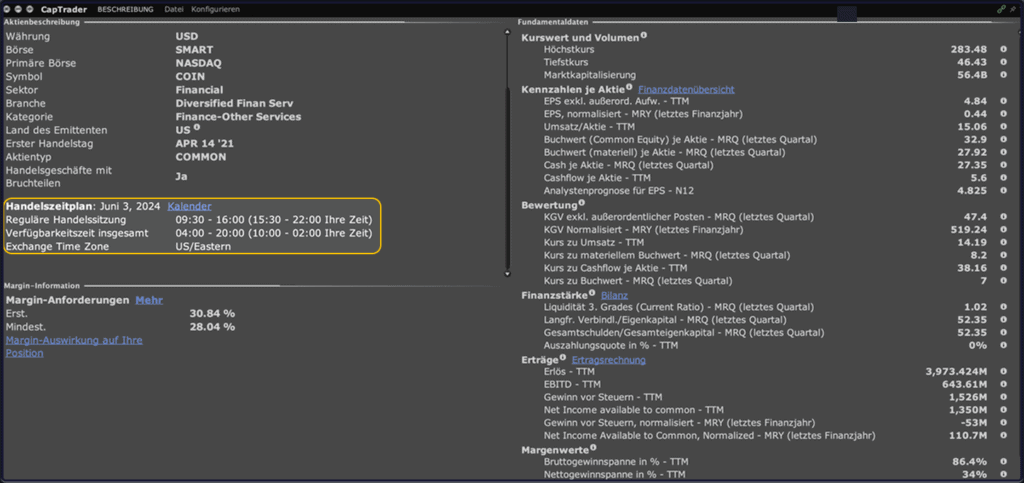
Worth knowing: Display of trading hours in the TWS and app
In all applications (Trader Workstation (TWS), App etc.), the regular trading hours can be viewed manually for each product. In TWS, for example, this is possible via Path > Right-click on Title > Financial instrument info > Description.
Nasdaq
The second most important US index is the technology exchange NASDAQ (National Association of Securities Dealers for Automated Quotation), which means "National Association of Securities Dealers for Automated Quotation". NASDAQ's two most important indices are the NASDAQ Composite and the NASDAQ 100.
Important difference: Nasdaq Composite and Nasdaq 100
While the Nasdaq Composite comprises over 3,000 different companies, the Nasdaq 100 only tracks the 100 largest technology companies by market capitalisation.
When and by whom was Nasdaq founded?
The National Association of Securities Dealers Automated Quotations (Nasdaq) founded Nasdaq as a fully electronic trading centre in the United States in 1971. The exchange is based in Manhattan. Nasdaq is controlled by the US Securities and Exchange Commission (SEC).
How is the Nasdaq calculated?
Each company value is assigned a certain weighting factor. The greater the company value, the greater the influence on the index.
Which companies are included in the Nasdaq?
The Nasdaq 100 includes a total of 100 different companies, mainly from the tech sector, such as the "Magnificent Seven":
- Amazon
- Alphabet (ex Google)
- Apple
- Meta Platforms (ex Facebook)
- Microsoft
- NVIDIA
- Tesla


Wie lauten die Handelszeiten NASDAQ?
Die regulären Handelszeiten an der Nasdaq reichen von 15:30 Uhr bis 22 Uhr MEZ. Dies entspricht einer Ortszeit von 09:30 Uhr bis 16:00 Uhr.
Notice: There will be deviations during the summer time changeover, so that the trading hours in the period from 8 March 2024 to 9 March 2024 and from 25 October 2024 to 1 November 2024 will be from 14:30 to 21:00 (CET).
Wissenswertes: Wie kann ich einen Index bei CapTrader handeln?
Um einen Index handeln zu können, benötigen Sie ein entsprechendes Finanzprodukt, welches die zugrunde liegende Wertentwicklung abbildet. Möglich ist dies beispielsweise mit Futures or Options. Der Index selbst dient lediglich zur Veranschaulichung.
S&P 500
The Standard & Poor’s 500 (S&P 500) umfasst die 500 größten börsennotierten US-Unternehmen, welcher an der New York Stock Exchange (NYSE), an der NYSE Amex nebst Nasdaq gelistet sind. Der S&P 500 wird nicht zuletzt auch als breitgefasster Index und somit auch als Gradmesser für den Gesundheitszustand der US-Wirtschaft bezeichnet, da dieser zahlreiche Titel umfasst.
Gegründet wurde der Index im Jahre 1957 durch zwei Mitarbeiter der Ratingagentur Standard & Poors.
Wie wird der S&P 500 berechnet?
Grundlage der Berechnung des S&P 500 ist der sogenannte „free float“, welcher den Teil der tatsächlich handelbaren Aktien repräsentiert. Größere Unternehmen mit einer höheren Marktkapitalisierung fallen stärker ins Gewicht als kleinere Unternehmen mit einer entsprechend niedrigeren Bewertung.
Der Indexwert wird wiederum mit dem Aktienkurs der handelbaren Aktien multipliziert, welcher anschließend durch einen Divisor geteilt wird.
Welche Unternehmen befinden sich im S&P 500?
Im S&P 500 befinden sich die nach Marktgröße 500 größten US-Börsenunternehmen wie z.B.
- Apple
- Alphabet (ex Google)
- Amazon
- Berkshire Hathaway
- BlackRock
- Goldman Sachs
- JPMorgan Chase
- Microsoft
- Meta Platforms
- Tesla
Wie lauten die Handelszeiten des S&P 500?
Der Handel des S&P 500 findet zeitgleich mit den Börsenbarometer Dow Jones und Nasdaq werktags von 15:30 Uhr bis 22:00 Uhr (MEZ/MESZ) bzw. von 09:30 Uhr bis 16:00 Uhr (EST/ETDT) statt.
Notice: There will be deviations during the summer time changeover, so that the trading hours in the period from 8 March 2024 to 9 March 2024 and from 25 October 2024 to 1 November 2024 will be from 14:30 to 21:00 (CET).
Russel 2000
Der Russel 2000 fungiert als klassische Richtschnur für die Wertentwicklung sogenannter US-Small-Caps. Wiederum umfasst der Russel 2000 rund 10 Prozent der Marktkapitalisierung des Russel 3000. Aus der Taufe gehoben wurde der Leitindex im Jahr 1984 durch die Frank Russel Company.
Wie wird der Russel 2000 berechnet?
Der Index besteht aus den wirtschaftsstärksten kleinen- und mittelständischen Unternehmen.
Gewichtet ist der Russel 2000 nach Marktkapitalisierung der jeweiligen Unternehmen. Der Kurs wird wiederum mit Hilfe des Gesamtwerts der jeweiligen Aktienkurse berechnet. Einmal im Jahr erfolgt eine Neukalibrierung.
Welche Unternehmen befinden sich im Russel 2000?
Insgesamt befinden sich im Russel 2000 verschiedene US-Unternehmen wie z.B.
- Super Micro Computer
- Light & Wonder
- Fabrinet
- Duolingo
- Marathon Digital Holdings
Wie lauten die Handelszeiten des Russel 2000?
Die Handelszeiten des Russel 2000 decken sich mit Dow Jones, Nasdaq und S&P 500 und reichen von 09:30 Uhr bis 16:00 Uhr deutscher Zeit.
Notice: There will be deviations during the summer time changeover, so that the trading hours in the period from 8 March 2024 to 9 March 2024 and from 25 October 2024 to 1 November 2024 will be from 14:30 to 21:00 (CET).


Fazit: US-Indizes können eine hilfreiche Orientierung für das Trading darstellen
An den US-Indizes Dow Jones, Nasdaq und S&P 500 führt möglicherweise auf lange Sicht kein Weg vorbei. Zu bedeutend sind die Indizes für den weltweiten Aktienhandel und nicht zuletzt für den Einfluss auf die Weltwirtschaft.
Mithilfe des Russel 2000 können Anleger eine hilfreiche Orientierung über Aktientitel aus den zweiten und dritten Reihen erhalten. Wer die Übersicht im Dschungel der US-Aktienwelt verloren oder noch nicht gefunden hat, kann den Blick auf die wichtigsten US-Indizes wagen.