The protagonist of my first Articles about Real Estate Investment Trusts (REITs) In July, Realty Income (TWS abbreviation: O) was the flagship among REITs and the best-known representative of the net lease REIT group. However, it is not only in the USA that there are high-dividend REITs that should be of particular interest to income investors. In today's blog post, I would therefore like to introduce Canadian Net REIT - a REIT that follows the same basic concept as Realty Income, but operates in the Canadian market and is very reminiscent of a "young" Realty Income.
Business model and strategy: What exactly does Canadian Net REIT do?
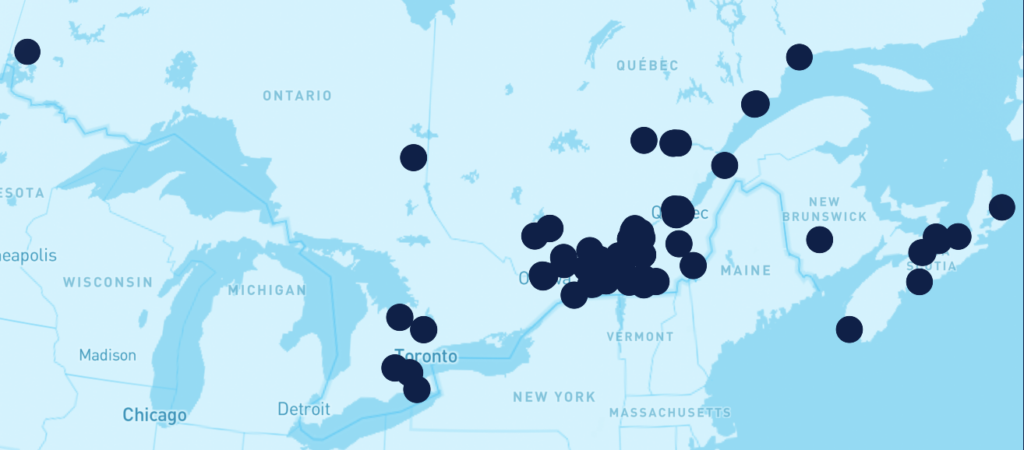
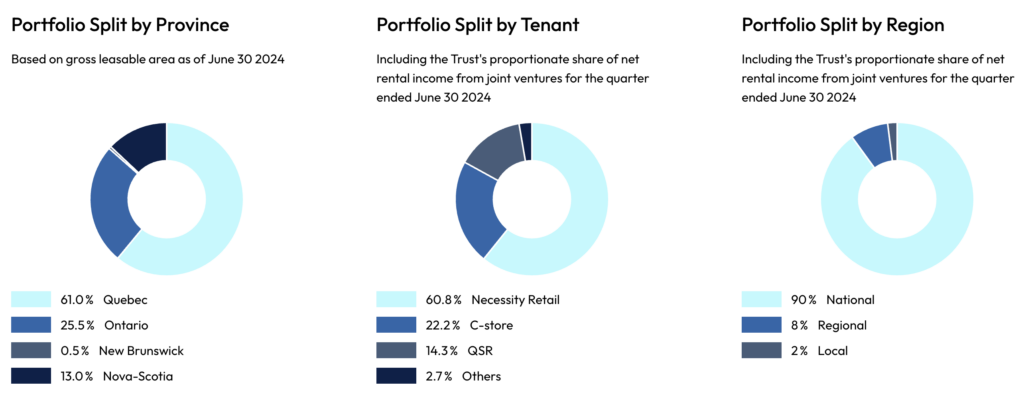
Canadian Net REIT (TWS symbol: NET.UN) is a small cap REIT with a market capitalization of just over 100 million and focuses on the purchase of high-quality retail properties in Canada that are leased to a single tenant. Like $O, NET.UN focuses on triple net leases (NNN) where the tenant pays all costs, including property taxes, building insurance and maintenance. These properties are leased to national or regional tenants operating in the necessity-oriented retail sector. On the Canadian market, Canadian Net REIT is strongly rooted in the province of Québec. The portfolio currently comprises just 94 assets.
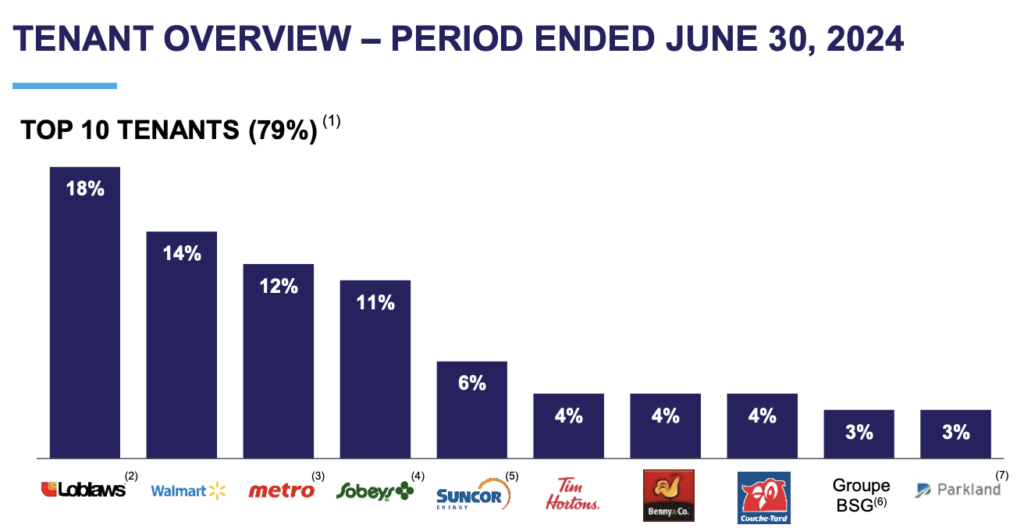
As we all know, a REIT is only as good as its tenants, so it is interesting to know that almost all tenants have an investment grade rating. These include three of Canada's largest supermarket chains, namely Walmart, Loblaws and Sobeys, which are also responsible for a large part of the rental income.
The other tenants focus on convenience stores, fast food restaurants and petrol stations, for example, all of which represent a good hedge against inflation.
Canadian Net REIT's rents are below market level and the rental agreements, which are often subject to a rent increase based on the consumer price index, have a relatively short remaining term of 6.5 years. This is significantly shorter than other net lease REITs. National Retail Properties (TWS abbreviation: NNN), for example, has >12 years.
Market development and the volatility
A look at the development of the share price shows that Canadian Net REIT, like many REITs, exhibits a certain degree of volatility. In recent years, economic challenges such as interest rate policy and the exchange rate have influenced the share price. However, the Canadian real estate market is less volatile than its US counterpart, which makes the company attractive to investors seeking broader diversification. The proximity of the market to the US and the continuous demand for Canadian commercial real estate could also enable long-term growth. What can also be clearly seen, and what is interesting for investors, NET.UN (and other Canadian REITs) have not really participated in the slight upward movement of the US peers. This is despite the fact that interest rates in Canada have now been cut more drastically than in the USA.
Acquisitions and portfolio quality
Canadian Net REIT is growing through targeted acquisitions and investments in real estate in preferred locations. As the REIT is still in a growth phase, even smaller acquisitions are often immediately value accretive. Unlike Realty Income, which relies on huge deals, Canadian Net REIT benefits from these focused acquisitions. The strategy ensures that the company can expand its portfolio in an efficient and targeted manner, just as $O did when it was much smaller.
NET.UN has a major advantage because the target properties are too large for individual investors and too small for institutional investors. This positions the company in an attractive niche. The properties are acquired from various sources, including retailers with whom "sale and leaseback" agreements are concluded, and are often found on the secondary market. Canadian Net REIT also participates in selected development projects in order to diversify the portfolio in a targeted manner and achieve increases in value.
Key figures: A look at the finances
A healthy balance sheet is a decisive criterion for investors in REITs. Canadian Net REIT has a comparatively higher level of debt, but this is not really a disadvantage due to its small size.
Debt and maturities
A look at the balance sheet quickly makes it clear that Canadian Net REIT uses slightly more debt than most of its US peers, but with a loan-to-value (LTV) ratio of 55 %, leverage remains reasonable, and NET.UN offsets that with a low payout ratio that allows the REIT to gradually pay down its debt with retained cash flow.
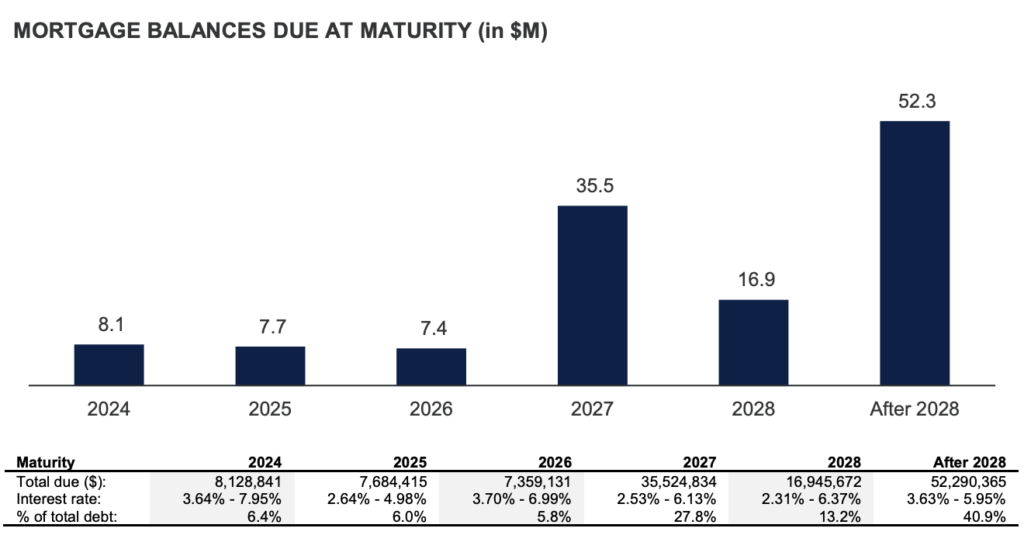
Larger maturities, namely around 1/3, will not be an issue until 2027, although Canadian Net REIT will probably have to deal with this as early as 2026. As mentioned above, however, the remaining cash flow will be used to permanently reduce debt.
(Adjusted) Funds From Operations
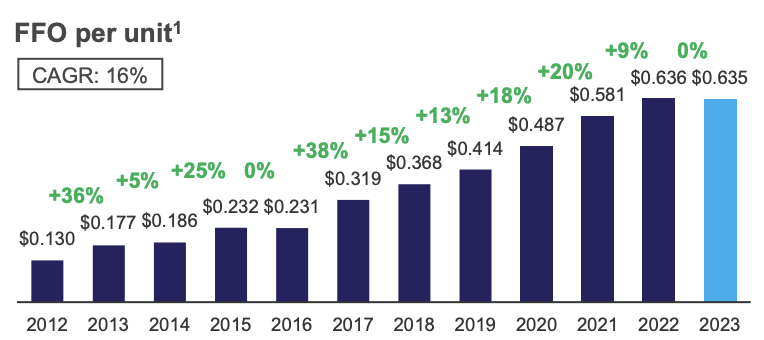
FFO development in recent years shows solid growth with an average annual growth rate of 16%. However, this growth has weakened recently, as illustrated by the stagnation of FFO per unit in 2023. A key reason for this is the currently limited supply of acquisition opportunities in the market, which makes it more difficult for Canadian Net REIT to expand its portfolio quickly. However, once the market environment improves (and there are early signs of this) and suitable properties become available again, the company should be able to resume its historical growth momentum. Thanks to a solid balance sheet and sufficient financial flexibility, Canadian Net REIT is well positioned to react quickly to opportunities as they arise and to reignite FFO growth.
Multiples
With a P/FFO <9x, Canadian Net REIT is valued far more favorably than the US peers and the historical valuation is also a good deal higher at a 15x multiple. Even if the REIT only reverts to a P/FFO of 12x, this would mean an upside of around 50%.
The Dividend
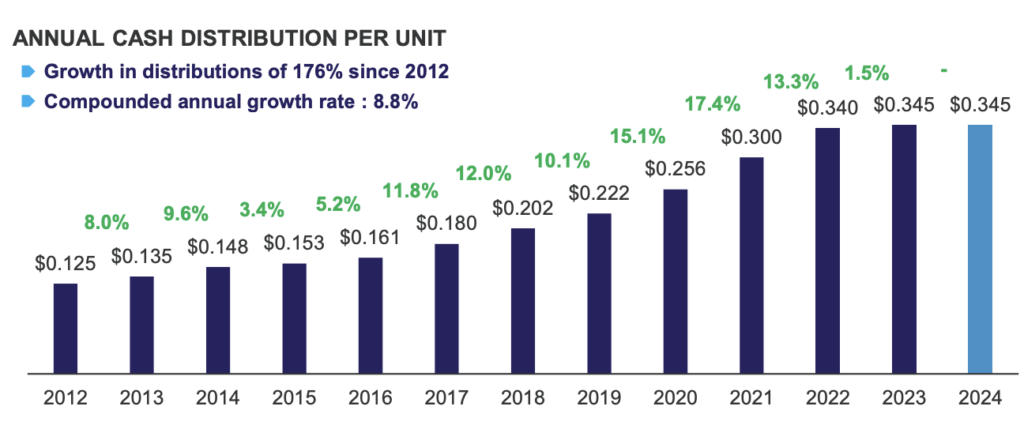
Like Realty Income, Canadian Net REIT distributes Dividends per month. Investors can expect an attractive dividend yield of around 6%. At around 55%, Canadian Net REIT's payout ratio is significantly lower than US peers, which tend to be in the 70-80% range. This gives plenty of room for maneuver in the future when overall growth picks up again.
Video: Concrete gold with REITs vs own real estate | Philipp Kässinger REIT Profiinvestor
Peer comparisonAlternative US REITs
Since Canadian Net REIT is not traded in the USA, it is interesting to compare it with similar American net lease REITs such as National Retail Properties (TWS abbreviation: NNN), NetSTREIT (NTST) and Realty Income (O).
- NetSTREIT (NTST)NTST is a relatively young REIT that also favors triple net leases. With a market capitalization of approximately $1.3 billion, the REIT is more than 10x the size of Canadian Net REIT. Due to the higher exposure to dollar stores and the economic plans of the upcoming US government (punitive tariffs etc.), the valuation is currently one of the lowest among US net lease REITs with a P/FFO of 13x. However, NET.UN is valued much more favorably in comparison.
- Realty Income (O)With a market capitalization that far exceeds Canadian Net REIT, Realty Income offers investors stability and a monthly dividend. However, the diversification of the portfolio and the solid credit rating also make it a more expensive alternative, although the valuation is currently also quite attractive.
- National Retail Properties (NNN)NNN also focuses on triple net leases and has a similar growth strategy to Canadian Net REIT. NNN also has high quality tenants and stable distributions, but has significantly longer remaining terms.
Options trading
I myself am also active as an options trader, but almost exclusively as a so-called "writer". Therefore, I am naturally also interested in Net Lease REITs, which are suitable for additional cash flow or for a favorable entry by means of a tender offer. Unfortunately, there are no option chains available for Canadian Net REITs themselves, which is why you have to switch to US peers.
Due to the current low Volatility (VIX) the premiums are unfortunately not as attractive as in volatile times.
Realty Income
For Realty Income, there are options with a Strike from $55 in December or more conservatively with $52.5 in January '25 that still offer halfway reasonable premiums despite the low volatility (VIX).
NetSTREIT
With NetSTREIT, an entry at a strike price of $15 in December may be interesting, although the premiums here are also rather moderate and the spread quite high.
NNN REIT
In the case of National Retail Properties, an entry at a strike price of $40 in December may be interesting, although the premiums here are also rather moderate.