


The stock exchange is the central place where securities are traded. The financial markets are monitored around the clock by investors worldwide, but there are days when trading suddenly comes to a standstill. As an investor, you should be prepared for the fact that on certain days of the year the usual stock market operations are interrupted.

The most important in a nutshell
- Stock market holidays have a significant impact on the marketLess trading volume, fluctuating liquidity and high Volatility after the reopening.
- Strategic preparation is crucialAnalysis of market data, backtesting and hedging with options help to minimize risks.
- Set important order types before public holidays: Limit orders, Stop loss and Take profit protect against unexpected price movements.
- Use stock market holidays for further training: Day trading strategies test, research new investment opportunities and prepare for upcoming market movements.
What are stock market holidays?
Stock exchange holidays are fixed days of the year on which stock exchange trading is officially suspended. These days may be associated with national holidays, religious occasions or other significant events.
In the USA, stock market holidays include Christmas, Independence Day and Thanksgiving. In Germany, the stock exchanges are closed on Good Friday and Christmas Day, among other days.

Why are there stock market holidays?
There are various reasons for these holidays. The most important reasons for stock market closures are explained in detail below.
1. public and national holidays
Many stock exchanges are based on the official public holidays of the country or region in which they are based. Banks and other financial institutions are often closed on these days, which would make trading more difficult.
Examples of public holidays on which stock exchanges are closed:
- New Year's Day (January 1): Internationally distributed
- Labor Day (May 1): A public holiday in many countries
- National holidays like the July 4 (Independence Day in the USA) or the October 26 (national holiday in Austria)
As the financial sector is closely intertwined with the banking industry, it would make little sense to open the stock exchange on such days, as many market participants (including institutional investors, banks and authorities) would not be able to actively participate in market activity.
2. religious holidays
In some countries, religious holidays are taken into account as stock exchange holidays in order to do justice to the tradition and culture of the respective region.
Examples of religious holidays with stock market closures:
- Good Friday and Easter Monday: Christian holidays in many European countries
- Christmas (December 25) and St. Stephen's Day (December 26): Christian holidays in many western countries
- Yom Kippur: The Tel Aviv Stock Exchange (TASE) will be closed on this highest Jewish holiday
- Eid al-Fitr: In Muslim countries, the stock exchange may remain closed during the feast at the end of Ramadan
Stock exchanges often close on these days, as large parts of the population traditionally spend these holidays with family and religious activities.
3. memorial days and political events
Some stock exchange closures take place for political or historical reasons. These can be national memorial days or special occasions that the exchange operators consider important.
Examples:
- National day of mourning for deceased US presidents: In the USA, the stock market remains closed during state funerals of former presidents, such as the recent ones for George H.W. Bush and Jimmy Carter.
- Day of German Unity (October 3)The Frankfurt Stock Exchange will be closed on this day, as it is Germany's national holiday.
These closures are often scheduled at short notice, especially in the event of sudden national mourning or other significant events.
4. stability of the financial market and recovery
Another reason for the stock market pause is the Stabilization of the markets. Financial markets can fluctuate wildly due to overheating, high volatility or extreme news. Stock market closures on strategic days can help to calm the markets.
Example: Thanksgiving in the USA
- The US stock markets close on Thanksgiving Day (fourth Thursday in November) and only have shortened trading hours on the following Friday.
- This prevents excessive price fluctuations on a day with low trading activity, as many market participants (especially in the USA) are busy with family celebrations.
In addition, trading pauses give investors an opportunity to Rethink strategies, revise positions and prepare for the next trading period.
5. technical maintenance and modernization of the trading platforms
One practical reason for the stock market break is the opportunity, carry out technical maintenance work. Stock exchanges work with complex IT systems that enable high-frequency trading, order management and the processing of transactions in milliseconds.
On regular trading days, it is not possible to make far-reaching Updates or maintenance work on these systems, as the market operates in real time. Exchange closures allow IT teams to carry out important infrastructure measures without disrupting trading operations.
Stock exchange holidays in Germany
In Germany, the largest and best-known stock exchanges such as the Frankfurt Stock Exchange and the Xetra platform are among the central trading venues. However, even here there are fixed breaks during which trading is paused.
It is important for you to know that on these days no new Share trends can be tracked. For example, you can use the time-out to Learn to trade use.
The Stock exchange holidays in Germany in 2025:
| Date | Holiday |
| 01.01.2025 | New Year |
| 18.04.2025 | Good Friday |
| 21.04.2025 | Easter Monday |
| 01.05.2025 | Labor Day |
| 24.12.2025 | Christmas Eve |
| 25.12.2025 | 1st Christmas Day |
| 26.12.2025 | 2nd Christmas Day |
| 31.12.2025 | New Year's Eve |
On these days there are no Trading opportunities in Germany, but you will be able to trade on the US stock exchanges again on Christmas Day, for example. For you as an investor, it can be advantageous to familiarize yourself with the topics Stock market psychology and market conditions in order to be properly prepared for the trading break, as well as the day before and after.
Stock market holidays in the USA
In the USA, the well-known stock exchanges such as the New York Stock Exchange (NYSE) and Nasdaq are also closed on public holidays. If you are familiar with the topic Trading for beginners it is advisable to read the US-American Stock exchange holidays in the calendar.
You can also use the Witches' Sabbath as larger market movements often take place on these days.
The US-American Stock exchange holidays 2025 include:
| Date | Holiday |
| 01.01.2025 | New Year |
| 09.01.2025 | National Day of Mourning (Jimmy Carter) |
| 20.01.2025 | Martin Luther King Day |
| 17.02.2025 | Presidents' Day |
| 18.04.2025 | Good Friday |
| 26.05.2025 | Memorial Day |
| 19.06.2025 | Juneteenth |
| 04.07.2025 | Independence Day |
| 01.09.2025 | Labor Day |
| 27.11.2025 | Thanksgiving |
| 25.12.2025 | Christmas |
During the holidays, the theme is Trade options particularly important to understand the best ways to hedge positions and generate profits.


Stock market holidays in Switzerland and Austria
In Switzerland and Austria, the stock exchanges are also closed on most major public holidays.
Especially for investors who invest in Aktien mit hoher Dividende it is crucial to know the trading breaks because on these days Market Gaps can arise.
The Stock exchange holidays in the Switzerland 2025 are:
| Date | Holiday |
| 01.01.2025 | New Year |
| 02.01.2025 | Berchtold's Day |
| 18.04.2025 | Good Friday |
| 21.04.2025 | Easter Monday |
| 01.05.2025 | Day of the Arbait |
| 29.05.2025 | Driveway |
| 09.06.2025 | Pentecost |
| 01.08.2025 | Federal holiday |
| 24.12.2025 | Heiligaabig |
| 25.12.2025 | Christmas |
| 26.12.2025 | Stefan's Day |
| 31.12.2025 | New Year's Eve |
In Austria similar Stock exchange holidays:
| Date | Holiday |
| 01.01.2025 | New Year |
| 18.04.2025 | Good Friday |
| 21.04.2025 | Easter Monday |
| 01.05.2025 | National holiday |
| 26.10.2025 | National holiday |
| 24.12.2025 | Christmas Eve |
| 25.12.2025 | Christmas Day |
| 26.12.2025 | St. Stephen's Day |
| 31.12.2025 | New Year's Eve |
International trading opportunities: CapTrader offers advantages on public holidays
If you use a (neo) broker that is limited to trading on German stock exchanges, no trading is possible on German public holidays. So your Depot with neobrokers for example inactive on Boxing Day, although the US stock markets have already reopened.
With an international and professional provider such as CapTrader, however, you have the opportunity, to stay active even on such days. While the German stock exchanges are closed, you can continue to trade with CapTrader in the USA, for example on the NYSE or Nasdaq.
This gives you a head start in terms of information and allows you to react to international developments at an early stage.
This is a strategic advantage, especially for active investors. Both to manage risk and to take advantage of short-term market opportunities. So if you want to be globally positioned, it is worth comparing brokers. For example, with regard to topics such as Open an account, Trading for beginners or access to options trading on international markets.
Influence of stock market holidays on the market
During stock market breaks, the major trading centers around the world are closed, which means that no new trades or transactions take place.
This can lead to various scenarios that can have both positive and negative effects on the market:
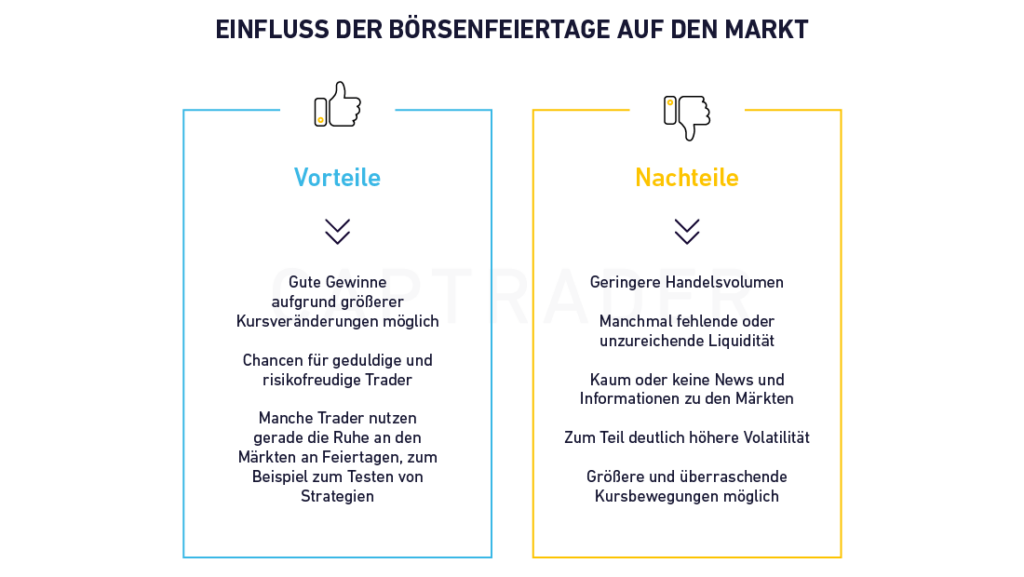
How do stock market holidays affect trading volumes and liquidity?
In the following sections you will find out, how exactly stock market holidays influence market activitywhy they often end up with a higher volatility and which Historical examples of strong price movements after public holidays there are.
Good to know:
The Trading volume indicates how many securities were bought or sold in a given period. The Liquidity describes how quickly and easily a security can be traded without major price deviations.
Before a stock market holiday: declining activity
Shortly before a stock market holiday, there is often a Declining trading activity can be observed. Many institutional investors and professional traders are closing their positions early in order to avoid taking any risks during the trading pause.
Trading volume decreases particularly on the afternoons before public holidays, as many market participants withdraw from trading.
A low trading volume can mean that larger orders trigger stronger price movements. An example: If only a few buyers are active on the market and an investor places a larger sell order, this can push the price down disproportionately.
Conversely, a large buy order in an illiquid market can lead to sudden price jumps.
After a stock market holiday: high liquidity and volatility
After a trading break, many market participants return, which is often accompanied by a sudden increase in trading volume goes hand in hand with this. New news published during the public holiday and changes in market expectations can lead to major price movements.
Particularly in times of high uncertainty (e.g. following economic or political events), this can have a strong Market swings cause.
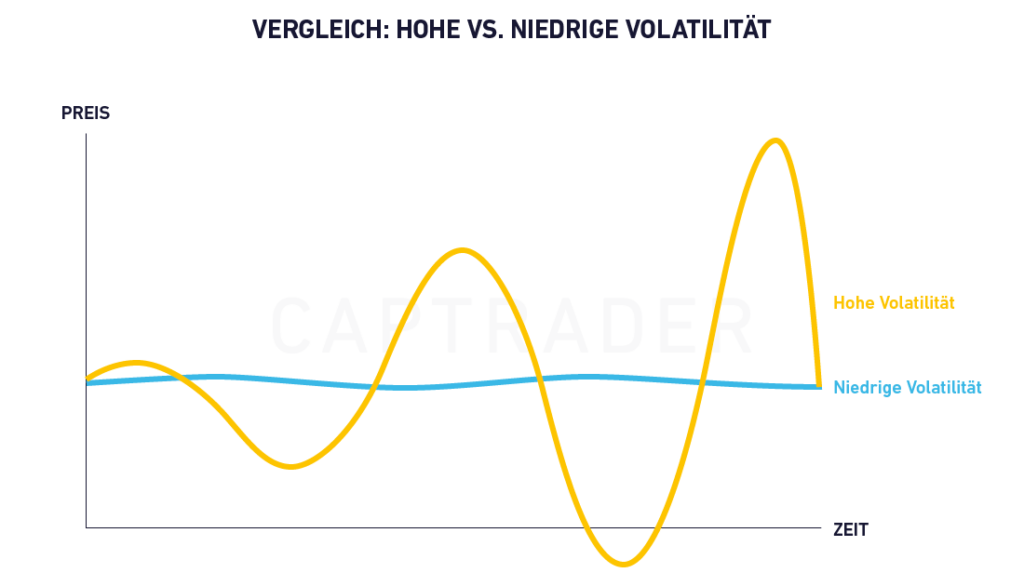
Why is there often higher volatility before and after public holidays?
The VolatilityThe volatility of share prices often increases around public holidays. This is due to several factors:
- Lower market participation before public holidays
- As fewer traders are active, individual orders can have a greater impact.
- Sudden price movements are more likely.
- News jam during the trading break
- Important economic, political or company-specific news often accumulates during a stock market holiday.
- After the break, this information often leads to a Revaluation of the markets.
- Gaps and unexpected price changes
- Especially after long holiday weekends, so-called Gaps (price gaps) occur where the opening prices are significantly higher or lower than the last closing prices.
- Traders must be prepared for the fact that their Stop-loss orders may not be executed at the desired price.
- Seasonal effects around public holidays
- Certain seasonal patterns influence the markets. A well-known example is the Christmas rallywhere share prices often rise in December.
- Also the End of the year can play a role when institutional investors adjust their portfolios (window dressing).
Examples of stock market holidays with strong price movements
There are some stock market holidays after which particularly high volatility and strong price movements can be observed:
- Christmas & New Year's Eve
- The markets are often quieter in the last week of December, but after the New Year there is often a sharp rise in trading.
- Investors make new investment decisions for the year, which often leads to positive momentum.
- At the same time, there is often increased volatility due to tax sales and repositioning by institutional investors.
- Independence Day (July 4, USA)
- Trading volumes are often low before the holiday, but after the holiday they often increase. Existing trends continue and intensify.
- Due to the shorter trading hours the day before, there may be unexpected price movements come.
- Thanksgiving (USA)
- Thanksgiving is followed by the so-called Black Fridaywhich traditionally has a strong impact on retail shares.
- Investors are speculating on Christmas sales, which leads to volatile market movements can lead to.
- Good Friday & Easter Monday
- Many large stock exchanges are closed, but others (e.g. in Asia) remain open.
- This can lead to a build-up over the long weekend. Continuing market trends in other regionsbefore European or US markets can react.
Trading strategies for the stock market holidays
While some investors take a break, smart investors and traders use this time to gain an advantage.
The following section explains strategies that are particularly useful during stock market holidays, as well as options for hedging and order placement in order to minimize risks and make the most of opportunities.
Reacting to the stock market closure with options
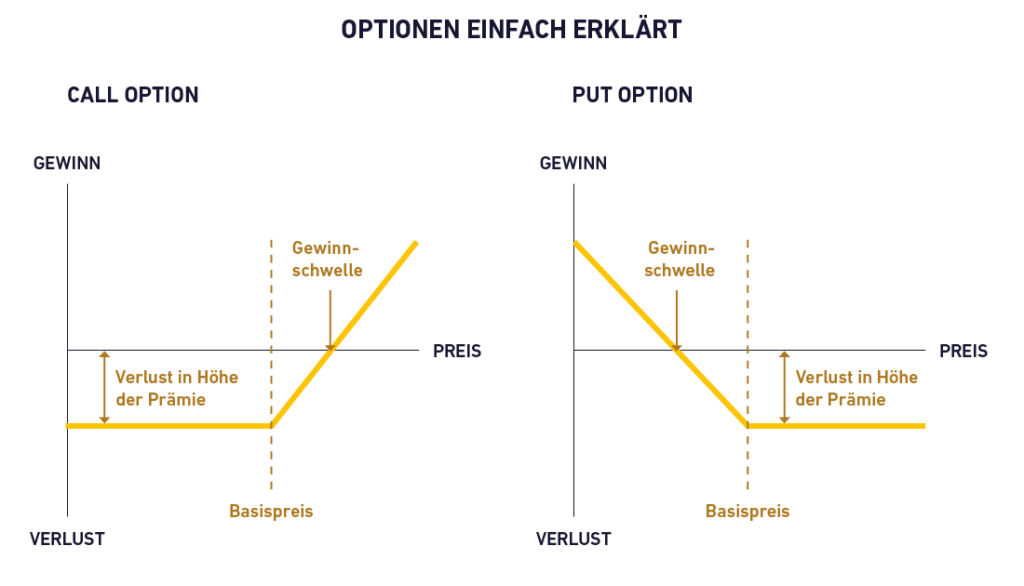
Options offer an excellent opportunity to hedge against strong price movements after the stock market holidays or to speculate on expected price changes.
Especially during periods of low liquidity, such as before or after public holidays, option strategies can offer decisive advantages.
1. hedging against market fluctuations with put options
Stock market holidays can lead to unexpected price movements after reopening, especially if significant news has been published in the meantime.
A Put option is one way of hedging against price losses:
- Investors can buy put options on their holdings to protect themselves against sudden price falls after the trading break.
- Should it come to a Stock market crash or a market correction after the holiday, the put options increase in value and thus compensate for the losses in the share portfolio.
2. generate income with covered calls
If you don't want to sell your position, you can earn premiums by writing covered calls during trading hours - these also generate income when the stock markets are closed.
- As volatility often increases before public holidays, option premiums rise, allowing additional income to be generated via covered calls.
- This strategy is particularly suitable for Aktien mit hoher Dividendeas they are generally more stable and are well suited for writing calls.
3. consideration of the witches' Sabbath effect
An important factor for options traders is the Witches' Sabbatha day on which futures and options on shares and indices expire simultaneously.
- Around public holidays, investors can increasingly speculate on the witches' Sabbath, as trading volumes and volatility can increase considerably.
- Traders who trade options should be on the lookout for increased implied volatility which can strongly influence the price of options.
Which order types should I place before stock market holidays?
Since after a stock market holiday often higher volatility it is important to position yourself well in advance. By choosing the right order types, you as an investor can avoid unnecessary risks and react to market changes in a targeted manner.
1. limit orders to avoid unexpected price deviations
Market prices can change dramatically after public holidays. If you work with market orders, you risk being executed at an undesirable price. Limit orders ensure that a transaction is only carried out at a certain price or better.
ExampleAn investor wants to buy a share for a maximum of €50. A limit order ensures that he does not suddenly have to pay €52 or more if the market rises sharply after the public holiday.
2. stop-loss orders to limit losses after public holidays
Since unexpected news during a stock market closure can have a major impact, a Stop-loss order a sensible hedge.
Especially for Leveraged positions or speculative shares, investors should place stop-loss orders before public holidays in order to avoid major losses.
ExampleAn investor holds a share that is currently trading at € 100. He sets a stop loss at € 95 to protect himself against unexpected price losses after the public holiday.
3. take profit orders for automated profit taking
If a share has already risen sharply before a stock market holiday, a Take profit order help to realize profits automatically.
ExampleA trader has bought a share for € 80 and it is now at € 100. He places a take profit order at € 105 to take his profits if the price continues to rise after the public holiday.


Conclusion: Stock market holidays: important orientation for investors
Stock market holidays are far more than just interrupted trading days. They are an integral part of the global financial markets. They are based on legal, religious or historical occasions and contribute to Stabilization of the markets with.
They also offer Technical maintenance window for the stock exchange infrastructure and give investors a break to review their strategy.
For long-term investors stock market pauses usually have little impact, as long-term strategies are designed to last for years.
However, if you active trader are, it is important to recognize the holidays and their impact on the Liquidity and market volatility in order to avoid unexpected gaps in the market or restricted trading hours.
A Good preparation is crucial: take advantage of the holiday-related market break to get in touch with Stock market psychology, market mechanisms and trading strategies to deal with.
Whether you are in Germany or international investing: it is worth keeping an eye on the stock market holidays in order to make informed investment decisions.
