


Whether you are successful with active trading depends largely on the strategy you choose! We will introduce you to some exciting methods and explain how to select and implement the right day trading strategy.

The most important in a nutshell
- Day trading strategies include various approaches that rely on short trading times (less than one trading day)
- Momentum, breakout, reversal, crossover and other day trading strategies are available
- It takes some experience, a willingness to take risks, start-up capital and enough time to be successful in day trading
- The different day trading strategies can work. However, most traders make losses for various reasons
What is day trading and how do day trading strategies work?
There are roughly two groups on the stock market:
- Investors are persons who Equity portfolio accumulate securities. You benefit from price gains or income from Aktien mit hoher Dividende.
- Traders, on the other hand, buy and sell actively and regularly in order to make profits. This group is divided into numerous sub-types, depending on the strategy chosen.
The best-known form of active trading is certainly day trading. all positions are closed by the end of the trading day at the latest.
It is therefore also referred to as “intraday trading”, as all transactions end within (= intra) one day.
This approach has some particular advantages and disadvantages:
- After the market closes, there are often major fluctuations that only become visible on the next trading day.
- Successful day trading strategies avoid precisely this phase and the so-called “swap costs”, as they entail considerable risks.
- Through a Short sale you can also profit from falling prices.
- The short time frames only allow for small profits. This is why leverage is almost always used: it multiplies profits, but also losses, by the specified factor.

Day trading strategies vs. investing
Day trading is a very short-term strategy. Several alternatives use different time frames and therefore achieve a completely different risk/reward profile:
- The slowest form of stock market transactions is investing. In some cases, it can take decades to sell. Anyone who has a Passive income through dividends in some cases never even sells its securities!
- The Scalping is even faster: here the short holding periods are taken to the extreme and trades are only held for a few seconds. A high volume of small profits can also generate an attractive return.
- We see the highest speed in the High frequency trading. Here we are talking about fractions of a second. Of course, only machines can execute such fast trades.
- In contrast, things are more leisurely with the Swing trading strategies to. There are no strict guidelines here; positions remain open as long as a further gain is expected.



In some cases, day trading is also understood as a generic term. In this case, swing trading and scalping are considered day trading strategies. The boundaries between the individual forms are fluid and different perspectives are possible.
Be careful with day trading strategies!
Day trading strategies are extremely risky: The vast majority of active traders lose money with these methods. The reason for this lies in the fundamental structure of trading:
- Traders need to predict market movements to open lucrative trades
- You can profit from both upward and downward movements through investments and short sales
- Even in the case of steady “sideways markets”, traders can Trade options and thus also generate profits
- Successful forecasts/trades can result in larger profits, while losses due to failures are limited in good time
- This should result in a positive overall result
- A correct forecast is always necessary for trading success!
By comparison, investors invest through their Equity portfolio in companies. They are thus betting on the fundamental direction of the economy (the markets are rising in the long term) and do not have to make short-term forecasts.
In order to make the right predictions that we need for our day trading strategies, various key figures are used. They are summarized as Day trading charts or under the generic term Chart analysis or Technical analysis zusammen.
The problem: There is no evidence that these forms of analysis actually work. The evaluation of current or historical data in order to make statements about future price trends is controversial.
This explains the very high failure rate in day trading. And even successful traders usually have a manageable Day trading profit. Active trading is and remains very risky!
We therefore recommend exercising caution when using day trading strategies! First of all, use a free Paper Trading Account from CapTrader to test the technology in a secure environment. Only when you are successful here should you invest your actual capital!
How to find the right day trading strategy for your needs
There are hundreds of possible day trading strategies available. It's easy for budding traders to lose track! We would therefore like to give you some practical tips to help you find the right approach.
What you need for active trading
For successful day trading (regardless of the exact strategy) you need a few basic things:
- Resilience and the ability to work conscientiously and with high concentration even under stress
- Sufficient time for analyzing and monitoring assets. Day trading is a time-consuming hobby or even a real full-time job!
- Extensive market knowledge and experience with other forms of trading
- Time and motivation to complete the long learning process
- Self-confidence so as not to doubt yourself and your day trading strategy even in the event of setbacks
- Sufficient Day trading starting capitalthe loss of which you could live with in the worst case scenario
- A professional broker like CapTrader that gives you access to leveraged positions and short selling
Day trading is very attractive for many hobby traders and investors. In addition to attractive profits, there is even the opportunity to scale up the activity and later pursue it as a profession! It is often forgotten that many aspiring day traders fail with their plans and can incur considerable losses.
It is important to approach the job with realistic expectations and not to expect miracles. In the long term earn money with day trading only works in a few cases.


Which assets are suitable for day trading strategies?
In principle, you can use any asset with fluctuating prices for day trading strategies. The only requirement is that there is no minimum holding period, as you have to close the position at the end of the day.
Some assets have proven themselves in practice, while others tend to lead a shadowy existence in day trading. Most day trading strategies also focus on specific asset classes or are particularly suitable for them.
The following asset classes have proven themselves as underlyings:
Stocks
The Day trading with shares is by far the most popular form of active trading. This is not only due to the advantages of this asset class, but also to the fact that most traders are already very familiar with the securities:
- We buy the shares in order to Long position and profit from rising share prices
- Through a Short sale we can create a Short position and earn from falling prices
- Products based on shares (for example Options or warrants) are available
In contrast to traditional investing, day trading strategies with shares do not require any Fundamental analysis required: The long-term prospects of a company are largely uninteresting with a holding period of a maximum of one day.
Indexes
An index is a collection of assets. Stock indices such as the DAX, NASDAQ or the S&P 500 are particularly popular, containing several dozen to several thousand stocks.
- The price of the index is calculated from the prices and price changes of all the assets it contains
- In practice, this usually leads to lower volatility, as extreme developments in individual stocks are compensated for by the many other stocks
- Price movements are somewhat easier to predict and are often less pronounced, which makes indices particularly interesting for beginners
- Trading can take the form of ETFs, for example, which track such an index
A major advantage of trading indices is the very large selection: In addition to hundreds of share indices, you can also choose from cryptocurrency, commodity, currency and other products.
Cryptocurrencies
Digital currencies are the latest addition to the repertoire of day traders. They offer extraordinary advantages and disadvantages:
- Unlimited trading hours: Buying and selling is possible around the clock, even at weekends
- Extreme volatility: Depending on the currency, exchange rate fluctuations of several hundred percent are possible within a few minutes
- Derivatives trading preferred: Day traders prefer to use derivatives such as futures or ETNs to trade cryptocurrencies. They are available from brokers such as CapTrader and offer extended options
- High liquidity: The major major currencies have extremely high liquidity, which makes trading particularly easy
Cryptocurrencies offer extraordinary opportunities due to their extreme price fluctuations. However, this also makes them correspondingly dangerous. Traders should be aware of the potential risks.
There are also problems with crypto exchanges: losses due to hacks, data theft or sudden terminations are commonplace. Active traders should therefore make sure they use a reputable broker to trade cryptos reliably and securely.
Forex
The Foreign exchange trading, The buying and selling of foreign currencies is an enormously popular form of day trading. Trades in euros, dollars and other currencies offer beginners good opportunities to learn short-term trading.
- Gains (or losses) arise from tiny changes in the price of one currency to another.
- Traders move capital back and forth between the two currencies and thus achieve a return.
- Here, too, the traders try to predict the movements correctly. To do this, they use special Forex Signals.
- The price changes are often minimal: so-called Pip Trading. Attractive profits only arise through the use of leverage
Forex trading is very popular with active intraday traders and is suitable for many day trading strategies. You benefit from a solid selection and extremely high liquidity: more than two trillion US dollars are traded here every day!
The trading hours are particularly exciting: Forex trading is carried out around the clock on all working days. So if you don't have time for day trading with other underlying assets (e.g. due to work), you can also trade at night or in the early hours of the morning.
Good to know:
Although the Forex market is generally available at all times, it is best to trade during “peak hours”, as liquidity and volatility are significantly better here.
Day trading strategies for beginners and advanced traders
Anyone who trades assets without a concrete plan has no chance of success in day trading. A day trading strategy is the concrete approach and includes the specifics of when to buy and sell which asset.
The various day trading strategies differ in terms of requirements, opportunities, risks, time required and more. Some of them are suitable for beginners, others require a high level of prior knowledge and qualifications.
Therefore, only you can decide which approach suits you and your personal circumstances.
We have put together four proven and successful day trading strategies for you below.
Trend following strategy
Among the day trading strategies, the Trend following ideal for beginners suitable. Hereby follow existing trendswhich are reflected in the prices of an asset.
- For example, if you discover an upward movement, open a long position to profit from the gains.
- If, on the other hand, the journey goes downwards, use a short position, i.e. a Short sale.
- Since you are only "Jump on" movements that are already in progress, you will not reach the best/most convenient entry point.
- In return, we offer the already visible trend but a good indicator and makes the decision easier.
It is then important to find the ideal exit time to realize the profits. However, close the position at the latest when a trend reversal becomes apparent, and close the position at the latest when a trend reversal becomes apparent.

With this approach, you do not need to put too much energy into identifying the perfect highs and lows; approximate values are sufficient. The day trading strategy of trend following is therefore a good way for beginners to trade unleveraged assets first and switch to leveraged products later.
In order to reliably determine trends, there is a wealth of key figures and formulas from the field of Day trading charts:
- For example, combinations that use the simple moving average (SMA) are particularly popular.
- The MACD ("Moving Average Convergence Divergence"), an indicator for the convergence/divergence of the moving average, is also frequently used in this day trading strategy.
Newstrading
At Newstrading we analyze News and opinions on an asset. The aim is to react as quickly as possible to upcoming changes and open a suitable position before the price reflects the news.
- This day trading strategy benefits massively from AI trading and automation! Today, we can automatically search through the latest news.
- Traders are under time pressure, as there are often only a few seconds before the markets react to news
- The strategy can also include other key figures, such as those from the technical analysis, include
- The retailer's gut feeling and common sense also play an important role here, especially in view of the very short response times!
There is a close relationship with signal services such as TraderFox, which often also include social and media aspects in their analyses. The service providers use this information to create specific trading instructions that they send to their customers.
Breakout strategy
Stock market prices often move back and forth between resistance and support lines. This can often be seen very clearly on the graphs. If there is finally a breakout after long phases, traders who follow a breakout strategy enter the market.
- By taking the right position, you can benefit from the strong changes that often follow such a breakout.
- However, this day trading strategy is not necessarily suitable for beginners, as correctly determining the upper and lower limits requires some experience and market knowledge.
- If you set the limits too tightly, you may assume a breakout too early. It may then turn out to be a normal fluctuation and the price of the asset will return.
- If, on the other hand, you define the limits too broadly, you run the risk of not recognizing/not taking advantage of a breakout. In this case, you are giving away potential returns! You run the risk of not recognizing/not taking advantage of a breakout. In this case, you are giving away potential returns!
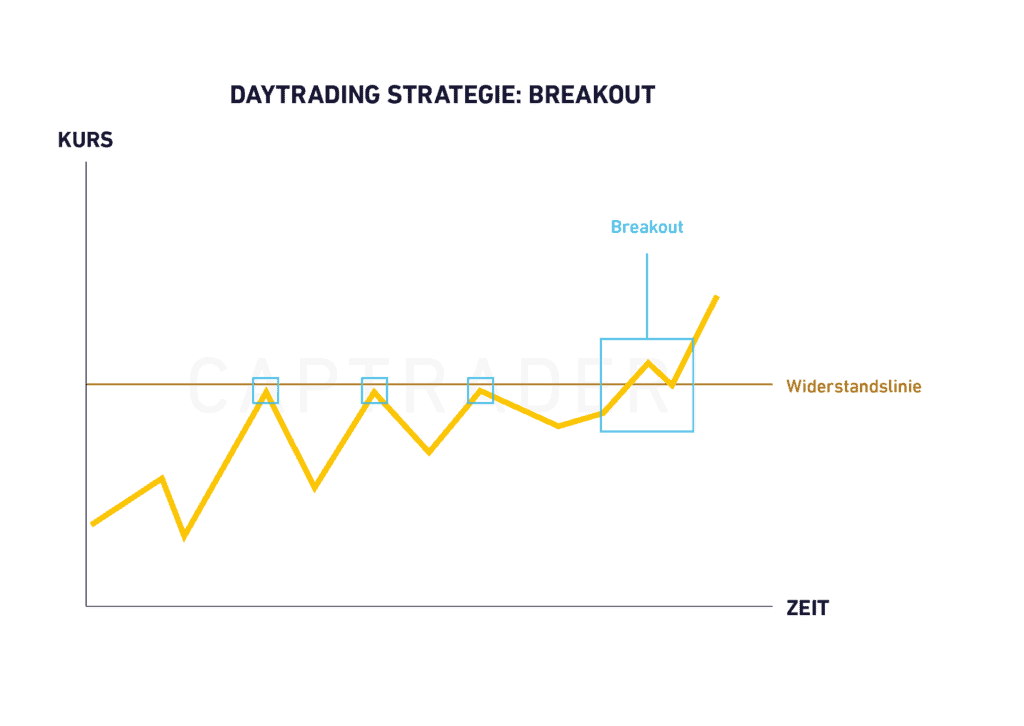
The advantage of this day trading strategy lies in its automation potential: once the upper and lower price limits have been determined, we can use stop orders and limit orders to ensure an automatic entry/exit.
If there is a breakout from the predefined range, a long or short position is automatically triggered according to the specifications.
Reversal strategy
All market trends end sooner or later. This is almost always followed by a longer correction phase in which the trend moves more or less clearly in the opposite direction. With the reversal strategy, traders try to avoid precisely this discover reversal points and exploit them with suitable investments.
- If the plan succeeds, this day trading strategy can generate considerable profits.
- The difficulty, of course, is to correctly predict the trend reversal.
- A range of key figures and metrics can help, but it is ultimately up to you to make the right decision!
- Trend reversal analyses often use trading volume and price to make an assessment. However, many other aspects and key figures can be used.
Numerous economists, analysts and others have conducted extensive research on this topic. Wyckoff's theories on recognizing a trend reversal, for example, are very popular among followers of this day trading strategy.
Despite the wealth of information on the reversal strategy, attempting to recognize trend changes remains very risky. If an assumed change in direction does not occur, there is a risk of potentially high losses.
However, if successful, the profits are also very good. This day trading strategy is therefore also less suitable for beginners.
Good to know:
Reversal strategies are linked to the Swing trading strategies related.


Conclusion: Day trading strategies promise high profits and high risk!
Day trading is a particularly attractive activity that promises high profits and the opportunity to work full-time as a stock market trader. As all trades are closed before the end of the trading day, there is no overnight risk.
But even without this additional danger, day trading remains extremely risky, especially for beginners. In practice, day trading strategies generally lead to high losses and can destroy entire livelihoods.
The reason: day trading is a complicated activity that requires a lot of experience in the markets, specialist knowledge and motivation. Successful day traders invest a lot of time and energy in analyzing the market and developing and refining their day trading strategies.
If you want to start day trading, you should fulfill a number of requirements. These include, for example, resistance to stress, a rational way of working and, of course, sufficient Day trading starting capital.
A day trading strategy describes the specific approach, i.e. when you trade which asset. There are countless options available to you here. The most popular include
- Trend following strategy: Jumping on existing movements on the markets
- Newstrading: Analysis of social media, news and co. to recognize trends at an early stage
- Breakout strategy: Waiting for an existing pattern to be interrupted
- Reversal strategy: Benefit from the counter-movements that often follow a trend
All day trading strategies are risky and can lead to enormous losses. We therefore recommend that you first test them on a Paper Trading Account to try out. Also a Trading Journal and our Day trading tips are important tools for long-term success!
