I would like to welcome all readers to my May blog post and of course we are also talking about Real Estate Investment Trusts (REIT). After looking at preferred shares and the like last time, I would like to focus on a single REIT today, namely Kite Realty Trust!
Business model and strategy: What does Kite Realty Trust do?
Kite Realty Trust (TWS ticker: KRG) focuses on economically strong Sunbelt states and selected gateway markets in the USA. The REIT invests in highly frequented locations with stable demand and prefers tenants that are considered less cyclical and solvent. The operating business model is based on long-term rental agreements with national retail chains.

The strategy is geared towards sustainable, conservative growth. Large, high-risk M&A transactions are not currently the focus. Instead, investments are being made in repositioning, modernization and targeted redevelopment projects in order to enhance the existing portfolio.
Tenants & portfolio diversification
A look at the current tenant structure shows that Kite Realty Trust attaches great importance to diversification. The top 15 tenants only account for around 21 percent of annualized base rent (ABR). No single tenant accounts for more than 3 percent. The most important tenants include companies such as TJX Companies, Ross Stores, Best Buy and PetSmart.

Around a third of rental income is attributable to the "essential retail" sector, which includes supermarkets, drugstores, electronics and office supplies. Restaurants contribute around 19 percent, with the remainder spread across a variety of retail and service sectors. This diversification makes Kite more resilient to economic fluctuations, such as a recession or tenant defaults. There were 3-4 of these at the end of last year.
Balance sheet and relevant Kennzahlen
In the REIT sector, a solid balance sheet structure is essential, especially in the current environment of higher interest rates, which may continue to rise. Kite Realty has a very conservative debt policy compared to many other REITs:
- Net debt + preferred to EBITDA: 4.7x
- Debt service coverage ratio: 4.6x
- Average interest rate: 4.34 percent
- 92 percent of debt is at fixed interest rates
- Available liquidity: USD 1.1 billion
- Credit ratings: Fitch (BBB / Positive), S&P (BBB / Stable), Moody's (Baa2 / Stable)
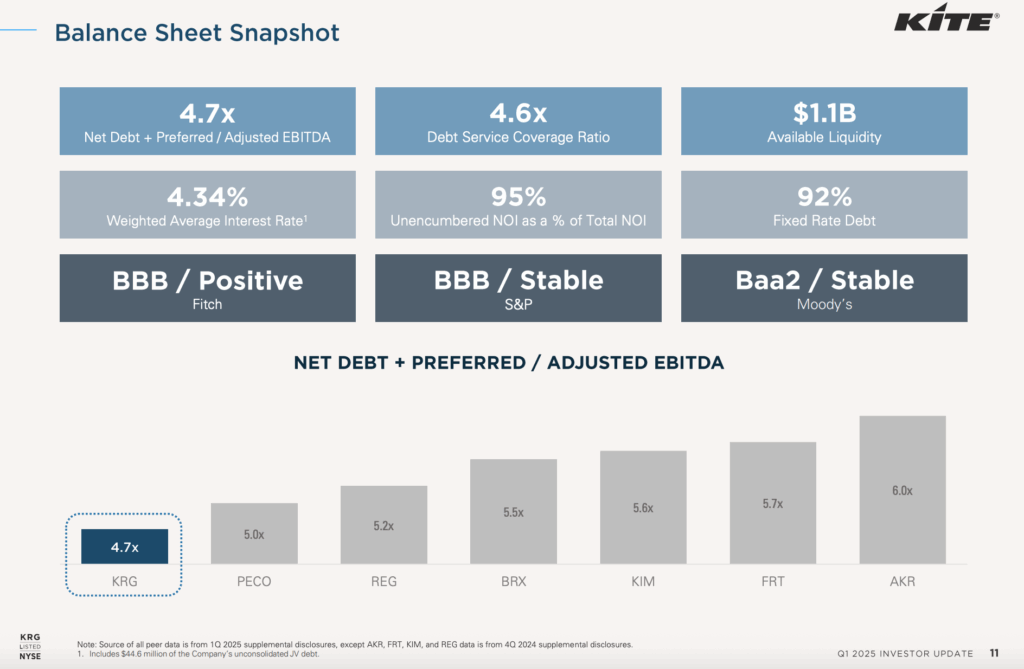
In a peer comparison, this puts Kite in a better position than many of its direct competitors, including Kimco Realty (TWS ticker KIM), Federal Realty (FRT) and Regency Centers (REG). The fixed-interest structure also looks very stable. Incidentally, KRG is a prime example of many REITs and how they have revamped their balance sheets in recent years.
Debt and maturities
It is not only the debt itself that is relevant for REITs today, but also when which maturities are due. KRG is not quite so well positioned here, as a whopping 15 percent of its total debt matures in 2026. This could be a reason for the undervaluation compared to peers, but I expect news on the refinancing in the next quarter.

In addition to classic bonds, KRG relies on term loans and credit lines. The majority of the debt is unsecured, which provides the company with operational flexibility for future financing. The average maturity of the debt is around 4.5 years. In other REIT sectors, you find significantly longer maturities (e.g., NNN REIT with >12 years).

Interestingly, KRG mentions the rating situation and a mismatch in the peer comparison in its reports. The "Rating Action Commentary" from Fitch, for example, reads consistently positive, but the outlook remains unchanged (positive, but lower than that of peers).
The dividend and the payout ratio
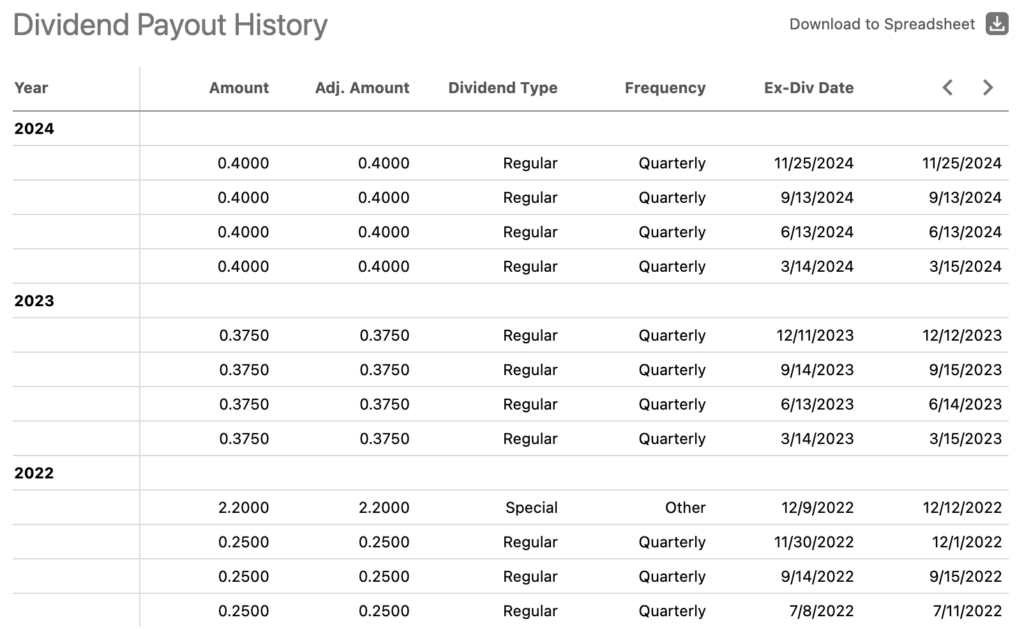
Kite Realty pays a regular quarterly dividend of USD 0.26 per share, i.e. a total of USD 1.08 per year. This corresponds to a current dividend yield of 4.71%. The dividend has been raised moderately several times in recent years, but was also reduced before that due to the pandemic. The payout ration in relation to the funds from operations is a very good ~49%, i.e. there is actually not much standing in the way of a regular increase in the dividend.
Video: Concrete gold with REITs vs own real estate | Philipp Kässinger REIT Profiinvestor
Peer comparison: Higher rating among competitors
Kite Realty is currently trading at an FFO multiple of less than 11x. This puts the company below the multiples of comparable REITs.
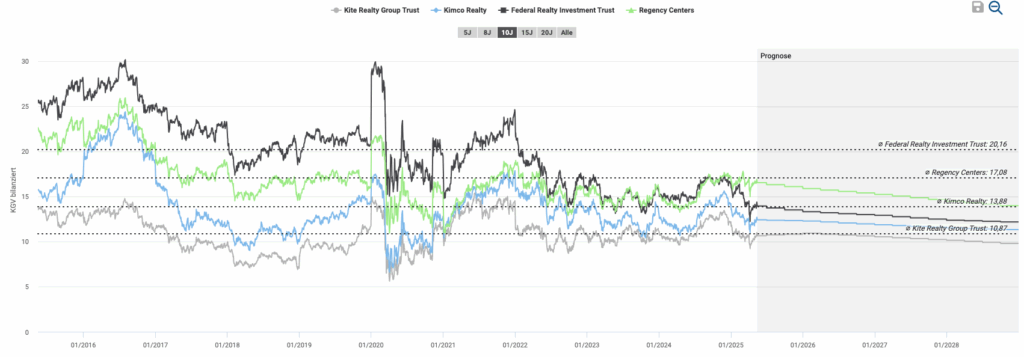
Compared to highly rated competitors such as Federal Realty or Regency Centers, Kite may offer less prestige, but a solid risk/reward ratio.
Options trading
I myself am also active as an options trader, but almost exclusively as a so-called "writer". Therefore, I am naturally also interested in KRG, which options are suitable for additional cash flow or for a favorable entry by means of a tender. Unfortunately, the spreads are higher here.
The Volatility (VIX) has retreated significantly from the massive rise at the beginning of April. Caution should therefore be exercised here again.
Kite Realty Trust
The only options currently available to KRG are at the money with a Strike from $22.5 in August which still offer reasonable premiums despite the lower volatility (VIX) and the high spread.
Kimco Realty Trust
KIM currently only offers at-the-money options with a strike price of $20 in June or July an.
Regency Centers
REG currently only offers at-the-money options with a strike price of $70 in June an.
Federal Realty Trust
FRG currently only offers at-the-money options with a strike price of $90 or $95 in June or July an.
Conclusion
Kite Realty Trust is a REIT for investors who value stability, diversification and predictable returns. With its focus on local shopping centers, a well-diversified tenant base and conservative financial management, the company offers a defensive addition to the REIT portfolio. Short-term share price fantasy is less to be expected here, but Kite convinces operationally and with long-term predictability.