


Do you trade stocks? Then you pay a spread on every transaction. This seemingly small difference between the buying and selling price can significantly impact your returns. In this article, you will learn what the stock spread really means, how it affects your trading costs, and how you can use it to your advantage.

The most important in a nutshell
- The spread is the difference between the buying and selling price of a stock and affects your trading costs.
- Tight spreads mean lower costs, while wide spreads reduce your profits.
- Spreads vary depending on liquidity, volatility, and trading hours. A broker like CapTrader offers you true market access with particularly tight spreads.
What does spread mean in stocks?
| Term | Meaning |
| Spread | Difference between bid price and ask price |
| Bid price | Highest price buyers are willing to pay |
| Ask price | Lowest price sellers will accept |
| Bid-Ask Spread | Aufstrich |
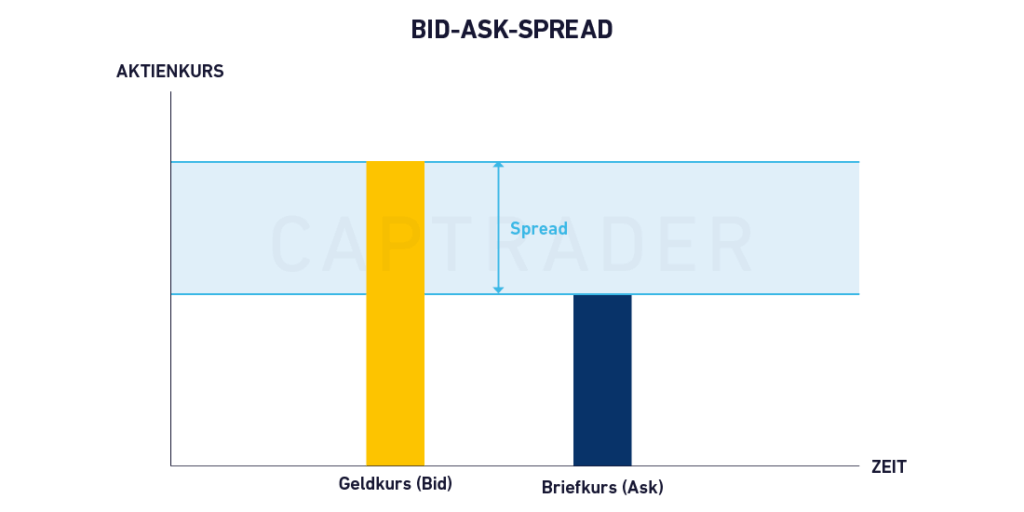
The spread in stocks is the difference between the price buyers are willing to pay (bid) and the price sellers are asking (ask). This difference is, so to speak, an indirect trading fee. A tight spread in stocks means cheaper trading. A wide spread reduces your return. What else you need to know about Spread Trading you can find out in our special article.
Stock Spread Explained: With a Practical Calculation Example
The spread is the difference between the bid price and the ask price, and thus one of your most important indirect trading costs.
Example: If you buy a share for 100.10 euros and sell it immediately for 100 euros, you pay a spread of 0.10 euros. What sounds like little adds up enormously with frequent trading.
Especially for smaller orders, the spread makes up a significant percentage. Therefore: the tighter the spread, the better for your returns.
Tip:
Use brokers with particularly tight spreads, such as CapTrader, to actively reduce these costs. This also makes the topic Spread Trading More interesting.
Difference between spreads in Forex & ETFs
The spread in stock trading is more fixed than in forex. In foreign exchange trading, spreads often vary depending on liquidity.
For ETFs, the spread is usually very narrow, but higher for exotic indices. The difference: With Aktien für Anfänger spreads usually play a smaller role than in high-frequency trading.
Important: Across all asset classes, pay attention to the spread as part of the total costs. Especially with market maker brokers, the spread is often increased „hiddenly“.
With a broker like CapTrader, you benefit from real market prices and market-oriented spreads. You can expect fair conditions when trading with Aktien für Anfänger and advanced learners, ETFs and more.
Why do spreads fluctuate?
Various factors influence the spread in stocks and make it an important indicator for traders.
- LiquidityHigh liquidity ensures tight spreads, as more market participants are active.
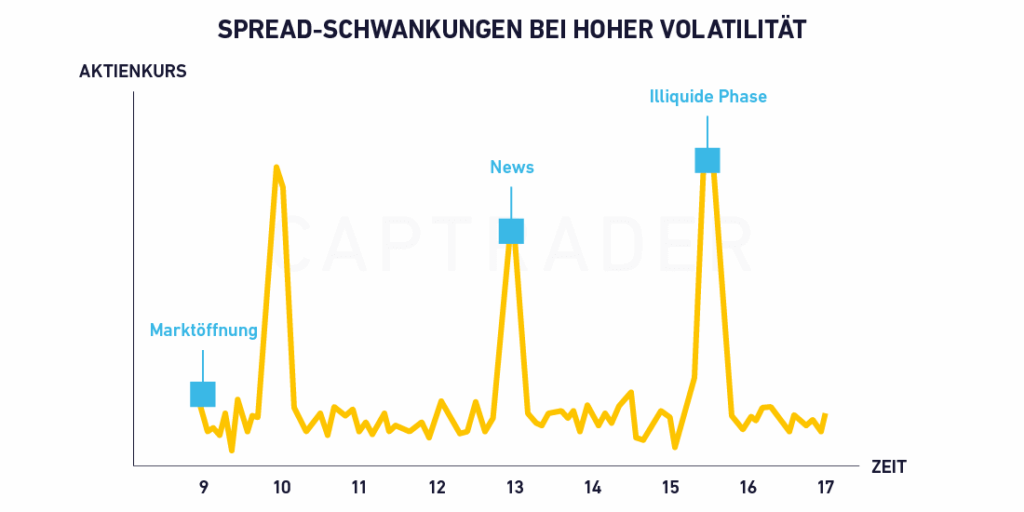
- VolatilityStrong fluctuations lead to wide spreads because uncertainty exists.
- Trading volumeHigh volume reduces the spread because more buy and sell orders meet.
- Trading hoursOutside of core hours, spreads are wider because there is less trading.
- news situationCrises and quarterly figures can widen spreads significantly as they increase uncertainty.
In summary, the stock spread adjusts immediately to the market. During calm phases, it is narrow; during uncertainty or low volume, it widens.
Spread Stocks Compared – Tight vs. Wide
Example: DAX stocks like Siemens often trade with a spread of 0.02 percent. A small-cap stock in the SDAX, on the other hand, can have a spread of 0.5 percent.
This difference has a direct impact on your costs. Over time, these add up and reduce your profits. An issue that also plays a role in the evaluation of the KGV in stocks is relevant.
How to read the spread correctly: What brokers reveal to you
Not every seemingly favorable spread is truly fair. Pay attention to the order book to see whether there is real volume behind the spread. Especially with exotic or thinly traded stocks, a tight spread can be deceptive.
With tools like the Trader Workstation (TWS) you keep all relevant data in view. Including true market depth and order book transparency. This allows you to make informed decisions and avoid unnecessarily expensive spread traps.
Learn more about such details in the article about the Profit-taking in stocks.
Exploiting the spread in stocks: How the trick works
| Advantage | Risk |
| Narrow spreads minimize costs | Wide spreads make purchases more expensive |
| Limit orders control the spread | Market orders increase slippage |
| Spread widening can be used during news | Widening spreads as an early warning sign |
The spread is not only a cost factor, but also a market indicator. Observe spread narrowings during high liquidity as an entry signal. Conversely, spread widenings should serve as a warning signal for uncertainty.
Use limit orders to minimize spread costs and avoid buying blindly at any price. Especially through brokers like CapTrader, which offer you direct market access, the spread can be managed strategically.
Spread Strategies for Day Traders & Scalpers
Active traders use tight spreads for quick profits. Through Limit orders and the correct timing of the trade, spread costs can be optimized. A proven strategy in professional Spread Trading Area.
Spread costs for long-term investors
Whether DAX, secondary stocks, or US tech, every sector has typical spread sizes. Before every order, check whether the current spread is in line with the market.
For buy-and-hold investors, spreads are less relevant in the long term. Nevertheless, even investors in German shares Pay attention to the spreads. And especially with small caps and exotic markets.


What is a normal spread for stocks?
| Segment | Typical spread size |
| DAX stocks | 0,01 – 0,03 % |
| Small caps | 0,3 – 0,5 % |
| US tech stocks | 0,02 – 0,1 % |
| OTC title | > 1.0 % |
A spread of 0.1 percent may seem small, but with high volumes the impact becomes noticeable.
Spread Benchmarks as a Guide
To properly assess the spread, you should orient yourself using typical benchmarks. DAX equities usually trade with minimal spreads, while secondary stocks or OTC securities are often burdened with spread sizes ranging from 0.3 to over 1 percent.
Especially with trendy papers like the popular FOMO shares the spread can fluctuate significantly. Therefore, use comparative data and observe how the spread behaves in different market phases.
A well-chosen entry time saves you hard cash and optimizes your trading costs. For beginners, we also recommend our Article about Aktien für Anfänger.
Optimize spread through timing and broker selection
The spread is not a fixed cost block because you can actively influence it. The decisive factors are the right timing and the choice of the appropriate broker. Preferably trade during core trading hours when liquidity is high and the spread is narrow. Avoid off-peak hours or volatile phases without news catalysts.
And particularly important: Your broker. Neobrokers often work with their own spreads, while ECN brokers like CapTrader offer you the real market price. And that without hidden markups. This not only saves fees, but also permanently lowers your spread costs.
You can find out more in our special article about KGV Aktien and Profit-taking in stocks.
Overview of Spread Costs: How to Calculate Properly
| Cost element | Meaning | Relevance |
| Spread | Bid-Ask Spread | hidden trading costs |
| Order commission | Broker fee | directly visible costs |
| Trading venue fees | exchange fee | additional fixed costs |
Many investors only look at visible fees such as order commissions, but overlook the spread as a hidden cost trap. Yet, depending on the trading volume, the spread can make up the majority of the actual trading costs.
Especially with small caps and low-liquidity stocks, the spread quickly becomes a drag on returns.
Important:
Always calculate the Total Cost of Ownership. That means spread plus commission plus exchange fees. This is the only way to recognize your true costs per trade. With a broker like CapTrader, which offers tight spreads and fair fees through direct exchange access, you noticeably reduce these costs when Spread Trading.
Spread as a component of your total cost ratio
The spread is not a one-time item, but acts like an entry fee to the market. Every time you buy or sell a stock. Especially with small orders or frequent trading, the spread has a direct impact on your performance.
The smaller your invested capital, the more significant the impact of even small spread differences.
Therefore, never forget to include the spread in your total expense ratio. Anyone who deliberately optimizes here will improve their net return. Especially when investing in German stocks or with short-term strategies like Scalping makes a huge difference.

Spread & Liquidity: Your Key to Cost Reduction
The more liquid a security, the tighter the spread. You should keep this rule of thumb in mind for every order. Liquid assets like DAX blue chips trade with minimal spreads, while exotic small caps quickly become more expensive.
Investors who specifically target liquid assets not only reduce their direct trading costs, but also benefit from faster order executions.
With CapTrader, you have access to over 160 international exchanges. This makes it ideal for selectively choosing liquid securities with tight spreads. Use this diversity to optimize your costs while flexibly implementing your investment strategy.
What CapTrader can do:
With a broker like CapTrader, you not only save on direct fees, but also benefit from particularly tight spreads. Thanks to access to over 170 international exchanges, you trade where liquidity is highest. Combined with professional tools like the Trader Workstation (TWS), you can sustainably optimize your costs.
Conclusion - Spread Shares: Will you reduce costs in the future?
The spread in equities is much more than just a number in the order book. It influences your trading costs, shows you liquidity situations, and often reveals more about the market than many other indicators.
Especially as a private investor, you should never underestimate the spread. It affects every transaction, regardless of whether you are buying or selling.
Anyone who does not actively deal with the spread on stocks pays unnecessarily. Those who understand the spread calculate it as an integral part of their strategy. Especially in small caps, exotic markets, or short-term trading, spreads are an often overlooked return killer.
