Your Broker for worldwide trading

Spread Stocks Explained: What You Should Know

Do you trade stocks? Then you pay a spread on every transaction. This seemingly small difference between the buying and selling price can significantly impact your returns. In this article, you will learn what the stock spread really means, how it affects your trading costs, and how you can use it to your advantage.

A simple outline of a document with horizontal lines and a yellow magnifying glass in front of it, symbolizing the document check or search.

The most important in a nutshell

  • The spread is the difference between the buying and selling price of a stock and affects your trading costs. 
  • Tight spreads mean lower costs, while wide spreads reduce your profits. 
  • Spreads vary depending on liquidity, volatility, and trading hours. A broker like CapTrader offers you true market access with particularly tight spreads.

What does spread mean in stocks? 

TermMeaning
SpreadDifference between bid price and ask price
Bid priceHighest price buyers are willing to pay
Ask priceLowest price sellers will accept
Bid-Ask SpreadAufstrich

The spread in stocks is the difference between the price buyers are willing to pay (bid) and the price sellers are asking (ask). This difference is, so to speak, an indirect trading fee. A tight spread in stocks means cheaper trading. A wide spread reduces your return. What else you need to know about Spread Trading you can find out in our special article.
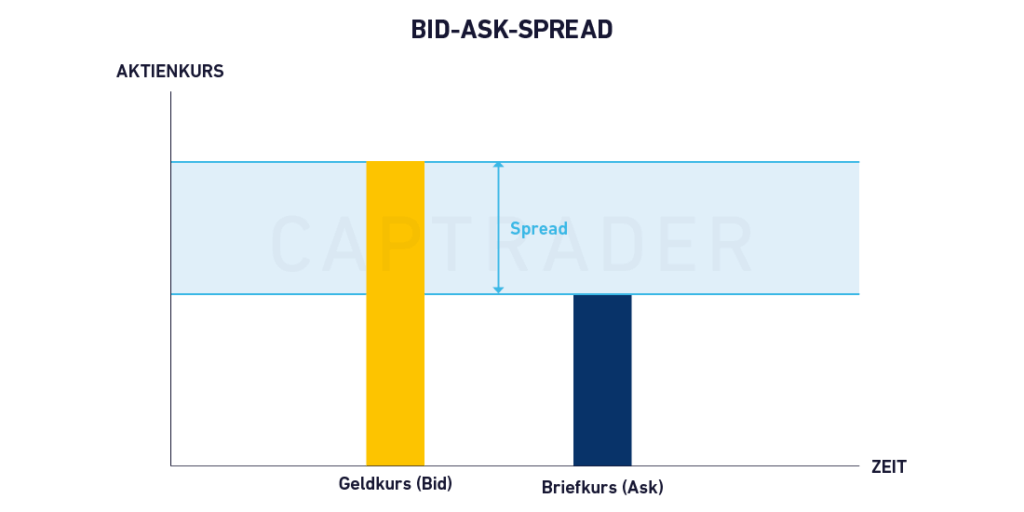
Bar chart illustrating the bid-ask spread for spread stocks, with the bid price highlighted in yellow, the ask price in navy blue, and the spread in between. The Y-axis is the stock price, and the X-axis is time.

Stock Spread Explained: With a Practical Calculation Example

The spread is the difference between the bid price and the ask price, and thus one of your most important indirect trading costs. 

Example: If you buy a share for 100.10 euros and sell it immediately for 100 euros, you pay a spread of 0.10 euros. What sounds like little adds up enormously with frequent trading. 

Especially for smaller orders, the spread makes up a significant percentage. Therefore: the tighter the spread, the better for your returns.

Tip:

Use brokers with particularly tight spreads, such as CapTrader, to actively reduce these costs. This also makes the topic Spread Trading More interesting.

Difference between spreads in Forex & ETFs 

The spread in stock trading is more fixed than in forex. In foreign exchange trading, spreads often vary depending on liquidity. 

For ETFs, the spread is usually very narrow, but higher for exotic indices. The difference: With Aktien für Anfänger spreads usually play a smaller role than in high-frequency trading.

Important: Across all asset classes, pay attention to the spread as part of the total costs. Especially with market maker brokers, the spread is often increased „hiddenly“.

With a broker like CapTrader, you benefit from real market prices and market-oriented spreads. You can expect fair conditions when trading with Aktien für Anfänger and advanced learners, ETFs and more.
Person holding a smartphone with a trading app on the screen in front of computer monitors displaying financial charts; ad text promoting trading with 100 order types and algorithms.

Why do spreads fluctuate? 

Various factors influence the spread in stocks and make it an important indicator for traders.

  • LiquidityHigh liquidity ensures tight spreads, as more market participants are active.
  • VolatilityStrong fluctuations lead to wide spreads because uncertainty exists.
  • Trading volumeHigh volume reduces the spread because more buy and sell orders meet.
  • Trading hoursOutside of core hours, spreads are wider because there is less trading.
  • news situationCrises and quarterly figures can widen spreads significantly as they increase uncertainty.

In summary, the stock spread adjusts immediately to the market. During calm phases, it is narrow; during uncertainty or low volume, it widens.

Spread Stocks Compared – Tight vs. Wide 

Example: DAX stocks like Siemens often trade with a spread of 0.02 percent. A small-cap stock in the SDAX, on the other hand, can have a spread of 0.5 percent. 

This difference has a direct impact on your costs. Over time, these add up and reduce your profits. An issue that also plays a role in the evaluation of the KGV in stocks is relevant.

How to read the spread correctly: What brokers reveal to you

Not every seemingly favorable spread is truly fair. Pay attention to the order book to see whether there is real volume behind the spread. Especially with exotic or thinly traded stocks, a tight spread can be deceptive.

With tools like the Trader Workstation (TWS) you keep all relevant data in view. Including true market depth and order book transparency. This allows you to make informed decisions and avoid unnecessarily expensive spread traps. 

Learn more about such details in the article about the Profit-taking in stocks.
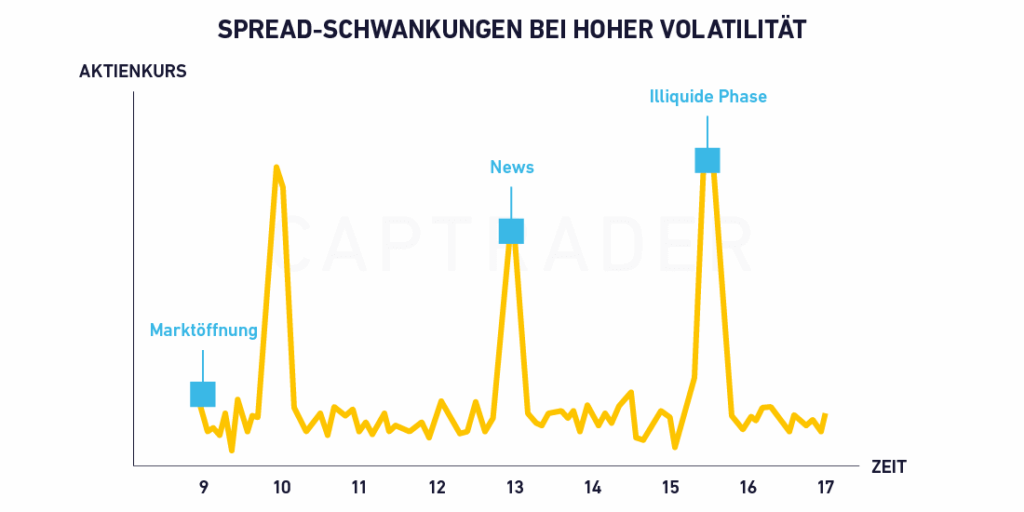
Line chart with stock price fluctuations and labeled points for "Market Open", "News", and "Illiquid Phase", highlighting periods of high volatility and spread in stocks.

Exploiting the spread in stocks: How the trick works 

AdvantageRisk
Narrow spreads minimize costsWide spreads make purchases more expensive
Limit orders control the spreadMarket orders increase slippage
Spread widening can be used during newsWidening spreads as an early warning sign

The spread is not only a cost factor, but also a market indicator. Observe spread narrowings during high liquidity as an entry signal. Conversely, spread widenings should serve as a warning signal for uncertainty.

Use limit orders to minimize spread costs and avoid buying blindly at any price. Especially through brokers like CapTrader, which offer you direct market access, the spread can be managed strategically.

Spread Strategies for Day Traders & Scalpers 

Active traders use tight spreads for quick profits. Through Limit orders and the correct timing of the trade, spread costs can be optimized. A proven strategy in professional Spread Trading Area.

Spread costs for long-term investors

Whether DAX, secondary stocks, or US tech, every sector has typical spread sizes. Before every order, check whether the current spread is in line with the market. 

For buy-and-hold investors, spreads are less relevant in the long term. Nevertheless, even investors in German shares Pay attention to the spreads. And especially with small caps and exotic markets.
Advertisement for CapTrader with a view of Europe from space at night, a list of trading advantages and a yellow button labeled "Open account".

What is a normal spread for stocks? 

SegmentTypical spread size
DAX stocks0,01 – 0,03 %
Small caps0,3 – 0,5 %
US tech stocks0,02 – 0,1 %
OTC title> 1.0 %

A spread of 0.1 percent may seem small, but with high volumes the impact becomes noticeable.

Spread Benchmarks as a Guide

To properly assess the spread, you should orient yourself using typical benchmarks. DAX equities usually trade with minimal spreads, while secondary stocks or OTC securities are often burdened with spread sizes ranging from 0.3 to over 1 percent. 

Especially with trendy papers like the popular FOMO shares the spread can fluctuate significantly. Therefore, use comparative data and observe how the spread behaves in different market phases. 

A well-chosen entry time saves you hard cash and optimizes your trading costs. For beginners, we also recommend our Article about Aktien für Anfänger.

Optimize spread through timing and broker selection

The spread is not a fixed cost block because you can actively influence it. The decisive factors are the right timing and the choice of the appropriate broker. Preferably trade during core trading hours when liquidity is high and the spread is narrow. Avoid off-peak hours or volatile phases without news catalysts. 

And particularly important: Your broker. Neobrokers often work with their own spreads, while ECN brokers like CapTrader offer you the real market price. And that without hidden markups. This not only saves fees, but also permanently lowers your spread costs. 

You can find out more in our special article about KGV Aktien and Profit-taking in stocks.

Overview of Spread Costs: How to Calculate Properly 

Cost elementMeaningRelevance
SpreadBid-Ask Spreadhidden trading costs
Order commissionBroker feedirectly visible costs
Trading venue feesexchange feeadditional fixed costs

Many investors only look at visible fees such as order commissions, but overlook the spread as a hidden cost trap. Yet, depending on the trading volume, the spread can make up the majority of the actual trading costs. 

Especially with small caps and low-liquidity stocks, the spread quickly becomes a drag on returns.

Important:

Always calculate the Total Cost of Ownership. That means spread plus commission plus exchange fees. This is the only way to recognize your true costs per trade. With a broker like CapTrader, which offers tight spreads and fair fees through direct exchange access, you noticeably reduce these costs when Spread Trading.

Spread as a component of your total cost ratio

The spread is not a one-time item, but acts like an entry fee to the market. Every time you buy or sell a stock. Especially with small orders or frequent trading, the spread has a direct impact on your performance. 

The smaller your invested capital, the more significant the impact of even small spread differences.

Therefore, never forget to include the spread in your total expense ratio. Anyone who deliberately optimizes here will improve their net return. Especially when investing in German stocks or with short-term strategies like Scalping makes a huge difference.

An astronaut floats in space next to ad text promoting stock trading features such as global exchanges, short selling and fractional shares. A yellow button reads "Open an account".

Spread & Liquidity: Your Key to Cost Reduction

The more liquid a security, the tighter the spread. You should keep this rule of thumb in mind for every order. Liquid assets like DAX blue chips trade with minimal spreads, while exotic small caps quickly become more expensive. 

Investors who specifically target liquid assets not only reduce their direct trading costs, but also benefit from faster order executions.

With CapTrader, you have access to over 160 international exchanges. This makes it ideal for selectively choosing liquid securities with tight spreads. Use this diversity to optimize your costs while flexibly implementing your investment strategy.

What CapTrader can do:

With a broker like CapTrader, you not only save on direct fees, but also benefit from particularly tight spreads. Thanks to access to over 170 international exchanges, you trade where liquidity is highest. Combined with professional tools like the Trader Workstation (TWS), you can sustainably optimize your costs.

Conclusion - Spread Shares: Will you reduce costs in the future?

The spread in equities is much more than just a number in the order book. It influences your trading costs, shows you liquidity situations, and often reveals more about the market than many other indicators. 

Especially as a private investor, you should never underestimate the spread. It affects every transaction, regardless of whether you are buying or selling.

Anyone who does not actively deal with the spread on stocks pays unnecessarily. Those who understand the spread calculate it as an integral part of their strategy. Especially in small caps, exotic markets, or short-term trading, spreads are an often overlooked return killer.

FAQ: The most frequently asked questions about Spread shares

What does spread mean for stocks in simple terms?

The spread is the difference between the buying and selling price and represents your „entry costs.“.

What is a normal spread?

For DAX stocks between 0.01 and 0.03 percent. Significantly higher for secondary stocks.

How can I reduce spread costs?

Through limit orders, the right timing for trades, and the choice of a low-cost broker.

Are spreads for ETFs and Forex comparable?

No, there spreads often serve as the main cost center. For equities, they are usually lower, but still relevant.

Can you trade actively with spreads?

Yes, in professional spread trading, minimal spread differences are specifically exploited.

Philipp Gilg with short, light-colored hair and a beard wears a light blue button-down shirt. He stands in front of a pane of glass and looks into the camera.
Philipp Gilg

Philipp Gilg is a freelance SEO expert and financial editor. He regularly publishes SEO-optimized articles about shares, trading, options and investing on the CapTrader blog. He also works with well-known financial influencers and supports them in gaining organic reach on Google. He developed a great passion for the stock market at a young age, trading his first shares at the age of 16. As a result, he now has years of experience and expertise in this area.

Mandatory information and disclaimer

This is a marketing communication within the meaning of Section 63 (6) of the German Securities Trading Act and does not contain investment strategy recommendations, investment recommendations or financial analyses in accordance with Section 85 of the German Securities Trading Act and Article 20 of the Market Abuse Regulation. It therefore does not fulfill the legal requirements to guarantee the objectivity of investment strategy recommendations/investment recommendations/financial analyses. CapTrader GmbH or its employees are therefore not legally prohibited from trading or providing services in the securities products mentioned therein prior to publication of the information.

Past performance, simulations or forecasts are not a reliable indicator of future performance. Mandatory information and limitation of liability for CapTrader and any third-party content providers can be found at https://www.captrader.com/marketingmitteilung/angaben
Please note that investing in financial instruments involves high risks and take note of our disclaimer and the mandatory legal information at the locations indicated.

  1. Mandatory information

Responsible: CapTrader GmbH, Elberfelder Straße 2, 40213 Düsseldorf; Commercial Register Number: HRB 86537 Düsseldorf Local Court; VAT ID DE323771603; Managing Directors Andreas Weiß, Christian Weiß, Michael Heyder; Tel: +49 211-740786-00, Fax: +49 211-740786-90.

Zuständige Aufsichtsbehörde: Bundesanstalt für Finanzdienstleistungsaufsicht, Graurheindorfer Straße 108, D – 53117 Bonn und Marie-Curie-Str. 24-28 D – 60439 Frankfurt am Main, Tel: 0228 4108 – 0 Fax: 0228 4108 1550 E-Mail: poststelle@bafin.de; Institutsnummer 10156708

Conflicts of interest CapTrader in marketing communications: CapTrader GmbH confirms that it does not hold any positions in the mentioned financial instruments beyond the positions mentioned in the marketing communication itself, if applicable. There are also no other conflicts of interest within the meaning of CapTrader GmbH's Financial Analysis and Marketing Communication Policy.

Conflicts of interest and mandatory disclosures by the third-party content provider for marketing communications with financial instrument recommendations: See under https://www.captrader.com/marketingmitteilung/angaben  to creators of third-party content

The copyright to the marketing communication is reserved. Reprinting and distribution is only permitted with our consent.

  1. Disclaimer

By accepting the content, the recipient accepts the binding nature of the limitation of liability.

a) Disclaimer for third-party content

CapTrader GmbH offers authors - such as editors, guest commentators, agencies and companies - the opportunity to publish comments, analyses, news and company announcements. Their opinions do not necessarily reflect the opinions and views of CapTrader GmbH and its employees. CapTrader GmbH assumes neither liability nor guarantee for this content. This applies in particular to incomplete or incorrectly reproduced reports, incorrect price information and editorial errors. Liability claims relating to material or immaterial damage caused by the use or non-use of the published information or by the use of incorrect or incomplete information are fundamentally excluded.

b) Exclusion of liability for CapTrader's own content

CapTrader has taken its own information in this marketing communication from sources believed to be reliable, but has not verified all such information itself. Accordingly, CapTrader makes no warranties or representations as to the accuracy, completeness or correctness of the information or opinions contained herein. Subsequent changes cannot be taken into account. The marketing communication does not constitute an offer or solicitation to buy shares of the issuer and is in no way a substitute for advice appropriate to the investor and the property. We cannot verify whether the information in the marketing communication is in line with your personal investment strategies and objectives. We recommend that you consult an investment advisor for advice that is appropriate to the investor and the property. The marketing communication cannot and should not replace a securities prospectus and/or expert investment advice required for an investment. It can therefore never be the sole basis for an investment decision. By accepting the marketing communication, the recipient accepts the binding nature of the above limitation of liability.

CapTrader provides the information despite careful procurement and provision only without guarantee for the correctness / completeness, timeliness or accuracy and availability of the stock exchange and economic information, prices, rates, indices, general market data, valuations, assessments and other accessible content held and displayed for retrieval. This also applies to third-party content. Historical observations and forecasts are not a reliable indicator of future developments. The facts presented in particular in connection with product information are for illustrative purposes only and do not permit any statements to be made about future profits or losses. Any conditions stated are to be understood as non-binding indications and are dependent on market developments on the day of conclusion.

CapTrader accepts no liability for any direct or indirect damage caused by and/or related to the distribution and/or use of this marketing communication.

The information, opinions and statements correspond to the status at the time of preparation of the marketing communication. They may be outdated due to future developments without the publication being changed.

CapTrader is not obliged to update, amend or supplement the information in this marketing communication if a circumstance mentioned in this publication or a statement, estimate or forecast contained therein changes or becomes inaccurate. The presentation of the performance of financial instruments over previous periods does not provide a reliable indication of their future performance. No guarantee can therefore be given for the future price, value or income of any financial instrument mentioned in this publication.

Despite careful control of the content, we assume no liability for the content of external links. The operators of the linked pages are solely responsible for their content.

Distribution: This publication may only be distributed in accordance with the laws of the respective countries, and persons in possession of this publication should inform themselves about the applicable local regulations. The information contained herein is not intended for natural or legal persons who, due to their place of residence or business, are subject to a foreign legal system that imposes restrictions on the distribution of such information. The contents are therefore exclusively in German. In particular, this publication contains neither an offer nor an invitation to purchase securities to citizens of the USA, Great Britain and Australia.

Taxes: The tax treatment of financial instruments depends on the personal circumstances of the respective investor and may be subject to future changes, which may also have a retroactive effect.

Historical observations and forecasts are not a reliable indicator of future developments. The facts presented in particular in connection with product information are for illustrative purposes only and do not permit any statements to be made about future profits or losses. Any conditions stated are to be understood as non-binding indications and are dependent on market developments on the day of conclusion.

CapTrader accepts no liability for direct or indirect damage caused by and/or in connection with the distribution and/or use.

The information, opinions and statements correspond to the status at the time of preparation of the marketing communication. They may be outdated due to future developments without the publication being changed.

CapTrader is not obliged to update, amend or supplement the information if a circumstance mentioned in this publication or a statement, estimate or forecast contained therein changes or becomes inaccurate. The presentation of the performance of financial instruments over previous periods does not provide a reliable indication of their future performance. No guarantee can therefore be given for the future price, value or income of any financial instrument mentioned in this publication.

Despite careful control of the content, we assume no liability for the content of external links. The operators of the linked pages are solely responsible for their content.

Distribution: This publication may only be distributed in accordance with the laws of the respective countries, and persons in possession of this publication should inform themselves about the applicable local regulations. The information contained herein is not intended for natural or legal persons who, due to their place of residence or business, are subject to a foreign legal system that imposes restrictions on the distribution of such information. The contents are therefore exclusively in German. In particular, this publication contains neither an offer nor an invitation to purchase securities to citizens of the USA, Great Britain and Australia.

Taxes: The tax treatment of financial instruments depends on the personal circumstances of the respective investor and may be subject to future changes, which may also have a retroactive effect.

Email:

info@captrader.com

Send e-mail

Phone:

Hotline (Germany)
0800-8723370

Hotline (International)
00800-08723370

Further contact options