


Many investors see drone stocks as an attractive opportunity to profit from the rapid growth of the global drone market. The sector is developing dynamically through advances in automation, rising demand in areas such as logistics, surveillance, and agriculture, as well as through technological innovations and regulatory developments.
As an investor, you should know that drone technology stocks are heavily influenced by factors such as government contracts, technological breakthroughs, competitive landscapes, and regulatory frameworks. In this article, you will learn which drone companies are currently positioned particularly promisingly and what opportunities and risks this future market offers.

The most important facts in brief:
- Drone stocks offer access to a rapidly growing future market with military, commercial, and industrial applications.
- The global market is expected to grow at an annual rate of 7.9 % through 2036.
- Risks include strict regulation, intense technological competition, and the heavy dependence of many companies on government budgets.
What are drone stocks?
Drone stocks encompass companies across the entire value chain of drone technology. This includes manufacturers of drone hardware, developers of software and control systems, service providers, and companies that integrate drones into their business models.
The sector is gaining in long-term importance as drones are increasingly used in areas such as logistics, defense, infrastructure monitoring, and agriculture. Growth drivers include technological advancements, rising automation, and efficiency gains across numerous industries. At the same time, drone stocks are sensitive to regulatory requirements, government budgets, and innovation cycles.
Drone stocks can be divided into several key sectors that react differently to market phases and trends:
- Drone manufacturerCompanies that develop and produce civil or military drones. They benefit from rising demand in areas such as defense, surveillance, and commercial applications. At the same time, competition is intense and heavily technology-driven.
- Software and AI providersCompanies that develop control systems, navigation software, data analytics, or artificial intelligence for drones. This sector is growing particularly rapidly as autonomous flight solutions and data-driven applications become increasingly important.
- Defense and security companyCorporations that use drones for military purposes or security solutions. They benefit from rising defense budgets and geopolitical tensions, but are heavily dependent on political decisions.
- Logistics and delivery servicesCompanies that use drones for the delivery of goods or are building corresponding networks. This sector is still in its infancy, but offers enormous growth potential through efficiency gains in the transport sector.
- Industrial and inspection service providerCompanies that use drones for inspections of infrastructure, energy facilities, or construction projects. They benefit from cost savings and higher safety compared to traditional methods.
- Agricultural and Environmental TechnologyProviders that use drones for precision agriculture, field monitoring, or environmental analysis. This sector is growing due to the trend toward data-driven and sustainable management.
- Component and supplier companiesManufacturer of sensors, cameras, Semiconductors or battery systems installed in drones. They benefit indirectly from the growth of the entire sector.
- Drone platforms and servicesCompanies that offer Drone-as-a-Service, including operation, maintenance, and data provision. This model is gaining importance as many companies want to use drone technology without building their own infrastructure.
Some companies cover multiple areas at the same time. This vertical integration can help secure technological advantages and better balance fluctuations in individual market segments.


The market potential of drone stocks and drone manufacturer stocks in 2026
Forecasts suggest that the global drone market will grow significantly by 2036, with revenues concentrating on a few dominant application areas.
The global market (including consumer, commercial, and military applications) is projected to grow from approximately $69 billion in 2026 to $147.8 billion by 2036, representing a compound annual growth rate (CAGR) of 7.9 %.
Of particular importance are military drones, inspection and maintenance applications, as well as delivery and logistics solutions.
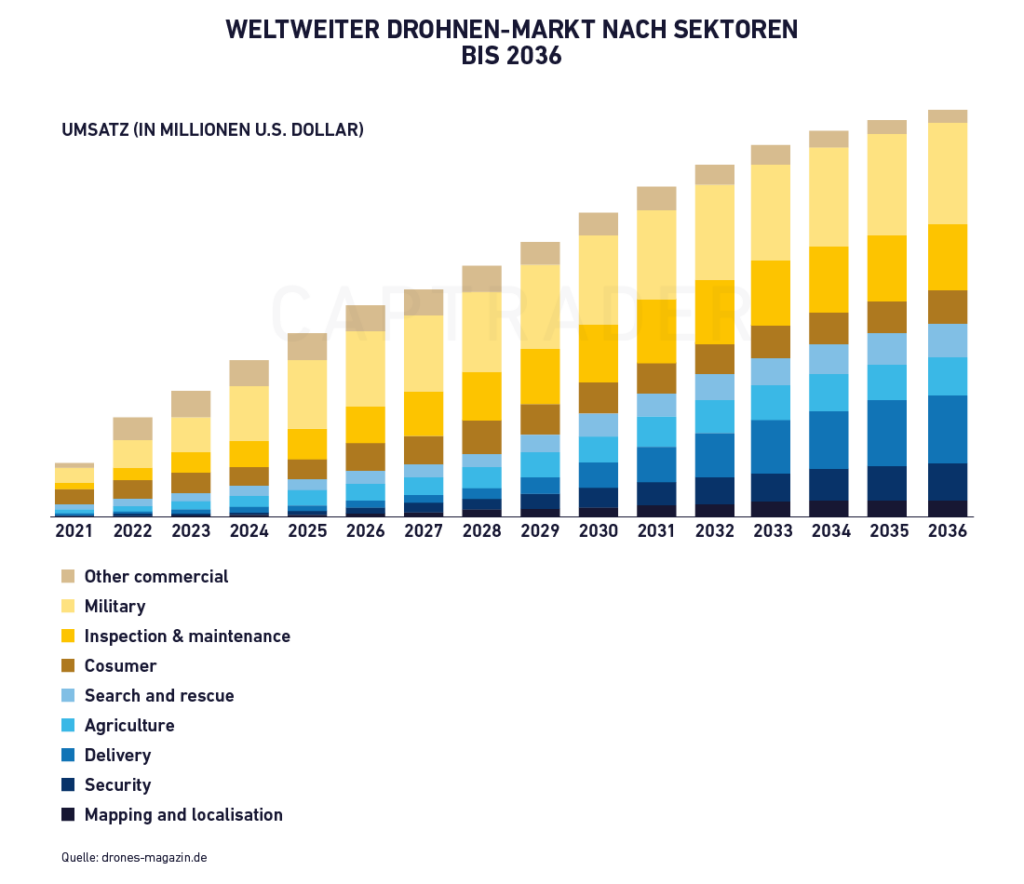
These segments drive long-term revenue growth and thus also form the most important value drivers for investors in drone stocks. These three areas are examined in detail below.
Strong growth in the military drone market
Studies² project that the European market for military drones will grow from approximately $9.47 billion in 2024 to about $19.46 billion in 2030, representing an average annual growth rate of approximately 12.9 %.
The causes are higher defense budgets in Europe, the experience from current conflicts, the increasing importance of drones for reconnaissance and precision strikes, as well as technological advances in sensor technology, data processing, and autonomy.
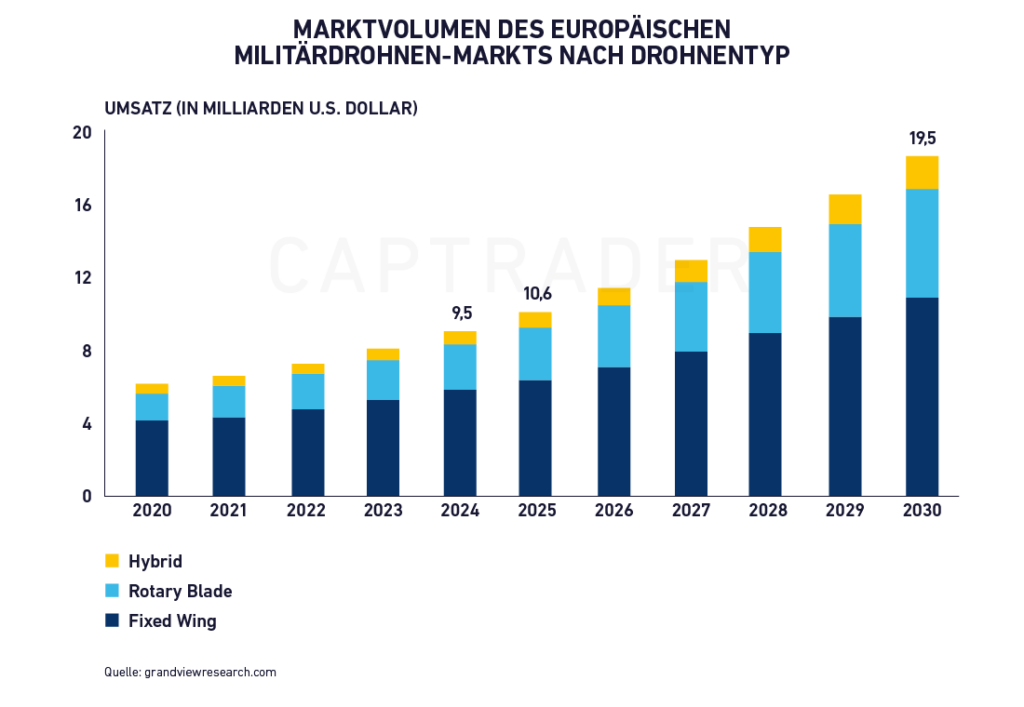
- Fixed WingFixed-wing aircraft without rotors that fly like small airplanes, are very efficient, and enable long ranges for reconnaissance and surveillance.
- Rotary Blade: Drones with one or more rotors, mostly multicopters, which can take off and land vertically and are suitable for flexible, precise deployments.
- HybridVTOL systems that take off and land like a multicopter and then fly on like a fixed-wing aircraft to combine hover capability with high range.
The chart shows that fixed-wing drones hold the largest share of revenue over the entire period, rotary-blade systems are growing steadily, and hybrid models are increasing significantly from a small starting point.
Experts therefore expect a dynamically growing European military drone market in which efficient fixed-wing platforms form the backbone, while rotor-based and hybrid VTOL drones increasingly take on specialized tasks, thereby significantly increasing the overall market volume by 2030.
Growth in the drone inspection and monitoring market
Trend analysts³ predict that the global market for drone inspection and surveillance will grow from $15.5 billion in 2025 to $36.94 billion in 2030, corresponding to a very dynamic annual growth rate of 19 %.
This growth is driven primarily by the increasing use of drones for the inspection of energy, industrial, and infrastructure facilities, as well as by the goal of reducing maintenance costs and risks for human inspection teams.
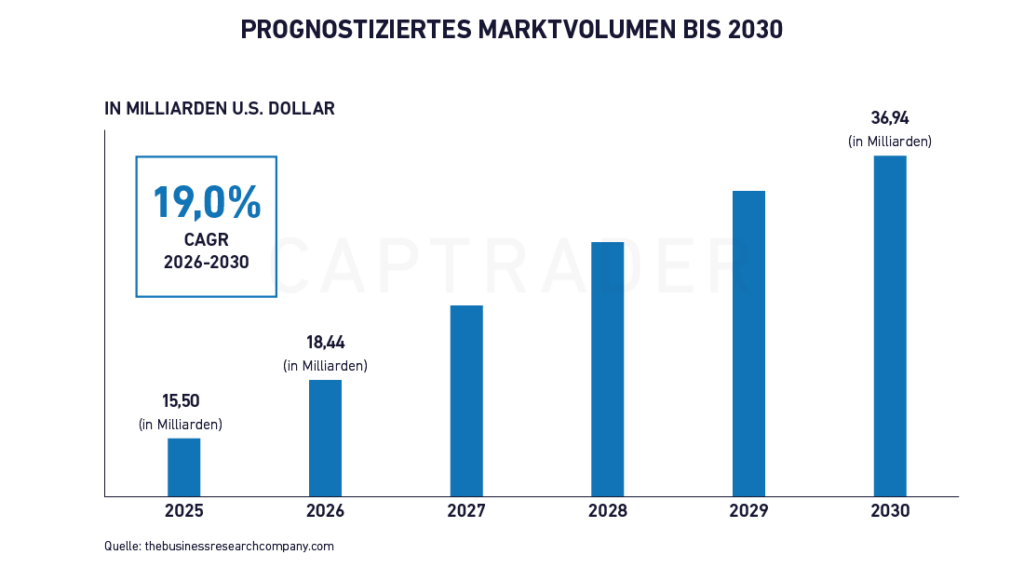
The graphic clearly shows how drone inspection and monitoring are evolving from a relatively young application field into a central growth segment of the global drone market.
The main reason is that companies worldwide are increasingly relying on automated aerial inspections to increase efficiency, safety, and data quality in maintenance and monitoring.
Rising demand for delivery drones
Analysts³ expect the global market for delivery drones to grow from $2.88 billion in 2025 to $8.38 billion in 2030, which corresponds to a very high annual growth rate of 23.6 %.
This growth is driven primarily by the expansion of e-commerce, the demand for increasingly fast delivery times, and the interest in climate-friendly, electric logistics.
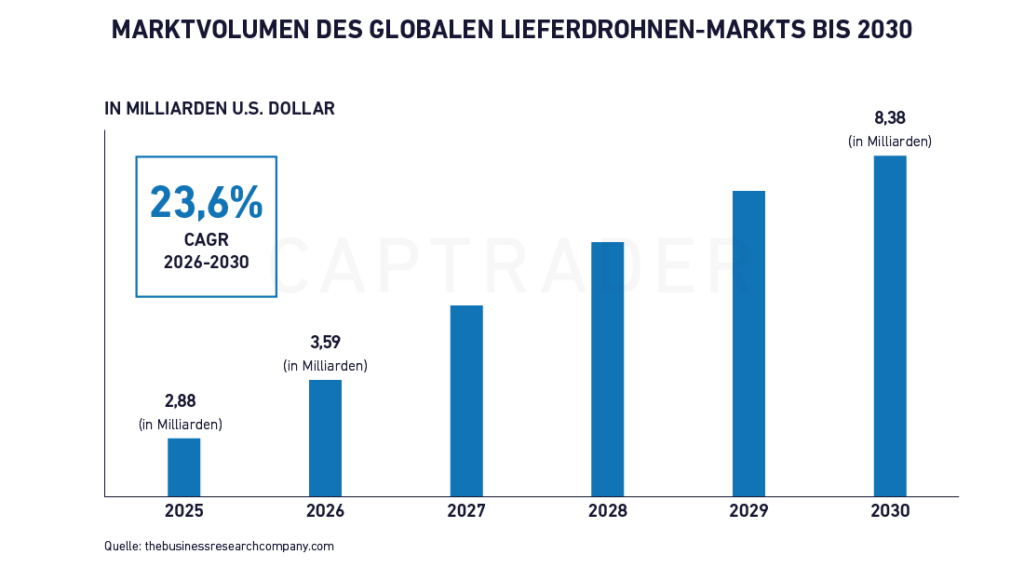
The graphic thus impressively shows how delivery drones are evolving from a still small, but highly dynamic segment into an important building block of global logistics.
This is primarily because retailers and logistics service providers are increasingly using drones for fast, flexible, and low-emission deliveries in urban areas and for medically critical shipments.
The most important drone manufacturer stocks and drone technology stocks
The following overview presents a selection of the world's most significant publicly traded companies whose business models are closely tied to unmanned aerial systems, drone technology, and related services.
The focus is primarily on corporations operating along the drone value chain. The order is based on current market capitalization in the drone sector (as of June 2026), allowing you to see at a glance which drone stocks dominate the segment.
| Company | ISIN | Country | Market capitalization in US dollars⁴ |
| The Boeing Company | US0970231058 | USA | 176 billion |
| Airbus SE | NL0000235190 | Netherlands | 171 billion |
| Honeywell International Inc. | US4385161066 | USA | 145 billion |
| Lockheed Martin Corp. | US5398301094 | USA | 118 billion |
| Northrop Grumman Corp. | US6668071029 | USA | 74 billion |
| BAE Systems plc | GB0002634946 | Great Britain | 69 billion |
| Rheinmetall AG | DE0007030009 | Germany | 64 billion |
| L3Harris Technologies Inc. | US5024311095 | USA | 55 billion |
| Thales Group | FR0000121329 | France | 54 billion |
| AeroVironment Inc. | US0080731088 | USA | 9 billion |
| Unusual Machines | US91532F1021 | USA | 0.9 billion |
To trade drone stocks, you need a brokerage account. With CapTrader, you can open one and subsequently invest on over 170 international stock exchanges. The favorable conditions are particularly attractive: for US stocks, the fee is only 1 cent per share, with a minimum fee per order of 2.00 US dollars.


1. AeroVironment
AeroVironment (ISIN: US0080731088) is one of the most renowned providers in the field of unmanned aircraft systems and has established itself internationally, particularly with tactical reconnaissance and precision-guided solutions.
As a clear pure-play provider in the drone segment, the growth stock holds a leading technological position in portable reconnaissance drones and remote-controlled precision munitions (e.g., Switchblade). The systems of Grow stock set global standards in tactical reconnaissance.
The technologies are manufactured and further developed in highly specialized production and research facilities within the USA, with a clear focus on military micro-drones and autonomous flight systems for international operational markets.
| Tax year | estimated revenue (in million USD)⁴ | Change from previous year⁴ |
| 2025 | 820,6 | 14,5 % |
| 2026 | 1.898 | 131,33 % |
| 2027 | 2.189 | 15,32 % |
AeroVironment is increasingly focusing on AI-powered autonomy, expanding production capacities for major orders, and strategic acquisitions in the robotics sector.
2. Rheinmetall
Rheinmetall (ISIN: DE0007030009) is one of the globally significant integrated technology groups within the defense industry.
In addition to its status as a blue-chip stock, the company is increasingly being perceived as a relevant drone stock because, as a systems provider, it combines proprietary tactical reconnaissance solutions (e.g., Luna NG) with modern counter-drone systems (e.g., Skyranger).
These integrated systems make a significant contribution to networked combat operations and the effective defense against unmanned threats. To this end, Rheinmetall operates a broad network of production sites in Europe, Australia, and the USA, focusing on tactical UAVs and air defense technologies for global deployment.
| Tax year | estimated revenue (in million USD)⁴ | Change from previous year⁴ |
| 2025 | 11.392 | 1,89 % |
| 2026 | 16.228 | 42,44 % |
| 2027 | 21.799 | 34,33 % |
Instead of traditional defense technology, Rheinmetall is focusing on the digitization of armed forces, modern anti-drone systems such as the Skyranger, and the massive expansion of European supply chains.
3. Lockheed Martin
Lockheed Martin (ISIN: US5398301094) is one of the leading technology corporations in aerospace and also plays a central role in the drone sector. The focus in the deep tech segment is on heavy, strategic stealth drones as well as the AI-supported networking of unmanned systems with manned fighter jets.
This positions the company's platforms at the forefront of the next generation of autonomous military drones.
Development and production take place in large-scale research and manufacturing facilities in the USA, with a focus on highly complex defense systems and advanced aviation technologies for international markets.
| Tax year | estimated revenue (in million USD)⁴ | Change from previous year⁴ |
| 2025 | 75.048 | 5,64 % |
| 2026 | 79.129 | 5,44 % |
| 2027 | 83.319 | 5,3 % |
Lockheed is focusing on the "loyal wingman" concept, the integration of software solutions for autonomous swarm technologies, and long-term government contracts.
4. Honeywell International
Honeywell International (ISIN: US4385161066) is a globally leading industrial corporation with a strong position in the field of avionics.
As Dividend aristocrat does the company operate primarily as an independent supplier of key core technologies, including satellite communications, inertial navigation, and microturbines. These components form an essential foundation and are integrated into almost all modern UAV platforms.
The company has a global network of production and development sites with a focus on aerospace components, sensor technology, and control systems for industrial and military applications.
| Tax year | estimated revenue (in million USD)⁴ | Change from previous year⁴ |
| 2025 | 37.442 | -2,74 % |
| 2026 | 39.422 | 5,29 % |
| 2027 | 41.762 | 5,94 % |
Instead of building its own finished drones, Honeywell supplies the essential technology for the entire industry: this includes extremely lightweight satellite connections, high-precision navigation systems for flying without GPS, and mini-turbines that give drones maximum ranges.
5. Thales Group
The Thales Group (ISIN: FR0000121329) is one of the world's leading technology companies in the fields of aerospace, space, and defense, and also plays a major role in the drone sector. The focus is particularly on software-based airspace monitoring and coordination using UTM (Unmanned Traffic Management) to enable the safe integration of commercial drones into civil air traffic.
The developed software and cloud solutions make a decisive contribution to the digitalization and security of both civil and military airspaces.
The corresponding technologies are being developed in specialized development centers, primarily in France and other European locations, with a focus on avionics, cybersecurity, and unmanned air traffic management systems.
| Tax year | estimated revenue (in million USD)⁴ | Change from previous year⁴ |
| 2025 | 24.128 | 7,58 % |
| 2026 | 25.850 | 7,14 % |
| 2027 | 27.985 | 8,25 % |
Thales relies on automated UTM systems (Unmanned Traffic Management) for the coordination of civilian drone traffic, secure data links, and AI-supported airspace surveillance.
6. Unusual Machines
Unusual Machines (ISIN: US91532F1021) is one of the up-and-coming technology companies in the field of unmanned aviation and is considered a relevant drone stock because the main focus of its business model is on onshoring—meaning the relocation of the production of critical drone components, such as motors and controllers, to the USA—to ensure complete independence of the domestic drone industry from China.
Its hardware and software solutions make a significant contribution to establishing a secure and NDAA-compliant Western supply chain (meeting the US government's strict security requirements and thus approved for government agencies and the military).
The company controls specialized development and production facilities, primarily in the US, with a focus on drone design, domestic component manufacturing, and FPV technologies (first-person view for precise drone control from a first-person perspective using video goggles).
| Tax year | estimated revenue (in million USD)⁴ | Change from previous year⁴ |
| 2025 | 11,2 | 101,23 % |
| 2026 | 39,49 | 252,62 % |
| 2027 | 61,16 | 54,88 % |
Unusual Machines relies on the independence of domestic drone manufacturing, certified US supply chains, and enormous growth potential through the regulatory shift away from Chinese technology imports.
Risk factors in drone stocks: A practical analysis for investors
While drone manufacturer stocks and drone technology stocks benefit from a dynamic growth market, they are at the same time exposed to specific risks that differ significantly from those of traditional industrial sectors.
Of particular importance are the regulatory hurdles, the rapid technological change in the competitive environment, and the heavy reliance of many providers on government budgets.
These three factors should always be examined closely in the investment process and not hidden behind growth forecasts.
1. Regulatory risks and approval uncertainty
Regulation is currently the central limiting and uncertainty factor for the drone industry. National and international aviation authorities determine where, how, and to what extent drones may be used at all, especially for flights beyond visual line of sight, over crowds of people, or in urban areas.
Delays, inconsistent standards, and new regulations can slow down business models, increase costs, or keep entire use cases stuck in the pilot phase indefinitely.
Key points for investors:
- Approvals for commercial and autonomous flights (BVLOS, operations over people, night flights) are often the bottleneck for scaling.
- Different sets of regulations between the USA, Europe, and Asia complicate international expansion and increase compliance efforts.
- Stricter regulations on safety, data protection, and airspace management can force additional investments in technology, processes, and governance.
For the analysis of drone stocks, it is worth taking a close look at the regulatory frameworks in which the company operates, which approvals are actually already in place, and whether the business strategy is compatible with foreseeable regulatory changes.
2. Technology, Innovation, and Competitive Risks
The drone sector is technology-driven, with short innovation cycles and intense competition: both from specialized providers and major technology corporations.
Advancements in areas such as AI, sensor technology, connectivity, and battery technology can make existing solutions look outdated within a few years. Companies that fail to keep pace technologically lose market share, get caught up in price wars, or remain stuck in low-margin niches.
Key points for investors:
- High R&D expenditure is necessary to remain competitive in autonomy, range, payload, and software functionality.
- Intense price pressure in the hardware business and falling component prices make differentiation through pure platforms difficult.
- Technological obsolescence and product development failures can devalue projects and cause valuation multiples to plummet.
Therefore, the investment process should focus on innovative strength, the IP position, the share of software and services in the business model, and the ability to continuously update and monetize products.
3. Dependence on government contracts and budgets
A large part of the value creation in the drone sector (especially in the military and security-related fields) is based on government contracts. On the one hand, this creates predictable demand, but on the other hand, it makes many providers heavily dependent on defense budgets, export regulations, and political priorities.
Delays in procurement programs, budget cuts, or stricter export controls can noticeably impact the revenue and profitability of individual companies.
Key points for investors:
- High customer concentration among a few government agencies or military forces increases the cluster risk.
- Export controls, sanctions, and arms control regimes can limit access to certain markets overnight.
- Project delays, cost overruns, and changes in political direction directly impact cash flows and valuation.
When evaluating drone stocks in the defense and security sector, particular critical attention should therefore be paid to dependence on single customers, the proportion of recurring service revenues, and the geographical diversification of clients.
CapTrader can do that:
At CapTrader, the trading fees are extremely low: you can trade US shares from as little as $ 0.01 per share (order minimum $ 2.00) and German shares from as little as 0.1 % of the order volume (order minimum €2.00), options from €2.00, futures from €1.00, ETFs from €2.00 and much more!
Conclusion: Are drone stocks worth it in 2026?
Drone stocks could be an exciting addition for yield-oriented investors, as the market is expected to grow in the long term and become established in an increasing number of industries.
At the same time, the high dependence on regulation, technology cycles, and government budgets is likely to ensure that price performance is significantly more volatile than in traditional industries.
If you want to invest in drone stocks, a broad Diversification within the sector as well as regular and detailed analyses. At the same time, you should keep an eye on industry-typical risks rather than relying solely on growth forecasts.
If you enjoyed this article on drone stocks, our other industry articles on topics such as Automotive stocks, Crypto shares, Water stocks, AI shares or Gold Stocks also be interesting.
List of sources:
(1) Source: Drones Magazin dated 06/19/26
(2) Source: Grand View Research, June 19, 2026
(3) Source: The Business Research Company, June 19, 2026
(4) Source: Marketscreener, June 19, 2026
