One worrying political headline follows the next. One of the best-known financial market proverbs about the short legs of political stock markets may have always been true in essence from a long-term perspective. In this review of the DGI model portfolio, I provide a transparent insight into the performance of the individual stocks in the portfolio in the first quarter of 2025, calculate the total return and take a look at the performers and laggards in the portfolio.
Facts and figures for the 2nd quarter of 2025
Let's start by looking at the overall portfolio level before I turn my attention to the individual stocks in the next chapter. The DGI model portfolio was filled with a starting capital of 100.000 Euro. As of 30.06.2025, approx. 75,000 euros or three quarters of the total amount invested.
The following chart shows the positive development of the dividend ladder. Since the portfolio was launched, the companies have paid me a total of around 2,500 Euro to my cash account.
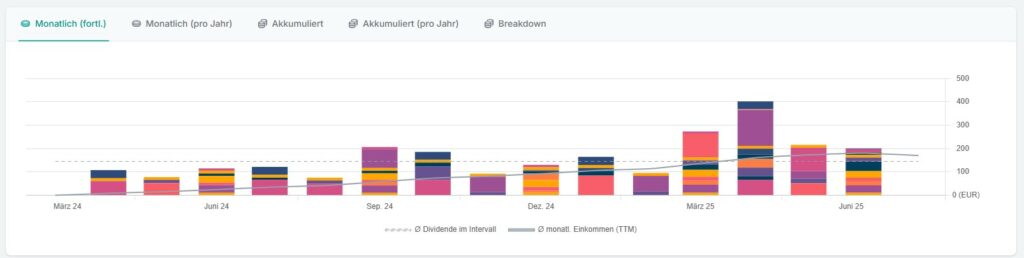
Taking all investments into account, I expect a Liquidity reserve from around 27,500 euros into the third quarter of 2025. Unrealized gains amount to just under 1,700 Euro. Here is a brief summary of all relevant depot components:
| Start-up capital 22.03.2024 | 100.000,00 |
| Invested capital | 75.108,96 |
| Unrealized capital gains | 1.678,98 |
| Terminal value 30.06.2025 | 76.787,95 |
| Free start-up capital at the end of Q2 2025 | 24.891,04 |
| Dividends received | 2.465,49 |
| Total liquidity reserve 31.03.2025 | 27.356,53 |
The personal dividend yield beträgt aktuell 2.9 percentThis corresponds to an increase of 30 basis points compared to the previous quarter. As a reminder of the calculation method: only the dividends actually received are divided by the total invested capital.
In the 2nd quarter of 2025, the portfolio recorded a return gain of 0.8 percent. Here I consider the Total Returni.e. (un)realized capital gains and dividends received are added together.

In view of the turbulence from the beginning of April in the wake of the trade conflict and the geopolitical turmoil in the Middle East, the return of just under two percent achieved at the end of the quarter was the result of an early recovery. This pleasing development is reflected almost identically in the broad FTSE-All-World market index.
As mentioned several times, the short period under review - the portfolio was launched in March 2024 - does not yet provide any significant insight into the performance of the portfolio. The aim is for the individual stocks in the portfolio to develop over the long term of ten years. That is why we are moving straight on to the next flight level and the individual stocks.
Deep-dive single stocks
At the end of June, a total of 27 Assets in the custody accountwhereby these are exclusively individual values. The following First purchases in chronological order.
| Purchase date | Company (Ticker) | Total investment in € | Quantity |
|---|---|---|---|
| 04.04.2025 | Comfort Systems USA (FIX) | 2.828,60 | 10 |
| 07.04.2025 | Visa (V) | 1.442,77 | 5 |
| 08.04.2025 | Munich Re (MUV2.DE) | 2.625,00 | 5 |
| 08.04.2025 | Tractor Supply (TSCO) | 2.163,02 | 50 |
Comfort Systems USA is a leading building technology company in the United States. Founded in 1997, the company specializes in providing comprehensive services for heating, ventilation and air conditioning (HVAC) and electrical systems. Comfort Systems USA offers a wide range of services, including design, installation, maintenance and repair of HVAC systems for both commercial and industrial customers.Another area of Comfort Systems USA's business is building automation. The company offers systems that make it possible to centrally control and monitor various building functions, such as lighting, temperature and security.
In addition to Mastercard Visa as the world's leading payment technology company specializing in electronic payments between consumers, businesses and banks. Founded in 1958 as BankAmericard in California, Visa has evolved into a global network that provides secure and reliable payment solutions. Visa operates one of the largest payment networks in the world, enabling transactions in more than 200 countries and territories. The IT company with a focus on the financial industry offers a wide range of products and services, including credit, debit and prepaid cards as well as digital payment solutions.
With a global presence, the Munich Realso known as Munich Re, is the largest reinsurance company. Reinsurance services for primary insurers form the basis of Munich Re's business model. The company is known for its expertise in the assessment and coverage of complex risks, including natural catastrophes, major losses and innovative insurance products. In addition to reinsurance, Munich Re is also active in the primary insurance market, particularly through its subsidiary ERGO Group, which offers a wide range of insurance solutions for private and business clients.
Tractor Supply Company is a US retail company based in Brentwood, Tennessee. The company specializes primarily in locations in rural areas of the USA, where it sells small agricultural equipment and materials for livestock farming as well as items for the home and garden. The company under the stock ticker TSCO retailer offers a wide range of products for farmers, ranchers and nature-loving people who pursue a hobby in agriculture, gardening or farming in their free time. The "Neighbor's Club" as a customer loyalty program as well as the logistics system established over the years are notable competitive advantages that contribute to strong customer satisfaction.
To complete the list, here is the list with a total of three additional purchases in the 2nd quartersorted by date of purchase:
| Purchase date | Company (Ticker) | Total investment in € | Quantity |
|---|---|---|---|
| 07.04.2025 | Microchip Technology (MCHP) | 1.763,39 | 50 |
| 16.05.2025 | UnitedHealth (UNH) | 752,48 | 3 |
| 27.06.2025 | LVMH (MC.PA) | 900,00 | 2 |
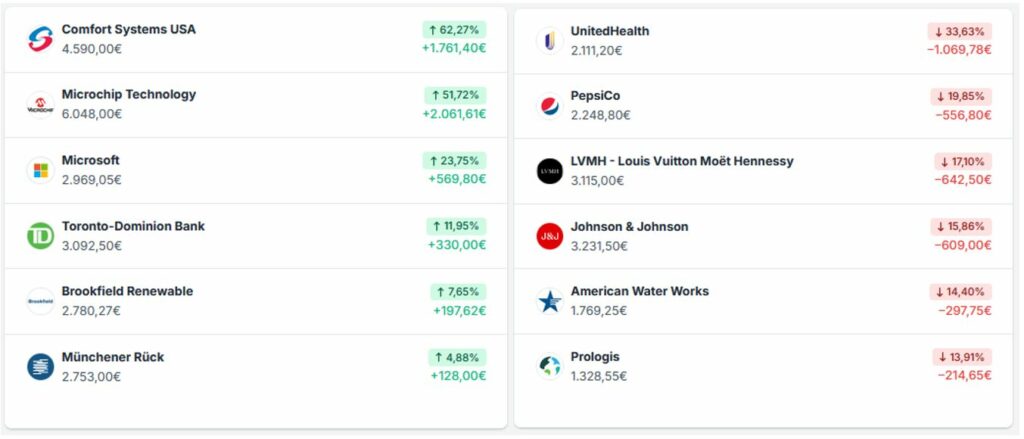
Below you will find the "admirable" Top performer and "unfortunate" Stragglers since the start of the DGI model portfolio, calculated in euros as the currency basis. I will explain the reasons for this in the next Webinars in more detail on July 10. Click here to register for free.
Diversification & Allocation
In my investment strategy, the Portfolio diversification a proven way to adequately manage the unsystematic risks and is therefore, in addition to the position size, an integral part of my Risk management represent. Let us now take a closer look at the status of diversification according to different characteristics such as sectors, countries or company sizes.
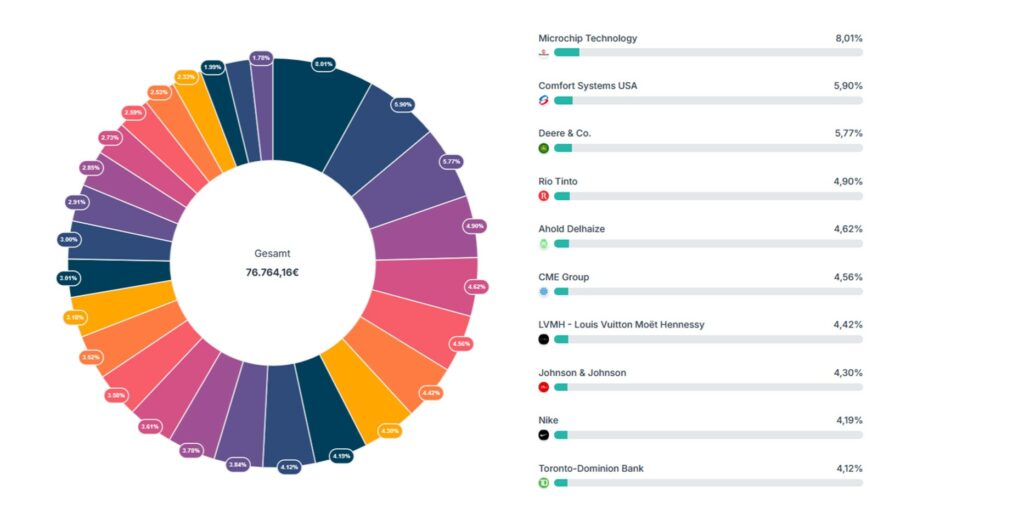
With regard to the fundamental question of whether the current tax rate should be used as the Market value or the value of the original invested capital I have meanwhile opted for the market value. I justify this because of the small discrepancy in the final result between the two reference figures. I will continue to keep an eye on the rule that no company should account for more than five percent of the invested capital, but this does not yet play a significant role at this stage of portfolio construction.
Let's start by looking at the composition of the portfolio on the basis of the Individual valuesthe situation is as follows. The chart on the right shows the top 10 by market value.
Based on the "Global Industry Classification Standard" I invest in the eleven sectors along the various value chains of the different industries that are important in our economy. It therefore makes sense to examine the actual status compared to the target status. I am still in the middle of setting up the DGI model depot. Stubbornly sticking to the Target allocationwhich I show in the next graphic, does not seem necessary for the time being:
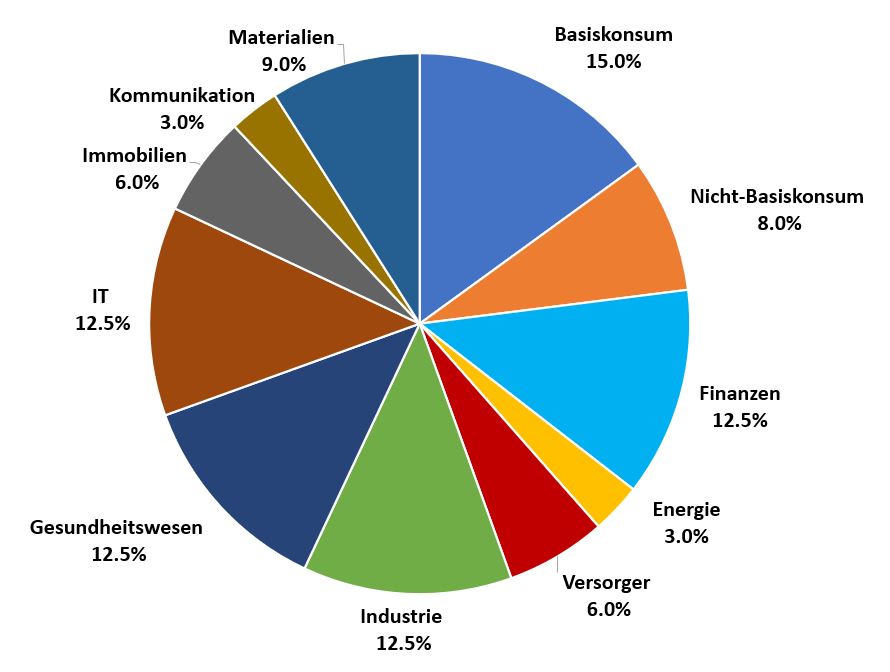
Finally, the following results Situation picture on sector distribution:

The Geographical spread I believe that investing across different countries and currency areas is an essential part of risk management. There are no fixed limits as to how much I want to invest in which country. My thoughts on this are quite simple: just because an organization has its corporate headquarters in country A, this does not automatically mean that this group only generates its sales from operating activities in its home country. But now we come to the Country allocation:

Outlook
All in vain?! If we were to connect the two price markers from the beginning of April and May 1 as the end point with a line, the result would be a straight line without a major rise or fall. One could get the immediate impression that supposedly little happened in between. In the US leading index S&P 500, we are back above the level before US President Donald Trump made the fateful "Liberation Day" exclaimed. Does this interim result aptly describe the notoriously short legs of political exchanges? So was all the fuss about tariffs and announcements of retaliation by affected countries for nothing? Everything is and remains in flux.
The law of the series persistently continues. As if the US president had a natural monopoly on the right headline. With him, there is definitely no danger of boredom. It would be almost ignorant not to say a single word about the new bill (commonly known as the "One Big Beautiful Bill Act"). The financial media have done this job and have sufficiently highlighted the "Section 899" contained in it, which is now obsolete in its original form, as a supposed spectre for foreign investors. Waving the reconciliation bill through would also have had a disastrous impact on the world's most liquid capital market, which would have primarily affected US investors negatively. If US assets become less attractive to international investors, the outflow of money would hardly be compensated for by domestic investors.
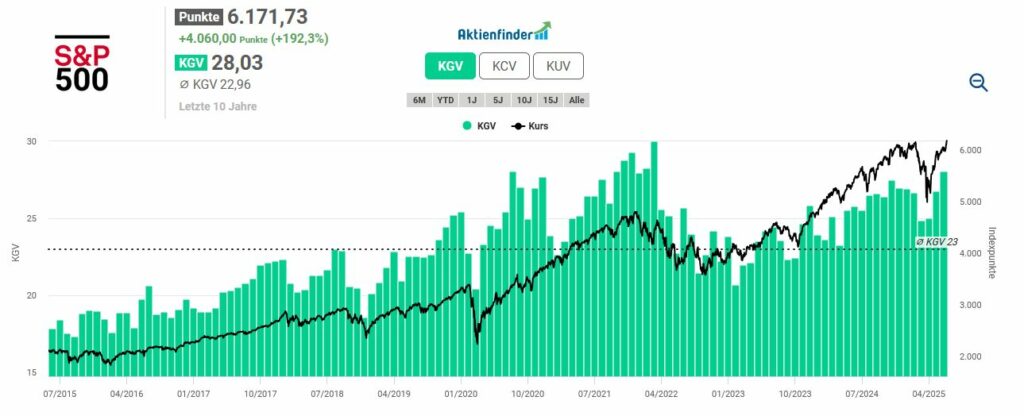
Let's get back to the actual topic of investing. It is hardly surprising that, on the basis of the latest company figures and quite positive analyst assessments, the Valuation level in the leading US index S&P 500 remains at an unbroken ambitious level - despite the brief dip in April.
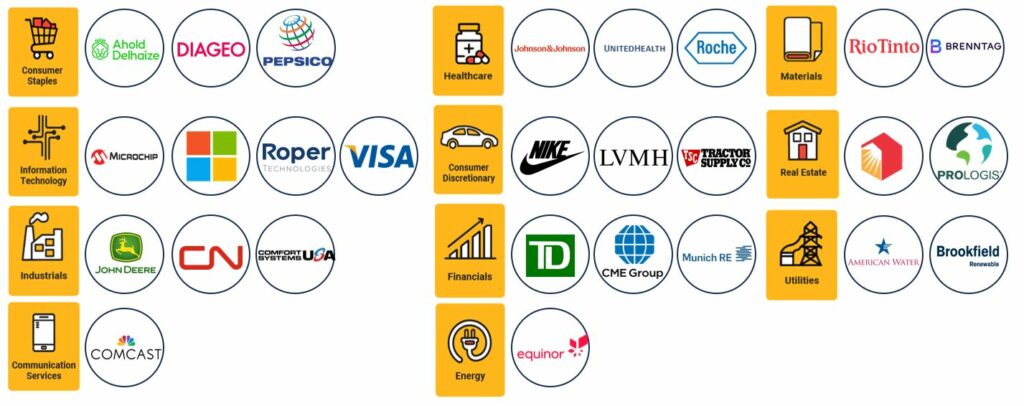
With 27 investments in my portfolio, I am sufficiently represented in the relevant sectors for the time being. I have taken advantage of the lower price levels in the wake of the customs conflict to buy one or two shares. Broken down into the eleven sectors, the distribution of companies is as follows:
The same question applies to all companies in the portfolio: at what price am I ultimately prepared to become active on the stock market? After all, it is not without good reason that common stock market literature Patience as a virtue touted. Characteristics such as "long-term oriented asset accumulation", "discipline" or "perseverance" are often associated with the patient investor type. The greater the fluctuations on the stock market and the higher the volatility, the more it tugs at your nerves. In the context of investing, I refer to the conscious investment decision to do nothing as the third optionwhich is open to all of us in addition to buying and selling shares.
Patient investing also means continuously practicing your skills. As active self-decision maker I try to understand and master the basics and also apply them in practice. It is probably human nature to be driven by short-term issues and questions in the here and now that we want to have answered quickly. I certainly don't exclude myself from this.
Nevertheless, things will remain varied in the future. I fear that there will still be a few unexpected twists and turns in the laborious customs zigzag. As private investors with a long-term investment horizon, we will encounter such phases of increased uncertainty more often, that much is certain. We have to be prepared for this on and off the stock markets. It has never been a very smart idea to panic on the stock market and sell shares erratically as we did this April. The motto is not to get carried away by political skirmishes.