Welcome to another blog post! After we last looked at the Q2 Earnings at REITs I've been busy with, today I'm dedicating myself to an asset class that still occupies a rather niche existence among German investors, although it has been a firm component of many income portfolios in the US for decades.
The discussion is about so-called preferred shares, or "Vorzugsaktien" in German, which actually only share the name with German preferred shares (such as those of VW or BMW).
In today's article, I'll introduce how they work, discuss their pros and cons, and present three specific examples of preferred shares for income investors that I currently find interesting.
Enjoy reading!
What are preferred shares anyway?
Preferred shares are easiest to understand when viewed as a hybrid between a bond and a stock. From bonds, they inherit the fixed, predetermined distribution and par value; from stocks, they inherit exchange listing, unlimited duration, and the fact that payments are legally dividends, not interest. In a company's capital structure, preferred shareholders sit between creditors and common shareholders, meaning their claims are subordinate to all loans and bonds, but are serviced before common stock. They are neither true creditors nor true co-owners, which is why preferred shares are also called hybrid securities.
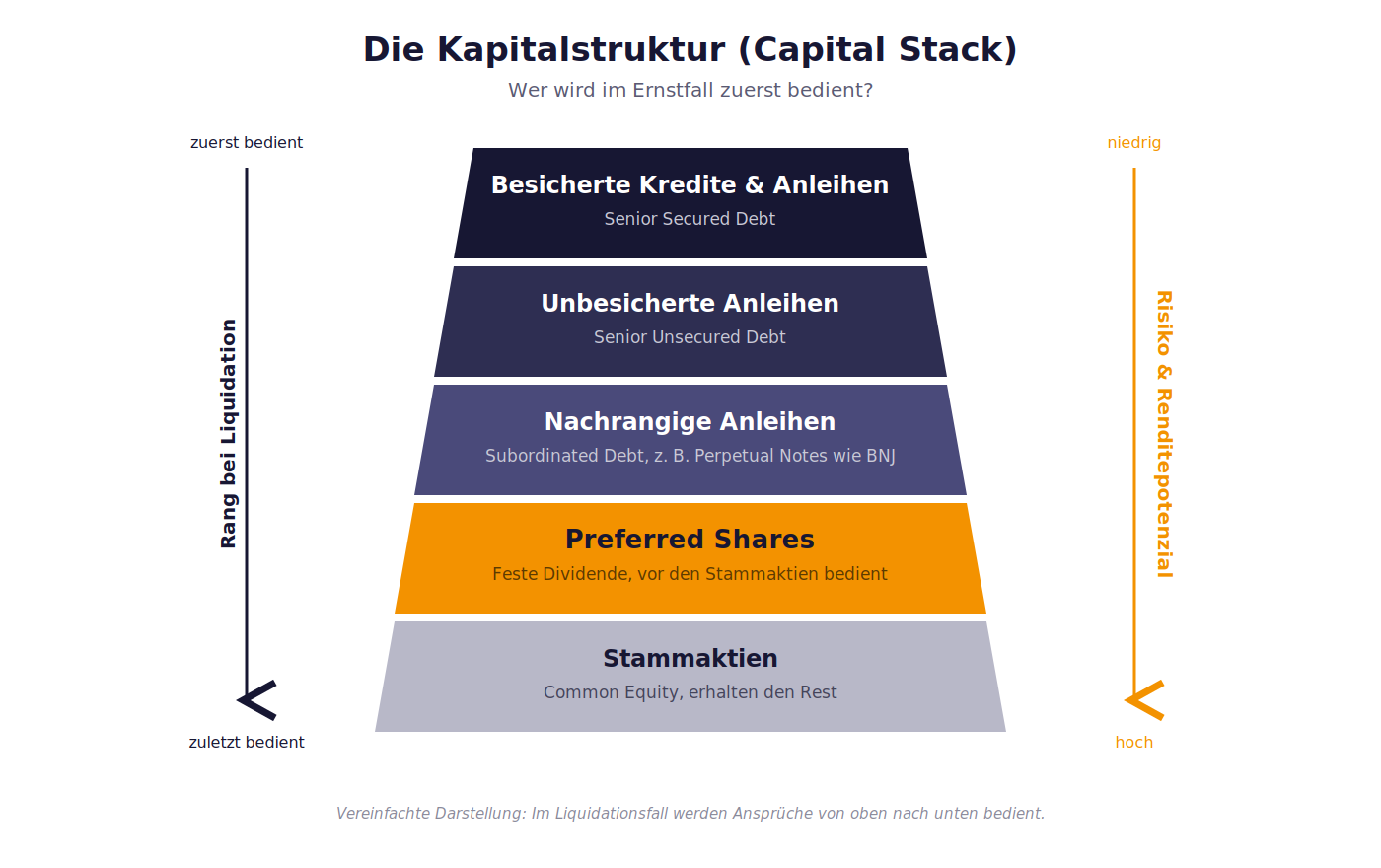
A company's capital structure: Preferred shares have priority over common shares,
but after all bonds have been redeemed (source: own calculation)
The typical publicly traded preferred stock is issued at a par value of $25 and the Dividend is set as a percentage of this face value. For a preferred stock with a 5.5 % coupon and a face value of 25 USD, the annual payment is therefore 1.375 USD, typically paid in four quarterly installments. It is important to note that the coupon always refers to the face value and not to the current market price; therefore, the actual current yield is correspondingly higher when prices are below par. There are also issues with a face value of $50 or $100, which is why it’s essential to review the prospectus or check QuantumOnline before purchasing. There, you’ll find a concise summary of all the relevant terms and conditions for a preferred stock.
A few terms you should know:
- Cumulative vs. Non-CumulativeIn cumulative preferred stocks, missed dividends accumulate and must be paid in full before common shareholders receive even a cent. In contrast, with non-cumulative preferred stocks (which primarily concerns bank preferred stocks), missed payments are irrevocably lost.
- CallableAlmost every preferred stock can be redeemed at par starting on a specific date. Companies use this option when they can refinance more cheaply, for example, because the Interest have fallen or your credit rating has improved. Why would you continue to pay 7 % when a new issue at 5.5 % is possible?
- Fixed vs. Fixed-to-Floating vs. ResetPreferred stocks pay a fixed rate permanently, while others switch to a variable rate (typically a spread over SOFR) after an initial period or are adjusted to the yield of U.S. Treasury bonds at fixed intervals.
Where Preferreds Fit in a Portfolio and Where They Don't
Personally, I see preferred shares as the missing piece of the puzzle between two worlds that many income investors are already familiar with. U.S. Treasury bonds and investment-grade corporate bonds currently offer decent to higher yields with greater security. Traditional blue-chip dividend stocks, as well as REITs and BDCs, offer higher current income plus growth potential; however, they come with higher volatility, and dividends can theoretically be cut, as some recent BDC examples have shown. But this can happen even with well-known stocks if the business environment deteriorates drastically. Preferred stocks fall somewhere in between, as the distribution is contractually fixed and cannot simply be „adjusted" like a common stock dividend; at the same time, the yield—currently 7 to 9 %—is significantly higher than the bond yields of comparable issuers.
The price for this is capped upside potential. If the issuer's business does great, the common shareholders benefit, while the preferred simply keeps paying its coupon. So, if you're looking for the next tenbagger, this is definitely the wrong place. However, there's an exception: buying below par value.
For example, if you buy a preferred share for $20 that has a par value of $25, you have two irons in the fire. The dividend, calculated based on the par value, yields a higher return relative to the investor’s purchase price, and there is also the chance (no guarantee!) that the gap to the par value will eventually close, whether through a call at full par value or through a revaluation on the market. In either case, a capital gain of up to 25 % would be added to the current income, without the company having to earn a single additional dollar.
But why are so many preferred shares currently trading below par value? The main reason is simply the interest rate environment, as most of these securities were issued during the zero-interest-rate period with coupons ranging from 4 to 6 % and had to adjust to the new yield level via their price after interest rates rose. In addition, there is a technical factor at play right now that investors should be aware of.
The market is valued at USD 14 billion iShares Preferred and Income Securities ETF (PFF) dominates, and when this index giant rebalances, for example, because new large issues (recently conspicuously many from tech concerns like Alphabet or also Strategy) are included in its reference index, its indiscriminate selling drives down the prices of smaller stocks for weeks at a time, completely without any fundamental reason. For income investors who have done their homework, such phases are more of an invitation than a warning signal.
The disadvantages
Before we get to the examples, for the sake of completeness, the downsides:
- Interest rate sensitivityPerpetual preferreds have virtually infinite duration. If long-term interest rates rise significantly, their prices fall, regardless of the issuer's quality.
- Call RiskAnyone who buys a preferred stock through a put can lose money upon termination (the so-called call). That's why I prefer to look at securities below par, where a call would even be a gift.
- No growthThe dividend is often fixed (except for a dividend reset under certain conditions). You don't benefit from the company's rising profits, and unlike many dividend stocks, there's no inflation protection through increases.
- LiquidityMany preferred shares only trade a few thousand shares a day. Limit orders Absolute must-haves here; market orders can get expensive. And you have to be patient, too.
- TaxesThe advantages of „Qualified Dividends" and potential tax benefits often advertised in U.S. sources only apply to U.S. taxpayers. For German investors, regular taxation including U.S. withholding tax applies, which is why this argument is largely irrelevant for us.
Three real-world examples
For the examples, I deliberately chose three very different issuers: an insurer, an industrial conglomerate, and a mortgage REIT, so that the breadth of the asset class would be visible. All three securities are trading below par.
The quality score from the insurance world
In my view, insurers are among the natural issuers of preferred shares, as their business model generates precisely the stable, regulated capital buffers on which a preferred dividend is securely based. Arch Capital Group (TWS ticker for preferred shares: ACGLN, common stock: ACGL) has been among the top performers in the specialty insurance and reinsurance sectors for many years and has not posted a single loss-making year in the past two decades—a remarkable achievement in an industry that thrives on hurricanes, wildfires, and major claims. The Series G Preferred pays a coupon of 4.55 % per $25 par value ($1.1375 per year) and is currently trading at around $16.50, which corresponds to a current yield of approximately 7 %.
The coupon immediately reveals the history of this security, because Arch could only offer 4.55 % during the low-interest-rate period of 2021, and today’s price of ~16.50 USD is simply an adjustment to the current yield level. This has not led to any deterioration in credit quality—quite the contrary, as the preferred shares are backed by over $22 billion in hard equity capital, largely held in an investment-grade bond portfolio. Even a historically severe catastrophe season would not seriously jeopardize this capital base.
Series G can be redeemed at any time starting in June 2026 at its face value of $25; however, given a price of ~$16.50, that would be more like winning the lottery than a risk. It should be noted that the dividend is non-cumulative, though in my opinion that’s a minor drawback for an issuer of this quality. A current yield of around 7 % for a security whose default risk I consider very low, plus upside potential as interest rates fall—I find that very attractive.
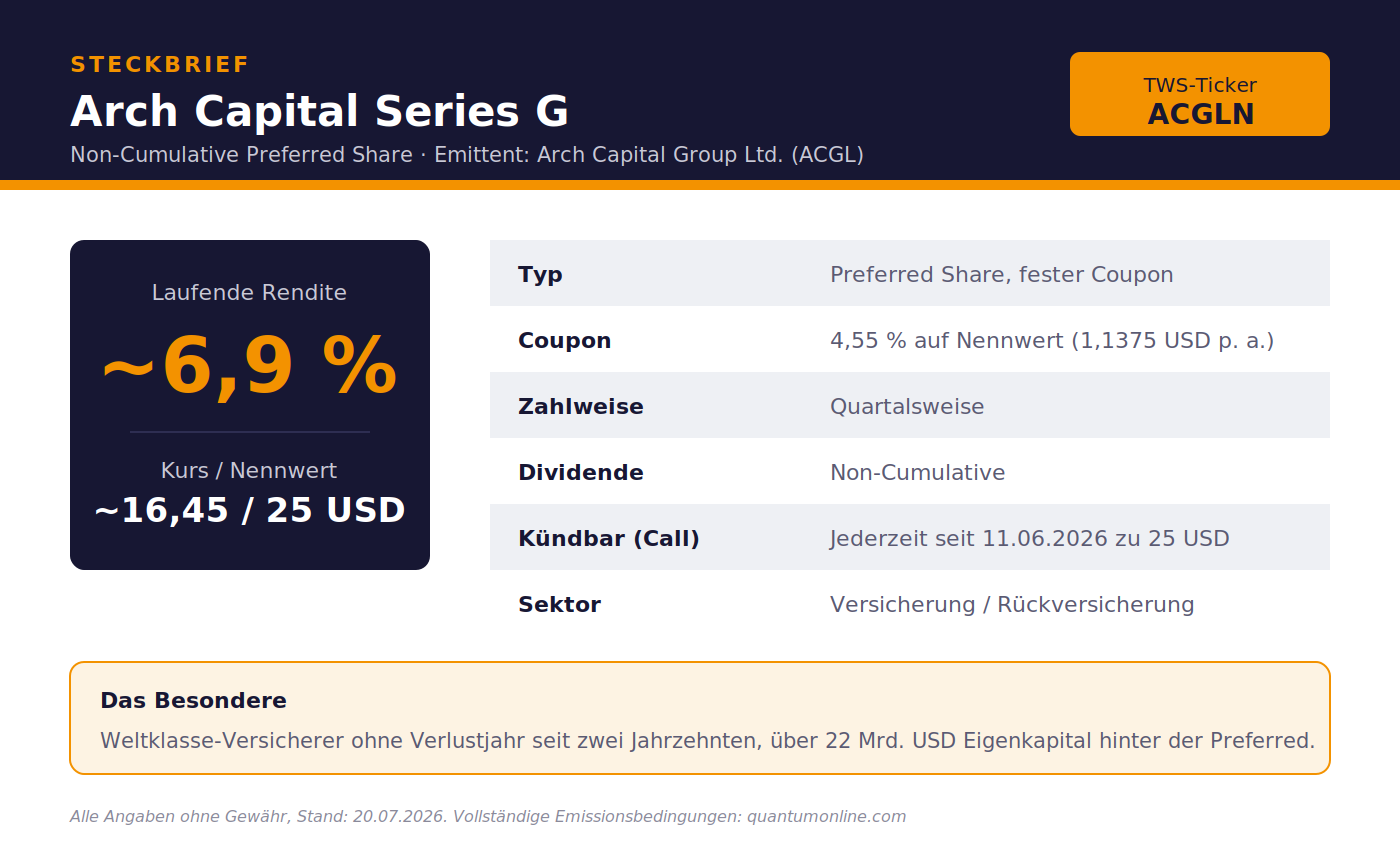
Key Facts of Arch Capital Series G at a Glance
(Source: Own representation, Data: QuantumOnline, as of 07/20/2026)
The special case from Brookfield
Strictly speaking, the second example is not a preferred share at all, but a perpetual subordinated note; however, it behaves practically the same as a preferred share and therefore deserves a place here. The Brookfield Finance 4.50 % Perpetual Subordinated Notes (TWS ticker: BNJ) are guaranteed by Brookfield Corporation (TWS ticker: BN, ISIN: CA11271J1075), a conglomerate rated A- with investments spanning renewable energy, infrastructure, real estate, and asset management.
Why am I discussing a bond in a Preferred article? Because BNJ shows that it’s worth looking beyond the boundaries of the security class. The security is currently trading at around $15.50 and offers a current yield of about 7.3 %, while typical preferred stocks with a comparable BBB rating tend to yield around 6.4 %. At the same time, the structure is actually safer than that of a traditional preferred stock, because as a bond, BNJ ranks above the Brookfield preferreds in the capital structure (see opening chart), and the payments are cumulative. Although payments can be deferred for up to five years, they must then be paid retroactively, including compound interest, whereas preferred dividends can be suspended indefinitely.
More security combined with higher returns doesn't really go together, and it's precisely these kinds of anomalies that I find very exciting. The explanation likely lies in its low awareness and manageable trading volume, because those who don't know the stock don't buy it. If the yield were to normalize to the level of comparable stocks, the fair value, in my opinion, would be closer to $18 USD.
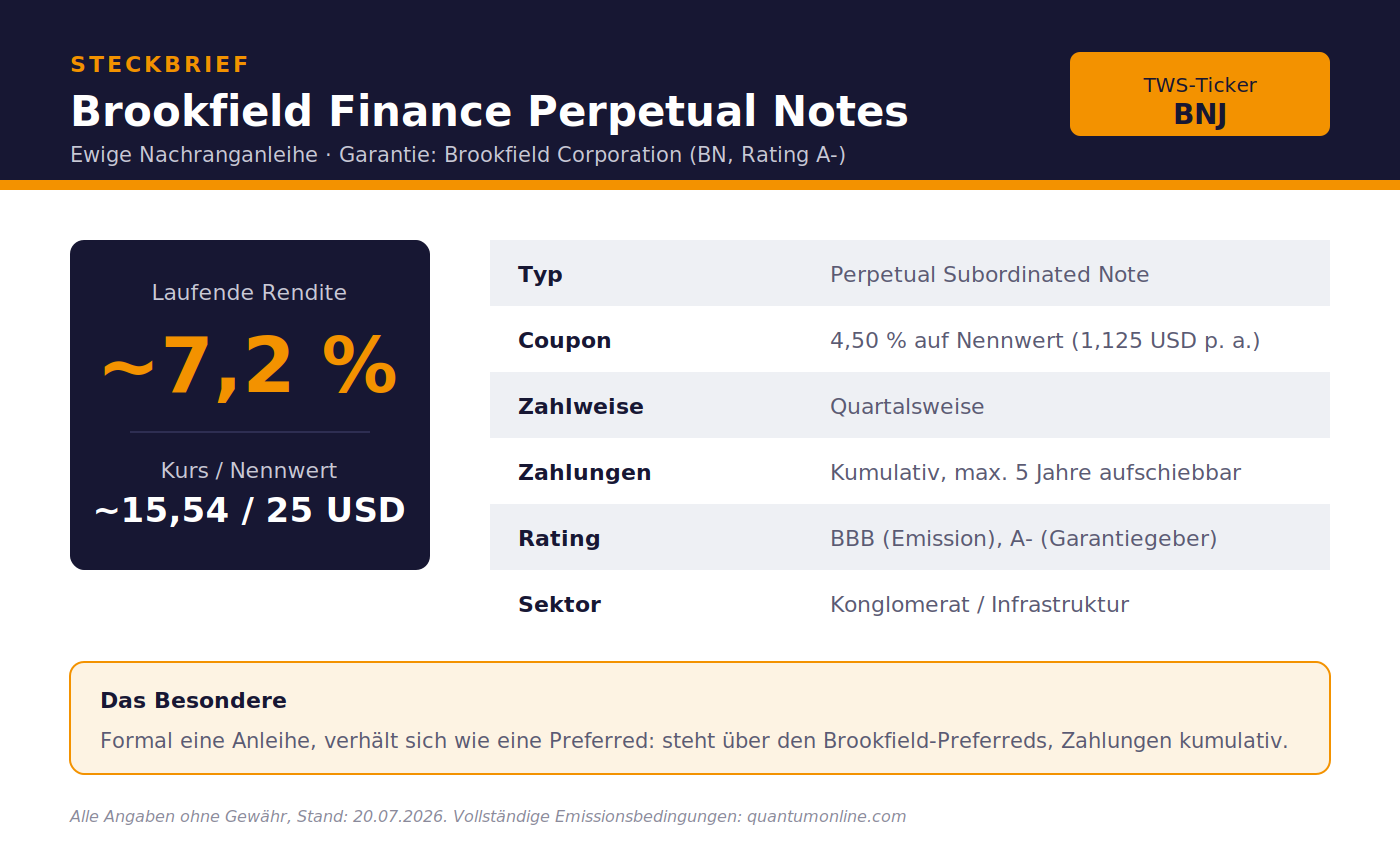
BNJ in a nutshell: formally a bond, practically preferred stock
(Source: Own representation, Data: QuantumOnline, as of 07/20/2026)
The high dividend payer from the Mortgage REIT sector
The third example becomes more profitably and riskier. Mortgage REITs are a sector I usually avoid when it comes to common stocks, as high leverage, complex interest rate derivatives, and regular dividend cuts are not my cup of tea. However, the calculation looks different for preferreds, as here I'm not interested in whether the book value grows, but only whether the preferred dividend is safely covered. Rithm Capital (TWS ticker: RITM, ISIN: US64828T2015) is my preferred candidate for this, as the company has been by far the best performer in the otherwise battered mREIT sector over the last five years, is increasingly transforming into a more broadly diversified asset manager, and, with 6 times equity, operates significantly more conservatively than many competitors who leverage 10 to 15 times.
The Series E Preferred (TWS ticker: RITM PRE) pays a fixed coupon of 8.75 % and is trading slightly below par with a current yield of around 9 %. According to the company, the distributions are covered nearly threefold by earnings, and the dividend is cumulative. What I particularly like about the Series E is the call protection through October 2030, because you can lock in this yield for a good four years, no matter what happens to interest rates. Should the Fed cut rates in the coming years, you’ll be in a pretty comfortable position with a fixed 8.75 % coupon. The residual risk remains the business model itself, which is why I would deliberately keep such a position small and view it as a yield component rather than a core investment.
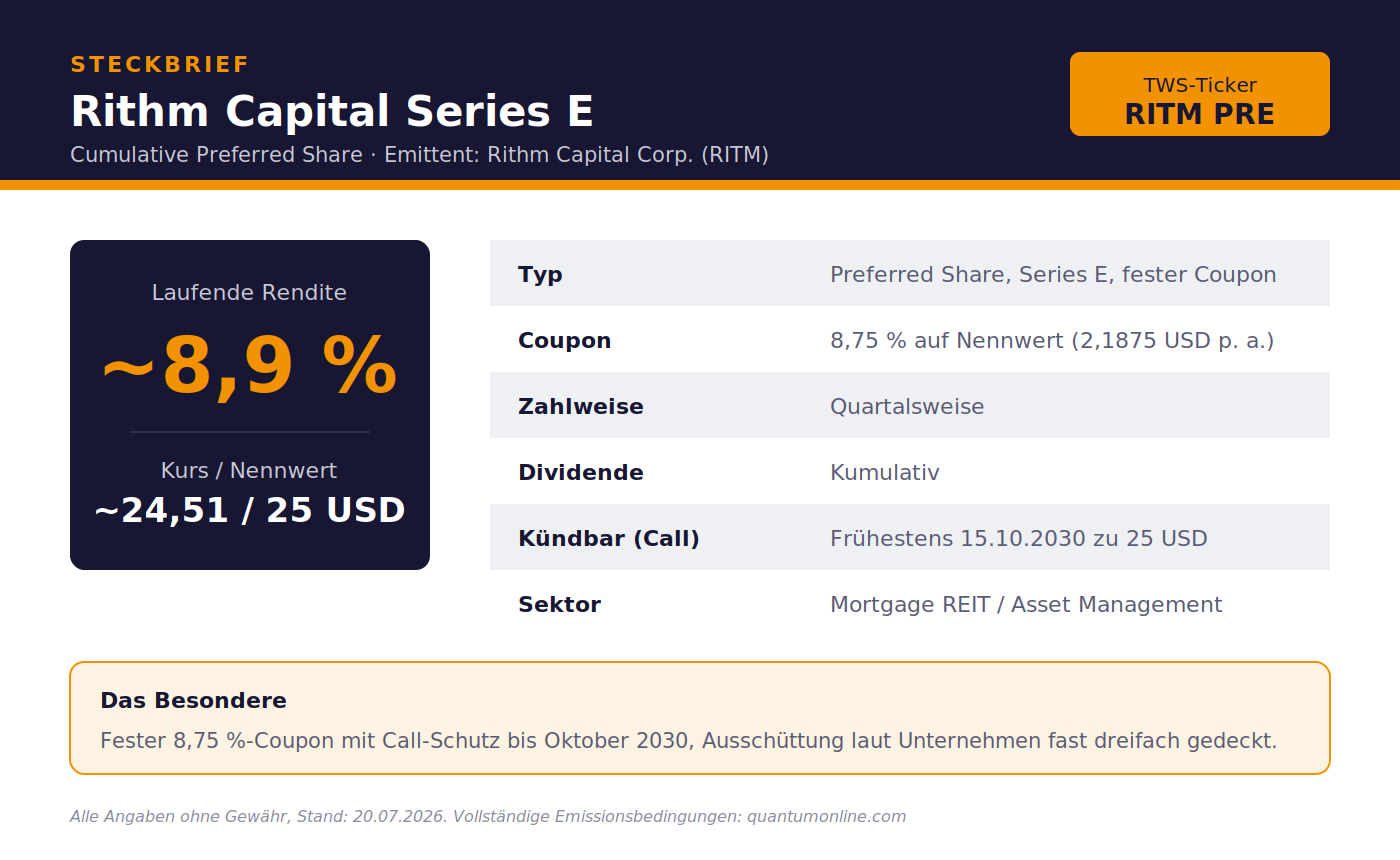
The Rithm Capital Series E offers the highest coupon of the three examples
(Source: Own representation, Data: QuantumOnline, as of 07/20/2026)
Practical tips for trading
From my own experience, here are a few tips for anyone who has now gotten interested in preferred shares. As an options trader, I'm used to working with limits and waiting for my price, true to the motto "Let the market come to you," and this exact way of thinking fits perfectly with preferreds. You define the yield you want for a security in advance, calculate the corresponding price, and place your buy limit there, gladly also as a GTC order for weeks.
With illiquid securities, an impatient seller may occasionally offer prices that would never be achievable in normal trading. Market orders, on the other hand, are completely out of the question, because with spreads sometimes running several percent, you’d otherwise end up paying an unnecessary premium. As for position size, I consider about 1 % per security to be reasonable, because Diversification Diversification across multiple issuers and ideally across industries is mandatory for this asset class, not a nice-to-have.
Conclusion
Preferred shares aren’t an instrument for dreamers—aka “tenbagger” hunters—but they are an excellent tool for income investors who want to bridge the gap between bonds and dividend-paying stocks. In my opinion, the current environment is particularly interesting because many high-quality securities issued during the low-interest-rate period are trading well below par value and thus offer not only a current yield of 7 to 9 % but also upside potential should interest rates fall in the medium term.
With Arch Capital Series G, you get a world-class insurer, with BNJ, a, in my opinion, undervalued quasi-preferred with a Brookfield guarantee, and with Rithm Series E, a high-yielder with four years of call protection, whereby each of the three securities covers a different risk-reward profile. As always, due diligence remains important, which for preferreds means reading the prospectus or QuantumOnline, paying attention to Cumulative vs. Non-Cumulative, knowing the call dates, and never trading without a limit. Then, preferreds can be a valuable building block for the cash flow portion of your portfolio.