


For yield-oriented investors, tobacco stocks offer attractive opportunities for reliable dividend payouts and high cash flows. At the same time, the shift towards smoke-free alternatives such as e-cigarettes, tobacco heaters, and nicotine pouches opens entirely new growth opportunities.
However, the market also carries specific risks. Strict government regulations, rising tobacco taxes, and ongoing health debates are challenging the industry. This article shows you which tobacco stocks currently offer a stable foundation and what you should consider when investing in this sector.

The most important facts in brief:
- Despite declining cigarette sales, high margins and pricing power continue to generate billions in revenue.
- The market is increasingly shifting towards smoke-free alternatives such as e-cigarettes, heated tobacco products, and nicotine pouches, with strong growth.
- Regulation, rising taxes and declining smoking rates are forcing the industry to undergo continuous transformation.
What are cigarette stocks and tobacco stocks?
Stocks in the tobacco sector cover the entire value chain of the industry. These include companies that grow and process raw tobacco, manufacture and distribute cigarettes, or develop modern alternatives such as e-cigarettes, tobacco heaters, and nicotine pouches.
Tobacco stocks are divided into various sub-sectors, each of which is subject to its own market mechanisms:
- Classic cigarette manufacturersThese are the established major corporations in the industry. They produce traditional cigarettes and still generate gigantic cash flow. Due to the worldwide decline in smoking rates, the focus of these companies is primarily on price increases to compensate for declining volumes. Strong brands provide reliable dividends here.
- Pioneers of smoke-free productsThese companies focus on novel nicotine products such as vapes, cigarette lighters, and nicotine-containing pouches (potential Growth shares). The segment is growing rapidly as many consumers are looking for less harmful alternatives. High spending on research and development characterizes this sector, but it also offers investors enormous dynamism and future opportunities.
- Tobacco traders and agricultural processorsThese players are at the beginning of the supply chain. They buy raw tobacco from farmers, process the leaves, and supply the large cigarette companies. Operational success depends heavily on crop yields, weather conditions, fertilizer prices, and global freight costs. The profit margins here are usually lower than in other sectors. Consumer goods stocks.
- Suppliers for packaging and filter technologySpecialized suppliers manufacture packaging prints, specialty papers, filters, or evaporator heads for e-cigarettes. These companies benefit directly from the production volume of the major brand manufacturers. Their business is determined by long-term supply contracts and is vulnerable to fluctuations in raw material prices.
- Tobacco logistics and wholesaleTransport and distribution companies deliver the goods safely to supermarkets, kiosks and gas stations. The segment benefits from stable trade volumes and sophisticated distribution networks. Since tobacco products are subject to strictly regulated supply chains, established logistics companies in this sector possess significant barriers to entry in the market compared to their competitors.
Many leading tobacco and cigarette stocks now cover several of these value creation stages simultaneously. They are leveraging the vast profits from the traditional cigarette business to fund the transition to smoke-free alternatives. This diversification mitigates risks and ensures long-term stable returns for investors.


The market potential of tobacco and cigarette stocks in 2026
The global tobacco market is undergoing structural change. Therefore, despite declining smoking rates, corporate profits have been continuously rising through regular price increases for years. This is primarily due to two reasons:
- Strong pricing powerBecause of the addictive effect and high brand loyalty, demand is extremely inelastic. Price increases or tobacco tax increases are easily passed on to customers without the same drop in sales figures.
- High profit marginsThe raw costs for production and raw materials are minimal. Since little investment in research or advertising is necessary, leading tobacco companies achieve operating margins of often 40 to 50 percent %.
Despite stricter regulations and increasing health awareness, the global market volume is continuously growing from approximately 965 billion US dollars (2026) to an estimated 1.3 trillion US dollars by 2035. This corresponds to an annual growth rate (CAGR) of 3.2 %.
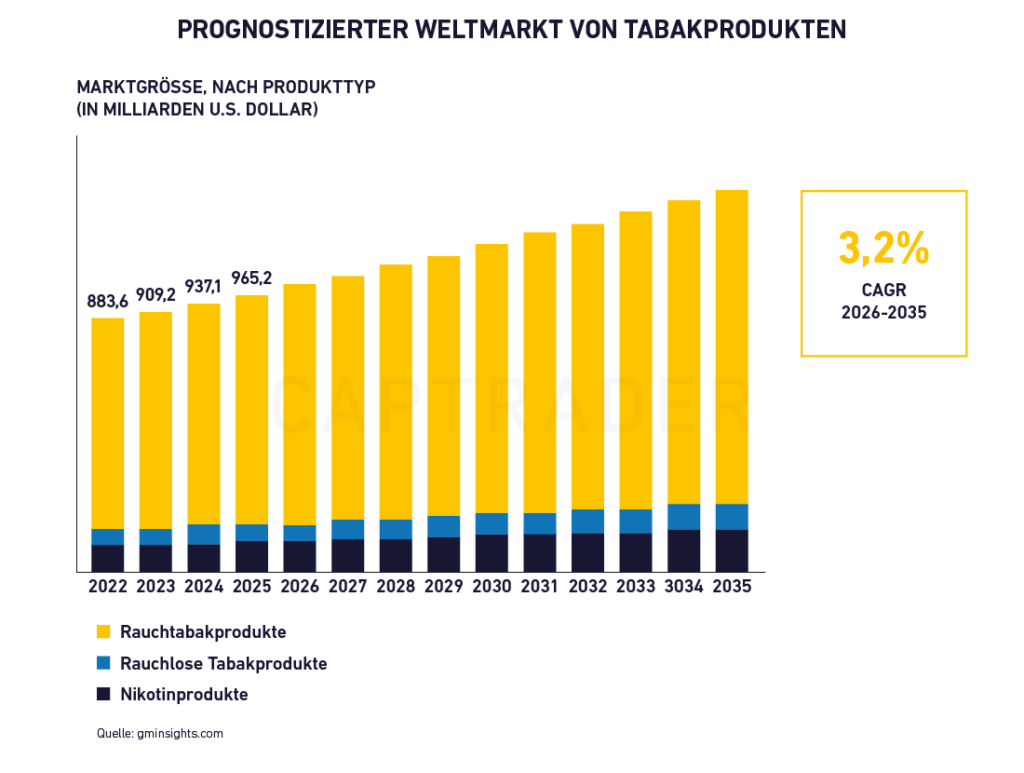
While conventional cigarettes still account for the majority of sales, manufacturers are increasingly shifting their strategic focus from purely volume growth to value enhancement and premiumization.
The key growth driver of the coming decade is the advance of new, risk-reducing products (Next-Generation Products), such as cigarette lighters and nicotine pouches.
Asia-Pacific remains regional (led by China) due to its high consumer numbers, which is by far the largest market; while Latin America records the highest growth rates. In Western markets such as the USA and Europe, however, regulatory approvals and the rapid acceptance of smoke-free alternatives will determine the market dynamics over the coming years.
Growth market for e-cigarettes
The global e-cigarette and vape market is experiencing strong growth and is expected to increase from around $24.48 billion in 2026 to $54.96 billion by 2035, % representing an annual growth rate (CAGR) of 9.4.
The main driver of this development is the increasing health awareness of smokers who are looking for less harmful alternatives to the traditional combustion of tobacco.
In addition, technological innovations such as user-friendly pod systems, improved battery life, and modern nicotine salt products with a gentler nicotine delivery promote sustainable acceptance and switching among consumers.
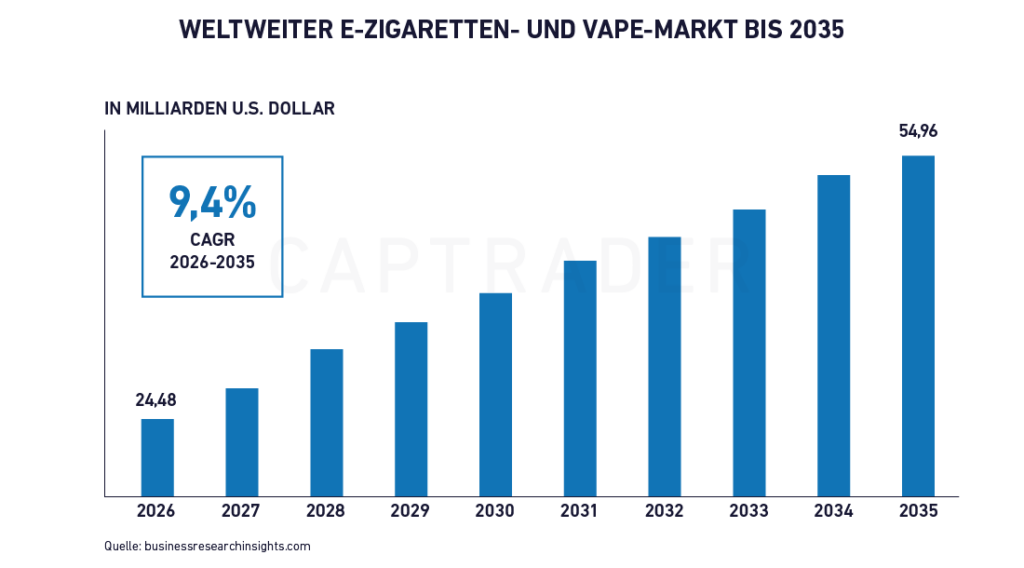
The market is primarily divided into classic vaporizing e-liquids (e-vapor) and heated tobacco devices (Heated Not Burn), while sales take place through both highly growing online platforms and established retail channels.
Regionally, the industry is currently led by North America and Europe, while Asia-Pacific offers the greatest potential for future growth due to urbanization and rising incomes. However, globally, stricter government regulations, youth protection requirements, and restrictions on ingredients and flavors are considered key challenges and growth inhibitors.
Future prospects for nicotine pouches
The international market for nicotine pouches is experiencing strong growth and is expected to increase from an estimated $6.85 billion in 2026 to nearly $9.98 billion by 2035. This represents an annual growth rate of 13.4 %.
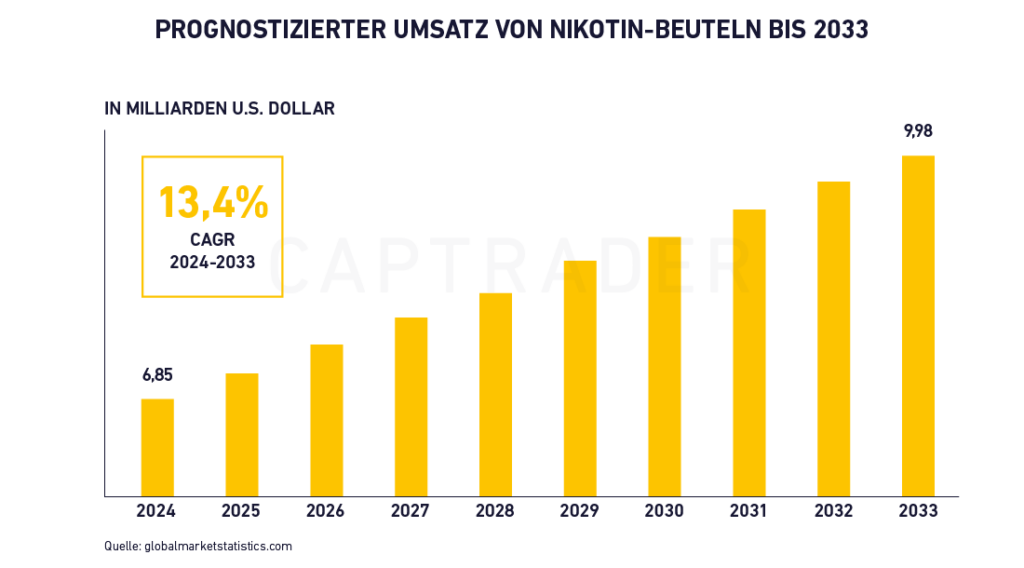
The key trigger for this surge in demand is the heightened awareness of respiratory diseases and the risks of traditional smoking. Consumers are increasingly turning to smoke- and tobacco-free portion packs as an inconspicuous, non-burning alternative product.
In addition, manufacturers are boosting sales by continuously introducing new flavors such as mint, fruit, or coffee, as well as different strengths. The product range is primarily divided into flavor categories, with sales taking place primarily through brick-and-mortar retail outlets (such as supermarkets or tobacco shops) as well as digital sales platforms.
Geographically speaking, Europe plays a key role: Strict regulations against tobacco consumption and an already well-developed infrastructure for alternative products are fueling demand there.
Investing in cigarettes: The best tobacco stocks
The following overview shows the largest publicly traded tobacco stocks worldwide (Blue chip stocks). It serves as a guide for investors who want to invest specifically in established tobacco companies.
It is important to know that tobacco stocks are considered more of a defensive asset and that no major price spikes are expected. Most investors value this sector due to its high dividend yields.
| Company | ISIN | Country | Market capitalization in US dollars¹ | Dividend yield¹ |
| Philip Morris International Inc. | US7181721090 | USA | 315 billion | 3,04 % |
| British American Tobacco plc | GB0002875804 | Vereinigtes Königreich | 135 billion | 5,68 % |
| Altria Group, Inc. | US02209S1033 | USA | 125 billion | 5,79 % |
| Japan Tobacco Inc. | JP3726800000 | Japan | 72 billion | 3,63 % |
| ITC Limited | INE154A01025 | India | 37 billion | 5,04 % |
| Imperial Brands PLC | GB0004544929 | Vereinigtes Königreich | 30 billion | 5,87 % |
| KT&G Corporation | KR7033780008 | South Korea | 13 billion | 3,75 % |
| Smoore International Holdings Ltd. | KYG8245V1023 | China (Cayman Islands) | 7 billion | 2,1 % |
| PT Hanjaya Mandala Sampoerna Tbk | ID1000074008 | Indonesien | 5 billion | 10,4 % |
| RLX Technology Inc. | US74969N1037 | China | 3 billion | 7,68 % |
To make a targeted investment in tobacco stocks, you need a broker. At CapTrader, you can open a trading account and directly trade shares on more than 170 international stock exchanges. The trading fees are particularly low: for stocks from the USA, you pay 1 cent per share, but at least 2.00 US dollars per order.


Philip Morris International Inc.
As the industry shifts towards risk-reducing offerings, Philip Morris (ISIN: US7181721090) is taking a pioneering role. For those looking for companies that are shaping the transition from traditional tobacco products to modern consumption, this is a key player to look for.
Established global brands such as Marlboro secure the financial foundation, while future-oriented product lines such as IQOS in the area of tobacco heating devices and ZYN in the area of nicotine pouches act as primary growth drivers.
The revenue model is based on a dual pillar of stable recurring revenue and high-margin resale of consumer materials in the constantly expanding alternative segment.
| Tax year | estimated revenue (in million USD)² | Change compared to previous year² |
| 2025 | 40.648 | 7,31 % |
| 2026 | 43.455 | 6,9 % |
| 2027 | 45.976 | 5,8 % |
British American Tobacco p.l.c.
Tradition and change are directly intertwined at British American Tobacco (ISIN: GB0002875804). To remain viable in the global soft drink market, the company is pursuing a diversified multi-brand strategy.
The product portfolio combines classic heavyweights such as Lucky Strike or Dunhill with modern growth fields such as Vuse in the vaping sector, Glo for tobacco heaters, and Velo for oral nicotine.
Since the Group has a strong pricing power in its core business, it continuously receives high levels of cash inflows. These cash flows enable it to finance the gradual transformation into a profit-making business in the new product categories.
By focusing on lean processes, disciplined capital returns, and a historically high dividend policy, the stock remains attractive primarily for classic investors.
| Tax year | estimated revenue (in million USD)² | Change compared to previous year² |
| 2025 | 25.610 | -0,99 % |
| 2026 | 26.239 | 2,46 % |
| 2027 | 27.166 | 3,53 % |
Altria Group, Inc.
Anyone who focuses solely on the US domestic market inevitably comes across Altria Group (ISIN: US02209S1033). Due to its high dividend yield, the company remains a firm fixture in the market. Dividends-Hunters who want to benefit from the dominant position in the North American market.
The undisputed centerpiece of the earnings is the Marlboro brand, while initiatives around NJOY and ON! are intended to secure the smoke-free future. Instead of relying on strong volume growth, Altria is focusing on extremely high price efficiency, which reliably offsets the structurally declining cigarette sales in the home market.
The business model generates consistently high operating margins, which provide the management with reliable leeway for continuous dividend increases. In addition, a significant stake in the brewing company Anheuser-Busch InBev offers additional value potential in the portfolio.
| Tax year | estimated revenue (in million USD)² | Change compared to previous year² |
| 2025 | 20.139 | -1,49 % |
| 2026 | 20.529 | 1,93 % |
| 2027 | 20.707 | 0,87 % |
Good to know:
The Altria Group holds the rights to Marlboro exclusively in the USA, while Philip Morris International has the rights to Marlboro worldwide.
Japan Tobacco Inc.
With a strong presence from Europe to Asia, Japan Tobacco (ISIN: JP3726800000) covers essential global markets. The company combines a broad base in the volume market with targeted steps towards modern heating technology.
The most important revenue drivers in the classic segment include internationally established names such as Winston, Camel and MEVIUS, while the Ploom system covers the field of risk-reduced alternatives.
This combination of established market shares in emerging markets and controlled expansion in new product categories provides JT with a very predictable revenue base.
The Japanese company scores with investors primarily thanks to its solid performance compared to the industry, a conservative balance sheet structure, and a reliable dividend policy.
| Tax year | estimated revenue (in million USD)² | Change compared to previous year² |
| 2025 | 21.922 | 10,09 % |
| 2026 | 24.124 | 10,05 % |
| 2027 | 25.196 | 4,45 % |
CapTrader can do that:
At CapTrader, trading fees are extremely low: You can trade Japanese stocks starting at 0.10 % of the order volume, with a minimum of 500 JPY per order.
Imperial Brands PLC
A leaner and more focused approach shapes the strategy of Imperial Brands (ISIN: GB0004544929). Instead of expanding simultaneously everywhere, the British company focuses on carefully selected key markets where the company already has strong roots.
The range extends from established cigarette brands such as Davidoff, Gauloises and West to the e-cigarette brand blu. As a typical representative among the Value-Aktien Through strict cost discipline, the model primarily aims to generate high free cash flow.
This continuous inflow of liquid funds is primarily used to specifically increase earnings per share for existing investors through ongoing share buyback programs.
| Tax year | estimated revenue (in million USD)² | Change compared to previous year² |
| 2025 | 13.275 | 1,93 % |
| 2026 | 13.553 | 2,1 % |
| 2027 | 13.794 | 1,78 % |
Risk factors in tobacco stocks: A practical analysis for investors
The presented growth forecasts for cigarette stocks face serious industry-specific challenges that are fundamentally different from those faced by traditional consumer goods manufacturers.
Anyone who wants to realistically assess the long-term opportunity-risk profile of tobacco companies as an investor should be aware of the key influencing factors and potential stressors.
1. Regulatory pressure and legal risks
Hardly any industry in the world is as strictly controlled and regulated as the tobacco industry. International guidelines such as the WHO Framework Convention on Tobacco Control (FCTC) set standards that gradually narrow the leeway available to manufacturers.
- Sales and advertising bansComprehensive restrictions on sponsorship, marketing, and point-of-sale presentation make it difficult to acquire new customers.
- Packaging regulationsThe requirement for neutral single packaging (plain packaging) and large-scale warning labels undermine the value of established brands.
- Product bans and limitsGuidelines for menthol cigarettes, flavor bans for vapes, or maximum nicotine content limits the portfolio.
- Legal liability and waves of lawsuitsClaims for damages by states, healthcare systems or those affected create a continuous and legal security risk.
The legal framework determines to a large extent the extent to which companies can impose price increases or establish new alternatives on the market.
2. Demographic change and sales volume
The trend in many industrialised countries is clear: Smoking rates have been declining for years. Growing health awareness, societal stigma, and strict non-smoking protection laws are leading to fewer and fewer people turning to traditional cigarettes.
- Decrease in volumesIn the core markets of Western Europe and North America, the number of cigarettes sold each year is shrinking at an average of the low single digits.
- Demographic crisisThe number of new customers among the younger generation is significantly lower than in previous decades.
- Switching to low-emission alternativesConsumers are increasingly turning to e-cigarettes, heat-not-burn tobacco devices or nicotine pouches (pouches).
This structural decline in core business is forcing manufacturers to compensate for reduced volumes by raising prices or to accelerate the shift to new products.
3. Tax burden and price limits
Tobacco products are among the most heavily taxed goods of all. Special taxes and tobacco duties serve as a lucrative source of revenue for states on the one hand and as a central management instrument for reducing consumption on the other.
- Regular tax increasesSudden or continuous increases in the tobacco tax significantly increase the cost of the final product for the consumer.
- Extending the elasticityAlthough the tax burden can often be passed on to customers thanks to high brand loyalty, at a certain price level consumers increasingly turn to cheaper brands or restrict their consumption.
- Illegal tradeHigh taxes encourage the black market and smuggling, which burdens the legal market share and the margins of the corporations.
Tobacco stocks and cigarette stocks have only a certain margin of tolerance that consumers are willing to accept. If the maximization of profits is pushed too far, demand can noticeably decline.
In Germany too, the margins of the tobacco corporations are under massive pressure from the tax authorities: Almost 70% of the price of % each pack of cigarettes already directly end up as tax revenue for the state here. After the most recent increase in 2026, the next steps in the tax increase have already been announced, which are set to drive pack prices towards 12 euros.
CapTrader can do that:
At CapTrader, the trading fees are extremely low: you can trade US shares from as little as $ 0.01 per share (order minimum $ 2.00) and German shares from as little as 0.1 % of the order volume (order minimum €2.00), options from €2.00, futures from €1.00, ETFs from €2.00 and much more!


Conclusion: Investing in tobacco: Are cigarette stocks worth it?
Tobacco stocks are likely to remain an extremely attractive component for investors. Depot stay. As the market continues to change, new growth opportunities are emerging thanks to the dynamic advance of smoke-free alternatives.
Those large corporations that are particularly likely to be successful are those that specifically use their operating earnings to take the lead in the field of next-generation products.
Those who factored in the regulatory framework and relied on established industry giants with strong pricing power could therefore continue to find an exceptionally solid foundation for steady cash flows and convincing overall returns in the tobacco sector.
Anyone who wants to delve deeper into other investment topics benefits from a Aktiensparplan. By investing regular savings installments, you gradually invest in selected assets such as Dividend Aristocrats. This doesn't just work for tobacco stocks; it can be flexibly applied to promising future sectors such as AI shares, Gold files, Crypto shares and other securities.
List of sources:
(1) Source: Marketscreener from 20.07.26
