


Traders want to make real bargains with value stocks: They are traded on the stock exchange below their actual value and therefore offer great profit potential. But finding them is often easier said than done!
In the following guide, we show how value stocks are created, why they are so attractive and how to identify them.

The most important in a nutshell
- Value shares are traded at a price that is below the real value of the company
- They are difficult to find, as the "real value" is not a fixed, unambiguous value.
- Traditional fundamental analysis, i.e. looking at key company figures, provides a good point of reference.
Definition: What are value stocks?
Whether you want to invest for the long term or Shares for day trading search: The aim is always to buy low and sell high. With value stocks, we focus specifically on the first point: buying cheap!
- Value shares are securities that are currently traded below their fair value (actual value of the company).
- The assumption here is that an undervaluation will not last long and that the stocks will then record price increases.
- They promise attractive returns and are correspondingly sought-after.
In addition to the favorable price, the quality of the companies also plays a role: value stocks are generally high-quality stocks that are assumed to have good future prospects.
This does not have to be Tenbagger or Growth shares The market is not a place to trade with explosive growth; however, solid gains or at least a stable performance are necessary.
A simple definition of value stocks would therefore be: "quality stocks that are currently trading below their real value".


How are value shares created?
Um das Prädikat “Value Aktie” zu erhalten, muss ein Unternehmen lediglich zwei Eigenschaften aufweisen:
- It is a stable, attractive company with good prospects for the future.
- The current share price is below the fair price that would be appropriate for such a company.
Theoretically, value stocks could therefore be created in two ways:
- A company develops into a stable company with good future prospects without the share price rising accordingly. Its real value therefore increases, but the prices on the stock exchange do not - the result is an undervaluation.
- A public limited company is already a reliable investment, but the share price falls - for example due to economic crises or a stock market crash. The undervaluation arises here on the price side, while the company characteristics remain the same.
In practice, we almost exclusively encounter the second variant.
The coveted value stocks can only emerge because the stock markets are not a 100 % perfect market. Prices depend on the moods, expectations and fears of investors and therefore do not always follow rational aspects.
Zu diesen Einflüssen zählen:
- Economic situation: Bull and bear set the tone on the stock market. In bear markets or deep crises, share prices fall. Even companies that continue to operate completely unaffected are often "caught up" in the downward trend and also lose value. This general movement can give rise to undervalued stocks.
- Media influence: The internet in particular often gives information an incredible reach these days. Repetition and often disproportionate reporting create real trends that can lead to irrational sales - a self-fulfilling prophecy.
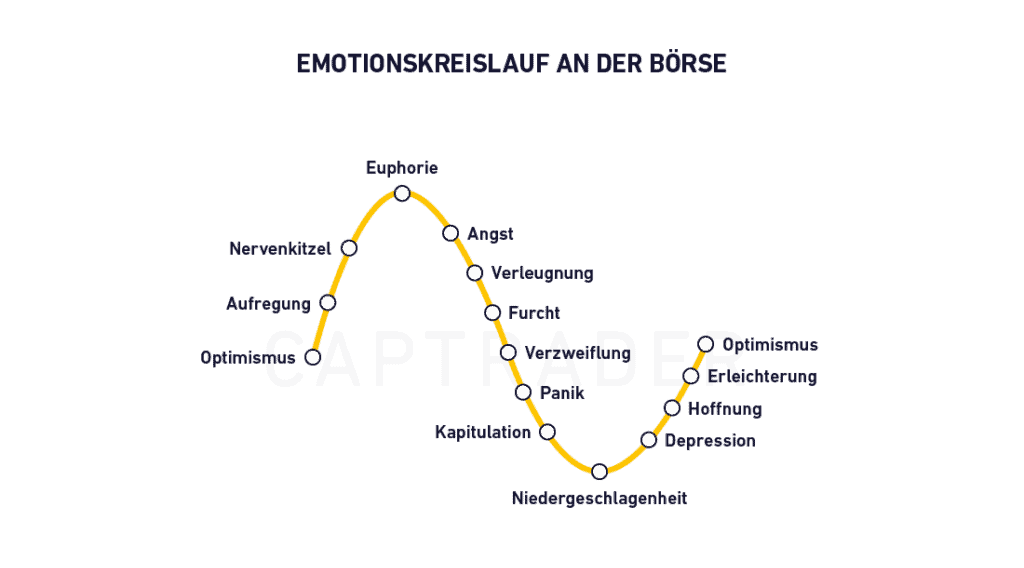
- Emotion curve: The stock markets are always going up and down - not only in terms of price, but also emotionally! The fluctuations follow an emotional curve that is always repeated and can lead to undervaluations at its lowest point. Investors who can assess where the markets are on the curve have a clear advantage.
Why are value stocks so attractive?
Cheap quality shares are very popular with long-term investors. They must be distinguished from the Growth Aktien which are also in high demand:
| Value Aktien | Growth Aktien | |
| Expectation | Strong growth | Very strong growth |
| Price | Undervalued | Fair to overvalued |
| Risk | Low (quality shares) | High (success not guaranteed) |
| Strategy | Defensive | Risky |
But why are value stocks so attractive for investors that they can even keep up with the popular growth stocks? One of the main reasons is certainly the fact that they bring high-quality companies into our portfolio!
Value shares are already successful companies that in most cases generate reliable profits. Value shares are also often assumed to have a certain resistance to crises.
Even if we were wrong in our analysis and there is no undervaluation, we often get a good deal when we buy.
- The search for value stocks is particularly common in difficult times. When key interest rates are high, the economy is shaken or crises, wars and disasters are on the rise, value stocks offer a safe haven.
- If, on the other hand, the signs point to growth (stock market rallies, exploding technology stocks, falling key interest rates ...), interest tends to be low, as other stock corporations perform better in these phases.
Famous success stories also contribute to investor interest. Warren Buffett, undoubtedly the best-known and probably most successful investor of all, is a prime example of the power of value stocks. He specifically focuses on outstanding companies that are undervalued on the stock market.
Vor- und Nachteile von Value Aktien
Hardly any other category of securities is as popular as value shares. Several attractive advantages contribute to this great interest:
- Attractive returns: Sooner or later, an undervalued company will most likely return to its fair value. Investors can benefit massively from this movement.
- Crisis resistance: These are established quality companies that often outperform the market in difficult phases.
- High quality: Value stocks are usually of high quality and are therefore suitable for long-term and lucrative investments.
- Good diversification opportunities: Value shares are not limited to individual sectors or regions and can therefore be used perfectly for diversification.
- Often lucrative dividends: As the companies have often reached a certain level of maturity, attractive dividend payments are not uncommon.
Bevor Sie sich für die unterbewerteten Qualitätsaktien entscheiden, sollten Sie auch die potenziellen Nachteile bedenken:
- Difficult search: To detect an undervaluation, we must first determine the "fair value" of a company - not an easy task, as this is not a fixed figure!
- Disappointment in case of misjudgment: If it is not a value stock as hoped, it may perform poorly or even suffer losses.
- Not lucrative in all phases: Many value stocks cannot keep up with the results of other stocks during high phases.
- Long waiting times: Traders may have to wait quite a long time before the market recognizes the undervaluation and prices rise.
Value Aktien: Listen und Indizes
There are numerous lists of supposed value stocks available on the Internet. However, the probability of finding such "insider tips" is extremely low.
- Die Attraktivität von Value Aktien liegt in ihrer Unterbewertung - ein Umstand, der sich generell nicht mit Best-of-Listen, frei zugänglichen Börsentipps und Clickbait aus der Social-Media-Welt vereinbaren lässt.
Such a list should never be the sole reason for buying shares; however, it can form a basis for personal research! A detailed analysis of the securities presented there can help you find real value stocks.
ETFs are another way of investing directly in value stocks:
- Various indices are available for this purpose, of which the "MSCI World Value Index" is probably the best known.
- However, its results are more than sobering: the overall performance lags far behind a standard world index or the S&P 500.
Other ETFs and funds that specialize in value stocks regularly perform just as poorly. We do not want to advise against such products in general, but recommend that you examine the results to date carefully before buying.
So far, it seems that there is no way around conscientious, manual stock analysis on the way to value stocks.


Buy shares cheaply: Options as an alternative
Value shares are so lucrative because we are buying a security at a bargain price. However, they are not the only way to buy particularly cheaply!
Investors can also Trade optionsto effectively lower the purchase price of a share. The tool of choice here is the Cash Secured Put, a simple options strategy that is also suitable for people with no prior knowledge of options trading:
- The Cash Secured Put is used when an attractive share is to be purchased.
- We write (sell) a short put option and receive a premium for it, which represents an immediate profit.
- We have concluded a trading contract with the short put: We assure another market participant that we will buy the shares at the agreed price if they so wish.
- The object of the trade is our desired share; we choose a price that seems fair to us.
There are now two possible outcomes to this transaction:
- The price of our desired shares on the stock exchange has fallen and is now below the value we agreed in our option. The counterparty will demand that we exercise the option and we will have to buy the securities at the agreed price.
- The price of our shares remains above the value agreed in our option. The other party will not exercise the option (it would achieve a better price on the stock exchange). We may keep the premium paid at the outset and recognize it as a profit.
The special thing about the Cash Secured Put: both outcomes are attractive for us! If the option is exercised (purchased), we have received our desired shares at a fair price. If, on the other hand, the option expires worthless, we have earned a premium.
This premium reduces the effective price that we paid for the securities. With a cash-secured put, we can therefore turn any (quality) share into a value stock!
Good to know:
For options trading you need a professional broker like CapTrader. Here you can trade options from as little as €2.00 and benefit from excellent trading programs and one of the best trading platforms. best trading apps.
How can I find value stocks
The search for value stocks is a complex undertaking: You have to use a large number of key figures and put them in relation to each other in order to discover an undervaluation.
- Many retailers shy away from this effort and rely on lists instead.
- However, such recommendations are treacherous, as the attention they attract quickly leads to an undervaluation.
- In order to discover lucrative value stocks, there is no way around manual analysis.
But how can you find value stocks, which key figures and aspects are decisive? There is no one-size-fits-all answer here; a mix of different indicators and personal intuition is required. The following factors can be included in the analysis:
1. KGV
The Kurs-Gewinn-Verhältnis The price/earnings ratio (P/E ratio) is probably the best-known and most frequently used ratio for shares. It should also be included in the analysis of value stocks!
We get it by dividing the price of a security by the company's profit (per share).

Das Ergebnis zeigt an, wie viele Euro wir investieren müssen, um uns an einem Euro des Unternehmensgewinns zu beteiligen. Umgekehrt können wir am Ergebnis auch ablesen, wie viele Jahre eine Gesellschaft wirtschaften müsste, um ihren aktuellen Börsenkurs zu verdienen.
The higher this value, the more expensive a security is. A P/E ratio of 15 is often cited as a "fair valuation", i.e. an appropriate average. Some investors also see P/E ratios of 18, 20 or 22 as a solid average.
However, there are several points to consider when analyzing this:
- What is a favorable, expensive or fair P/E ratio depends extremely on the respective industry, market situation and much more. For example, the popular technology stocks in the S&P 500 generally have higher P/E ratios, but this does not automatically make them overpriced!
- The P/E ratio can be distorted by numerous influences. Therefore, when analyzing, pay attention to factors such as extensive investments (they reduce profits and thus increase the P/E ratio), share buyback programs (they can drive up the price) or current "hypes" (price increases due to great interest in certain sectors)
- A high P/E ratio does not automatically indicate an overpriced share! Such stocks can also be value stocks if the actual quality of the company justifies the high P/E ratio.
- Viewed in isolation, the P/E ratio provides hardly any useful information. Only in conjunction with other key figures and an overall view of a stock corporation can meaningful conclusions be drawn.
- It is best to compare the P/E ratio with several reference values: similar companies in the same industry, the P/E ratio of the entire industry and the historical P/E ratio of the company under consideration in order to gain better insights.
- For growth stocks in particular, the P/E ratio is of very limited informative value. The price/earnings/growth ratio can be an alternative here.
Attention!
Fixed limits ("P/E ratio over 15 is overpriced!") make little sense in practice. Too many factors can influence the figure. We therefore recommend not simply accepting the P/E ratio, but analyzing relevant influencing factors.
Meta, for example, had a P/E ratio of more than 1,200 at times in 2013. Although this would indicate a massive overvaluation, an investment at that time would have paid off enormously: over the following ten years, the company developed into a Tenbagger entwickelt!
A look at Meta's performance shows that, despite the high P/E ratio, an investment in 2013 would have been extremely worthwhile.
You can find the P/E ratio of a share with a quick internet search. The ratio is also available in your trading software. Depending on the program used, further derivations based on the price/earnings ratio are also possible.
2. Kurs-Gewinn-Wachstums-Verhältnis (“PEG Ratio”)
One of the biggest disadvantages of the P/E ratio is the fact that it ignores a company's forecasts - but traders buy shares specifically because they expect growth.
- When searching for undervalued value stocks, it therefore makes sense to add this aspect to the price/earnings ratio.
- The result is the price-earnings-growth ratio, or P/E ratio for short: PEG Ratio.
- To do this, divide the P/E ratio by the expected earnings growth in percent.
- You can derive this forecast from the opinions of various analysts. Periods of three to five years are common.

The informative value of the P/E ratio depends heavily on the forecasts used and should therefore be used with caution. The ratio has proven to be particularly useful for growth stocks: These fast-growing companies can hardly be meaningfully captured with the regular P/E ratio, so the price/earnings/growth ratio is a good choice.
3. Kurs-Buchwert-Verhältnis
The Kurs-Buchwert-Verhältnis is calculated by dividing a company's equity by the number of shares issued. Put simply, it tells us how much of the company's value is represented by a single share.
It is therefore suitable as an indicator for the fair price of a share. A high value indicates expensive shares, while a low value indicates a favorable offer. The best way to find out what is "high" and what is "low" is to compare it with similarly positioned companies.
4. Umsatz
The turnover of a stock corporation is an easy-to-use key figure that can help in the search for value stocks. You can find this information, for example, on the investor relations page of the respective company.
- A consistently high turnover indicates a corresponding demand. If this demand is accompanied by a rather low share price, it may be an undervalued value stock.
- Strong fluctuations, on the other hand, should be viewed with caution: There could be fundamental problems here that disqualify a company as a potential value stock - after all, a stock corporation must operate successfully in the long term for the market to recognize this quality and for share prices to rise.
Constant sales growth within an attractive but not exaggerated framework has proven to be ideal.
5. Gesamtkapitalrendite, Free Cashflow und Gewinne
Es bietet sich an, die Return on assetsfree cash flow and profits together. Together, the three indicators provide a good insight into performance. Growth that is as continuous as possible is ideal: together with steadily rising share prices, this creates a "long-running share", which many investors consider to be the ideal form of value share.
6. Kurs-Cashflow-Verhältnis
The price/cash flow ratio is easy to calculate: All you have to do is divide the current share price by the Cash flow per share. Both values and the KCV You can find these yourself on various financial portals or in your trading program.
A low price/cash flow ratio indicates an undervalued, potential value company. A look at competitors in the same sector or a larger market/region is particularly suitable as a reference.
7. Verschuldungsgrad
If you divide the debt capital of a public limited company by its equity and multiply the result by 100, you get the gearing ratio. It goes without saying that a high level of debt can be associated with considerable disadvantages:
- Financial burden
- Less "air" in the event of a crisis
- Limited opportunities for new investments
- And much more.
Accordingly, value stocks should be characterized by a low debt-equity ratio, whereby a look at competitor companies also facilitates the assessment. Regardless of whether you are pursuing a value or other strategy, you should exercise extreme caution with a debt/equity ratio of more than 200!
8. Dividendenhistorie und Dividendenrendite
Many value shares come from long-established companies that often pay an attractive dividend. Stable profit sharing is a positive sign and testifies to a solid economic situation and a high, "real value" of the company.
Die Analyse erfolgt dabei anhand der gleichen Gesichtspunkte wie auch bei einer Dividendenstrategie:
- Pay attention to Aktien mit hoher Dividende or dividend yield, which should not be exaggerated. With a few exceptions, double-digit dividend yields are not sustainable and indicate problems.
- A public limited company can increase, reduce or suspend the dividend payment at any time. The dividend history has proven to be a good indicator that investors can use to assess future developments. Make sure that the dividend payout has been rising continuously for as long as possible.
- A dividend payment or even an increase in conjunction with persistently poor business figures is a possible warning signal: the management may want to squeeze the last profits out of the company before insolvency threatens.
A dividendenstarke Aktie is not automatically a value share! Only in conjunction with other key figures does a dividend contribute to the overall picture as an indicator.
Market position and other "soft" criteria
The indicators mentioned so far are all based on figures and calculation methods. However, qualitative factors can also play an important role in the search for value stocks! They are not so easy to determine, but can contribute a great deal to understanding the company in question.
- We recommend that you first take a close look at the market: Number of competitors, market share, sales, growth of the sector and competitors ... You are very likely to find a value stock among the leading companies in a sector.
- Smaller, up-and-coming companies, on the other hand, tend to fall into the category of Growth Aktien - Such investments can also pay off enormously, but are somewhat more of a gamble than the value stocks.
- A look at the product range can help to better understand the market position. A comparison with competitors is a worthwhile first step. You should then find out what the demand is like.
- A concentration of sales on a single product is potentially dangerous. Such a "golden goose" could find imitators at any time or no longer be attractive for other reasons.
- For some companies, a closer examination of the business model may also be necessary. This is generally not necessary for manufacturing companies (a look at the product range is sufficient here), but there are also many complex concepts on the stock market.
Financial and technology stocks are typical examples of complex business models. Generally speaking, several lucrative income streams are considered attractive - companies that put all their eggs in one basket, on the other hand, are exposed to greater risk.
Combine key figures and find value stocks
To discover a value stock, you need to look at several of the key figures mentioned (or your own criteria) together. This creates an overall picture that you can use to estimate the fair value of the company. If the current stock market price is lower, the stock is undervalued - you have discovered a value stock!
- Please note: No single key figure makes a value share - the overall picture is decisive! Special care should be taken with conspicuous "outliers". They may or may not indicate an unfavorable investment.
In the case of some stocks, it is already clear from the key figures that they are undervalued quality shares: The company makes a very positive impression and "just feels right". For the majority of value stocks, however, a comparison with other stocks is necessary.
The best way to do this is to select and analyze several such companies and add them to your list. This allows you to directly compare the different values and find the most attractive candidate.


Particularly lucrative: "long-running" value shares
If a company shows sustained growth without any major setbacks, it is referred to as a "long-term runner". They have established themselves as particularly lucrative value stocks and are accordingly sought after by investors.
- Reliable profits: As a rule, long-running companies show profit growth of between 5 and 10 % per year.
- Solid share price growth: The shares become more valuable from year to year. A look at their price chart over a long period (e.g. 10 years) shows a relatively straight, ascending line.
- Market position: Long-running companies have a very good, secure market position. In many cases, they dominate their respective sectors and hold a quasi-monopoly position.
- Sales growth: Sales of these stocks are also rising continuously and form the basis for the increasing profits.
- Dividend growth: The majority of long-term investors pay a dividend. This is also increasing continuously.
A special feature of long-dated shares is that it hardly matters when an investor buys them. Due to the continuously rising prices, an investment leads to a positive result at any time. Thanks to the positive performance, even major setbacks (e.g. COVID crisis) are offset in the long term.
The long-running value stocks are generally not exciting companies that receive a lot of media attention. Nevertheless, they can be very worthwhile! Typical examples are
- Brown & Brown (BRO): Insurance broker who brings customers together with insurance companies and receives premiums in return.
- Costco Wholesale Corporation (COST): Wholesaler known for particularly low prices. Membership is a prerequisite for access and ensures strong customer loyalty.
- Republic Services Inc (RSG): The second largest waste disposal service provider in the USA operates landfills and the associated infrastructure - with great success!
- Boston Scientific Corp (BSX): The company produces drugs for special treatments and is a global leader in this field.
- Berkshire Hathaway (BRK-B): The holding company's core business is insurance, but it is also active in many other areas.
Fazit: Value Aktien finden bleibt eine schwierige Aufgabe
Value shares are shares in high-quality, well-positioned companies that are traded on the stock exchange below their actual value. There are various reasons for this undervaluation. One thing is certain, however: investors can use such "bargains" to add lucrative, crisis-resistant stocks to their portfolio.
Unfortunately, it is not easy to find such titles. Although numerous financial portals offer lists of supposedly undervalued quality stocks, in practice such tips are usually unsuccessful. Value indices also tend to perform poorly.
Therefore, there is usually no way around manual analysis! We have a large selection of possible indicators at our disposal, none of which is "the one, ideal key figure". Only in combination and comparison with other companies can meaningful insights be gained.
A good basis for this is the evaluation of:
- Price/earnings ratios (Can also be supplemented by the growth factor (KGWV))
- Price to book value
- Kurs-Cashflow-Verhältnis
- Turnover
- Gewinnen
- Return on assets
- Free Cashflow
A look at the market environment, competitors and the product catalog is also recommended. You can then collate all the data and structure it in a list, for example.
Look for a positive overall picture with as few "outliers" as possible. This gives you a good chance of identifying value stocks. You may even find a "long-term runner": these stocks are characterized by very consistent growth and are a particularly popular sub-category!
To simplify the search for value stocks, many investors rely on signaling services such as TraderFox or use Social Trading.
