The VIX stands below 16, the VVIX below 90. There is little fear in the overall market. There is already some fear in individual stocks: McDonald's % lost around 9.5 in September and is trading at a four-year low; PepsiCo and Uber are just above their 52-week lows. A calmer index, with stressed individual stocks. For holders, this is a useful combination because the premiums on these three stocks are higher than the VIX suggests.
What VIX and VVIX are saying right now
The VIX This represents the expected volatility of the S&P 500 over the next 30 days. A value below 16 means that the options market prices the index with less than 16 % annual volatility, approximately 4.6 per month when calculated down to a month %. The VVIX measures the volatility of the VIX itself. Below 90 means that hardly anyone buys VIX calls as a crash insurance. The market feels safe.
This leads to two things. Anyone who wants to secure their deposit can buy index puts right now at a very low price. How this works with puts for a few cents is explained in our August post VIX at 15, put at five cents Calculated. And anyone who wants to sell bonuses is more likely to find them in stocks that are currently being punished than in the index.
Roughly speaking, the implied volatility of the three puts is even lower, between just over 20 % for McDonald's and just under 40 % for Uber. For McDonald's, a stock with a beta of 0.4, this is unusually high compared to the VIX.
Long-term cash secured puts
At Cash Secured Put selling it to her Short Put and keep the money ready to buy the stock when the strike is exercised. If the price stays above the strike, the option expires worthless and the premium belongs to you. If it falls below it, you buy the stock, and the premium lowers your initial investment. This is only useful for stocks that you want to own at that price anyway.
All three ideas run until September 17, 2027, that is 347 days. With this option, you earn less in value per day than with 45-day options. The absolute premium is high, and you don’t have to do anything for a little over a year. This duration is suitable for stocks that you want to hold in your portfolio for the long term. Those who trade more actively can close the position early with a % profit of 50%.
Important: The following trading ideas are editorial examples. They are not investment advice and do not constitute an invitation to enter a position.
McDonald's – Four-year low at a beta of 0.4
McDonald's closed on October 2 at $231.89. The 52-week high is $341.75, the low is $229.61. The stock is thus right at the bottom of its year-to-date range. In September it fell by 9.5 % %, and the price is just under 20 % below the 200-day line. US business growth is slowing, and investments in the NEXT strategy are costing margin. Morgan Stanley has therefore lowered the price target to $297.
Operationally, things look less dramatic. % In the second quarter, revenue rose by 4 % to $7.1 billion, while net profit rose by 5 % to $2.36 billion. The KGV is just under 19, the 10-year average is well over 23. The dividend is $7.51 per year, which is 3.2%.
Possible Cash Secured Put:
- Expiration September 17, 2027 with 347 days of grace period
- Strike 230 (Amount of the award 23,000 USD)
- Premium income 1,900 USD
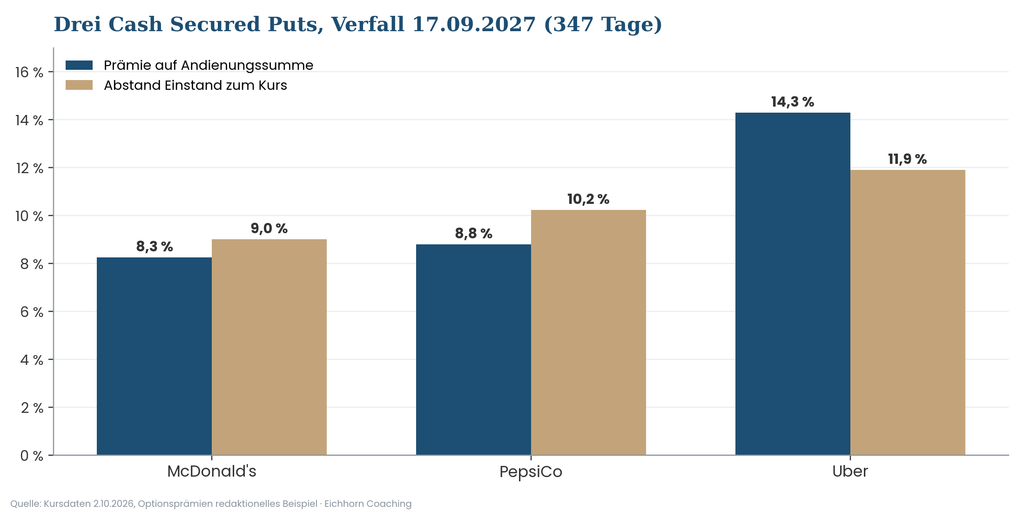
The strike is only 0.8 % below the current price. If it goes through, you will effectively buy McDonald's for $211. That's $9 % below today's price and nearly 40 % below the high. Calculated at the strike price, the premium brings in $8.3. Part of that will offset the dividends that shareholders receive until expiration and won %'t be lost to you as a put seller. The Q3 numbers are due in the coming weeks, so long before expiration.
PepsiCo – Numbers on Thursday
PepsiCo is trading at around $127, and thus at the 52-week low. The problem lies in North America: The beverage business PBNA performed weaker than expected in the second quarter, and management expects higher raw material costs for the second half of the year. Earnings estimates for the third quarter have fallen by about 5 % over the last 90 days.
The dividend is $1.48 per quarter. PepsiCo has paid it out every year for over 50 years. At the current price, that amounts to about $4.6 %, and the 10-year average yield was more like 2.9 %. The forward P/E ratio for 2026 is around 15.
Possible Cash Secured Put:
- Expiration September 17, 2027 with 347 days of grace period
- Strike 125er (Upfront payment 12,500 USD)
- Premium income 1,100 USD
At the offering, the entry price is $114, which % is about 10% below the current price. The premium brings $8.8 % to the offering price. There is a catch with the timing. On Thursday, October 8, PepsiCo will present its Q3 results before the market opens; the consensus expectation is $2.30 per share profit on $25.0 billion in revenue. Until then, event volatility is pricing in the option price. Those who sell earlier get more premium and bear the risk of a price gap. Those who sell later probably get less, but they know the numbers.
Uber – The fear of robot taxis is in the cards
Uber closed on October 2 at $68.11. Since the beginning of the year, that’s a 16.6 percent % decline, about a third from its high of $101.30. The 52-week low is $65.41. The pressure comes mainly from the robotaxi debate. On September 8, Tesla unveiled the Cybercab in Austin; Uber lost $4 that day. % Bank of America estimates that autonomous competitors have an advantage of 18 to 24 months before Uber’s own fleet scales up. In addition, there are tensions with Waymo, the layoff of about 3,300 employees, and the acquisition of Delivery Hero for $14.8 billion.
Uber's counterargument: An empty robotaxi doesn't make money, and Uber provides the demand that fills the cars. CEO Dara Khosrowshahi bought his own shares for about $10 million in September. The KGV is around 15. Uber does not pay a dividend.
Possible Cash Secured Put:
- Expiration September 17, 2027 with 347 days of grace period
- Strike 70er (initial investment amount 7,000 USD)
- Premium income 1,000 USD
The 70s are worth $1.89 in cash. Of the $10 bonus, therefore, about $8 is in time value. By buying now, you effectively pay $60 for Uber, just % under the current price and below the previous 52-week low. The bonus brings $14.3 % to the purchase price, significantly more than the two consumer values. The reason is the higher risk. Uber fluctuates with a beta of 1.16 almost three times as much as McDonald's, and there is no dividend as a buffer. The Q3 figures come in early November.
Conclusion
We are in a phase where the markets are technically weak, and geopolitical uncertainty is overshadowing everything. The VIX futures curve indicates that the market is no longer expecting a strong sell-off. The high OVX opens up many opportunities for option sellers. Additionally, there are high premium income opportunities in software stocks.
What does this mean for us as traders? Seize opportunities, observe premium levels, and wait for targeted chances. In such market phases, the best trades often arise – but only if you have patience and don't blindly jump into the market. Volatility is there, premiums are high – but you still need to have risk and money management under control.
Conclusion
October offers long-term investors a rare combination: The index is so quiet that hedging costs little, and at the same time three well-known names are trading at or near their annual lows. Anyone who wants to put money into the stock market in the long term, regardless of whether they are interested in McDonald's or PepsiCo, will receive a premium of % 8 to 9 % percent over the put options and a starting price of around 10 percent % below the current price. Uber brings 14 percent, but requires the willingness to hold a stock whose business model is being revalued by the market. At PepsiCo, the amount of the premium depends on the timing around the figures on October 8. And as long as VIX and VVIX remain so low, it is worth looking at cheap index puts as a counterweight to the short puts.
Further trading ideas and the monthly classification of VIX and VVIX can be found in the Option letter. We discuss the ideas live in the CapTrader webinar Overview of options markets on October 6 at 17:00.
Please note: This is not investment advice and not a trading recommendation. Long positions with options carry significant risk of loss.