


Besides the purchase of a Put option to hedge or speculate against/on falling prices, may be used by the Sale of a put (short put) on rising or stable or only slightly falling prices. In addition to the so-called naked put, the Cash Secured Put a popular strategy, with the short put functioning similarly to a limit buy order.
Definition Short Put
The term "short put" refers to the sale of a put option. The option seller receives a premium from the option buyer and, in return, undertakes to buy the underlying on a certain date (European type option) or by a certain date (American type option) at a certain price (strike price) if the option buyer exercises his right to sell the underlying.
The option buyer (long put position) decides unilaterally whether to exercise the right and sell the underlying asset or not.
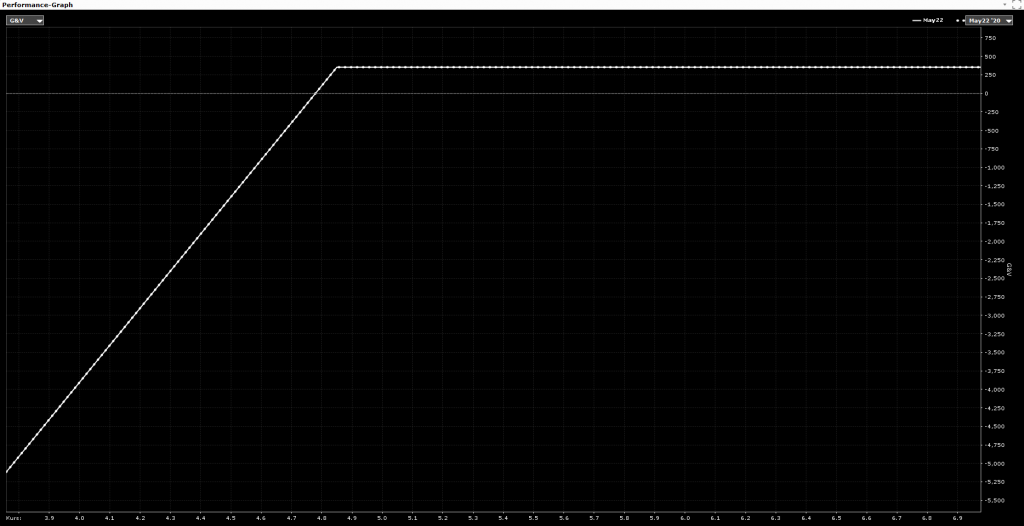
P&L diagram of a short put
The premium taken at the beginning defines the maximum possible profit on the expiration date. This occurs if the option expires worthless, i.e. if the underlying is quoted Out Of The Money or At The Money on the expiration date.
Possible applications
The short put is most often used as Naked Put or as Cash Secured Put used. There are no differences in terms of rights and obligations, as well as the operation and process of the trade.
With a Naked Put the seller of the option pursues the goal of merely making a profit by collecting the option premium and speculating that the underlying will not be quoted In The Money on the expiration date.
A Cash Secured Put is used when the option seller aims to buy the underlying if it is quoted In The Money on the expiration date. In this case, the short put functions as a kind of limit buy order, whereby an additional premium income is achieved.
In addition, there are numerous option strategies that combine the short put with other options. On our website you will find a separate article for each of these strategies.
What should I pay attention to when trading a short put?
As can be seen in the P&L diagram, the short put has a (quasi) unlimited loss potential. Strict money and risk management is therefore very important. The unlimited loss potential can at best be limited by buying a put with a lower strike price.
The maximum possible profit is limited to the amount of the option premium.
Maximum and realized loss
The maximum loss would occur if the underlying falls to zero. However, it does not make sense to calculate this. If the underlying is quoted In The Money on the expiration date, the maximum loss is calculated as follows Realized loss as follows:
Loss = (strike price option - price underlying) - credit
Maximum and realized profit
The maximum profit of a short put arises when the sold option expires worthless (OTM or ATM) and is exactly equal to the amount of the received Option premium, less financing costs.
Often option traders buy back the option beforehand and realize a profit, which is for example 50% - 90% of the option premium.
Break Even Point
If the sold put option runs into the money, a loss is incurred on the expiration date. Since a premium income was generated at the beginning, this serves as a kind of buffer and the break-even point is a few points below the base price of the short put.
Break Even Point = Base Price - Credit
Implied volatility
The short put reacts sensitively to changes in the implied volatility (IV). I.e. the sold option benefits from a declining IV and suffers from an increase in the IV. On the stock markets, the development of the implied volatility can be estimated very well, as it usually increases strongly when prices are falling. With other underlyings (e.g. currencies, commodities), however, it is somewhat more difficult to estimate the development of the IV.
Residual term and fair value expiry
The time value of an option falls to zero by the expiration date, from which the short put profits. The longer the remaining life of the option, the higher the time value and the higher the option premium. However, the acceleration of the Time value expiry of an option as the expiration date approaches and is comparatively low for long remaining terms.